Edith Simmons didn’t walk into the academy looking for applause, revenge, or attention. She came for one simple reason: to keep training after a lifetime on the mat. But when the head instructor called her “Grandma,” turned her first class into a public joke, and challenged her in front of everyone, the room learned the difference between age and weakness in less than ten seconds.
Edith Simmons folded her white gi with the kind of care that comes from doing the same ritual for decades.
At seventy-two, her hands moved more slowly than they once had, but never uncertainly. She ran her fingers along the faded black belt resting across her lap, feeling the frayed threads, the softened cloth, the long memory stitched into it. Some people wore a belt like proof. Edith had worn hers so long it no longer felt like proof of anything.
It felt like part of her.
Morning light filtered through the small windows of her apartment, touching the neat stack of unpacked boxes she still hadn’t finished sorting. She had only moved into the neighborhood three weeks earlier, after burying her husband and leaving behind the house where nearly every chapter of her adult life had unfolded. Starting over at her age was not graceful. It was not inspiring. It was just necessary.
Her doctor had told her the truth with the gentle bluntness older bodies demand.
Keep moving, or start disappearing.
For Edith, there had never really been a choice.
She tied back her silver hair, checked herself once in the mirror, and gave the same silent nod she had given before training since 1980. Then she picked up her bag, her belt, and the version of herself the world kept mistaking for fragile.
The drive to Elite Martial Arts Academy took fifteen minutes.
From the outside, it looked exactly like the kind of place a woman like Edith was not expected to belong: polished windows, sleek signage, expensive cars, young athletes moving in groups with the easy arrogance of people whose bodies had not yet betrayed them. Edith’s modest sedan looked out of place among the shiny SUVs and sports cars.
So, perhaps, did she.
Inside, the receptionist looked up and gave Edith the same quick, puzzled once-over she had seen a hundred times before.
“Can I help you?” the young woman asked.
“Yes,” Edith said pleasantly. “I’m here to join your jiu-jitsu program.”
The receptionist blinked.
“Our adult classes are intensive,” she said carefully. “You might prefer senior yoga. Tuesday mornings.”
Edith smiled, not offended, only familiar with the script.
“I’ve been practicing jiu-jitsu for over forty years, dear. I’m not looking to begin. I’m looking to continue.”
That earned her a flicker of disbelief, but not enough respect to erase it.
The young woman slid waiver forms across the desk and told her an instructor would assess her.
Assess her.
Edith signed without comment.
She had spent too many years being underestimated to waste energy resenting it every time.
The mat room itself was impressive — wide, bright, clean, alive with controlled movement and the quiet snap of practiced technique. About twenty students were already warming up. Most were young. Strong. Fast-looking. Confident in the way people are when they have not yet been embarrassed by someone smaller, older, or calmer than themselves.
Edith stood at the edge of the mat and watched.
The drills were clean.
The fundamentals solid.
The academy, at first glance, respectable.
Then she saw the coach.
Adam Jackson moved through the room like a man who had been admired for being good at something long enough to confuse skill with superiority. Tall, athletic, decorated with patches, black belt tied neatly, voice clipped and assured. The students responded to him with the kind of deference that fed his confidence and sharpened his arrogance.
When his gaze landed on Edith, surprise crossed his face first.
Then amusement.
He said something under his breath to one of the senior students. The student smirked. Edith did not need to hear the words to know their shape.
She stepped onto the mat anyway and bowed, following etiquette older than most of the people in the room.
The noise died down as more students noticed her.
Coach Jackson approached.
“Can I help you, ma’am?” he asked, already smiling in a way that made help sound impossible. “I think you may have wandered into the wrong class. Senior Tai Chi is down the hall.”
Laughter rippled across the room.
Edith lifted her head.
“I’m here for jiu-jitsu,” she said. “I recently moved here and I’m looking for a place to train.”
Jackson glanced around at his students, inviting them to enjoy the moment with him.
“Train… at your age?” he said. “No offense, ma’am, but this is competition-level work.”
“I’m aware,” Edith replied.
He gave her another look, this one more openly condescending.
“Look, Grandma,” he said, drawing fresh laughter from the room, “I appreciate the enthusiasm. But this isn’t beginner-friendly.”
A younger student from the back called out, “Can she even stand back up if she falls?”
More laughter.
Edith stayed very still.
She had seen this before — the mockery disguised as concern, the patronizing tone offered as professionalism, the quiet confidence of people who assume a body that looks older must automatically know less.
“What belt do you claim to be?” Jackson asked.
“I don’t claim anything,” Edith said. “I earned my second-degree black belt under Master Hiroshi Takahashi in 1995.”
That landed differently.
Not with everyone. Most students were too young or too inexperienced to understand what that name meant. But Jackson’s expression flickered, just enough to tell her he recognized it.
He recovered quickly.
“Standards have changed,” he said. “Why don’t you observe first?”
“I didn’t come to watch,” Edith replied. “I came to train.”
Something in her tone changed the room.
Not loudly.
Not dramatically.
Just enough that the amusement started giving way to curiosity.
Jackson folded his arms.
“We have safety protocols,” he said. “I can’t let someone in your condition join an advanced class without assessment.”
Edith nodded once.
“That’s reasonable. Assess me.”
A few students snorted.
Jackson looked around, enjoying the spectacle too much to step away from it.
“You want me to assess you? Right now?”
“That’s why I’m here.”
He called a blue belt forward for a demonstration.
Edith didn’t look at the blue belt.
“I’d prefer to work with you, Coach Jackson.”
That silenced the room.
Now even the students who had been laughing were fully awake.
Jackson’s face hardened.
“Me?”
“If you’re evaluating me properly,” Edith said, “it should be you.”
He could not refuse without losing face.
He could not accept without risking it.
That was the moment his mockery turned into irritation.
“Fine,” he said. “Light demonstration. Three minutes.”
He announced it loudly enough for the class, still pretending he was in control of the story.
Everyone cleared the center mat.
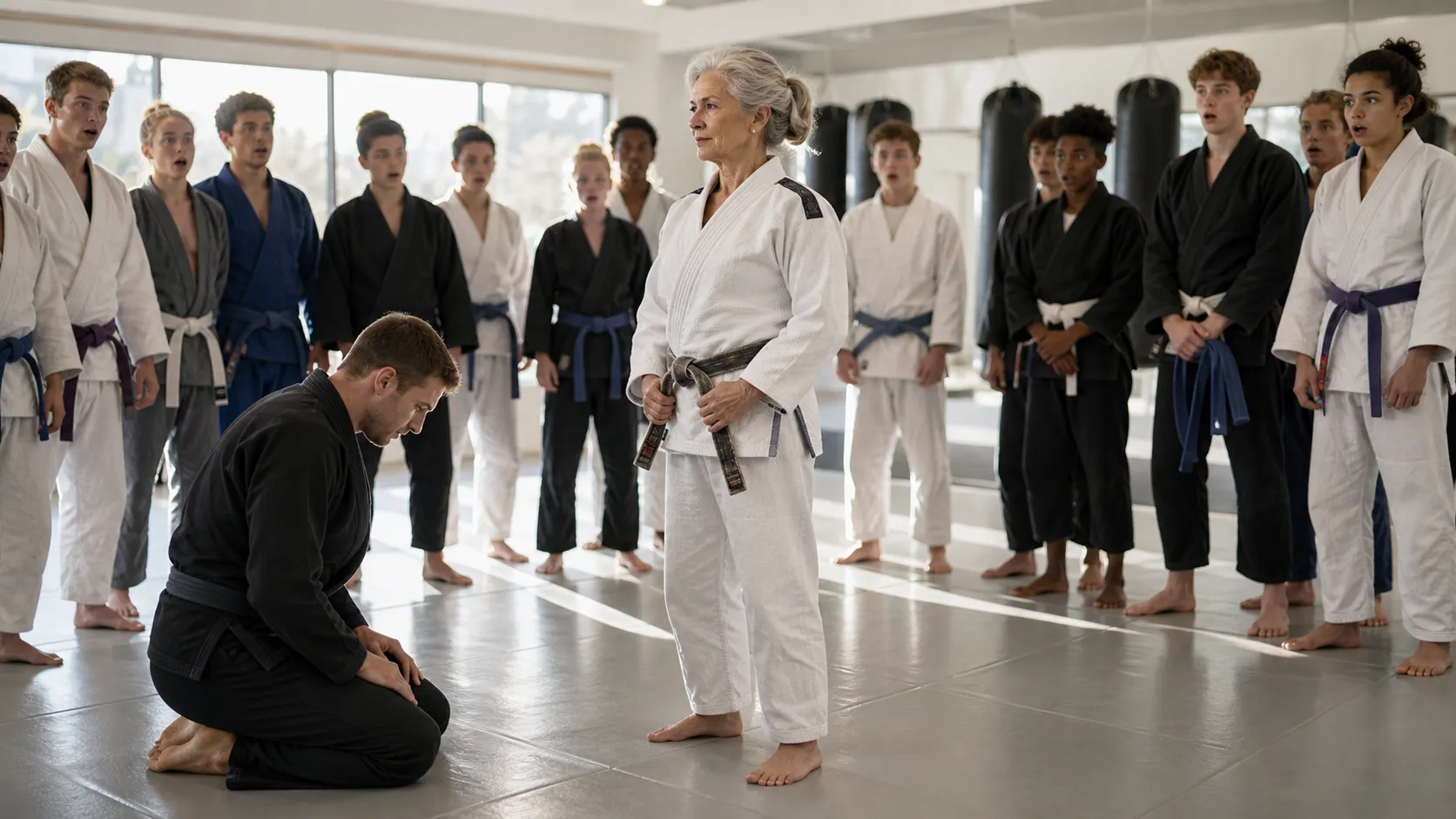
The students formed a ring around them. Phones disappeared. Smirks faded. People sensed, if not yet danger, then at least the possibility of embarrassment.
Edith stepped into position quietly, every movement smooth and unhurried. Jackson bounced lightly on his feet, already performing restraint for the crowd.
“We’ll just work basic positioning,” he said.
He reached for her sleeve.
What happened next moved too fast for some of the students to understand in sequence.
Edith shifted her weight by what looked like almost nothing.
Her grip closed over his wrist.
She dragged the sleeve.
Broke his balance.
Jackson stepped forward instinctively to recover — exactly where she wanted him.
In the same motion, Edith dropped, threaded her legs into the angle of his movement, hooked the ankle, and rotated her hips with frightening economy.
There was no force wasted.
No flourish.
No hesitation.
Just timing.
Jackson toppled.
By the time his knees hit the mat, Edith had already established mount.
A collective gasp shot through the room.
Jackson tried to bridge, then push, then force space.
Every choice came half a second too late.
Edith flowed with him, redirected the movement, trapped the arm, and spun cleanly into the armbar.
Locked.
Precise.
Final.
“Tap!” Jackson gasped, slapping the mat with his free hand.
It had taken less than ten seconds.
The silence afterward was heavier than the laughter had been.
Edith released him immediately, rose without strain, adjusted her gi, and bowed.
“Thank you for the assessment opportunity, Coach,” she said calmly. “I hope that addresses your concerns.”
No one moved.
Jackson got to his feet slowly, face flushed with something deeper than embarrassment. Not just humiliation.
Recognition.
“Who are you?” he asked quietly.
Edith met his gaze.
“I told you,” she said. “Edith Simmons.”
One of the students whispered from the edge of the mat, “She was one of Takahashi’s top competitors.”
Another voice added, “Eastern Regionals. Three-time champion.”
Edith gave the smallest shrug.
“That was a long time ago.”
Jackson bowed then.
Deeply.
Properly.
“I owe you an apology.”
Edith held the silence for a moment before answering.
“We all judge,” she said. “What matters is correcting it.”
Something changed in the room after that.
A student stepped forward first and asked if she could show the move again.
Then another asked about the timing.
Another about leverage.
Another about balance and age and reaction speed and whether technique really could outlive youth when practiced correctly.
Edith glanced once at Jackson.
He nodded.
This time, not as the owner of the room.
As a student inside it.
What followed stopped being a spectacle and became a lesson.
For the next hour, Edith turned the academy into something it had not been when she walked in. She demonstrated grips, weight shifts, foot placement, pressure, patience, and the discipline of not wasting movement. She corrected with clarity, not ego. She explained how timing defeats strength, how posture defeats panic, how true technique does not announce itself loudly.
The students listened.
Really listened.
Mockery turned into respect so completely it almost felt like shame learning manners.
Even Jackson trained beside her, asking questions without defensiveness now, absorbing every correction she gave him.
At the end of the session, when the room had finally emptied of disbelief and filled instead with a kind of reverence, he approached her again.
“I’d like to offer you a position here,” he said.
Edith smiled faintly.
“I came to train.”
“And we want to learn,” he replied.
She considered that for a moment.
Then she said, “One condition.”
He waited.
“This dojo becomes a place where no one is dismissed because of age, size, appearance, or first impressions. Respect first. Technique second. Ego never.”
Jackson nodded without hesitation this time.
“Agreed.”
Three months later, the academy no longer felt the same.
Edith’s classes were the fullest.
Older students started joining.
Younger ones improved.
The atmosphere changed.
The jokes stopped.
The bows got cleaner.
The listening got deeper.
And sometimes, when new students came in uncertain, awkward, underestimated, or visibly out of place, someone would quietly point toward the mat and say:
“Wait until you see Edith.”