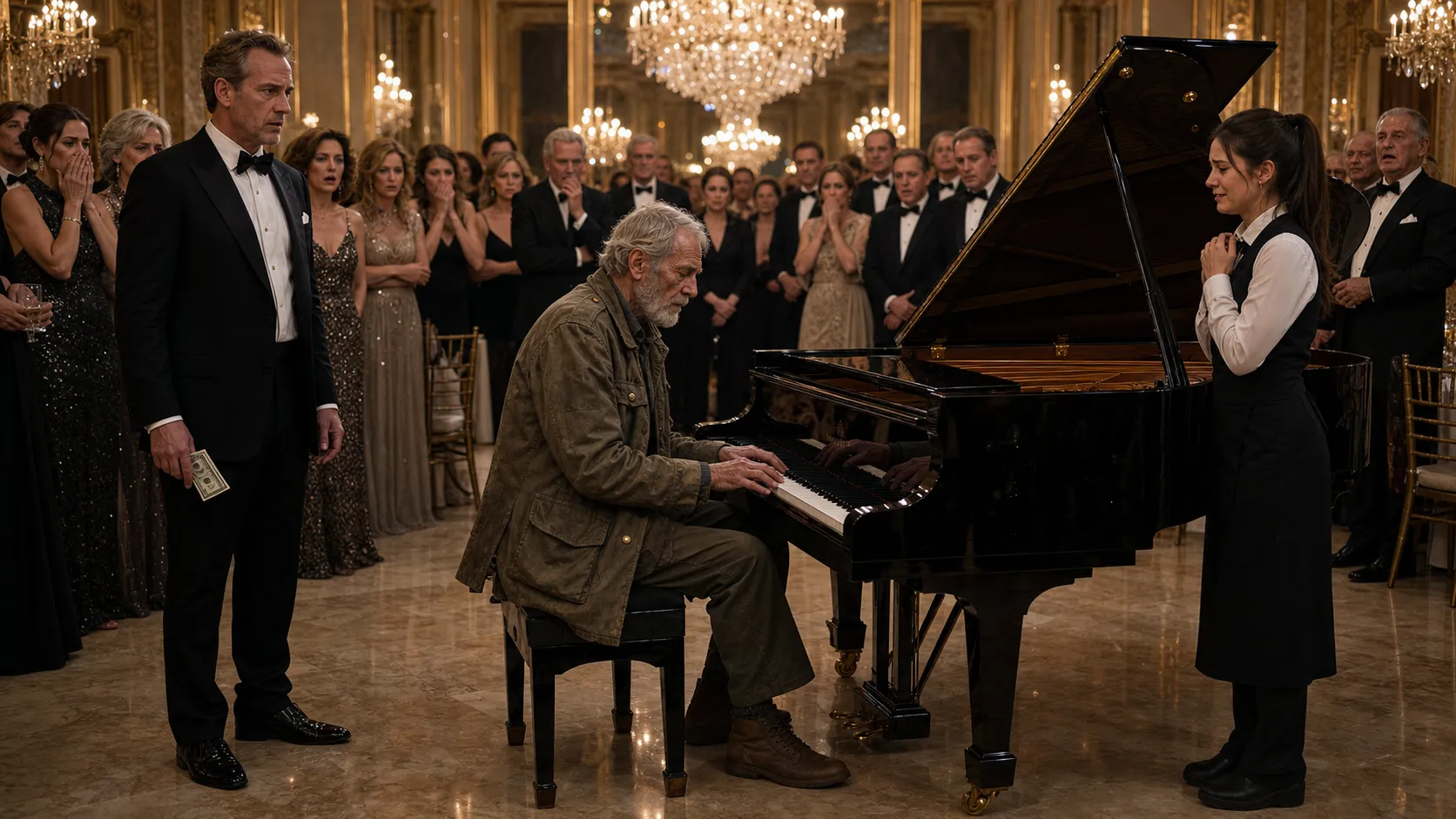
Walter Hayes walked into the Grand Legacy Ballroom asking for nothing more than a warm plate of food and one song at the piano. The city’s elite saw only a homeless old man in a faded army jacket — but the moment his fingers touched the keys, their laughter turned into silence, their certainty into shame, and one cruel wager into the public collapse of a powerful man.
Walter Hayes had learned long ago that the world listens differently when a man looks broken.
At seventy-eight, he had become very good at allowing people to underestimate him.
He knew how to stoop just enough.
How to let his hands tremble at the right moment.
How to move like age had taken more than it really had.
How to wear silence until other people rushed to fill it with their own assumptions.
That night, the Grand Legacy Ballroom shimmered beneath crystal chandeliers and self-importance.
Everything about the room had been arranged to flatter wealth. Gold light slid over marble floors. Expensive perfume mixed with roasted duck and polished silver. Two hundred guests moved through the hall with the easy confidence of people who had spent their lives being welcomed into every room worth entering. CEOs. Surgeons. Investors. Heirs. Men who believed success gave them taste, and women who had learned to make refinement look effortless.
Into that world walked an old man in a faded army jacket.
His boots left light dust on the marble.
His face was weathered, unreadable.
His pale blue eyes carried the stillness of someone who had already outlived enough humiliation not to fear one more.
He stopped near the edge of the crowd and spoke in a voice roughened by age, silence, and things far harder than either.
“Could I play the piano… for a plate of food?”
For one brief second, the room didn’t know what to do with him.
Then the laughter started.
It spread quickly — sharp, amused, cruel in the lazy way rich laughter often is when it believes it is protected from consequences. A woman clutched her pearls as if poverty itself had crossed the floor. A man near the bar turned to his wife and smirked. Someone muttered that security should have been tighter.
The loudest voice belonged to Richard Thompson.
At forty-five, Richard was handsome in the polished, predatory way some men are when they have inherited power early and mistaken it for proof of worth. His suit was perfect. His shoes gleamed. His smile had all the warmth of a knife.
He made his money tearing down low-income blocks and replacing them with glass towers nobody who once lived there could afford to enter. He liked speaking about discipline, excellence, and opportunity. What he meant, more often than not, was that suffering only bothered him when it stood close enough to stain something expensive.
“Security!” he called. “Get this bum out of here.”
Two guards began moving.
But Walter did not step back.
“Please,” he said again, his gaze fixed not on the guards but on the black Fazioli concert grand sitting at the center of the room. “I’m not asking for charity. Just one song… in exchange for a warm meal.”
The strangeness of the request slowed the room.
Not enough to soften it.
Enough to sharpen it.
Near the kitchen doors, a young waitress named Emily Carter stood very still with a glass of water in her hand. She was twenty-one, working late shifts to keep herself in school, and she had already taken one step toward Walter before the hotel manager grabbed her arm and hissed that if she got involved, she could say goodbye to her job.
Walter saw that.
He saw her stop.
Saw the conflict in her face.
Saw the apology she couldn’t say aloud.
That mattered.
But he turned back toward Richard.
Because Richard had made a decision.
And men like him almost always mistake cruelty for control when they are in front of an audience.
“You know what?” Richard said loudly, climbing onto a chair as if he were about to announce the evening’s entertainment. “Let him play.”
The crowd laughed again, grateful for the permission.
Richard spread his hands.
“Ladies and gentlemen, let’s give our unexpected guest a chance to entertain us.”
More laughter.
Then he pointed at Walter with theatrical generosity.
“Here’s the deal. You play one song. If you can finish it without sounding like a dying cat, I’ll personally buy you the most expensive meal on the menu.”
The room warmed to the joke at once.
“But,” Richard added, lowering his voice just enough to make everyone lean in, “when you fail — and we all know you will — security escorts you out, and you crawl back to whatever gutter you came from.”
That got the loudest laugh of the night.
Walter stood there and let it wash over him.
He had endured mortar fire.
He had endured prison camps.
He had endured the strange emptiness of coming home from war to a country that preferred to admire soldiers in theory and ignore them in practice.
He could survive a ballroom.
In fact, he needed the room to reach exactly this level of certainty.
He needed their arrogance to ripen fully before he broke it.
Richard, delighted now, decided to go further.
“If you somehow impress us,” he said, “if you play well enough to make someone in this room cry… I’ll give you not just a meal, but one thousand dollars.”
The crowd howled.
To them, a thousand dollars was nothing.
A tip.
A bottle.
An indulgence.
To offer it to Walter as if it were a royal gesture only made the insult cleaner.
Walter said nothing.
He walked slowly to the piano.
He let himself look awkward settling onto the bench. Let his hands hover uncertainly above the keys. Let them think he had never touched such an instrument before. Let them keep laughing right up to the last possible second.
Because the piano in front of him was not unfamiliar.
He knew this exact model.
Owned one like it.
Had once played halls far more important than this room.
Had once been a name people whispered with reverence.
But tonight he was not that man.
Tonight he was a ghost asking for soup.
“Twinkle, Twinkle Little Star?” Richard sneered. “That’s probably about your level.”
Walter lifted his head then and looked at him.
“Opportunities,” he murmured softly, after Richard had mocked him for wasting his life.
Then he turned back to the keys.
The first piece he chose was not gentle.
It needed to hurt.
He let the opening of Chopin’s Revolutionary Etude fall into the room like the first crack in a dam. At once the laughter stopped — not gradually, not politely, but as if someone had cut the wire holding it up. The music surged outward with force, fury, and total command. It was not background music. It was memory sharpened into sound.
Every note accused them.
The room changed shape around it.
The chandeliers still shone.
The marble still gleamed.
But suddenly the wealth in the room looked decorative, brittle, and embarrassingly small.
Walter’s hands no longer trembled.
They flew.
The Etude roared across the ballroom with all the defiance of a man who had been crushed, humiliated, starved, imprisoned, and still refused to become obedient. Guests who had laughed minutes earlier now stood frozen, glasses forgotten halfway to their lips. One woman lowered herself into a chair as if her knees had failed. A gray-haired man in the front row began to cry openly without seeming to know it.
Richard Thompson stopped smiling.
By the time Walter finished, nobody clapped.
Not because they were unimpressed.
Because they were too stunned.
Walter remained seated just long enough for the silence to deepen.
Then he lifted his hands again.
This time, when his fingers touched the keys, the entire room braced.
But what came next was not fire.
It was moonlight.
He moved into Clair de Lune with such tenderness that the ballroom seemed to breathe differently. If the first piece had been battle, this was memory after battle — the quiet ache of survival, the faces that come back to men at night, the things worth loving that war never quite manages to erase. It floated through the room like something sacred and private, something too pure for mockery.
People cried now.
Not one or two.
Many.
Even those who did not know why.
Because true music rarely asks permission before reaching whatever grief a person keeps locked behind posture, money, and rehearsal.
Walter finished on a fading breath of light.
Then he stood.
And when he did, the last traces of the old, uncertain drifter vanished.
The hunched posture disappeared.
His shoulders squared.
His spine straightened.
He no longer looked like a man begging for food.
He looked like command.
He looked directly at Richard Thompson and said, in a voice that no one in the room could mistake for weakness:
“You owe me one thousand dollars.”
A nervous laugh escaped from somewhere and died immediately.
Richard walked toward the stage with cash already in his hand, trying to recover superiority through contempt.
“Take your charity and leave,” he said, shoving the bills toward Walter.
Walter didn’t take them.
Instead, he looked at Richard with calm that felt far more dangerous than anger.
“You spoke about opportunity tonight,” Walter said. “You said I wasted mine.”
The room fell silent again.
“Let me tell you about the opportunities I was given.”
He stepped down from the stage and moved through the crowd slowly, and people parted for him without thinking.
“At nineteen,” he said, “I had the opportunity to carry a wounded friend two miles through enemy fire.”
No one moved.
“At twenty, I had the opportunity to call an airstrike on my own position. It was the only way to save the rest of my platoon.”
Gasps spread through the hall.
“I also had the opportunity,” he continued, voice steady, “to spend three years in a prisoner-of-war camp. In the dark. Where the only thing keeping us sane was humming Mozart and Beethoven under our breath because music was the one thing they couldn’t beat out of us.”
A man near the front — Abram Stevens, one of the evening’s oldest donors — had gone visibly pale.
Then he stepped forward, voice trembling.
“Do you people know who this man is?”
Nobody answered.
Mr. Stevens looked at Walter as if seeing a ghost made of memory.
“They called him the Phantom Pianist,” he said. “He played for soldiers before battle. In field hospitals. In the camps after liberation. People said his music brought men back from the edge. He disappeared during a classified mission. We were told he died.”
A murmur ran through the room.
Walter Hayes.
The Phantom Pianist.
A legend no one had expected to find asking for soup in a ballroom full of cowards.
Richard’s face had gone nearly colorless.
Walter turned back to him.
“The Revolutionary Etude,” he said, “is about refusing to be crushed by men who think power makes them superior.”
Then, more quietly:
“And Clair de Lune is for the moments soldiers remember what they’re fighting for.”
There was nowhere left for Richard Thompson to stand that did not look contemptible.
Walter stepped closer.
“How can a man with that kind of heart,” he asked the room, not Richard alone, “be trusted to care for those who have suffered?”
No one answered.
They did not need to.
Walter turned toward the assembled donors and board members.
“Effective immediately,” he said, “Richard Thompson is removed as chairman of the Veterans Support Committee.”
The words struck harder than any slap could have.
Richard looked around desperately for support.
He found only disgust.
Disappointment.
Silence.
Without another word, he turned and walked toward the exit. The sound of his expensive shoes clicked across the marble with a strange new quality.
Not authority.
Defeat.
A respectful applause began somewhere in the back.
Walter raised one hand, and it died.
He was not finished.
His eyes moved through the room until they found Emily near the kitchen doors.
She was still standing there in her uniform, face red from tears she had not meant anyone to notice.
“Come here,” he said gently.
She hesitated.
Then walked toward him.
“What is your name, young lady?”
“Emily Carter, sir.”
Walter nodded.
“Emily, tonight I saw a great deal of ugliness in this room.”
He let that truth settle.
“But I saw something else too. I saw you.”
She looked confused.
“You were the only one who tried to help. You were willing to risk your job for someone you thought was hungry. Character like that is rare.”
Emily’s eyes filled again.
“You’re a student?” Walter asked.
“Yes, sir.”
“What are you studying?”
“Social work.”
A real smile touched Walter’s face then.
“Of course you are.”
She let out a breath that was nearly a laugh.
“I want to help people who are homeless,” she said quietly. “Especially veterans.”
Walter nodded once.
“Then starting tomorrow, your tuition and every dollar of your student loans will be paid in full.”
The ballroom gasped again.
Emily brought both hands to her mouth.
“Sir… I can’t accept—”
“Yes, you can,” Walter said. “And when you graduate, I would be honored if you would accept a position as Director of Community Outreach at the new Veteran Support Center.”
She could not speak after that.
She only nodded through tears.
Then Walter turned to Abram Stevens.
“You were the first man in this room to see a human being instead of a problem,” he said. “I would like you to serve as chairman of the new center.”
Stevens took his hand immediately.
“It would be the greatest honor of my life.”
Only then did Walter go back to the piano.
The scattered money Richard had thrown still lay across its polished surface.
Walter picked it up, returned to Emily, and placed it gently in her hands.
“I believe this belongs to you.”
She looked bewildered.
Walter’s eyes softened.
“Richard wagered that no one in this room would cry because of my music. You proved him wrong. You won the bet.”
That earned the room’s first honest laugh of the night.
The ballroom no longer looked the same after that.
Still beautiful.
Still wealthy.
Still glittering.
But transformed.
Because the illusion at its center had been broken.
A man had entered looking like someone disposable and left having exposed the poverty of nearly everyone there.
Walter Hayes had not come for revenge.
He had come hungry.
But hunger, in the hands of a man who knows exactly who he is, can become something far more dangerous than humiliation.
It can become judgment.
And by the end of that night, every person in the room understood the difference between wealth and worth.