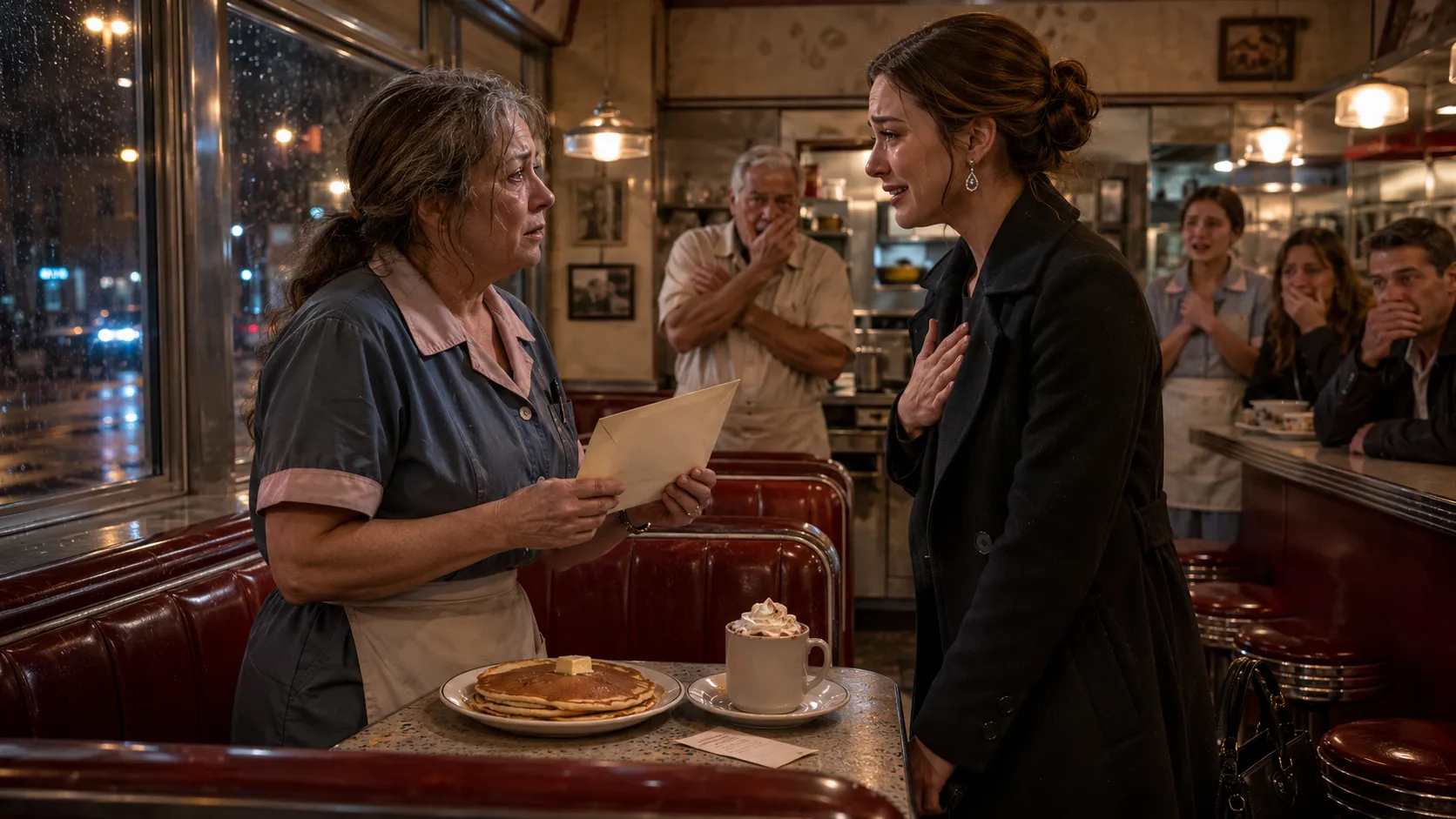
Everyone in the diner watched as a hungry little girl was humiliated for eating leftover pancakes. Only one tired waitress stepped forward and said, “Let her eat” — never knowing that one small act would return twenty years later and change her life.
The little girl had learned that hunger made people invisible.
Not completely invisible.
People still saw enough to move their purses closer, pull their children away, or tell her to stop standing near the door.
But they did not see her the way children are supposed to be seen.
They did not wonder where her mother was.
They did not ask why her shoes had split open at the toes.
They did not notice that her hands shook not from misbehavior, but from cold and days without a proper meal.
At eight years old, Emily Carter sat alone in the corner booth of Miller’s Diner on the edge of downtown Chicago, holding a chipped spoon in both hands as if someone might take it from her.
Outside, snow fell hard enough to blur the streetlights. Wind pressed against the windows. Cars hissed through slush along the curb, carrying people home to warm apartments, families, beds, televisions, leftovers, and all the ordinary comforts that had begun to feel like fairy tales to Emily.
Inside the diner, yellow lights glowed over red vinyl booths. Families ate burgers and fries. A man in a business coat complained about his coffee. Two teenagers shared milkshakes near the front window. Behind the counter, plates clattered, oil hissed, and the smell of pancakes, bacon, and hot chocolate filled the air.
Emily had not planned to steal.
That was what she told herself.
She had been standing outside the diner for almost an hour, watching people eat through the fogged glass, pressing both hands into the pockets of her oversized hoodie to keep from crying. Then a family left the corner booth in a hurry, arguing about a movie time, and on the table they abandoned half a plate of pancakes.
Not scraps from the trash.
Not food spoiled by rain.
Real pancakes.
Warm enough that a little steam still rose from them.
Emily waited until the waitress turned away.
Then she slipped inside, climbed into the booth, and began eating.
Every bite hurt her throat because she was trying not to cry.
She ate slowly at first, then faster, terrified someone would notice before she finished. The syrup had soaked into the pancakes. One piece had fallen apart under the fork. To a paying customer, it would have been leftovers.
To Emily, it felt like being allowed to live for one more night.
She had just lifted another bite to her mouth when a loud voice shattered the warmth around her.
“HEY!”
The entire diner turned.
Emily froze with the fork halfway to her lips.
A tall man in a stained white shirt stormed toward her from the kitchen entrance. His name tag read RICK, and his face carried the kind of anger some adults reserve for people who cannot fight back.
“What do you think you’re doing?” he barked.
Emily lowered the fork.
“I’m sorry,” she whispered.
Rick grabbed the plate and yanked it away so hard the fork clattered onto the table. Pancakes slid across the edge, hit the floor, and landed in a dirty pile near Emily’s torn shoes.
“You didn’t pay for that,” he shouted.
Everyone was watching now.
A little boy at another table stared with his mouth open until his mother turned his face away. An older couple looked uncomfortable but said nothing. A man in a gray suit frowned, then returned to his newspaper as if the matter had become unpleasantly inconvenient.
Emily stared at the pancakes on the floor.
Her stomach twisted so badly she thought she might be sick.
“I was hungry,” she said.
Rick laughed.
“Everybody’s hungry. That doesn’t make the food free.”
He reached for her arm.
“Out. Now.”
Before his hand touched her sleeve, another voice cut through the diner.
“Rick. Stop.”
The voice was tired.
Not loud.
But firm enough to make him pause.
A waitress stepped between them.
She was young, maybe twenty-seven, with brown hair pulled into a messy bun and dark circles beneath her eyes from too many double shifts. Her uniform was faded from washing. One of her shoes had a strip of black tape across the side where the seam was splitting.
Her name tag read SARAH.
Rick glared at her.
“She’s stealing food.”
Sarah looked down at Emily.
The little girl braced herself for disgust.
But Sarah’s eyes did not harden.
They softened.
“She’s a child,” Sarah said.
“She didn’t pay.”
“She’s hungry.”
“That’s not our problem.”
Sarah held his stare.
For one long second, nobody in the diner moved.
Then Sarah turned to Emily and crouched beside the booth.
“You can finish eating, sweetheart.”
Emily looked at her in disbelief.
Sweetheart.
No one had called her that in so long that for a moment she forgot what it meant.
Rick scoffed.
“Fine. Then it comes out of your pay.”
Sarah’s face changed just slightly.
Emily noticed.
Even at eight, she understood what that meant. Adults only made that face when something small had suddenly become expensive.
But Sarah only nodded.
“Okay.”
Rick stared at her.
“You’re ridiculous.”
“Maybe.”
He walked away muttering loud enough for everyone to hear.
Sarah bent down and picked up the pancakes from the floor. Emily’s eyes followed them with a shame so heavy it felt larger than hunger.
“I’m sorry,” she whispered.
Sarah looked at her.
“Don’t apologize for needing food.”
She disappeared into the kitchen.
Emily sat perfectly still, too afraid to move, too embarrassed to look around. People slowly returned to their meals. Conversations resumed. Forks scraped plates. Coffee poured.
But Emily could feel every glance like cold fingers on the back of her neck.
A few minutes later, Sarah returned carrying a fresh plate.
Not leftovers.
Fresh pancakes.
Eggs.
Toast.
A small cup of fruit.
And hot chocolate with whipped cream melting at the top.
Emily stared.
“That’s not mine,” she said.
Sarah placed the plate gently in front of her.
“It is now.”
Emily looked up.
“For me?”
“For you.”
The girl’s hands began to tremble again, but this time not only from cold.
Sarah sat in the booth across from her for a moment, even though she was clearly busy.
“What’s your name?”
Emily hesitated.
She had learned not to give strangers too much.
But Sarah’s voice was careful.
“Emily.”
“That’s a beautiful name.”
Emily stared at the hot chocolate.
“My mom picked it.”
“Where is your mom, Emily?”
The question came gently, but Emily still flinched.
She swallowed hard.
“She died.”
Sarah’s face changed.
“I’m sorry.”
Emily nodded once because she did not know what else to do with sympathy.
Her mother had died six weeks earlier in a shelter clinic after years of sickness, moving, and bad luck that adults called complicated when they did not want to admit no one had helped in time. After that, Emily had gone to a temporary placement, run away from a man who shouted too much, and spent nights wherever she could find dry ground.
She did not explain any of that.
Sarah did not force her to.
Instead, she pushed the hot chocolate a little closer.
“Eat before it gets cold.”
Emily ate.
Carefully at first.
Then with the quiet desperation of a child whose body no longer trusted that food would come again.
Sarah worked while she ate, refilling coffee, carrying plates, smiling at customers who barely looked at her. But every few minutes, she glanced back at Emily to make sure she was still there.
When the plate was empty, Emily sat with both hands around the mug of hot chocolate, trying to make it last.
Sarah returned with a napkin folded into a small square.
Inside were two wrapped cookies.
“For later,” she said.
Emily accepted them as if they were jewelry.
“I don’t have money.”
“I know.”
“I can pay you back someday.”
Sarah smiled faintly.
“You don’t have to.”
Emily looked toward Rick near the kitchen entrance. He was watching them with disgust.
“He’ll take it from your pay.”
Sarah followed her gaze.
“Probably.”
“Why would you do that?”
Sarah sat across from her again.
For a moment, she looked much older than twenty-seven.
“Because once, when I was little, someone fed me when they didn’t have to.”
Emily absorbed that quietly.
Outside, snow thickened against the glass.
Sarah reached into her apron and removed a scrap of receipt paper. She wrote an address on it.
“There’s a church three blocks from here. St. Mark’s. They have beds tonight because of the storm. Ask for Sister Margaret. Tell her Sarah sent you.”
Emily took the paper.
Her fingers closed around it tightly.
“Will they make me leave?”
“No.”
“Will they call someone?”
Sarah paused.
“They’ll try to help you safely.”
Emily looked down.
Safely was a word adults used before things got worse.
Sarah seemed to understand.
“I can’t promise everything,” she said softly. “But I can promise Sister Margaret is kind.”
Emily folded the paper and placed it carefully in her hoodie pocket beside the cookies.
Then she slid out of the booth.
She stood near the door for a moment, small beneath the heavy winter coat Sarah had found for her from the lost-and-found box.
Sarah held the door open.
Snow blew inside.
Emily looked back at her.
“I’ll remember you.”
Sarah smiled gently, assuming it was something a grateful child said because children often said large things when they did not know what else to offer.
“I’ll remember you too.”
But Emily meant every word.
That night changed the direction of her life.
She made it to St. Mark’s just before the storm became dangerous. Sister Margaret did not ask too many questions. She gave Emily a blanket, clean socks, soup, and a place to sleep near a radiator that clicked all night.
The next morning, Emily woke expecting the kindness to vanish.
It did not.
Margaret was not soft in the way Emily expected kind people to be. She was seventy-one, sharp-eyed, and direct enough to frighten grown men into honesty. She had spent decades working with children who had been dropped by the world and then blamed for breaking.
She took one look at Emily and said, “You’ve been running too long.”
Emily said nothing.
Margaret placed oatmeal in front of her.
“You can keep running after breakfast if you insist. But eat first.”
Emily stayed for breakfast.
Then lunch.
Then one more night.
Then a week.
Eventually, through a long chain of paperwork, hearings, home visits, and stubborn phone calls Margaret made while pacing church hallways, Emily became her foster child.
Life did not become easy.
That only happens in stories told too quickly.
Emily carried hunger in her body long after food became regular. She hid crackers under pillows. She woke in the night afraid someone had taken her shoes. At school, children mocked her thrift-store clothes and the way she watched adults before answering questions. She learned quickly, but trust came slowly.
Margaret never rushed her.
“You’re not difficult,” she told Emily one night after the girl had screamed through a nightmare. “You’re injured.”
That distinction saved something in Emily.
Years passed.
Emily grew.
She studied as if grades were doors and every A was a key. She worked after school at the church pantry, then later at a grocery store, then a call center, then a warehouse dispatch office where she discovered she had a mind for systems.
Where other people saw chaos, Emily saw patterns.
Routes.
Delays.
Wasted fuel.
Missing inventory.
Inefficient scheduling.
She understood movement because she had spent childhood surviving by knowing where to go next.
By twenty-two, she had earned a scholarship to study business logistics at a state university.
By twenty-four, she was building software at night in her apartment, creating a system that helped small delivery companies compete with larger ones by predicting route failures before they happened.
By twenty-six, investors were calling.
By twenty-eight, Carter Logistics Systems was worth millions.
Business magazines called her brilliant.
A founder to watch.
A self-made success.
Emily hated that phrase a little.
Self-made.
No one is self-made.
She had been made, in part, by a dead mother who loved her, an old church worker who refused to let her disappear, and a tired waitress who gave away money she barely had so a hungry child could eat with dignity.
The world saw Emily Carter in tailored coats and black cars.
But inside, she still remembered the corner booth.
The pancakes.
Rick’s hand reaching for her arm.
Sarah’s voice.
Let her eat.
That memory returned most often when people praised her ruthlessness in business.
They meant it as a compliment.
Emily did not accept it as one.
Twenty years after the night at Miller’s Diner, Emily sat in the backseat of her car during another winter rainstorm, staring at the old restaurant through the glass.
It was smaller than she remembered.
The sign above the door flickered weakly. One corner of the awning sagged under collected water. The windows were fogged from kitchen heat, and the paint around the door had peeled in long strips.
Her assistant, Nora, sat beside her with a tablet open.
“Are you sure this is the place?”
Emily nodded.
“Yes.”
Nora looked at the diner, then at Emily’s coat, diamond earrings, and polished black heels.
“You bought the building yesterday. The closing papers are signed. You don’t have to go in personally.”
Emily gave a small smile.
“Yes, I do.”
“Do they know who you are?”
“No.”
“Does she know?”
Emily looked through the window.
A waitress with streaks of gray in her brown hair moved slowly between tables carrying a coffee pot.
Emily’s throat tightened.
“No.”
She stepped out into the rain.
For a moment, the smell hit her before the memories did.
Coffee.
Griddle grease.
Wet coats.
Old vinyl.
Pancakes.
The diner was nearly empty. A truck driver sat near the counter. Two elderly women shared pie by the window. A young mother fed fries to a toddler in the corner.
The same corner.
Emily stopped.
The booth was still there.
Recovered in newer vinyl, but the shape was the same.
Sarah approached with a menu in one hand.
She was nearly fifty now. Lines framed her mouth. Her hands were rough from years of work. Her limp was slight but visible, a careful shift in weight every few steps. Her uniform looked clean but faded thin at the sleeves.
She did not recognize Emily.
Why would she?
To Sarah, that night had likely been one small act of kindness buried beneath thousands of long shifts.
“Table for one?” Sarah asked.
Emily almost answered with the truth.
I was here before.
You saved me.
I came back.
Instead, she said softly, “Yes, please.”
Sarah led her to the corner booth.
Emily sat where she had sat as a child.
For a second, her hands felt small again.
Sarah handed her a menu.
“What can I get you to drink?”
Emily looked up.
“Hot chocolate.”
Sarah smiled automatically.
“Whipped cream?”
Emily’s eyes burned.
“Yes.”
“And to eat?”
“Pancakes.”
Sarah nodded.
“Coming right up.”
As Sarah walked away, Emily watched the limp, the tired shoulders, the careful way she carried herself like every joint had learned to negotiate with pain.
A younger waitress stopped near Emily’s table to refill sugar containers.
Emily glanced at her name tag.
MIA.
“Excuse me,” Emily said. “Has Sarah worked here long?”
Mia sighed.
“Forever. Longer than I’ve been alive, probably.”
“She seems kind.”
“She is.” Mia lowered her voice. “Too kind, honestly. This place would fall apart without her, and Rick still treats her like she’s disposable.”
Emily’s fingers tightened around the menu.
“Rick?”
Mia nodded toward the kitchen window.
“He owns the place now. Used to be manager. Bought it cheap after the old owner died. He’s awful, but Sarah stays because…” She hesitated.
“Because what?”
“Because she needs the job. Her husband died five years ago. Cancer. Insurance didn’t cover enough. She sold her house for medical bills, and now she rents a room from her cousin.”
Emily looked toward the kitchen.
An older, heavier version of Rick stood near the pass, barking at a cook about an order.
Age had not softened him.
It had only made his bitterness more confident.
Mia leaned closer.
“Don’t tell anyone I said that.”
“I won’t.”
Sarah returned with hot chocolate first.
The whipped cream melted exactly the way it had twenty years ago.
Emily wrapped her hands around the mug and felt the past rise like steam.
Sarah noticed her expression.
“Cold night?”
“Yes,” Emily said. “Very.”
A few minutes later, the pancakes arrived.
Fresh.
Golden.
Carefully placed.
Emily stared at them so long that Sarah looked concerned.
“Everything okay?”
Emily nodded.
“I just haven’t had pancakes here in a long time.”
Sarah smiled.
“Well, welcome back.”
She turned to leave.
Emily spoke before she lost courage.
“You once helped a little girl in this booth.”
Sarah paused.
“A little girl?”
“She was homeless.”
Sarah’s hand tightened slightly around the coffee pot.
Emily continued carefully.
“She was eating leftovers because she hadn’t eaten in days. A man yelled at her. He said the food would come out of your pay.”
Sarah did not move.
The noise of the diner faded around them.
Emily’s voice softened.
“And you said, ‘Let her eat.’”
Sarah turned slowly.
Her face had gone pale.
For several seconds, she only stared at Emily.
Then her eyes moved over the elegant coat, the styled hair, the diamond earrings, the woman sitting upright in the booth where a shaking child had once hidden behind a plate.
“No,” Sarah whispered.
Emily smiled through tears.
“I told you I would remember.”
The coffee pot trembled in Sarah’s hand.
“Oh my God.”
Emily stood.
“I’m Emily.”
Sarah covered her mouth.
“The little girl from the snowstorm.”
Emily nodded.
Sarah began crying before she could stop herself.
“I wondered what happened to you,” she whispered. “I asked at the church once, but they couldn’t tell me anything. I thought maybe—”
“I made it,” Emily said.
Sarah’s face crumpled.
“I’m so glad.”
Those three words undid Emily more than any apology or speech could have.
She stepped forward and hugged the woman who had once given her pancakes, socks, and an address to safety.
Sarah froze for one second.
Then she held Emily tightly.
Not like a customer.
Not like a stranger.
Like someone who had been waiting twenty years to know whether a child survived the night.
The diner had gone quiet.
Mia watched from near the counter with tears in her eyes.
The truck driver lowered his fork.
Even the two elderly women by the window had stopped speaking.
Then Rick’s voice cut across the room.
“What is going on out here?”
Sarah pulled back quickly, wiping her face.
“Nothing, Rick.”
He walked toward them with the same irritated authority Emily remembered.
“Then why are customers staring?”
Emily turned.
Rick looked at her, then at Sarah, then at the untouched pancakes on the table.
“You bothering this lady?”
Sarah lowered her eyes automatically.
The movement was small.
But Emily saw twenty years of it.
“No,” Emily said.
Rick gave her a salesman’s smile.
“My apologies, ma’am. Sarah gets emotional sometimes. Long shifts.”
Emily looked at him.
“Do you remember me?”
Rick blinked.
“Should I?”
“I was eight years old. Sitting in this booth. Eating leftover pancakes.”
His smile weakened.
Sarah whispered, “Emily…”
Rick’s face changed slowly.
Not with remorse.
With calculation.
He looked at Emily’s coat, jewelry, shoes, the black car visible through the window.
Recognition came not from memory of harm, but from awareness of status.
“Oh,” he said. “Well. That was a long time ago.”
“Yes.”
“Kids do things. Staff had rules. You understand how business works.”
Emily’s expression did not change.
“I understand it better than you think.”
Rick laughed awkwardly.
“Look, if I was rough back then, I’m sure it wasn’t personal.”
“It was personal to the hungry child.”
The room went still again.
Rick’s smile vanished.
Sarah touched Emily’s arm.
“It’s alright.”
Emily looked at her gently.
“No. It wasn’t.”
For twenty years, Emily had imagined this moment in different ways.
Sometimes, in the angry versions, she shouted. Sometimes she embarrassed him. Sometimes she listed every cruel word he had said and made him feel as small as he had made her feel.
But standing there now, she realized revenge would be too small for what Sarah had given her.
She reached into her purse and removed a folder.
Rick looked at it nervously.
“What’s that?”
“The deed.”
He frowned.
“To what?”
“This building.”
The silence became absolute.
Rick stared.
“You’re joking.”
Emily placed the folder on the table.
“I bought it yesterday.”
Mia gasped softly.
Sarah looked confused.
Rick’s mouth opened, then closed.
Emily turned toward Sarah.
“I didn’t come here to punish anyone. I came here because twenty years ago you paid for my meal when you could barely afford it.”
Sarah shook her head.
“Emily, it was just pancakes.”
“No,” Emily said. “It was dignity.”
Sarah’s eyes filled again.
Emily continued, “That night, you gave me food, but you also gave me an address. Sister Margaret took me in. She became my foster mother. I went to school. I built a company. Every time life became impossible, I remembered that one person had treated me like I mattered.”
Sarah pressed one hand to her chest.
“I never knew.”
“I know.”
Emily took another envelope from her purse.
“This is for you.”
Sarah backed away slightly.
“No.”
“You haven’t opened it.”
“I already know it’s too much.”
Emily smiled sadly.
“It is not enough.”
Sarah’s hands shook as Emily placed the envelope in them.
Inside was a cashier’s check.
Two million dollars.
Sarah stared at the number for several seconds before understanding it.
Then her knees nearly gave out.
Mia rushed forward to steady her.
“I can’t take this,” Sarah whispered.
“Yes, you can.”
“No, Emily. No. I gave you breakfast. I didn’t—”
“You gave me proof that I wasn’t invisible.”
Sarah began sobbing openly.
Rick stepped forward suddenly.
“Now hold on. If there’s money involved, we should probably discuss—”
Emily turned to him.
“No.”
He stopped.
One word, and the room understood the old order had ended.
Emily looked toward the employees gathered near the kitchen entrance.
“Everyone working here will receive raises. Back pay where records show wage violations. Full healthcare coverage through the new operating company. Mia, if you want it, I’d like you to stay on as assistant manager during the transition.”
Mia stared at her.
“Me?”
“You told the truth when it would have been easier not to.”
Mia began crying too.
Rick’s face darkened.
“You can’t walk in here and take over my business.”
Emily opened the folder and slid the papers across the table.
“I already did.”
“I had a verbal agreement to stay on.”
“With the previous landlord. Not with me.”
“You don’t know how to run a restaurant.”
Emily gave a faint smile.
“I built a logistics company from nothing. I think I can learn pancakes.”
A few customers laughed quietly.
Rick’s face reddened.
“You think money makes you better than me?”
Emily’s smile faded.
“No. That’s what you thought when I had none.”
The words landed hard.
Rick looked away first.
For the first time, Emily saw him clearly. Not as the giant who had towered over a starving child, but as an aging man who had spent his life making small people feel smaller because it was the only power he ever trusted.
She felt no triumph.
Only distance.
“You will receive the severance required by law,” she said. “And nothing more.”
Rick left through the kitchen without another word.
No one followed him.
Sarah was still holding the check like it might disappear.
“What am I supposed to do with this?” she whispered.
Emily took her hands.
“Rest. Get your knee treated. Buy a home if you want one. Stop working double shifts. Visit somewhere warm. Or do nothing for a while.”
Sarah let out a broken laugh through tears.
“I don’t know how to do nothing.”
“Then learn.”
The diner laughed gently.
Sarah looked around at the place where she had spent most of her adult life. The cracked counter. The old coffee machine. The booths. The kitchen door. The people.
Then she looked at Emily.
“You came back.”
Emily nodded.
“You told me to go somewhere safe. I did. But part of me stayed in this booth.”
Sarah touched her cheek with the back of her fingers, the way one might touch a child’s face.
“You were so little.”
“I know.”
“So cold.”
“I know.”
Sarah’s voice broke.
“I should have done more.”
Emily shook her head immediately.
“No. You did the thing that mattered at the exact moment it mattered.”
For the first time, Sarah seemed to believe her.
By the end of the week, the diner had a new sign taped inside the front window:
CLOSED TEMPORARILY
REOPENING SOON UNDER NEW OWNERSHIP
ALL STAFF WILL BE PAID DURING RENOVATION
People in the neighborhood talked.
Some said a millionaire bought the diner out of nostalgia.
Some said the old waitress had secretly been related to someone powerful.
Some said Rick had finally gotten what he deserved.
The truth was simpler.
A hungry girl remembered.
Emily did not turn Miller’s into a luxury restaurant.
That would have been an insult to everything the place had been.
Instead, she repaired it.
New roof.
New plumbing.
New kitchen equipment.
Better lights.
Clean booths.
A staff room that did not smell like bleach and despair.
A proper break policy.
A meal program for employees and anyone under eighteen who came in hungry.
No questions.
No humiliation.
Sarah refused to retire completely.
That surprised no one.
She did reduce her hours after Emily threatened to hire a full-time nurse to follow her around the diner and lecture her about her knee.
“You wouldn’t,” Sarah said.
Emily looked at her.
“I run a company.”
Sarah sighed.
“You’re impossible.”
“Margaret said the same thing.”
At the mention of Margaret, Sarah’s expression softened.
“Is she still alive?”
Emily nodded.
“Ninety-one and bossier than ever.”
“Good.”
On reopening day, the line stretched down the block.
Old customers came. Former employees came. Reporters came, though Emily kept them outside until the first meal service was over. She did not want cameras turning Sarah’s kindness into a spectacle before the neighborhood had a chance to reclaim the place.
The first customer seated was not a celebrity or investor.
It was Sister Margaret.
She arrived in a wheelchair pushed by one of the young women from St. Mark’s, wearing a purple scarf and an expression of mild disapproval.
“You made the front door too fancy,” she told Emily.
Emily bent and kissed her cheek.
“Hello to you too.”
Margaret looked around.
“Clean, though.”
“High praise.”
Sarah came from the kitchen carrying a plate of pancakes and stopped when she saw her.
For a moment, the two older women simply looked at each other.
Then Margaret smiled.
“So you’re the waitress.”
Sarah’s eyes filled.
“And you’re the woman who saved her.”
Margaret waved one hand dismissively.
“We took turns.”
They sat together in the corner booth, the same booth where a starving child had once eaten leftovers under the judgment of strangers.
Emily stood beside them.
Mia, now in a manager’s jacket, set three cups of hot chocolate on the table.
Sarah looked at Emily.
“You still drink it?”
“Always.”
Margaret snorted.
“Too much sugar.”
“You gave me cookies for breakfast once.”
“I was bribing you into staying.”
“It worked.”
The three women laughed.
Then Emily looked around the diner.
Children ate free pancakes near the front window. A tired father drank coffee while his daughter colored on a paper menu. Workers moved through the room without fear in their shoulders. Mia trained a new server patiently. In the kitchen, no one shouted.
It was still a diner.
But it no longer felt like a place where kindness had to be smuggled in quietly.
Later that afternoon, Emily made a short speech outside beneath the new sign.
Not a polished business speech.
Not the kind her public relations team had prepared and she had ignored.
She stood beside Sarah and Margaret and spoke from a single folded page.
“When I was eight years old,” Emily said, “I sat inside this diner because I was hungry enough to risk being thrown out. A man saw a thief. A room full of people saw a problem. Sarah saw a child.”
The crowd quieted.
“She paid for my meal. She gave me an address. She gave me a coat and cookies and the first sentence I had heard in weeks that made me feel human: You can finish eating, sweetheart.”
Sarah wiped her eyes.
Emily continued, “This diner will never again throw out a hungry child. It will never punish an employee for being kind. And it will never measure a person’s worth by what they can afford to order.”
The applause came slowly at first.
Then fully.
Sarah stood beside Emily with both hands clasped, overwhelmed but smiling.
Margaret leaned toward her and whispered loudly enough for the front row to hear, “Get used to it. She’s dramatic.”
Emily laughed.
For the first time in years, the sound did not feel like something she had practiced for cameras.
That evening, after everyone left and the diner finally grew quiet, Emily sat alone in the corner booth.
A plate of pancakes sat in front of her.
Fresh.
Warm.
Paid for, though Sarah had insisted she never needed to pay there again.
Emily cut one small piece and tasted it.
For a moment, she was eight again.
Cold.
Terrified.
Invisible.
Then Sarah slid into the booth across from her with two mugs of hot chocolate.
“You okay?” she asked.
Emily looked at her.
“I used to think coming back would close something.”
“Did it?”
Emily considered that.
Outside, rain tapped gently against the window. The diner lights glowed warmly. Somewhere in the kitchen, Mia was singing off-key while closing up.
“No,” Emily said. “But it opened the right thing.”
Sarah smiled.
“That sounds better.”
Emily reached into her pocket and removed the old receipt paper Sarah had written on twenty years earlier.
The ink had faded almost completely, but the address of St. Mark’s could still be read.
Sarah stared at it.
“You kept that?”
“Always.”
Emily placed it carefully on the table between them.
“This was the first map anyone ever gave me to a safer life.”
Sarah covered her mouth.
Emily’s voice softened.
“I know you think it was just pancakes. But sometimes people are standing at the edge of disappearing, and one ordinary kindness pulls them back.”
Sarah reached across the table and took her hand.
For a while, neither spoke.
They did not need to.
Years later, people would still tell the story of the girl who came back rich.
Some would focus on the check.
Some on Rick losing the diner.
Some on the free meal program that eventually spread to five other locations across the city.
But Emily always corrected people when she could.
She had not come back rich.
Not really.
She had come back grateful.
The wealth was only how the gratitude found a shape.
And every winter, on the first night heavy snow fell over Chicago, Miller’s Diner stayed open late. The kitchen made pancakes, eggs, toast, and hot chocolate for anyone who came through the door hungry.
No questions.
No proof.
No shame.
Near the corner booth hung a small framed sign written in Sarah’s careful handwriting:
LET HER EAT.
Most customers never knew the whole story.
They did not need to.
The people who needed the sign understood it immediately.
And Emily Carter, who had once been a starving little girl with frozen toes and a chipped spoon, made sure the door stayed open.