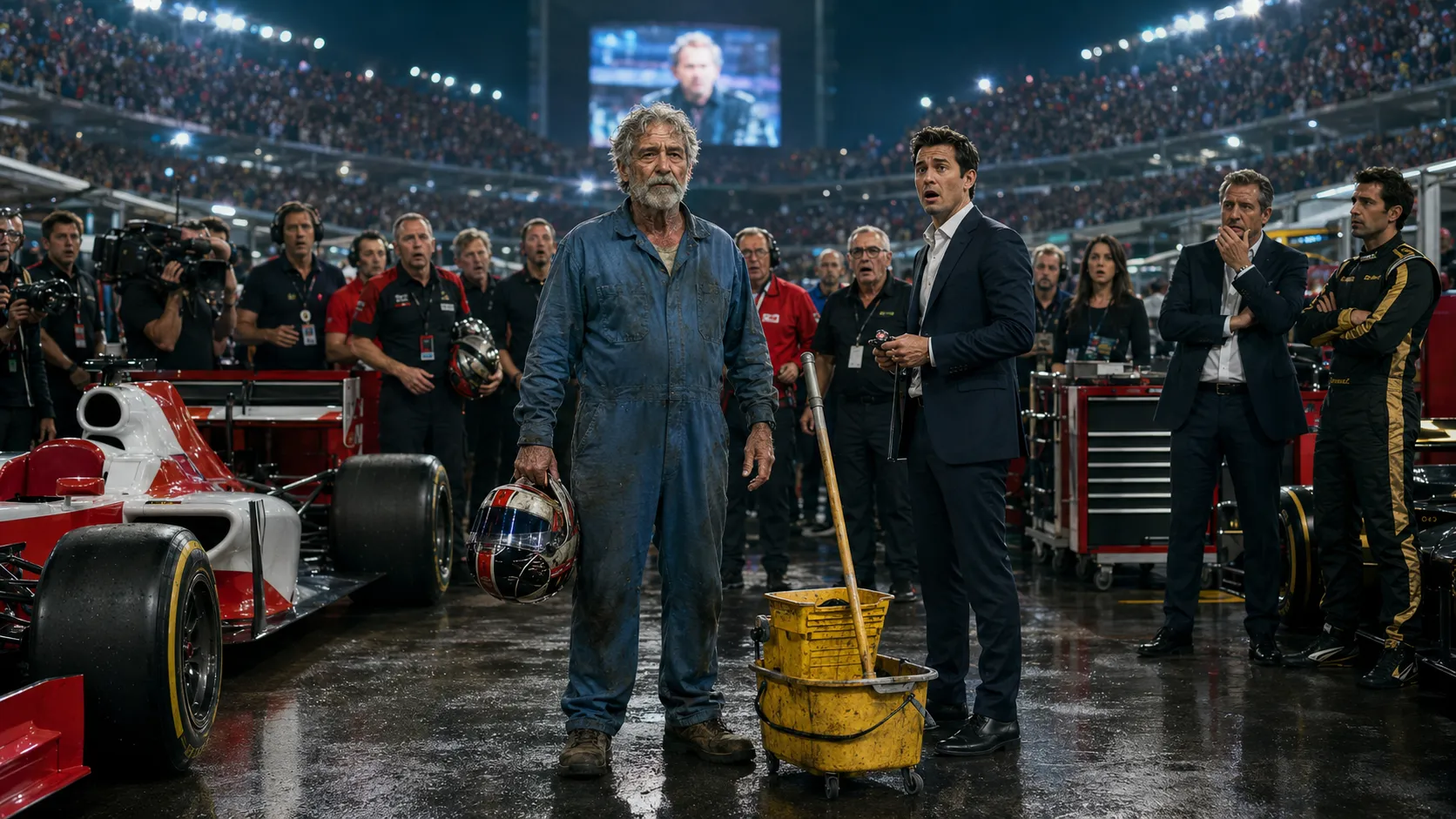
Everyone in the stadium laughed when the old janitor stepped forward and said he could drive the championship car. But when the announcer recognized his face under the helmet, the crowd went silent — because the man with the mop had once been the most feared driver in America.
The entire stadium was shaking before the race even began.
Engines roared beneath the lights. Thousands of fans filled the grandstands, waving banners, filming on their phones, and shouting over music blasting from the speakers. Camera crews moved through the pit lane. Sponsors in tailored suits laughed near the VIP platform. Reporters waited for the story everyone expected to write by midnight.
The Falcon Racing Team was supposed to lose.
Everyone knew it.
They were a small team with old debts, tired mechanics, one aging car, and a young owner who had already sold almost everything his father left behind just to keep the garage open.
His name was Marcus Reed.
He was thirty-two years old, and he had not slept properly in three days.
Inside Pit Garage 7, he stood in front of a tool cabinet with both hands on his head, trying not to panic in front of his crew.
His assistant, Ethan, held a phone in one hand and looked as if he had just heard a death sentence.
“Say it again,” Marcus said.
Ethan swallowed.
“Chase signed with Black Titans.”
The garage went silent.
One of the mechanics dropped a wrench.
Marcus stared at Ethan.
“No. He can’t do that. The race starts in forty minutes.”
“He did it thirty minutes ago.”
Marcus’s jaw tightened.
“Our contract?”
“His lawyer says the penalty clause was covered by Black Titans. Five million dollars.”
A bitter laugh escaped someone near the workbench.
Five million dollars.
To Falcon Racing, that number sounded less like money and more like another planet.
Marcus turned toward the open garage door. Across the pit lane, the Black Titans team looked rich enough to buy the weather. Their cars were polished black and gold. Their staff wore matching headsets. Their owner, Vincent Cross, stood on the platform smiling like a man who had already won.
Beside him stood Chase Miller, Falcon’s former driver, now wearing a Black Titans jacket.
Chase did not look guilty.
He looked relieved.
Marcus’s hands curled into fists.
“He knew,” Marcus said quietly. “He knew this would destroy us.”
Ethan did not answer.
There was nothing kind to say.
Falcon Racing had one chance left. Win the championship, earn the prize purse, secure new sponsorships, and save the team from bankruptcy.
Without a driver, there would be no race.
No money.
No team.
No future.
Marcus looked around the garage at the people who had stayed with him when staying made no sense: Luis, their lead mechanic, whose hands were always black with grease; Carla, the data engineer who had turned down better offers because she believed loyalty still meant something; Big Mike, the tire chief, who had worked with Marcus’s father twenty years earlier; and half a dozen crew members who had families, rent, medical bills, and no reason to keep trusting a sinking ship.
His father’s photograph hung on the wall near the garage entrance.
Robert Reed, founder of Falcon Racing.
Smiling beside the first car he ever built.
Marcus looked away before the photo could accuse him of failing.
“We need a driver,” he said.
No one spoke.
Then a voice came from near the hallway.
“I can drive.”
Everyone turned.
Standing near the entrance was the stadium janitor.
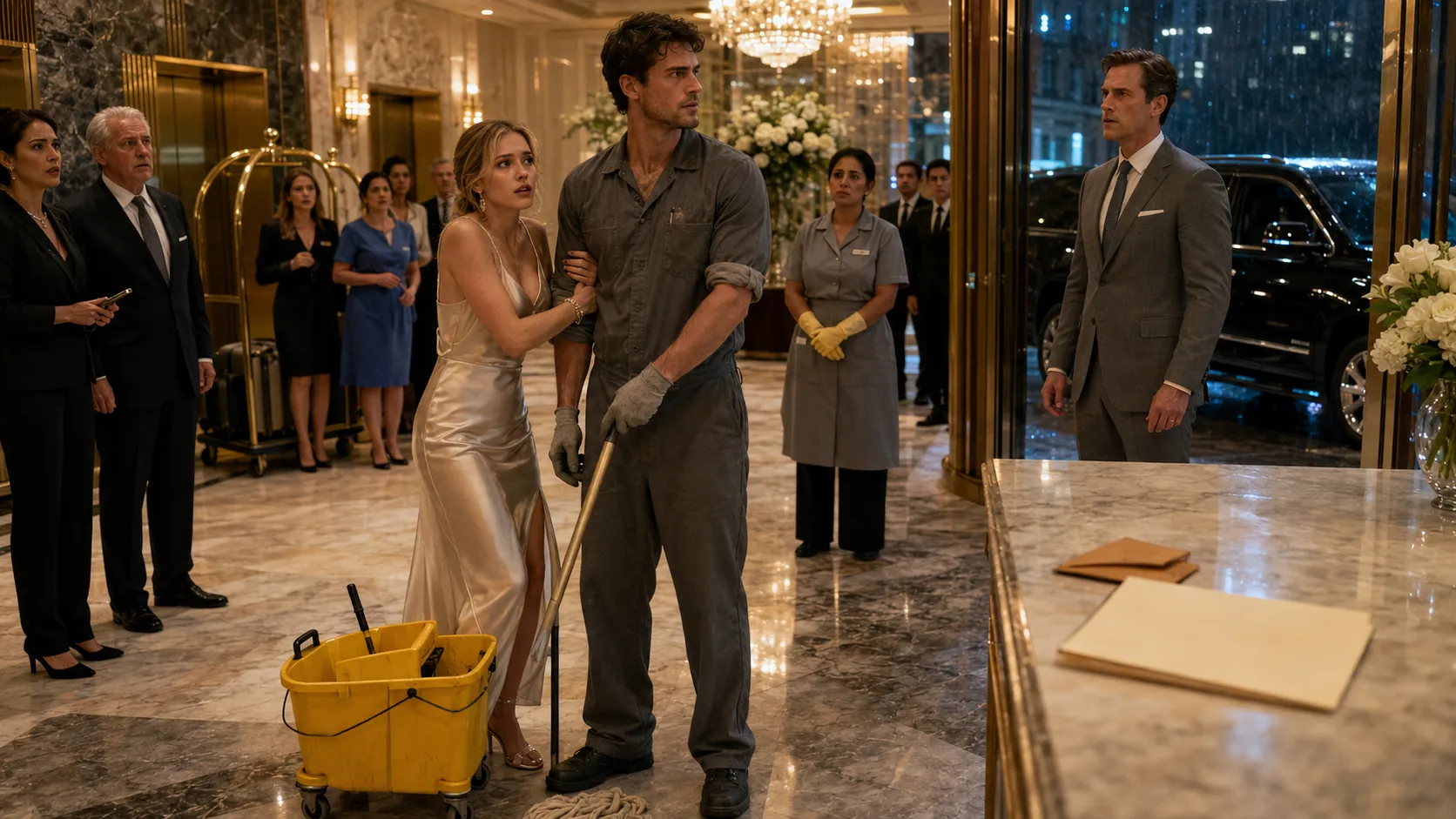
He wore faded blue coveralls with a name tag that simply read FRANK. His beard was gray and uneven. His sleeves were stained from oil, cleaning solution, and years of work nobody important ever noticed. One hand rested on a mop handle. A yellow bucket sat beside his boots.
For a moment, nobody reacted.
Then one of the younger mechanics laughed.
Another joined him.
Within seconds, half the garage was laughing.
Marcus did not laugh.
He was too tired for that.
He looked at the old man and said, “Frank, this isn’t the time.”
The janitor stepped closer.
His face remained calm.
“I know this track.”
Luis wiped his hands on a rag.
“You mop this track.”
Frank looked toward the roaring stadium beyond the garage.
“I know every turn. Every grade change. Every drain line. Every patch of asphalt that stays wet three seconds longer than the rest.”
Someone snorted.
“Great. We’ll put that on your résumé.”
Marcus stepped toward him, anger finally breaking through exhaustion.
“Do you have any idea what this race is?”
“Yes.”
“This is the American Street Circuit Championship. The best drivers in the country are out there.”
“I know.”
“You don’t just climb into a 900-horsepower car because you’ve pushed a mop around the pit lane.”
Frank’s eyes did not change.
“No,” he said. “You climb in because no one else will.”
The laughter faded slightly.
Ethan looked at the old man more carefully now.
Something about Frank’s posture was strange.
Not proud.
Not nervous.
Steady.
Marcus shook his head.
“I appreciate whatever this is, but we’re not putting a janitor in a championship car.”
Frank nodded once.
“Then you already lost.”
The words landed harder than they should have.
Marcus stared at him.
Frank picked up his bucket.
He did not argue.
He did not beg.
He simply turned and walked back toward the hallway, leaving wet tracks behind him on the concrete floor.
For several seconds, nobody spoke.
Then Marcus snapped back to the room.
“Find me a driver. Anyone with a professional license.”
Ethan was already dialing.
Ten minutes passed.
Then fifteen.
Every call ended the same way.
No.
Too risky.
Too late.
Not interested.
Then disaster struck again.
Their backup driver, a nervous twenty-three-year-old named Tyler, volunteered to take the wheel for warm-up laps. He had never driven the championship car under full race conditions, but desperation makes people say yes to things courage alone would not.
He lasted four minutes.
At Turn Nine, the rear tires lost grip. The car spun hard, clipped the barrier, and slid nose-first into the safety wall.
The car survived.
Tyler did not walk away.
He was conscious when the medical team arrived, but his shoulder was broken and his right wrist hung at a wrong angle.
Marcus watched the stretcher disappear toward the medical bay while the entire stadium murmured with excitement and pity.
An official approached him with a clipboard.
“Mr. Reed.”
Marcus did not turn.
The official’s voice was professional, which somehow made it worse.
“You have ten minutes to name an eligible driver or Falcon Racing will be disqualified.”
Marcus looked toward his crew.
Nobody met his eyes.
Years of work.
Gone in ten minutes.
Then Ethan spoke quietly.
“There is one option.”
Marcus closed his eyes.
“Don’t say it.”
“The janitor.”
Marcus turned on him.
“You cannot be serious.”
Ethan held his ground, though his voice shook.
“You heard him. He wasn’t joking.”
“He’s fifty-something years old.”
“Fifty-five, maybe.”
“He cleans bathrooms.”
“He said he can drive.”
“People say things.”
Ethan glanced toward the medical bay, then at the official waiting nearby.
“Yes,” he said. “And sometimes desperate people listen.”
Marcus looked around the garage.
At the broken pride on every face.
At the empty driver’s suit hanging from the rack.
At the photograph of his father.
He hated the idea.
He hated the humiliation of it.
He hated that the whole stadium would laugh at them.
But Falcon Racing had already become a joke tonight.
At least this way, the joke might make it to the starting grid.
“Find him,” Marcus said.
Five minutes later, Frank was back in the garage, mopping near a row of toolboxes as if nothing had happened.
Marcus walked toward him slowly.
Frank looked up.
“You changed your mind.”
“I ran out of choices.”
“That happens to men who wait too long.”
Marcus almost snapped back, then stopped himself.
He was too close to losing everything to waste strength on pride.
“You really think you can handle that car?”
“Yes.”
“You have racing experience?”
Frank was silent for a few seconds.
Then he said, “A little.”
Marcus studied him.
There it was again.
That strange calm.
No excitement. No fear. No hunger for attention.
Only certainty.
Marcus held out the keys.
“If you wreck my car, there won’t be enough of this team left to sue you.”
Frank took the keys.
His hand moved fast.
Too fast.
The key ring snapped cleanly out of the air without a glance, as if his fingers had known exactly where it would be.
Luis noticed.
So did Ethan.
Marcus did too.
Frank looked toward the racing suit hanging on the rack.
“You have one that fits?”
Carla stepped forward, still unsure whether to laugh or pray.
“We’ll find one.”
The stadium erupted in confusion when the announcement appeared on the giant screen.
FALCON RACING REPLACEMENT DRIVER: FRANK DALTON
Most people missed the last name.
They were too busy laughing at the camera feed showing an old janitor stepping into the driver preparation area.
Social media exploded instantly.
“Falcon Racing is finished.”
“They put Grandpa in the car.”
“Is this a charity event?”
“Someone check if the janitor knows where the brake is.”
In the VIP section, Vincent Cross smiled broadly.
He turned to Chase Miller.
“They really replaced you with a janitor.”
Chase laughed, but not comfortably.
He kept watching Frank.
Something about the old man’s walk bothered him.
Not because he recognized him.
Because he should have.
Inside the broadcast booth, two commentators were preparing filler material for what they assumed would be an embarrassing final chapter for Falcon Racing.
The younger commentator, Blake Morris, grinned at the camera.
“Well, folks, we’ve seen chaos before, but I don’t think we’ve ever seen anything quite like this. Falcon Racing has named a last-minute replacement driver, and yes, you are reading that correctly — their new driver appears to be a stadium janitor.”
The older commentator beside him, Arthur Bell, did not laugh.
Arthur had been covering motorsports for thirty-six years. He had seen drivers rise, fall, crash, disappear, return, lie, cheat, pray, and break. His eyesight was weaker now, but his memory was still cruelly sharp.
He leaned closer to his monitor.
Frank had just removed his cap.
The camera caught his face under the pit lights for one brief second.
Arthur stopped breathing.
Blake glanced at him.
“Arthur?”
The old commentator stood slowly.
“No.”
Blake frowned.
“What?”
Arthur’s voice dropped.
“That can’t be him.”
“Who?”
The camera zoomed in again as Frank pulled on his racing gloves.
Arthur’s hand moved to his mouth.
“That’s Frank Dalton.”
Blake blinked.
“Should I know that name?”
Arthur looked at him as if he had just admitted he did not know what an engine was.
“Twenty-five years ago, Frank Dalton was the most feared street racer in America.”
The booth went silent.
The production director spoke through their headsets.
“Arthur, are you sure?”
Arthur’s eyes stayed on the screen.
“Yes.”
His voice changed now. It was no longer commentary. It was memory.
“They called him the Ghost Driver.”
The phrase moved from the booth to the broadcast, from the broadcast to the stadium, from the stadium to millions of phones within seconds.
The Ghost Driver.
Older fans heard it first.
Then fathers told sons.
Uncles told nephews.
Men who had followed illegal racing in the nineties stood up from couches across the country, staring at their screens in disbelief.
Frank Dalton.
The legend.
The outlaw.
The man who once drove through traffic, rain, mountain passes, and unfinished highways like he had been born understanding speed as a language.
No one knew exactly how many races he had won because half of them had never officially existed.
Professional teams had begged him to go legitimate.
He refused every offer.
Then one night in Chicago, during an underground championship run, his younger brother Tommy died in a pit-lane accident.
Frank disappeared after the funeral.
No interviews.
No public apology.
No farewell.
Nothing.
Some said guilt killed him.
Some said he changed his name.
Some said he drank himself into a grave.
But he had been here all along.
Mopping floors under stadium lights while young drivers passed him without seeing the man who had built the roads they dreamed of conquering.
Back in Pit Garage 7, Marcus heard the commentators through the monitor.
He turned slowly toward Frank.
“You’re Frank Dalton?”
Frank tightened the strap on his glove.
“I used to be.”
Luis crossed himself.
Big Mike took one step forward, staring like he had seen a ghost.
“Tommy Dalton was your brother?”
Frank paused.
The garage quieted again.
“Yes.”
Big Mike swallowed.
“I was there that night.”
Frank looked at him.
“I know.”
“You remember me?”
“I remember everyone who was there.”
The sentence carried no accusation.
That made it heavier.
Marcus stepped closer.
“Why are you working here as a janitor?”
Frank looked toward the track, where rain clouds had begun gathering beyond the open roofline.
“Because after Tommy died, racing stopped sounding like engines.”
“What did it sound like?”
Frank’s face remained still.
“Like his mother crying.”
Nobody spoke after that.
The official appeared at the garage entrance.
“Driver to grid. Now.”
Frank picked up the helmet.
Before putting it on, he walked to the wall where Marcus’s father’s photograph hung.
He studied it for a moment.
“You’re Robert Reed’s boy?”
Marcus stiffened.
“You knew my father?”
Frank gave the smallest nod.
“He beat me once.”
Marcus stared.
“My father never mentioned that.”
“He was a good enough man not to spend his life bragging about it.”
For the first time all night, Marcus almost smiled.
Frank placed the helmet under one arm.
“Your father gave drivers chances when no one else would. That’s why I offered.”
Marcus had no answer ready.
Frank climbed into the car.
The cockpit was tight. His knees complained immediately. His hands moved over the controls with an intimacy that silenced the remaining doubts in the garage. He did not search for anything. He did not ask questions. He settled into the seat like an old pianist returning to a piano he had once loved and feared in equal measure.
Carla connected the radio.
“Can you hear us?”
Frank’s voice came through calm and low.
“Yes.”
Marcus stepped near the window.
“Frank.”
The old man turned his helmet slightly.
“Don’t try to prove anything out there.”
Frank’s answer was immediate.
“I’m not.”
“Then what are you doing?”
Frank looked toward the starting line.
“Keeping your father’s team alive.”
The car rolled out.
The stadium did not know whether to laugh or cheer anymore.
Some still mocked him.
Some chanted his name.
Others were too stunned to react.
On the starting grid, twelve cars lined up beneath the lights.
Black Titans occupied pole position with Chase Miller in one car and their lead driver, Roman Vale, in the other. Roman was younger, brutal, and famous for blocking so aggressively that other drivers called him a wall with a steering wheel.
Frank sat at the back of the grid in the Falcon car.
Last position.
Last chance.
Above him, the lights began to count down.
Five red lights.
The engines climbed into a scream.
Marcus stood in the pit box with both hands gripping the edge of the monitor stand.
Ethan whispered, “Please.”
Frank closed his eyes for one second.
Not to pray.
To hear.
The engine.
The tires.
The rain approaching in the distance.
And somewhere beneath all of it, the voice of his brother Tommy, laughing under a hood with grease on his cheek.
You always wait too long before the first corner, Frankie.
Frank opened his eyes.
The lights went out.
The race exploded forward.
Cars launched down the straight like bullets.
The Falcon car was instantly swallowed.
By Turn One, Frank was last.
By Turn Two, the crowd online had already decided the comeback story was over before it began.
“He’s done.”
“Legend? Please.”
“Twenty-five years is too long.”
Marcus slammed his headset onto the table.
“What is he doing? He’s not attacking.”
Carla watched the telemetry.
“No,” she said slowly. “He’s listening.”
“What?”
She leaned closer to the screen.
“He’s not pushing yet. He’s measuring grip, brake response, tire temperature, wet patches…”
Marcus looked toward the track.
Frank was losing distance.
The first three laps were humiliating.
He stayed last.
He let younger drivers cut him off.
He avoided risky openings.
The commentators tried to remain respectful, but even Blake began to sound disappointed.
“Maybe the years away are too much.”
Arthur Bell said nothing.
His eyes were narrow.
He had seen Frank Dalton race before.
The old man never wasted movement.
On Lap Four, Frank reached Turn Seven.
A section of track slightly off-camber, recently resurfaced, with a seam near the outside line that most drivers avoided because it looked dangerous.
Frank aimed directly for it.
Marcus shouted into the radio.
“Frank, wrong line!”
“No.”
The Falcon car touched the seam.
For half a second, it looked like a mistake.
Then the car rotated perfectly.
Not sliding out.
Pivoting.
It shot out of the corner with such clean speed that it passed two cars before the next straight.
The stadium noise shifted.
Frank did not react.
Lap Five.
Another pass.
Lap Six.
Two more.
At Turn Nine, where Tyler had crashed less than an hour earlier, most drivers braked cautiously.
Frank braked later.
Much later.
Marcus’s heart nearly stopped.
The Falcon car dived inside, inches from the barrier, and emerged ahead of another competitor with no contact.
The crowd rose.
Blake Morris shouted into the microphone.
“Wait a second — Frank Dalton is moving through the field!”
Arthur finally smiled.
“No. He’s remembering.”
Inside the car, Frank’s breathing remained slow.
But the past was awake now.
He saw the track and another track beneath it.
He saw polished stadium asphalt and old industrial roads under yellow streetlights.
He saw the present and the ghosts layered over it.
Tommy leaning through the passenger window before a race.
Check your right front, Frankie. She’s talking different tonight.
Frank had not listened that night.
That was the truth no documentary ever knew.
He had felt something wrong in the car before Tommy died. A vibration. Slight. Intermittent. Not enough to stop, he told himself. Not enough to lose the championship. Tommy had wanted to inspect it. Frank had snapped at him.
After the race began, a suspension part failed near the pit lane.
Frank survived.
Tommy, standing too close with a radio in his hand, did not.
For twenty-five years, Frank had told people racing killed his brother.
But in the deepest part of him, he believed pride had done it first.
Lap Eight.
Frank reached fifth.
The stadium was no longer laughing.
Lap Ten.
Third.
Vincent Cross ripped off his headset in the Black Titans pit box.
“How is that old man still gaining?”
Chase Miller stared at the monitor with a sick look on his face.
Roman Vale, still leading, heard the update over his team radio.
“Falcon car is P3 and gaining.”
Roman laughed.
“The janitor?”
“Frank Dalton.”
Silence.
Then Roman said, “Keep him away from me.”
On Lap Twelve, the first raindrops hit the track.
The warning lights flashed.
The roof remained open over half the stadium, and a cold front moved in faster than the forecasts had predicted. Water began collecting near Turn Four, then along the back straight, then in the shallow grooves near the final corner.
Modern drivers hated rain.
Computers helped, but fear still came through the steering wheel.
Frank almost smiled.
Rain had been his oldest teacher.
Arthur Bell’s voice lowered in the booth.
“This changes everything.”
Blake asked, “Does it help him?”
Arthur watched the Falcon car enter the wet section without hesitation.
“It may be the reason he wins.”
The rain thickened by Lap Fourteen.
Cars began slipping.
One driver spun into the gravel.
Another clipped a barrier and limped toward the pit lane.
Black Titans called Roman in for caution mode.
Roman refused.
“I’m not letting him catch me.”
Frank moved into second.
Marcus was nearly shouting into the radio now.
“Frank, we can take the podium. Don’t throw this away. We don’t need the win.”
Frank’s response came calm as ever.
“Your father didn’t build a team to survive in second place.”
Marcus froze.
For a moment, all he could hear was the rain.
Then he looked toward his father’s photograph.
The final lap began with Roman Vale still ahead.
The Black Titans car was faster on paper.
More expensive engine.
Better aero package.
Newer tires.
But paper did not drive in rain.
Frank closed the gap through Turn Three.
Roman blocked the inside.
Frank let him.
At Turn Four, Roman defended again.
Frank waited.
At Turn Six, Roman moved aggressively, nearly forcing the Falcon car toward the wet curb.
The crowd booed.
Marcus slammed his fist into the pit wall.
“He’s going to kill him!”
Frank’s voice came through the radio.
“No. He’s scared.”
The words were not angry.
They were almost sad.
On the back straight, Roman weaved once.
A warning flashed.
The stewards noticed.
The crowd roared.
Frank stayed behind him.
Not because he could not pass.
Because he was waiting for the one corner only he understood.
The final corner.
Turn Twelve.
Everyone called it The Hook because it bent tighter than it looked and punished anyone who entered too fast. In dry conditions, the racing line was obvious. In rain, it was a trap. Water collected near the center, but the outside lane held a narrow strip of grip where the drainage slope pulled water toward the wall.
Frank knew it because he had cleaned that corner every Sunday morning.
He knew where the oil lingered.
He knew where water ran.
He knew where the wall curved half an inch away from the painted line.
Roman took the safe line.
Frank went outside.
The stadium screamed.
Marcus shouted, “No!”
Arthur Bell stood in the broadcast booth.
“Oh my God.”
The Falcon car entered the corner inches from the wall, rear tires sliding, front wheels correcting in movements too small for most cameras to catch. Water exploded behind him. For one impossible second, the car seemed sideways enough to be lost.
Then it found grip.
Frank carried speed through the outside line exactly where the drainage strip held firm.
Roman’s car slipped in the middle of the corner.
Only half a second.
That was enough.
Frank shot out of Turn Twelve beside him.
Then ahead.
The finish line came fast.
Black and gold.
Red and white.
Two cars screaming through rain beneath stadium lights.
The Falcon crossed first.
For one heartbeat, there was silence.
Then the world erupted.
The stadium became thunder.
Mechanics screamed.
Fans jumped over seats.
Commentators shouted over each other.
Marcus stood frozen at the pit wall, rain on his face, unable to move.
Ethan grabbed him by both shoulders.
“We won,” he said.
Marcus blinked.
“What?”
“We won!”
Then Marcus was laughing and crying at the same time, pulled into a crush of mechanics, engineers, and staff who had been preparing for ruin less than an hour earlier.
Frank slowed after the finish.
He did not raise a fist.
He did not shout.
He drove one careful cooldown lap as if carrying something fragile in the car with him.
When he returned to the pit lane, the entire stadium was chanting his name.
“FRANK! FRANK! FRANK!”
He climbed out slowly.
Age returned all at once.
His knees hurt. His back complained. His hands trembled slightly as he removed the helmet.
Reporters swarmed him immediately.
“Frank! Why come back tonight?”
“Where have you been for twenty-five years?”
“Are you returning to professional racing?”
“Did you know Falcon would win?”
Frank stood under the pit lights, rain dripping from his gray hair.
For a moment, he looked toward the track.
Then toward the sky.
“My brother loved racing,” he said quietly. “For a long time, I only remembered the night it took him from me. Tonight, I remembered why he loved it.”
The reporters lowered their microphones slightly.
The noise softened.
Even the crowd seemed to sense this was not a victory speech.
This was a man speaking near a grave only he could see.
Marcus stepped toward him.
“I’m sorry,” he said.
Frank looked at him.
“For what?”
“For laughing. For not seeing you.”
Frank’s expression softened.
“Most people don’t see the man holding the mop.”
Marcus nodded, ashamed.
Frank glanced toward his bucket still sitting by the garage wall.
“I should finish before the morning crew comes in.”
The crowd laughed when the line reached the broadcast.
But Marcus did not.
He took a contract folder from Ethan and held it out.
“You’re not cleaning floors tomorrow.”
Frank raised an eyebrow.
Marcus said, “Falcon Racing needs a driver.”
The stadium roared again.
Frank looked at the folder for a long time.
Then he shook his head.
“No.”
The cheer died in confusion.
Marcus stared.
“No?”
Frank handed the helmet back to Luis.
“I won one race tonight. That’s enough.”
Marcus looked stunned.
“But you could come back. Sponsors are already calling. You could save this team.”
Frank looked toward the mechanics.
“Your team doesn’t need an old ghost trying to become young again.”
He turned back to Marcus.
“It needs someone who knows the difference between speed and purpose.”
Marcus did not understand at first.
Then Frank placed a hand on his shoulder.
“I’ll help you build that.”
The words meant more than a contract.
Two weeks later, Falcon Racing announced Frank Dalton as senior driving coach and safety director.
The headlines were enormous.
THE GHOST DRIVER RETURNS.
JANITOR LEGEND SAVES FALCON RACING.
FROM MOP BUCKET TO VICTORY LANE.
Frank hated all of them.
He hated cameras more.
He hated interviews most.
But he stayed.
Not because fame had returned.
Because the garage felt different now.
Marcus changed first.
He stopped shouting before asking questions. He rebuilt the team structure. He listened to Carla about data instead of overriding her to look decisive. He promoted Ethan. He gave mechanics written contracts, proper rest schedules, and medical coverage. He made sure no one ever again had to choose between speaking up about safety and keeping their job.
Frank demanded that before signing anything.
“This garage will not bury another brother because somebody wanted one more lap,” he said.
No one argued.
A month after the championship, Marcus found Frank alone in the empty stadium near Turn Twelve.
The track lights were off except for the maintenance lamps. The grandstands were dark. Without crowds, the place looked less like an arena and more like a church built for engines.
Frank stood by the wall where he had made the final pass.
Marcus approached carefully.
“You come here often?”
Frank did not turn.
“Every Sunday.”
“To clean?”
Frank smiled faintly.
“To remember.”
Marcus stood beside him.
For a while, they said nothing.
Then Marcus pulled a folded photograph from his jacket.
“My father kept this in his office.”
He handed it to Frank.
The picture was old and slightly faded. Two young men stood beside a battered race car in a Chicago parking lot, laughing with their arms around each other’s shoulders.
Frank Dalton and Robert Reed.
Frank stared at it.
His face changed.
“You said my father beat you once,” Marcus said.
Frank nodded.
“He did.”
“You never said he was your friend.”
Frank swallowed.
“After Tommy died, Robert was the only man who came to my apartment and didn’t tell me to move on.”
Marcus looked at him.
“What did he tell you?”
Frank’s eyes stayed on the photograph.
“He sat on my kitchen floor because I wouldn’t get up. Stayed there six hours. Then he said, ‘Grief is not proof you loved him. What you do after grief is.’”
Marcus lowered his head.
“That sounds like him.”
Frank handed the photo back, but Marcus shook his head.
“Keep it.”
The old man’s fingers closed around it carefully.
“Thank you.”
Marcus looked toward the track.
“I was afraid I’d lose everything he built.”
“You nearly did.”
Marcus almost smiled.
“Comforting.”
Frank turned to him.
“But you didn’t. Now the question is whether you build something worthy of keeping.”
The words stayed with Marcus long after that night.
The next season began differently.
Falcon Racing did not become rich overnight. That was not how real resurrection worked. Sponsorship came, but carefully. Debts were renegotiated. The car improved. The crew worked harder than ever, but not with desperation now.
With belief.
Frank coached the new driver, a quiet woman named Elena Ruiz who had spent years being told she was too cautious, too technical, too old for a rookie.
Frank watched her first test lap and said, “You listen to the car. That’s rare.”
Elena frowned.
“They told me I need to be more aggressive.”
“They told you that because they confuse aggression with courage.”
She looked at him.
“What do you think courage is?”
Frank nodded toward the wet track.
“Knowing exactly how afraid you should be and driving anyway.”
Under his training, Elena became Falcon’s strongest driver in years.
Not reckless.
Not flashy.
Precise.
Patient.
Deadly in the rain.
Fans who had expected Frank to return full-time slowly accepted that his victory had not been the beginning of an old man chasing youth. It had been a bridge.
From what racing had been to what Falcon could become.
But not everyone loved the new story.
Black Titans lost sponsors after the scandal of buying Chase from Falcon leaked with the timing exposed. Vincent Cross denied wrongdoing, blamed market competition, and called Marcus sentimental and weak.
Roman Vale gave interviews mocking Frank’s “fairy tale comeback.”
Chase Miller said nothing publicly.
Then, one evening three months after the championship, Chase appeared at Falcon’s garage.
Rain tapped against the roof.
Most of the crew had gone home.
Frank was checking tire wear notes when he saw the young man standing near the entrance.
Chase looked different without the cameras.
Younger.
Ashamed.
“Mr. Dalton,” he said.
Frank continued writing.
“You lost?”
Chase swallowed.
“I wanted to apologize.”
Frank looked up.
“To me?”
“To Marcus. To the team. To everyone.”
“Marcus is in the office.”
“I know.” Chase shifted uncomfortably. “I thought I should talk to you first.”
Frank closed the notebook.
“You left a team an hour before the biggest race of their lives.”
“I know.”
“Men with families nearly lost jobs because you wanted a larger check.”
“I know.”
“Knowing comes after. Character comes before.”
Chase lowered his eyes.
Frank studied him for a long moment.
He saw arrogance there still, but cracked now. He saw fear. He saw a young man who had believed money was proof of value because too many older men had taught him exactly that.
Frank softened by one degree.
“Why did you really come?”
Chase looked toward the Falcon car.
“Because when you crossed the line, I realized something.”
“What?”
“I was in the better-funded team. Better car. Better position. Better contract.” His voice dropped. “And I’ve never felt smaller.”
Frank said nothing.
Chase continued.
“My father called me after the race. He said he watched it from the nursing home. First thing he said was, ‘That old janitor drove like a man who still had someone to answer to.’”
Frank’s expression shifted.
Chase wiped at his face angrily.
“He asked who I answer to. I didn’t know what to say.”
For a while, only the rain spoke.
Then Frank pointed toward the office.
“Start with Marcus.”
Chase nodded.
“Will he forgive me?”
“That’s his business.”
“And you?”
Frank picked up his notebook again.
“I’ll decide after I see what you do when nobody is paying you to be sorry.”
Chase almost smiled, but thought better of it.
Then he went to Marcus.
Frank stayed in the garage alone, listening to the muffled conversation through the office walls. He could not hear words. Only tones. Apology. Anger. Silence. Something like repair beginning badly.
That was how most repair began.
Badly.
A year after the championship, Falcon Racing returned to the same stadium.
This time, they were not a joke.
They were not favorites either.
They were something more dangerous.
A team people respected.
Before the race, the stadium held a short ceremony for driver safety awareness. Marcus had insisted on naming the initiative after Tommy Dalton, but Frank refused twice.
On the third request, Marcus brought Big Mike, Carla, Ethan, Elena, and half the crew into Frank’s office.
They did not plead.
They simply stood there.
Frank looked at them.
“You rehearsed this?”
Carla said, “Yes.”
“Badly,” Ethan added.
Frank sighed.
“What exactly do you want?”
Marcus placed a folder on the desk.
“The Tommy Dalton Foundation. Emergency support for injured pit crews, safety training for small racing teams, and scholarships for mechanics who can’t afford certification programs.”
Frank stared at the name.
For twenty-five years, Tommy had existed mostly as an absence.
A photograph in Frank’s wallet.
A birthday Frank never stopped counting.
A voice he heard near engines and rain.
Now these people wanted to turn his brother into help for others.
Frank’s throat tightened.
“He would have hated the attention.”
Marcus nodded.
“My father hated attention too. Didn’t stop people from needing what he built.”
Frank looked out the window toward the track.
“You’re all very annoying.”
Carla smiled.
“Is that a yes?”
Frank did not turn around.
“Yes.”
On race night, before the cars lined up, Frank walked onto the track with Marcus at his side.
The stadium announcer spoke about Tommy Dalton. About pit safety. About crews who worked in dangerous conditions while drivers got the glory. About the old championship footage no one had seen in years, now restored and displayed on the giant screen.
Then Tommy’s face appeared.
Twenty-seven years old.
Grease on one cheek.
Laughing beside his brother.
Frank’s knees nearly weakened.
The crowd applauded, but gently.
Not like a victory.
Like a tribute.
Marcus leaned closer.
“You okay?”
Frank looked at the screen.
“No.”
Marcus nodded.
Frank breathed slowly.
“But I’m here.”
That seemed to be enough.
Elena drove that night.
Frank stood in the pit box wearing a headset, calmer than everyone else.
The race was difficult. Clean. Brutal. Honest. Elena finished second, then received a penalty upgrade after the first-place driver was found to have illegally blocked on the final lap.
Falcon won again.
Not as a miracle this time.
As a team.
When reporters rushed toward Elena, she pulled Frank into the camera frame.
“Ask him,” she said. “He taught me the final corner.”
Frank stepped backward immediately.
“No, no. This is your race.”
Elena grinned.
“You keep saying racing isn’t about ego.”
“It isn’t.”
“Then stop making it about yours.”
The crew laughed.
Frank glared at her, but there was no heat in it.
That night, after the celebrations ended, Frank returned to the maintenance hallway where his mop bucket still sat.
He had kept it.
Not because he missed the work.
Because humility needed objects.
He placed one hand on the handle.
Marcus found him there.
“You’re not thinking of going back to cleaning, are you?”
Frank smiled faintly.
“Some floors still need it.”
“Frank.”
The old man looked at him.
“I spent years being invisible. At first, I thought it was punishment. Then I thought it was peace.” He paused. “But it taught me something.”
“What?”
Frank looked toward the garage, where the team was still laughing, arguing, celebrating, living.
“People tell you who they are when they think you don’t matter.”
Marcus thought of the night he had dismissed Frank.
“I know.”
Frank studied him.
“Yes,” he said. “You do now.”
Marcus leaned against the wall beside him.
“My father would have liked you working here.”
“He did like me.”
“Before or after you beat him?”
Frank smiled.
“After. Before that, he called me an arrogant idiot.”
Marcus laughed.
“That also sounds like him.”
Frank reached into his pocket and pulled out the old photograph Marcus had given him: Robert Reed and Frank Dalton beside the car, young and foolish and certain life would give them more time than it did.
He looked at it for a long moment.
Then he removed another photograph from his wallet.
Tommy.
Frank placed the two photographs side by side on the cleaning cart.
For the first time, the past did not feel like a closed door.
It felt like a garage with the lights still on.
Three years later, the Tommy Dalton Foundation had helped seventy-two injured crew members, funded eighteen mechanic scholarships, and forced several smaller racing leagues to adopt stronger pit safety standards.
Frank never became comfortable with speeches, but he gave one every year anyway.
Short.
Blunt.
Usually ending with something like, “Wear the helmet properly, and don’t be stupid.”
People loved him for it.
He pretended to dislike that.
Falcon Racing grew, but Marcus kept the garage photograph of his father exactly where it had always been. Beside it hung a second photo now: Frank in blue janitor coveralls, mop in one hand, helmet in the other, looking mildly annoyed while the team laughed around him.
Under the photo, someone had placed a small brass plate.
THE MAN WE ALMOST DIDN’T SEE.
Frank complained about it for two weeks.
No one removed it.
On the fifth anniversary of the race that saved Falcon, the stadium invited Frank to drive one ceremonial lap before the championship.
He refused.
Then Elena asked.
He refused again.
Then Marcus brought out a restored car painted in old Dalton gray, the color Frank had driven in the nineties. On the side, beneath the number, were two names:
FRANK & TOMMY
Frank stared at the car for a long time.
“You people fight dirty.”
Marcus smiled.
“I learned from racing legends.”
Frank walked around the car slowly.
His hand brushed the roof.
For once, the memories did not arrive as punishment.
Tommy’s laugh.
Robert Reed’s handshake.
Rain on asphalt.
Crowds under illegal streetlights.
The smell of hot brakes.
The night everything ended.
And then, unexpectedly, the night something began again.
Frank climbed in.
The stadium stood before the engine even started.
When it did, the sound rolled across the track low and deep.
Not as violent as modern cars.
Older.
Rougher.
Alive.
Frank drove one lap.
Slow at first.
Then faster.
Not dangerously.
Not to prove he still could.
Simply enough to let the car breathe.
At Turn Twelve, he eased off the throttle and looked toward the outside line where he had passed Roman in the rain.
Then he whispered, “You would’ve liked that one, Tommy.”
For a second, he could almost hear his brother answer.
You waited long enough, Frankie.
When Frank returned to the pit lane, he did not cry in front of the cameras.
He waited until he reached the garage.
Marcus found him there later, sitting beside the old mop bucket with his helmet resting on his knees.
“You alright?”
Frank looked up.
This time, the smile came easily.
“Yes,” he said. “I think I am.”
Outside, the stadium roared for the next generation of drivers.
Inside, the old janitor sat among the team that had finally seen him.
Not as a joke.
Not as a legend only.
Not as a ghost.
As a man who had lost, hidden, returned, and taught them all something that mattered more than speed:
No person is finished simply because the world stops looking.