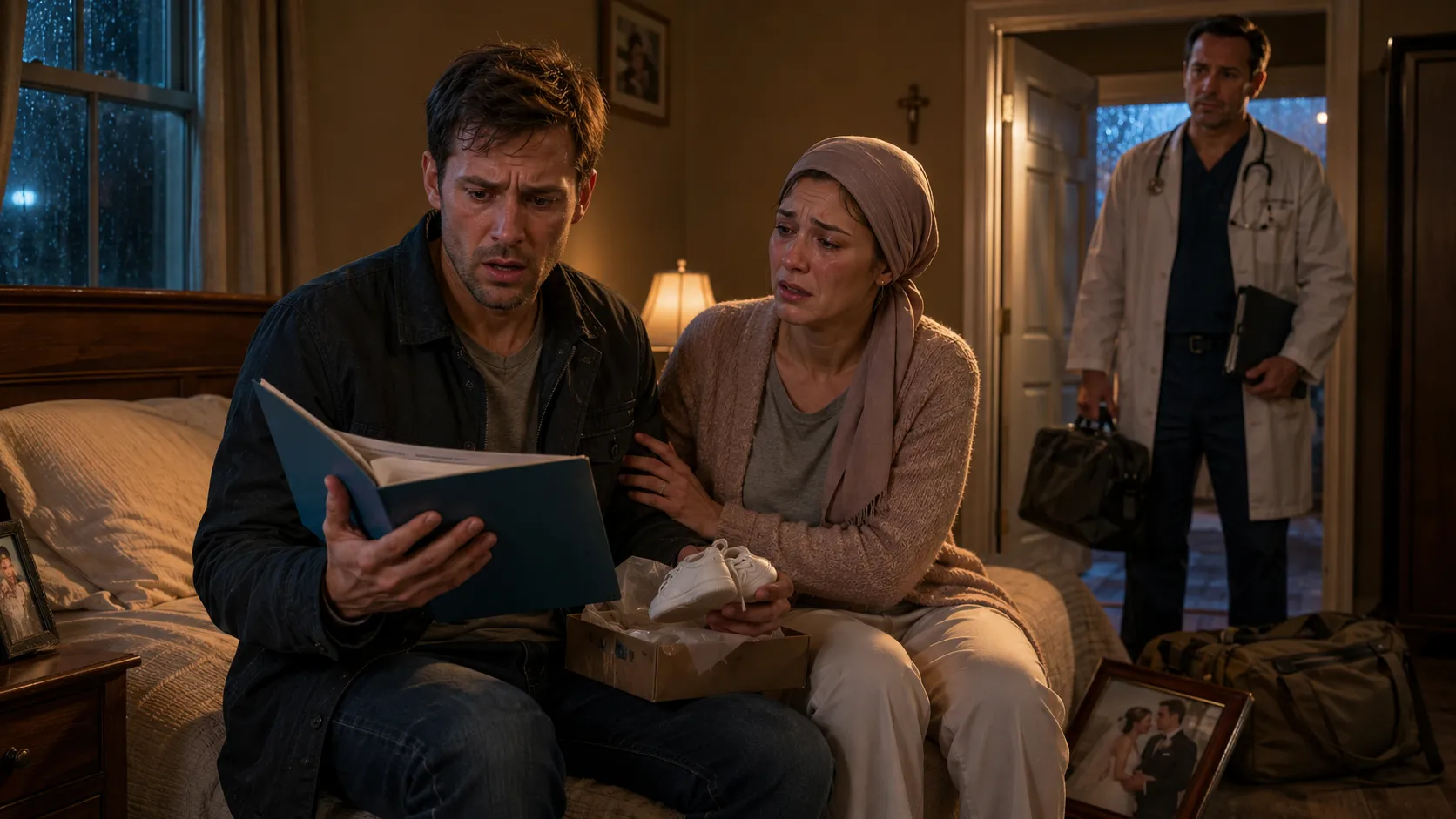
Captain Daniel Reeves survived eleven months in a war zone by dreaming of the moment he would hold his wife again. But when he opened their bedroom door and found a strange man beside her, the truth waiting in that room nearly broke him.
Captain Daniel Reeves had spent eleven months learning how to stay alive in places where the ground itself could not be trusted.
Afghanistan had a sound to it.
Wind over sand.
Engines at night.
Distant gunfire.
The strange silence that came before explosions.
Men in his unit joked when they could, because joking was sometimes the only thing standing between courage and collapse. They talked about steaks, football, old trucks, bad coffee, and the first thing they would do when they got home.
Daniel almost never joined those conversations.
When someone asked, he always gave the same answer.
“My wife.”
That was all.
Emily Reeves was the reason he counted days.
Her photograph had lived inside the left pocket of his combat vest for nearly a year. The corners were bent. The color had faded slightly. A thin crease ran across her cheek from the night Daniel folded the photo too quickly during a mortar alarm and shoved it back against his chest like a prayer.
In the picture, Emily was standing on their front porch in Texas wearing his old denim jacket, laughing because the wind had blown her hair across her eyes.
That laugh had kept him alive.
On the nights when the desert turned cold enough to make his hands ache, Daniel would pull the photo out and stare at it under a weak flashlight.
He would remember the smell of coffee in their kitchen.
The way Emily sang badly while folding laundry.
The soft sound she made when she fell asleep during movies but insisted she had heard every word.
The way she touched his arm whenever she was nervous.
He had promised her he would come home.
And now, finally, he had.
The return order came two days earlier than expected.
A transport delay had shifted, paperwork cleared faster than anyone thought, and Daniel found himself standing in an airport in Dallas with a duffel bag over one shoulder and his phone in his hand.
He almost called her.
He typed the message twice.
Landed. I’m coming home.
Then he deleted it.
After eleven months of fear, distance, bad connections, and half-finished video calls, he wanted one clean moment.
One surprise.
One instant where Emily opened the door, saw him standing there, and all the months between them collapsed into nothing.
So Daniel took a taxi from the airport.
He sat in the back seat wearing civilian clothes that felt strange on his body, one hand resting on the duffel bag beside him.
The driver tried making conversation.
Daniel answered politely at first, then fell quiet.
The closer they got to home, the harder his chest became to manage.
He had faced gunfire without shaking.
But the thought of seeing Emily made his hands tremble.
The neighborhood looked exactly the same when the taxi turned onto Willow Creek Drive.
White fences.
Wide lawns.
Porch lights glowing in early evening.
A child riding a bicycle in circles near the curb.
American flags hanging from two houses.
The ordinary world.
Daniel had forgotten how unreal ordinary could look after war.
The taxi stopped outside the small cream-colored house he and Emily had bought three years earlier with more optimism than savings.
The porch light was on.
So were the living room lights.
Daniel paid the driver, grabbed his duffel, and stood for a moment at the end of the walkway.
Home.
He had said the word hundreds of times overseas, but it had become abstract there. Something distant. Something fragile. Something that might vanish if he let himself believe in it too hard.
Now it stood in front of him with peeling paint near the railing and Emily’s blue flowerpots by the door.
Daniel smiled for the first time in days.
He walked quietly up the steps.
His key still fit.
That tiny fact nearly undid him.
He turned it slowly, opened the door, and stepped inside.
“Emily?” he called softly.
No answer.
The house smelled faintly of lavender detergent and something medicinal he could not place.
His duffel slid from his shoulder and landed near the entryway.
“Em?”
Still nothing.
Then he heard voices upstairs.
A man’s voice.
Daniel froze.
The sound moved through him faster than thought.
Not fear first.
Instinct.
His body tightened the way it did before danger. His breathing slowed. His hand moved slightly, then stopped when he remembered he was not armed and not in uniform and not overseas.
He stood at the bottom of the stairs listening.
The voices stopped.
Then came movement.
Fast.
Nervous.
A floorboard creaked above him.
Daniel’s stomach twisted.
For eleven months, he had imagined every possible way he might die.
He had not imagined this.
He climbed the stairs slowly.
Each step felt heavier than the one before it.
At the top of the hallway, the bedroom door stood half open.
Warm yellow light spilled onto the carpet.
Daniel reached it and pushed the door wider.
Then he saw them.
Emily was sitting on the edge of the bed.
Another man sat beside her.
Close.
Too close.
His hand was near hers.
Emily’s eyes widened in horror when she saw Daniel.
For one second, nobody moved.
Then Emily whispered, “Daniel.”
That was when something inside him broke.
Every lonely night.
Every explosion.
Every letter he had written and never sent because he did not want to frighten her.
Every time he had looked at her photograph and promised himself she was waiting.
All of it collapsed into that one image.
His wife.
Their bedroom.
A stranger beside her.
The man stood quickly.
“Whoa, listen—”
Daniel crossed the room in three strides.
He grabbed the man by the shirt and slammed him against the wall hard enough to knock a framed wedding photo onto the floor.
Glass shattered.
Emily screamed.
“Daniel, stop!”
Daniel did not hear her.
Or he heard her through the old noise in his head — the noise of danger, betrayal, panic, threat.
“Who are you?” he roared.
The man lifted both hands.
“I’m not here to hurt anyone.”
“You’re in my house.”
“I know.”
“In my bedroom.”
“Daniel!” Emily cried. “Please!”
He pressed the man harder against the wall.
“Tell me who you are.”
The stranger’s face was pale, but his voice stayed controlled.
“My name is Marcus Hale.”
Daniel stared at him.
“That means nothing to me.”
“I know.”
Emily stepped forward, crying now.
“Daniel, let him go.”
He turned toward her, and the pain in his face made her stop.
“You want me to let him go?”
“It’s not what you think.”
Daniel laughed once.
Bitter.
Broken.
“That’s what people say when it is exactly what someone thinks.”
Emily covered her mouth.
Marcus spoke carefully.
“Captain Reeves, I need you to listen to me.”
Daniel’s head snapped back toward him.
“You know my rank?”
“Yes.”
“How?”
Marcus swallowed.
“Because your wife talks about you all the time.”
Daniel almost hit him.
His fist lifted before thought caught up.
Emily rushed between them.
“Daniel, no!”
The sight of her standing so close stopped him.
Not because the anger left.
Because beneath it, something else had begun to move.
Emily looked wrong.
He had been so focused on the man that he had not seen her clearly.
She was thinner than he remembered.
Her cheeks were hollow.
Her eyes were bruised with exhaustion.
A scarf was wrapped loosely around her head, though the room was warm.
Daniel lowered his fist.
For the first time, he looked at her properly.
“Emily?”
She tried to hold his gaze.
Failed.
Marcus gently touched Daniel’s wrist, not to restrain him, but to get his attention.
“There’s a folder on the nightstand,” he said. “Please. Open it.”
Daniel looked at him with hatred still burning in his eyes.
“What folder?”
Emily began crying harder.
“The blue one,” she whispered.
Daniel released Marcus slowly.
The man stepped away from the wall but made no move to leave.
Daniel grabbed the blue folder from the nightstand and opened it with angry hands.
Medical reports.
Appointment schedules.
Hospital discharge papers.
Scans.
Bloodwork.
Treatment plans.
His eyes moved over the pages without understanding at first.
Then one line stopped him.
Stage III Glioblastoma.
The room changed shape around him.
Daniel read it again.
Then again.
The words did not become different.
Glioblastoma.
Brain tumor.
Treatment plan.
Oncology.
Radiation.
Chemotherapy.
His hands began to shake.
He looked up slowly.
“What is this?”
Emily stood in front of him with tears running down her face.
“I didn’t want you to find out like this.”
Daniel stared at her.
“What is this?”
Marcus spoke quietly from behind her.
“She has a brain tumor.”
Daniel’s entire body went cold.
“No.”
Emily closed her eyes.
“Daniel…”
“No.”
He looked back at the papers.
There had to be another explanation. Another Emily Reeves. A misfiled folder. A wrong label. Some clerical mistake that had found its way into their bedroom.
He turned pages faster.
The more he read, the worse it became.
Six months of appointments.
Six months of treatment.
Six months of hiding.
Daniel looked at Marcus.
“Who are you?”
Marcus answered carefully.
“I’m her oncologist.”
Doctor.
Not lover.
Doctor.
The rage inside Daniel cracked so suddenly that it left him with nothing to stand on.
He took one step backward.
Then another.
His legs hit the edge of the bed, and he sat down hard.
For a few seconds, no one spoke.
The ticking clock on the dresser became painfully loud.
Emily wiped her face with trembling fingers.
“I was going to tell you tonight,” she whispered. “I thought I had two more days to prepare.”
Daniel’s voice came out low and rough.
“You’ve been sick for six months?”
She nodded.
“And you didn’t tell me?”
“I couldn’t.”
“You couldn’t?”
His voice rose, not with anger now, but with disbelief so deep it hurt.
“I called you every chance I got. I asked if you were okay.”
“I know.”
“You said you were tired from work.”
“I know.”
“You smiled at me.”
Her face folded.
“I know.”
Daniel stood suddenly.
“Emily, I was in a war zone.”
“That’s why I didn’t tell you.”
He stared.
She stepped closer.
“Every time the phone rang, I was afraid it would be someone telling me you were dead. Every time the connection froze, I thought it was the last time I would see your face. I couldn’t put this on you too.”
“You should have.”
“I was scared.”
“So was I.”
The words landed between them.
Simple.
True.
Awful.
Marcus picked up his coat from the chair.
“I should go.”
Daniel looked at him.
For the first time, he saw the man clearly.
Not as a threat.
Not as an enemy.
As a tired doctor standing in the middle of a marriage breaking open under more fear than either person knew how to carry.
Marcus paused near the door.
“She has another treatment appointment tomorrow morning,” he said. “I came by because she had a dizzy spell after her last scan, and she refused to go to the hospital unless I checked her here.”
Daniel closed his eyes.
Marcus continued, softer now.
“She needs rest tonight. No more stress, if possible.”
Daniel almost laughed at the impossibility of that sentence.
Marcus looked at Emily.
“Call if the headache changes.”
She nodded.
Then he left.
The bedroom door closed quietly behind him.
Now it was only husband and wife.
And the broken wedding photo on the floor.
Daniel stared at the shattered glass around the frame.
In the picture, he and Emily stood under white flowers outside a small chapel. He was laughing. She was holding both hands over her mouth because the wind had caught her veil and thrown it over the minister’s face.
They had been so young that day.
Young enough to believe love meant never keeping secrets.
Daniel bent slowly and picked up the frame.
A piece of glass sliced his thumb.
He barely felt it.
Emily reached for him.
“Daniel, you’re bleeding.”
He pulled his hand back reflexively.
She froze.
That small movement hurt them both.
He looked at his thumb, then at her.
“I thought you betrayed me.”
“I know.”
“I almost hit your doctor.”
“I know.”
“I scared you.”
Her answer came after a pause.
“Yes.”
Daniel looked away.
The shame arrived fully then.
Not gentle shame.
The kind that makes a man see himself from outside his own body and hate what he sees.
He sat on the bed again, elbows on his knees, blood from his thumb staining his palm.
“In my head,” he said slowly, “I was still there.”
Emily understood.
She sat beside him, but not close enough to touch.
“In Afghanistan?”
He nodded.
“I heard a man’s voice. Saw him near you. I didn’t think. I just reacted.”
“I should have told you.”
“That doesn’t excuse what I did.”
“No.”
The honesty hurt, but it was better than comfort.
For a long time, they sat in silence.
Rain began tapping against the window.
Daniel had not noticed the weather until then.
A Texas storm was moving in, soft at first, then harder against the glass.
Finally, he asked the question that terrified him most.
“How bad is it?”
Emily closed her eyes.
“The doctors are careful with words.”
“That bad?”
“They say treatment is helping some. But it’s aggressive.”
Daniel stared at the floor.
The war had trained him to face possibilities.
Ambush.
Loss.
Evacuation.
Injury.
Death.
But no training had prepared him for sitting beside the woman he loved while a folder on the bed quietly suggested there might not be enough time.
He swallowed.
“Why were you alone?”
She looked at him.
“I wasn’t always. Your sister came to appointments when she could. Mrs. Alvarez from next door helped with groceries. Marcus checked on me. I tried to manage.”
“Without me.”
Emily’s voice broke.
“I thought I was protecting you.”
Daniel looked at her.
“And I thought I was coming home to surprise you.”
She gave a small, ruined laugh through tears.
“You did.”
For the first time, the absurdity of it struck them both.
Not enough to become funny.
But enough to let them breathe.
Then Emily’s face changed.
“There’s something else.”
Daniel stiffened.
He did not know how much more one heart could take in a single night.
She stood slowly and walked to the closet.
Her movements were careful.
Too careful.
From the top shelf, she took down a small cardboard box tied with a white ribbon.
She carried it to him and placed it in his hands.
Daniel stared at the box.
“What is this?”
“Open it.”
He untied the ribbon and lifted the lid.
Inside was a tiny pair of baby shoes.
White.
Soft.
Impossible.
For a second, Daniel did not understand.
Then he looked up.
Emily’s eyes were full of tears again, but this time there was something else in them.
Fear.
Hope.
Love.
“I found out three weeks ago,” she whispered.
Daniel could not speak.
His mouth opened, but no sound came out.
Emily pressed one hand to her stomach.
“I’m pregnant.”
The room went silent in a way Daniel would remember for the rest of his life.
He looked down at the shoes.
Then at her.
Then back at the shoes.
Every emotion in him collided at once.
Joy.
Terror.
Wonder.
Grief.
Guilt.
The strange, sacred panic of learning life had entered a room where death had already been sitting quietly.
“You’re pregnant,” he whispered.
She nodded.
“The doctors are still figuring out what it means for treatment. They’re being cautious. They said there are decisions we need to make together.”
Together.
The word broke something open in him.
Emily took one step closer.
“I was going to tell you first. Before the rest. I wanted you to have one happy second before everything else came crashing in.”
Daniel covered his mouth with one hand.
The baby shoes blurred.
A hardened Army captain who had survived firefights and roadside bombs sat on the edge of his own bed and began to cry like a man who had been holding up the sky with both hands and finally dropped it.
Emily moved toward him.
This time, when she reached for his face, he did not pull away.
“I’m scared,” she whispered.
That sentence finished him.
He put the box down and wrapped both arms around her carefully, as if she were both the woman he loved and something made of glass.
“I’m here,” he said into her shoulder.
Emily sobbed.
“I’m so scared.”
“I know.”
“I didn’t know what to do.”
“I know.”
“I didn’t want you to come home and have to become a nurse instead of a husband.”
Daniel pulled back enough to look at her.
“Emily, listen to me. I did not survive over there so I could come home and be protected from your pain.”
Her tears fell harder.
“You’re not doing this alone anymore,” he said.
She nodded, but he saw she did not fully believe it yet.
So he said it again.
Slower.
“You are not doing this alone anymore.”
That night, they did not sleep.
They sat on the bedroom floor because Daniel could not bring himself to sit beside the broken glass on the bed until he cleaned it properly, and Emily said the floor felt more honest anyway.
He bandaged his thumb.
She brought tea.
They talked until sunrise.
Not the polite video-call talk of two people trying to protect each other from worry.
Real talk.
Ugly talk.
Necessary talk.
Daniel told her about the nights he had woken shaking after mortar fire and lied to her because he did not want her to hear fear in his voice.
Emily told him about the day she collapsed at the grocery store and woke up surrounded by strangers before anyone knew what was wrong.
Daniel told her about the young soldier he had carried after an explosion and how he still heard the boy calling for his mother.
Emily told him about the first time clumps of hair came out in her hands and how she sat on the bathroom floor for twenty minutes before she could move.
Daniel admitted he had been angry overseas sometimes.
Not at her.
At the distance.
At orders.
At God.
At the phone signal.
At himself for choosing a life where leaving her had become normal.
Emily admitted that sometimes she had resented him too.
Not because he served.
Because every doctor asked, “Is your husband available?” and she had to say no.
They cried.
They apologized.
They argued softly.
They held hands.
By morning, the walls they had built to protect each other had begun to fall.
Not all at once.
But enough for light to enter.
At eight-thirty, Daniel drove Emily to the hospital.
He sat beside her in the waiting room wearing the same clothes he had worn home from the airport. His eyes were red. His jaw unshaven. His left thumb bandaged badly.
Emily leaned against his shoulder.
For the first time in six months, she did not sit through an appointment alone.
Dr. Marcus Hale entered the consultation room with a folder in one hand and a cautious expression.
Daniel stood immediately.
Not aggressively this time.
Respectfully.
“Doctor,” he said.
Marcus stopped.
For a moment, both men remembered the wall, the fist, the broken glass.
Then Daniel held out his hand.
“I owe you an apology.”
Marcus looked at the hand.
Then took it.
“You came home to a hard moment.”
“That explains it. It doesn’t excuse it.”
Marcus nodded once.
“No. It doesn’t.”
Emily exhaled quietly.
That was the beginning.
The months that followed did not become beautiful in the way people use that word when they are far away from suffering.
They became hard.
Messy.
Terrifying.
Human.
Daniel applied for extended leave and fought through military paperwork with a patience that failed at least twice a week. He learned the names of medications. He learned what foods Emily could tolerate after treatment. He learned how to braid the scarves she wore when she did not want to look at herself in mirrors.
He attended every scan.
Every appointment.
Every discussion where doctors used careful language and left husband and wife to translate it into fear.
The pregnancy made everything more complicated.
The oncology team met with specialists. There were risks. There were options. There were decisions no couple should have to make with a baby’s heartbeat visible on a screen and a tumor growing in the same life that carried it.
Daniel discovered that bravery in a hospital looked nothing like bravery in war.
In war, fear usually came loud.
In hospitals, it came softly.
A doctor pausing half a second too long.
A nurse lowering her voice.
A scan being scheduled sooner than expected.
Emily, asleep on the couch with one hand on her stomach.
There were good days too.
Small ones.
The first time Daniel felt the baby move, he stared at Emily in complete disbelief.
“That was her?”
Emily smiled.
“We don’t know it’s a her.”
Daniel kept his hand frozen on her stomach.
“She kicked me.”
“She probably heard you criticizing the crib instructions.”
“I was not criticizing. I was identifying structural weaknesses.”
“You put the side rail on backward.”
“That crib lacked leadership.”
Emily laughed so hard she had to lean into him.
Daniel lived for those moments.
He stored them like supplies.
There were nights when Emily woke crying because she dreamed the baby was born and she was not there to hold it. There were mornings when Daniel sat alone in the garage, gripping the steering wheel, because he did not want her to hear him break.
One afternoon, Mrs. Alvarez from next door found him there.
She was seventy-two, widowed, and had the kind of eyes that had seen enough life to recognize a man trying to fall apart quietly.
She knocked on the car window.
Daniel rolled it down.
“Yes, ma’am?”
“You planning to defeat grief by sitting in a Toyota?”
He almost laughed.
“I needed a minute.”
She nodded.
“I’ll give you two.”
Then she opened the passenger door and sat beside him.
He looked at her.
She looked straight ahead.
“My husband died in a hospital bed,” she said. “I spent two months being brave for him. After he passed, I realized I had mistaken silence for strength.”
Daniel swallowed.
“I don’t know how to do this.”
“No decent person does.”
He looked down.
“I almost ruined everything the night I came home.”
“You didn’t know.”
“I should have stopped.”
“Yes,” she said. “You should have.”
The answer hurt because it was true.
Mrs. Alvarez continued, “Now you learn. That is what apologies are for. Not to erase what happened. To make sure it does not happen twice.”
Daniel nodded slowly.
From then on, when fear surged too fast, he learned to leave the room before his voice became sharp.
He learned to say, “I’m scared,” instead of “Why didn’t you tell me?”
He learned that Emily did not need a soldier in every moment.
Sometimes she needed a husband who could sit beside her and be helpless without trying to command the helplessness into order.
The baby arrived six weeks early.
A storm rolled over Texas that night, rattling the hospital windows as Daniel sat beside Emily’s bed holding her hand.
There had been warning signs.
Pain.
Blood pressure concerns.
Doctors moving quickly but speaking calmly in that practiced way that made Daniel’s skin prickle.
Emily was exhausted, pale, and terrified.
“Daniel,” she whispered as they prepared to take her to delivery.
“I’m here.”
“If something happens—”
“No.”
“You have to listen.”
“No.”
Her grip tightened.
“If something happens, you tell her I wanted her.”
Daniel’s eyes filled instantly.
“Emily—”
“Promise me.”
He could barely breathe.
“I promise.”
“And you tell her I wasn’t only sick.”
He bowed his head over her hand.
“I promise.”
“You tell her I was funny.”
Despite everything, he choked out a laugh.
“You are not as funny as you think.”
She managed a weak smile.
“Tell her I was extremely funny.”
“I’ll lie to our child. Yes.”
Emily’s smile faded into tears.
“I love you.”
“I love you too.”
The delivery room became a blur of lights, voices, movement, and fear.
Daniel stayed where they told him to stay.
He spoke when Emily needed his voice.
He was silent when she needed quiet.
He watched the woman who had hidden cancer from him, the woman who had carried his child through impossible fear, fight with a strength that made every battlefield he had ever seen feel small by comparison.
Then, at 2:14 in the morning, their daughter cried.
Tiny.
Furious.
Alive.
The sound cut through the room like grace.
Daniel froze.
Emily turned her head weakly.
“Is she okay?”
A nurse smiled.
“She’s small, but she’s breathing.”
Daniel began crying before he saw her.
When they placed the baby briefly against Emily’s chest, Emily looked down as if someone had placed the whole universe in her arms and trusted her not to drop it.
“She’s real,” Emily whispered.
Daniel touched the baby’s tiny back with one trembling finger.
“What’s her name?” the nurse asked.
Emily looked at him.
They had discussed names for weeks but never settled.
Daniel looked at his daughter.
Then at his wife.
“Grace,” he said quietly.
Emily’s eyes filled.
“Grace Reeves.”
The baby made a small sound, as if objecting to the weight of the name.
Daniel laughed through tears.
“She has your attitude.”
“She has your volume,” Emily whispered.
For two days, hope filled the hospital room.
Not because everything was solved.
Nothing was solved.
Grace stayed in neonatal care under warm lights, smaller than Daniel could bear. Emily needed rest and more tests. The tumor had not vanished because a baby was born. Bills continued. Fear continued.
But something had changed.
Life had arrived loudly.
And for a while, fear had to make room.
Three weeks later, Emily’s scan showed improvement.
Not a miracle.
Not a cure.
A better word, Marcus said carefully, was response.
The treatment was helping.
Daniel held Emily’s hand under the consultation table and felt her fingers squeeze his so hard it hurt.
He welcomed the pain.
Marcus smiled slightly.
“This is good news,” he said. “Careful good news. But good.”
Emily closed her eyes.
Daniel looked at the doctor.
“Thank you.”
Marcus nodded.
“She’s the one doing the hard part.”
Daniel looked at Emily.
“I know.”
She opened one eye.
“Remember that when I ask for pancakes at midnight.”
“Yes, ma’am.”
Treatment continued.
Motherhood began.
Both were harder than inspirational stories usually admit.
Emily fed Grace with trembling hands on days her body felt too weak to belong to her. Daniel changed diapers with the intense focus of a man defusing explosives. He sang badly because Emily was too tired to sing, and Grace cried anyway, possibly from musical judgment.
There were nights all three of them cried.
There were mornings when Emily could not get out of bed, and Daniel brought Grace to lie beside her so mother and daughter could sleep breathing the same air.
There were appointments where the news was not as good.
Then appointments where it was better again.
Life became a rhythm of fear and gratitude.
Scan.
Bottle.
Treatment.
Diaper.
Prayer.
Nap.
Another scan.
Another bottle.
Another reason to continue.
Daniel eventually returned to the base for administrative duty, but he did not deploy again while Emily was in active treatment. He struggled with guilt over that at first. His unit was still his unit. Men he loved were still serving.
Emily saw it.
One night, while Grace slept against Daniel’s chest, Emily said, “You miss them.”
He looked up.
“I’m where I should be.”
“That’s not what I said.”
He rubbed Grace’s back gently.
“Yes,” he admitted. “I miss them.”
Emily nodded.
“And you feel guilty.”
He did not answer.
She reached across the couch and touched his knee.
“Daniel, you came home.”
He looked at her.
“You really came home. Not just your body. You. That matters too.”
He looked down at Grace.
It took him a long time to believe her.
A year passed.
Then two.
Emily’s hair grew back thinner at first, then soft and dark in uneven waves that Daniel loved more than any style she had ever chosen. Her strength returned slowly. There were still scans. Still cautious doctors. Still the shadow no one pretended had disappeared forever.
But there were birthdays too.
Grace’s first steps happened in the living room while Daniel was on the floor assembling a toy barn and Emily was laughing because he had once again ignored instructions.
Grace stood, wobbled, and took two unsteady steps toward Emily.
Daniel went completely still.
Emily held out both arms.
“Come here, baby.”
Grace fell forward into her mother’s lap.
Emily cried so hard Daniel thought something was wrong.
Then he understood.
For months, she had been afraid she would not see that moment.
Daniel sat beside them and wrapped one arm around both.
“You saw it,” he whispered.
Emily nodded against Grace’s hair.
“I saw it.”
Five years after the night Daniel came home early, they returned to the airport together.
Not because anyone was leaving.
Because Daniel had been asked to speak at a support event for military families dealing with illness, distance, secrecy, and reintegration after deployment.
He almost said no.
Public speaking had never frightened him.
Honesty did.
But Emily told him, “Someone in that room needs to hear the part where we almost broke.”
So he went.
Grace sat in the front row on Emily’s lap wearing a yellow dress and holding a stuffed rabbit by one ear. Emily looked healthier than Daniel had dared dream on that first hospital morning, though her eyes still held the calm of someone who knew life could change in a single sentence.
Daniel stepped to the microphone.
For a moment, he saw not the audience, but the bedroom.
The man beside his wife.
The folder.
The baby shoes.
His own fist raised.
His own shame.
He took a breath.
“When I came home from Afghanistan,” he began, “I thought the hard part was over.”
The room became still.
“I thought survival ended when the plane landed. I thought if I could just get back to my wife, everything would become simple again.”
He looked at Emily.
“She was fighting brain cancer and had hidden it from me because she thought protecting me meant carrying terror alone. I came home early to surprise her and found her doctor in our bedroom. I thought the worst. I reacted like a man still at war.”
Emily held his gaze.
Daniel continued.
“That night, I learned something I wish I had understood sooner. Fear can look like betrayal when people stop talking. Love can become a wall if both people are trying to protect each other from the truth.”
Several people in the room wiped their eyes.
Daniel’s voice tightened, but he kept going.
“My wife should have told me. I should have listened before I judged. Both things are true. Marriage is not saved by pretending one person was completely right and the other completely wrong. It is saved, if you are lucky, by telling the truth before silence finishes what fear started.”
Grace waved the stuffed rabbit at him.
A few people laughed softly.
Daniel smiled.
“And sometimes,” he said, “you come home thinking you lost everything, only to learn you arrived just in time to fight for what matters.”
After the event, people lined up to speak with them.
Military spouses.
Veterans.
Caregivers.
A young woman whose husband was deployed while she waited for biopsy results held Emily for a long time and cried into her shoulder.
Emily held her back.
Daniel watched quietly.
Later, as they walked to the parking lot, Grace running ahead between painted lines, Emily slipped her hand into his.
“You did good,” she said.
Daniel squeezed her fingers.
“We did.”
She smiled.
“You’re getting better at that.”
“At what?”
“Not carrying every sentence alone.”
He looked at her.
She looked back with the same eyes from the porch photograph.
Older now.
Wiser.
Still hers.
Still home.
That evening, they returned to the little house on Willow Creek Drive.
The porch paint had been repaired.
The flowerpots were new.
Inside, the broken wedding photo had been reframed years earlier, but Daniel had kept one tiny piece of the old cracked glass sealed in an envelope behind it.
Not as punishment.
As a reminder.
Grace ran upstairs to find crayons. Emily moved more slowly, one hand on the railing. Daniel followed with the bags.
Halfway up, Emily stopped.
“What?” he asked.
She looked toward the bedroom at the end of the hall.
“The night you came home,” she said quietly. “Sometimes I still think about it.”
Daniel stepped beside her.
“So do I.”
“I hated that night for a long time.”
He lowered his eyes.
“I know.”
She touched his arm.
“But sometimes I think… if you had come home two days later like planned, I might have kept hiding. I might have gone to that appointment alone. I might have told myself one more lie.”
Daniel swallowed.
“Emily—”
She shook her head gently.
“No. I’m not saying it was good. I’m saying somehow, even that terrible moment became the door we had to walk through.”
He looked toward their room.
The place where he had thought his life was ending.
The place where he learned his wife was sick.
The place where he learned he was going to be a father.
The place where fear entered as a storm and left, by morning, as truth.
Grace appeared at the top of the stairs holding three crayons in one hand and a paper crown in the other.
“Daddy, you have to be the dragon.”
Daniel looked at Emily.
Emily smiled.
“Go be terrifying.”
Grace frowned.
“Not too terrifying.”
Daniel placed one hand over his heart.
“I’ll manage my range.”
Emily laughed.
The sound moved through the hallway.
Warm.
Alive.
Ordinary.
And after everything they had survived, ordinary felt like the greatest miracle of all.