Marcus thought the old man with the silver cane had given him a miracle. But when a desperate stranger saw the gold brick in his hands, the little boy learned that the most dangerous thing about treasure is how quickly it reveals people’s hearts.
The rain had been falling over Chicago for hours.
Cold water ran through the gutters in silver streams, carrying cigarette butts, leaves, and the wrappers people dropped without looking. Neon signs trembled in puddles. Taxi horns echoed between tall buildings. Office workers hurried past with umbrellas angled low, their faces hidden from the world and from one another.
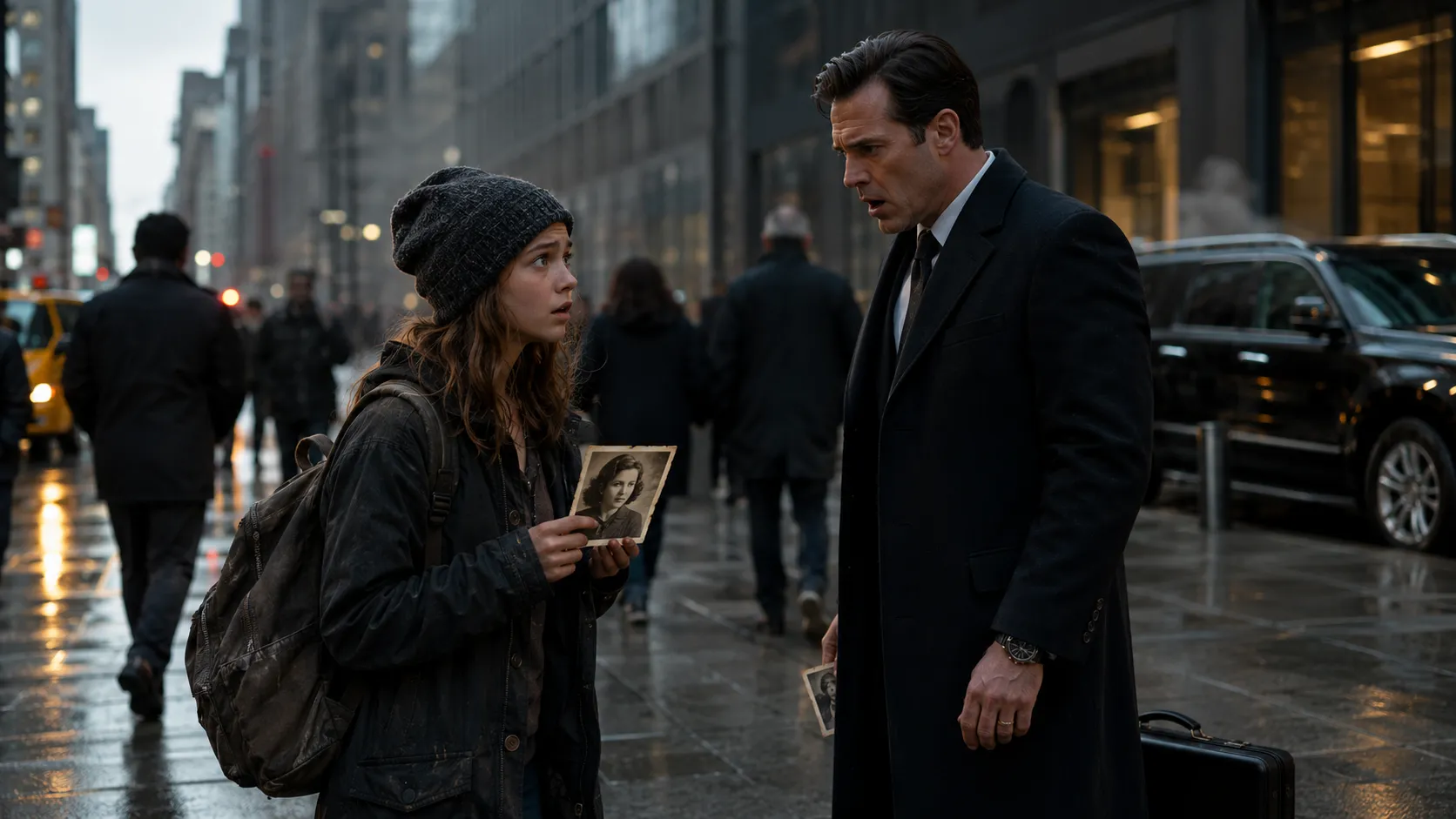
Near the entrance of an old closed convenience store, a little boy sat curled against the wall.
His name was Marcus Bell.
He was seven years old.
His hoodie was soaked through. His sneakers were too small and split at the toes. His hands were tucked deep into his sleeves, but they still trembled from the cold. Beside him lay a torn backpack containing everything he owned: one dirty blanket, two candy bars, a plastic bottle half-filled with water, and an old photograph of his mother.
In the photograph, she was laughing.
That was the part Marcus looked at most.
Not her dress. Not the park behind her. Not the cake on the picnic table where someone had written his third birthday in blue icing.
Her laugh.
He was afraid that if he stopped looking at it, he would forget the sound.
His mother’s name was Alicia. She had been gone for nearly four months.
At first, Marcus had told people she would come back.
Then he told himself.
Then he stopped saying it out loud.
He had learned that adults asked questions differently depending on how tired they were. Some asked where his parents were with kindness. Some asked because they wanted him to move along. Some called shelters. Some called police. Some offered food. Some offered prayers and then walked away quickly before prayers became responsibility.
So Marcus had become good at hiding.
He slept where doorways blocked the wind.
He ate when churches opened their basements.
He kept the photograph in a plastic sleeve inside his backpack and checked every morning to make sure it was still dry.
But tonight, Marcus held something else.
Something impossible.
A gold brick.
It rested in his lap beneath the weak yellow glow of the streetlight, heavy enough that his thighs ached from holding it. Even with rainwater running over his dirty fingers, the metal shone brighter than anything else on the block.
Marcus stared at it again.
Then at the street.
Then back at the gold.
He still could not understand how it had happened.
Three hours earlier, he had been sitting near the subway stairs, sharing one of his candy bars with a smaller girl named Lucy who had been crying because she lost the mitten her grandmother gave her.
Marcus had broken the candy bar in half.
Then, after looking at Lucy’s face, he had broken his half again and given her the bigger piece.
“You need it more,” he told her.
Lucy had asked, “What about you?”
Marcus had shrugged like hunger was something ordinary.
“I ate yesterday.”
That was when the old man appeared.
He wore a long black coat, polished shoes, and a hat that looked too expensive for the subway entrance. His beard was white, neatly trimmed. His eyes were kind but strangely sharp, as if age had not made him softer, only harder to fool.
In one hand, he carried a silver cane.
He watched Marcus for a moment before kneeling carefully in front of him.
“You gave away most of your dinner,” the old man said.
Marcus pulled back slightly, unsure whether he was in trouble.
“She was crying.”
“You were hungry too.”
Marcus looked down at the sidewalk.
“She was smaller.”
The old man studied him with an expression Marcus did not understand.
Then he reached into a black leather case and removed the gold brick.
Marcus’s eyes widened.
He had seen gold in cartoons, pirate books, and pawnshop windows.
Never like this.
Never close enough to touch.
The old man placed it gently in Marcus’s lap.
“Protect this,” he said.
Marcus stared at him.
“Is it fake?”
“No.”
“Then why are you giving it to me?”
The old man’s mouth moved into the smallest smile.
“Because one day, it may change your life.”
Marcus shook his head, confused.
“I can’t keep this.”
“Why not?”
“Because it’s too much.”
The old man’s eyes softened.
“That is the first honest answer I have heard today.”
Marcus looked at the gold again.
“What am I supposed to do with it?”
“Hold it until someone worthy helps you understand.”
“Who?”
The old man stood slowly, leaning on his cane.
“You’ll know.”
Before Marcus could ask anything else, the crowd shifted between them.
A train arrived below.
People poured up the stairs.
When the bodies cleared, the old man was gone.
Marcus had searched the sidewalk.
Then the station entrance.
Then the corner.
Nothing.
Only the gold remained.
At first, he thought it had to be painted. But when he accidentally scraped one corner against the concrete, bright yellow metal showed beneath the dull surface.
Real.
It had to be real.
He did not know how much it was worth.
He only knew it was more money than he had ever seen, more than anyone like him was supposed to touch, more than the world usually placed in the hands of children sleeping beside locked stores.
For the first time in months, Marcus imagined something dangerous.
A warm bed.
Clean socks.
Food every day.
Maybe even someone who could help him find out what happened to his mother.
He hugged the gold brick to his chest.
That was when the voice came from above him.
“Why are you holding that?”
Marcus looked up quickly.
A man stood over him near the edge of the awning.
He was around forty, with an unshaven face, wet hair, and a brown leather jacket darkened by rain. His eyes were not on Marcus.
They were on the gold.
Marcus pulled the brick closer.
The man crouched slowly, forcing a smile that did not reach his eyes.
“That thing looks heavy, kid.”
Marcus said nothing.
The man glanced up and down the street.
Most people were gone now. The rain had emptied the block. The convenience store behind Marcus was closed. The pawnshop across the street had its shutters down. Even the bus stop was empty.
The man smiled wider.
“You know, something like that can be dangerous to carry around.”
Marcus tightened his arms.
“Someone gave it to me.”
“Sure they did.”
“He said it could change my life.”
The man’s face changed for half a second.
Greed does not always arrive loudly.
Sometimes it arrives as silence.
His breathing slowed. His eyes sharpened. His smile disappeared before he remembered to put it back.
“What’s your name?” he asked.
Marcus did not answer.
“Smart kid,” the man said. “Real smart. But you’re not smart enough to know what you’re holding.”
“It’s mine.”
The man leaned closer.
“Nothing is yours when you’re sleeping on concrete.”
Marcus felt cold move through him that had nothing to do with rain.
The man lowered his voice.
“Listen. I know people. Bad people. If they see you with that, they’ll hurt you. I can keep it safe.”
“No.”
“I’ll give you money for it.”
Marcus shook his head.
“A hundred dollars.”
No.
“Five hundred.”
Marcus’s arms tightened.
The man’s fake patience cracked.
“You don’t even know what it’s worth.”
“I know he gave it to me.”
The man looked around again.
Still no one close enough to help.
His voice hardened.
“Give it here.”
“No.”
He reached for it.
Marcus twisted away.
The man grabbed the corner of the gold brick and pulled hard.
Marcus screamed.
It was not only fear.
It was every night he had been stepped around, every adult who had looked through him, every hand that had taken something because he was too small to stop it.
“Let go!” Marcus cried.
The man yanked harder.
Marcus slipped on the wet pavement, one knee hitting the concrete. Pain shot through his leg, but he held on.
“Give it to me!” the man shouted.
Across the street, a woman under an umbrella slowed for one second.
Then kept walking.
A delivery cyclist looked over.
Then looked away.
Trouble belonged to whoever stopped for it.
The man’s fingers dug into Marcus’s sleeve.
“You little brat!”
Then a large hand closed around the man’s shoulder.
Firm.
Quiet.
Final.
The man froze.
Slowly, he turned.
Standing behind him was a tall man in a dark coat and black gloves. Rain ran down his shaved head, but he did not seem to notice it. He had the stillness of someone who did not need to raise his voice to be dangerous.
“I think,” the man said calmly, “the boy told you no.”
The stranger released the gold brick instantly.
Marcus hugged it against his chest and scrambled backward against the wall.
The man in the leather jacket tried to laugh.
“Hey, hey. No problem. I was helping him.”
The tall man’s expression did not change.
“You call stealing from a child helping?”
The man swallowed.
“You don’t understand. That gold belongs to dangerous people.”
“Who told you that?”
The question was so calm that it made the lie collapse before it was even spoken.
The man looked toward the street.
Too late.
Headlights came through the rain.
One black SUV rolled to the curb.
Then another.
Then a third.
Their doors opened almost together, and several men in suits stepped out. Not gangsters. Not street criminals. They moved with discipline, scanning windows, alleys, rooftops, and corners.
One of them approached the tall man respectfully.
“Mr. King,” he said. “We found you.”
Marcus stared.
The man in the leather jacket turned pale.
“Oh, no…”
The tall man ignored him and crouched beside Marcus.
“You okay, little man?”
Marcus nodded, still breathing too fast.
The man’s voice softened.
“My name is David King.”
Marcus blinked rain from his eyelashes.
“Are you a police officer?”
“No.”
“Are you the old man?”
David almost smiled.
“No. The old man is my father.”
Marcus looked down at the gold brick, then back at him.
“The man with the cane?”
David nodded.
“Silas King.”
Marcus did not know the name.
But everyone else on that sidewalk did.
One of the security men stiffened when the man in the leather jacket tried to move backward. Another guard stepped behind him before he made it two steps.
David stood slowly.
“My father owns King Dominion Metals,” he said. “Gold mines, refineries, storage contracts, security systems. He built his life around precious things.”
Marcus looked at the brick.
David’s eyes softened.
“But lately he became more interested in finding out what people consider precious when nobody is watching.”
The man in the leather jacket raised both hands.
“Listen, I didn’t know—”
David turned toward him.
“That the boy mattered?”
The man fell silent.
David looked to one of his guards.
“Name?”
The guard checked his phone.
“Gary Whitman. Outstanding warrant in Indiana. Gambling debts listed in three states. Suspected of following Mr. Silas King for two weeks.”
Gary’s face twisted.
“That’s not true.”
David’s voice remained calm.
“You followed an old man because you thought he was carrying valuables. Then you watched him give the gold to a homeless child and waited until the boy was alone.”
Gary looked at Marcus, then at the brick, then at the security men closing around him.
“I wasn’t going to hurt him.”
Marcus’s knee still burned from hitting the pavement.
David noticed the blood through the torn denim.
“You already did.”
Police sirens grew louder in the distance.
Gary’s panic finally broke through.
“You can’t just give away gold like that!”
David looked at him for a long second.
“My father can give away anything he owns.”
“That kid can’t even protect it!”
David’s jaw tightened.
“No,” he said. “But he protected something more valuable than gold yesterday.”
Gary scoffed.
“What?”
David looked down at Marcus.
“A smaller child.”
Marcus’s face changed.
“You saw Lucy?”
“My father did.”
Marcus clutched the brick tighter.
“He was watching me?”
“For three days.”
The answer did not frighten Marcus as much as it should have.
It made him feel seen.
That was worse somehow.
He looked down at the sidewalk because tears had filled his eyes and he did not want the grown men to notice.
David crouched again.
“My father saw you share food when you barely had any. He saw you cover another boy with your blanket while you sat in the cold. He saw you give a woman directions to the church kitchen even though you were afraid she would take your place in line.”
Marcus wiped his nose with his sleeve.
“I didn’t do anything big.”
David’s voice softened.
“That depends on what a person has.”
Marcus looked at the gold brick.
“What happens now?”
The police cars arrived before David answered.
Gary tried one last time to talk his way out. He said he was helping. He said he thought Marcus had stolen the gold. He said the whole thing was a misunderstanding.
Nobody believed him.
When officers placed him in handcuffs, he looked back at the gold brick with such hunger that Marcus understood something he had not understood before.
Some people could be starving even after eating every day.
Gary disappeared into the rain inside the back of a police car.
For a while, the street became quiet again.
David removed his coat and placed it gently around Marcus’s shoulders.
The coat was heavy, warm, and smelled faintly of cedar.
Marcus looked up.
“Do I have to give it back?”
“The coat?”
“The gold.”
David sat beside him under the awning, ignoring the rain running down the curb.
“No,” he said. “My father gave it to you.”
Marcus looked stunned.
“But I’m little.”
“Yes.”
“And I don’t have a house.”
“I know.”
“And I don’t know what to do with it.”
David nodded.
“That is why my father sent me.”
Marcus looked toward the SUVs.
“Is this a test?”
David was quiet for a moment.
“Yes.”
Marcus’s face fell.
He had known it was too good to be simple.
David saw the disappointment and spoke quickly.
“But not the way you think. The test was never whether you deserved gold.”
“What was it?”
“Whether the people around you deserved to be trusted near a child with hope.”
Marcus did not fully understand.
David continued, “My father grew up poor. Poorer than most people now believe. His mother cleaned train stations. His father disappeared when he was nine. One winter, a stranger gave him a pair of boots outside a shelter. My father always said those boots did more than keep his feet warm. They proved one person had looked down and seen a boy instead of a problem.”
Marcus listened carefully.
“When he became rich, he started doing things people called eccentric. Some were foolish. Some were generous. Some were both. But this year, after getting sick, he wanted to leave behind something that measured kindness in a different way.”
“Sick?”
David looked away briefly.
“My father doesn’t have much time.”
Marcus lowered his eyes.
“I’m sorry.”
David looked back at him, surprised by the softness in the boy’s voice.
“You don’t even know him.”
Marcus shrugged.
“I know what it’s like to miss someone before they’re gone.”
The words landed hard.
David sat very still.
Then he asked, “The photograph in your backpack. Is that your mother?”
Marcus nodded.
“Where is she?”
“I don’t know.”
David’s expression changed.
Not pity.
Attention.
Marcus pulled the plastic sleeve from his backpack and handed it over carefully.
“My mom. Alicia Bell. We were staying in a shelter near Madison Street. She got sick, but she said she was okay. Then one morning she went to talk to someone about work and didn’t come back.”
“How long ago?”
“Four months.”
David looked at the photograph.
Alicia Bell smiled out from a summer day, one arm around a much younger Marcus, birthday candles glowing between them.
“Did anyone file a missing person report?”
Marcus looked confused.
“I told people.”
“Who?”
“The shelter lady. A police man. A woman at the church. They said maybe she left.”
His voice cracked.
“She wouldn’t leave me.”
David’s face hardened, but not at Marcus.
At the world.
“No,” he said quietly. “Maybe she wouldn’t.”
One of the security men approached.
“Sir, your father is asking if we’re bringing the boy.”
David looked down at Marcus.
“You hungry?”
Marcus nodded despite himself.
“Good,” David said. “Because my father knows a diner with the best pancakes in Chicago.”
Marcus did not move.
“What about the gold?”
David smiled faintly.
“It comes with us.”
“And my backpack?”
“Everything.”
Marcus hesitated.
“If I go with you, are you going to make me give answers to people?”
“Only the ones that help keep you safe.”
“Are you going to put me somewhere?”
David did not lie.
“We may have to call people whose job is to protect children. But I promise you something, Marcus. Nobody is going to make decisions over your head tonight like you’re luggage.”
Marcus studied him carefully.
He had learned that adults promised many things when other adults were listening.
David seemed to understand that too.
He said, “You can sit by the door in the diner. You can keep your backpack. You can keep the photograph. And if you want to leave, you tell me before you run. Deal?”
Marcus thought about it.
Then he nodded.
“Deal.”
Inside the SUV, warmth hit him so suddenly that his skin hurt.
Marcus sat rigidly near the window with the gold brick on his lap and David’s coat wrapped around him. The security men spoke quietly through radios. Rain slid down the tinted glass. The city looked different from inside a vehicle like that — softer, farther away, as if the cold had belonged to someone else.
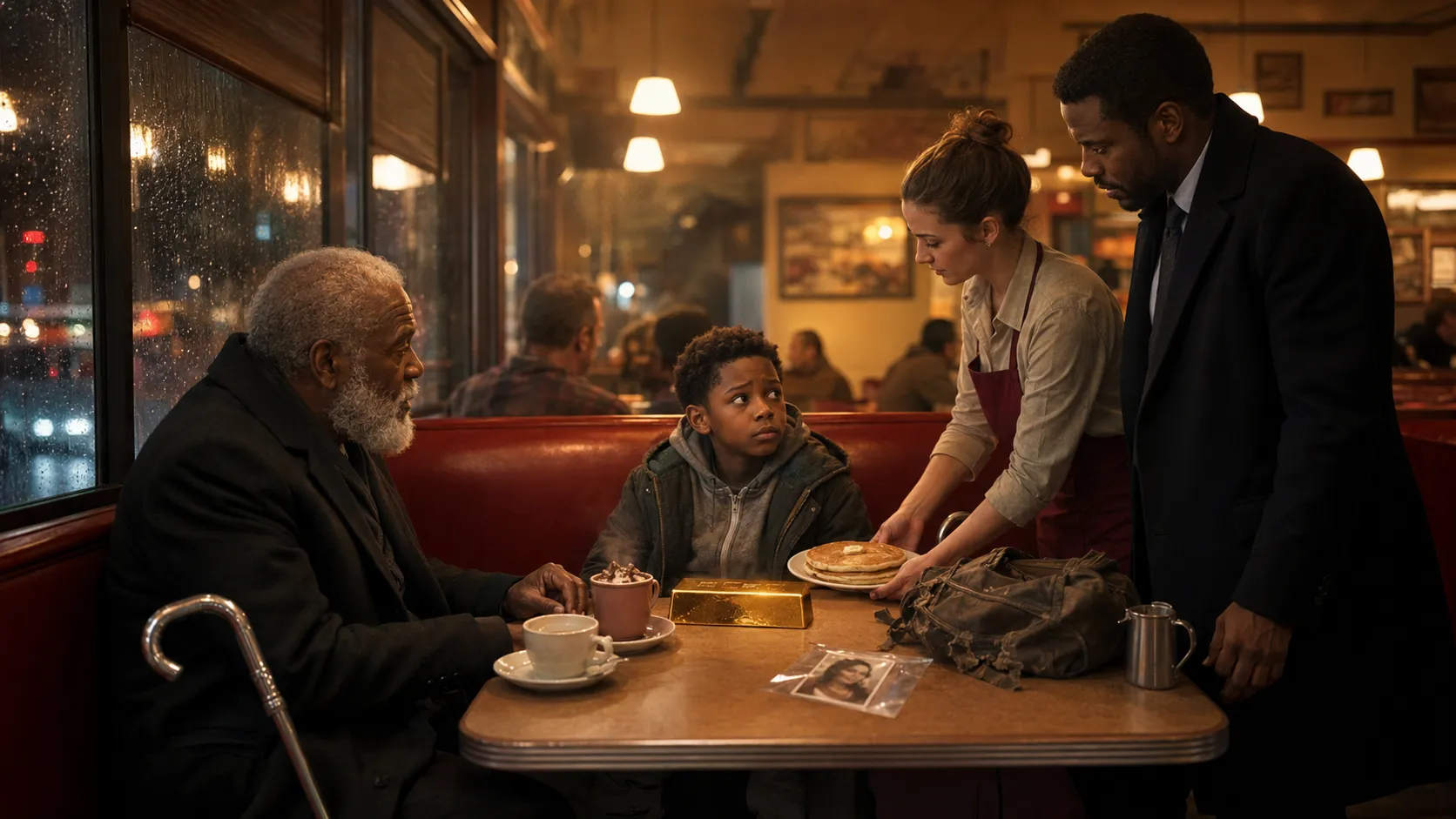
Ten minutes later, they stopped at a small diner tucked between a pharmacy and a laundromat.
The sign above the door read ROSE’S.
It did not look fancy.
That made Marcus trust it more.
Inside, the air smelled of coffee, butter, syrup, and frying potatoes. A tired waitress with silver hair looked up from behind the counter and smiled when she saw David.
“Late night again?”
“Complicated one,” David said.
Then her eyes moved to Marcus.
Her expression changed with the kind of tenderness that did not make a child feel weak.
“Well,” she said gently, “you look like pancakes might help.”
Marcus looked at David.
David nodded.
“They usually do.”
They sat in the back booth where Marcus could see the door.
He kept the gold brick under the table beside his backpack.
A few minutes later, an elderly man entered.
He wore the same long black coat.
The same polished shoes.
The same hat.
But without the shadows of the subway entrance around him, he looked smaller than Marcus remembered.
Older.
His silver cane tapped once against the floor.
David stood.
“Dad.”
Silas King waved one hand impatiently.
“Don’t stand like I’m dead already.”
David sat.
Silas turned to Marcus.
The old man’s eyes softened.
“There you are.”
Marcus slid slightly closer to the wall.
“You gave me gold.”
“I did.”
“Why?”
Silas lowered himself carefully into the booth across from him.
“Because I wanted to know what would happen.”
Marcus frowned.
“That’s a strange thing to do.”
Silas smiled.
“It is.”
“You could’ve gotten me hurt.”
David looked at his father sharply.
Silas did not look away from Marcus.
“Yes,” he said. “I could have.”
The honesty surprised the boy.
Silas continued, “That is why my son was watching. But watching is not the same as preventing fear. For that, I owe you an apology.”
Marcus did not know what to do with an apology from a rich old man.
So he asked, “Is it real gold?”
Silas laughed once.
“Oh, yes.”
“How much is it worth?”
“That depends on the market, weight, purity, and the buyer.”
Marcus stared.
Silas leaned closer.
“But the simple answer is: enough.”
“Enough for what?”
“For food. School. A safe place. Lawyers. Doctors. Answers about your mother.” His voice softened. “Enough for a beginning.”
Marcus looked down at his hands.
The waitress brought pancakes, eggs, bacon, and hot chocolate.
Marcus stared at the plate.
“All that’s mine?”
The waitress smiled.
“All yours, sweetheart.”
He ate carefully at first.
Then faster.
Silas watched him, and something in the old man’s face shifted. He looked not pleased, exactly. More like a man receiving proof of something he feared had vanished from the world.
“Marcus,” he said after a while, “when I was a child, I was once given something I could not repay.”
“Boots?”
David looked at his father in surprise.
Silas glanced at him.
“You told him.”
David shrugged.
“He asked better questions than most executives.”
Silas looked back at Marcus.
“Yes. Boots. Brown leather. Too large for me. A man gave them to me outside a train station after watching me wrap newspaper around my feet.”
“What happened to him?”
“I don’t know. I never saw him again.”
“Did you look?”
Silas’s face grew still.
“No,” he said. “For many years, I was too busy becoming rich.”
Marcus did not understand how anyone could forget someone who helped them.
Silas seemed to read that on his face.
“That was my shame,” he said. “Not poverty. Not hunger. Forgetting.”
The booth fell quiet.
Then Marcus asked the question that had been pressing against his chest since the sidewalk.
“Can the gold help other kids too?”
David closed his eyes briefly.
Silas did not.
He smiled slowly.
“That,” he said, “is exactly why I chose you.”
Marcus did not feel chosen.
He felt wet, tired, full for the first time in days, and scared that morning would come and everything would be taken back.
“What do you mean?”
Silas reached into his coat and removed a folded paper.
“I created a fund years ago, but I never knew what to name it. Lawyers wanted my name on it. My board wanted something elegant. My son wanted something sensible.”
David muttered, “Because sensible occasionally helps.”
Silas ignored him.
“I wanted the name to come from someone who understood what it was for.”
He placed the paper on the table.
Marcus sounded out the words slowly.
THE GOLD DOOR FUND.
Silas said, “A door should open. Gold usually closes doors. I would like to change that.”
Marcus stared at the paper.
“What does it do?”
“It will help children without homes, children looking for missing parents, children who need lawyers, doctors, food, school, and people who do not quit after one phone call.”
Marcus swallowed.
“Can it look for my mom first?”
Silas’s face softened.
“Yes.”
David added quietly, “We already started.”
Marcus looked up sharply.
“You did?”
David held up his phone.
“One of my people is contacting shelters. Hospitals. Police departments. Outreach centers. We’ll need your help with details.”
Marcus pushed the plate away slightly.
“What if she’s dead?”
No one rushed to answer.
That was how Marcus knew they were not treating him like a baby.
Silas folded both hands over the top of his cane.
“Then we will find the truth. And if she is alive, we will find her. But either way, you will not be left alone with not knowing.”
Marcus nodded, though tears had begun sliding down his face.
The waitress quietly placed extra napkins beside him and walked away without making a fuss.
By morning, the gold brick was no longer in Marcus’s lap.
It was locked in a private vault, photographed, documented, insured, and placed under a legal trust in his name. Silas insisted on it before doctors, social workers, lawyers, and reporters could complicate the story beyond recognition.
“You do not hand a starving child treasure and call that care,” he told his attorney over the phone. “You build walls around the treasure and doors around the child.”
Marcus did not understand all the legal words.
Beneficiary.
Guardian ad litem.
Protective trust.
Emergency placement.
Asset management.
But he understood one thing.
Nobody was laughing at him.
Nobody was telling him he had stolen it.
Nobody was trying to take it away because he was small.
That afternoon, David took Marcus to a private medical clinic.
A doctor checked his knee, his lungs, his weight, his hands, his feet. A nurse gave him clean socks, warm clothes, and a blanket from a heated cabinet. Marcus fell asleep halfway through eating a sandwich.
When he woke, David was sitting in a chair near the door, reading through papers.
“You stayed?”
David looked up.
“I said I would.”
“Adults say things.”
“Yes,” David said. “Then children learn whether the words mean anything.”
Marcus thought about that.
“Do yours?”
David folded the papers.
“I’m trying to make sure they do.”
For the next three days, Marcus lived in a quiet guest room at one of Silas King’s private residences under temporary emergency care while officials worked through the proper channels. It was the largest house Marcus had ever seen. The first night, he slept on the floor beside the bed because the mattress felt too high and too clean to trust.
The housekeeper, Mrs. Alvarez, found him there at dawn.
She did not scold him.
She simply brought extra blankets and said, “Beds can wait until they earn you.”
By the fourth night, he slept on top of the blanket.
By the seventh, under it.
The search for Alicia Bell moved faster than anything in Marcus’s life had ever moved.
David hired investigators, but Silas demanded that everything be shared with police and child services properly. He did not want a rich family privately collecting a child.
“Money must not become another kind of kidnapping,” he said.
They found the first clue in a hospital record from three months earlier.
Alicia Bell had been admitted under the name Alicia Brown after collapsing outside a bus station. Severe infection. Malnutrition. Confusion. No identification except an old library card damaged by water.
From there, the trail moved to a county care facility.
Then to a women’s recovery shelter.
Then to a small clinic in Milwaukee.
David received the call on a Thursday morning.
Marcus was in the kitchen learning how to make scrambled eggs with Mrs. Alvarez when he saw David enter.
The man’s face was careful.
Too careful.
Marcus put down the wooden spoon.
“What?”
David crouched to his height.
“We found someone we believe is your mother.”
Marcus did not move.
“She’s alive?”
“Yes.”
The word passed through him so violently that he almost fell.
Mrs. Alvarez made a small sound and turned away, wiping her eyes with her apron.
Marcus whispered, “Can I see her?”
David nodded.
“If you want to.”
“She didn’t leave me?”
David hesitated.
Marcus saw the hesitation and stiffened.
David said, “She was very sick. She may not remember everything clearly. But the clinic says she has asked for you many times.”
Marcus covered his mouth.
Alicia Bell looked smaller than the woman in the photograph.
That was Marcus’s first thought when he saw her.
She sat in a recovery room wearing a pale blue sweater someone had given her. Her hair was shorter now. Her cheeks were hollow. Her hands rested in her lap as if she did not fully trust them.
But when Marcus entered, she stood so quickly the nurse reached for her.
“Marcus?”
He froze.
For four months, he had imagined this moment every night.
In some versions, she ran to him.
In some, she cried.
In some, she did not recognize him.
In the worst version, he arrived too late.
Now she stood ten feet away, alive, shaking, and looking at him with such pain that he felt suddenly afraid of being loved that much.
“Mom?”
Alicia made a broken sound and held out both arms.
Marcus ran.
She fell to her knees before he reached her, and he crashed into her chest with enough force to hurt them both. Alicia wrapped herself around him, sobbing into his hair.
“I tried,” she kept saying. “Baby, I tried to come back. I tried.”
Marcus clung to her sweater.
“I waited.”
“I know.”
“I thought you left.”
“No. Never. Never.”
David stood near the door, his face turned slightly away.
Silas King had insisted on coming too, though the trip had exhausted him. He waited outside the room with his cane across his knees, listening to a reunion he had no right to enter but every reason to protect.
The full story came slowly.
Alicia had been offered a cleaning job through a man near the shelter. It was supposed to be one day of work at a warehouse outside the city. She went because Marcus needed medicine for a cough and she had no money.
At the warehouse, she became dizzy.
The next clear memory she had was waking in a hospital without her bag, without identification, and without anyone believing she had a child waiting for her near Madison Street. Infection had worsened. Fever had blurred days into weeks. By the time she was strong enough to explain clearly, Marcus was gone from the shelter system’s immediate record because he had run after being moved twice.
“I thought I lost you,” Alicia whispered.
Marcus pressed closer.
“I had your picture.”
She closed her eyes.
“Good.”
“And a gold brick.”
Alicia pulled back just enough to look at him.
“A what?”
For the first time in months, Marcus laughed.
It came out wet and shaky.
“A gold brick.”
Alicia looked toward David in confusion.
David nodded solemnly.
“Yes. That part is true.”
The reunion did not magically fix their lives.
Real healing rarely arrives that clean.
Alicia still needed medical care. Marcus still woke screaming some nights. Legal officials still had questions. Social workers still had forms. Silas still had lawyers. David still had reporters calling because the story of the homeless boy with the gold brick had leaked after Gary Whitman’s arrest record became public.
But this time, the adults around Marcus did not vanish after the dramatic moment.
They stayed.
Silas funded Alicia’s medical treatment through the Gold Door Fund, but he refused to make her feel owned by gratitude. A family attorney helped restore her documents. A housing specialist found them a small apartment close to the clinic. Marcus enrolled in school with a backpack that did not have holes in it.
On his first day, he cried in the car and said his stomach hurt.
David did not force him out.
He sat beside him in the parking lot and said, “New doors can be scary even when they open the right way.”
Marcus asked, “Did you get scared at school?”
David smiled faintly.
“I got scared at board meetings last week.”
“That’s not school.”
“No. But one man did yell about quarterly projections like he needed a nap.”
Marcus laughed.
Then he went inside.
Silas King died eight months later.
He did not die in a hospital suite surrounded by executives, as many expected.
He died at Rose’s Diner, in the back booth, after insisting that David, Marcus, Alicia, Mrs. Alvarez, and three children from the first Gold Door housing program join him for pancakes.
He was eighty-four.
Stubborn until the end.
The morning of his death, he gave Marcus a small wooden box.
Inside was an old pair of brown leather boots.
Tiny.
Cracked.
Repaired at the heel.
“The boots?” Marcus asked.
Silas nodded.
“The ones the stranger gave me.”
“You kept them?”
“For seventy-three years.”
Marcus touched the old leather carefully.
“Why give them to me?”
Silas breathed slowly.
“Because I forgot the man who gave them to me. I don’t want you to forget what was given to you.”
“The gold?”
Silas shook his head.
“The responsibility.”
Marcus did not fully understand then.
He would later.
At the funeral, powerful people filled the church.
Executives.
Politicians.
Bankers.
Board members.
Men in suits who spoke in low voices about markets and legacy.
Marcus sat in the front row beside his mother and David.
He wore a dark suit that made him uncomfortable and shoes that pinched slightly even though Mrs. Alvarez swore they fit. His hands held the small wooden box with the boots inside.
David gave the eulogy.
He spoke about his father’s business, his mistakes, his strange tests, his loneliness, his stubborn belief that kindness could still be found if a person was willing to look where rich people usually refused to look.
Then David paused.
“My father once gave gold to a child,” he said, looking toward Marcus. “Many people thought the gold changed the boy’s life.”
The church was silent.
David’s voice softened.
“They were wrong. The boy changed what the gold was for.”
One year later, the first Gold Door House opened in Chicago.
Not a shelter exactly.
Silas had disliked that word.
“A shelter can sound like a place to wait out bad weather,” he once said. “Children need more than waiting.”
Gold Door House had warm beds, family search services, meals, showers, counselors, medical care, legal advocates, and staff trained not to treat frightened children like paperwork. It had a room full of books. A kitchen that smelled like soup most afternoons. A small wall near the entrance where children could hang photographs of people they were missing.
Marcus hung the old birthday photo of his mother there only for opening day.
Then he took it home.
He did not need to leave her picture on a missing wall anymore.
The gold brick itself sat behind glass in the front hall.
Not as decoration.
As a reminder.
A small plaque beneath it read:
THIS BRICK WAS GIVEN TO A CHILD.
HE ASKED IF IT COULD HELP OTHER CHILDREN TOO.
THAT QUESTION BUILT THIS HOUSE.
Marcus hated the attention at first.
Reporters wanted him to stand beside the brick. Donors wanted photographs. Adults said he was inspiring in voices that made him feel less like a boy and more like a story they could repeat at dinner.
David protected him from most of it.
Alicia protected him from the rest.
When Marcus was twelve, he asked David a question while they sat together outside Gold Door House watching a group of children play in the courtyard.
“Do you think your dad was wrong to give me the brick?”
David took a long time answering.
“Yes.”
Marcus looked at him.
“And no.”
“That’s not an answer.”
“At my age,” David said, “you learn that most honest answers are inconvenient.”
Marcus rolled his eyes.
David smiled.
Then grew serious.
“My father risked frightening you. He risked making you a target. I argued with him about that until the day he died.”
Marcus looked toward the gold behind the glass.
“But?”
“But he also saw something most people missed. He saw that you were not just a child who needed help. You were a child still capable of thinking about others.”
Marcus picked at a loose thread on his sleeve.
“I was just sharing candy.”
David shook his head.
“You were sharing scarcity. That is different.”
Years passed.
The story of the homeless boy’s gold brick spread farther than Marcus expected. Sometimes people told it badly. They made Silas sound like a perfect saint, which he was not. They made David sound like a superhero, which made David groan. They made Marcus sound like a magical child chosen because he was pure, which embarrassed him most of all.
The truth was more complicated.
Marcus had been scared.
Hungry.
Angry sometimes.
Ungrateful sometimes.
Difficult often.
He loved his mother but resented the months she was gone even after he understood why. He loved David but hated when people assumed David had “saved” him. He was grateful for Silas but old enough, eventually, to question whether rich men should ever test poor children.
When he was sixteen, he said so publicly at a Gold Door fundraiser.
The room went still.
David, standing near the wall, smiled faintly.
Marcus continued anyway.
“I’m grateful for what Mr. King gave me. But I don’t think children should have to prove kindness before they deserve safety. I don’t think hunger should be used to reveal character. Adults have enough chances to reveal theirs without handing a child a burden he cannot carry.”
Some donors looked uncomfortable.
Good, Marcus thought.
Then he added, “The gold mattered because of what it became. Not because a rich man gave it. Because people kept showing up after the cameras left.”
That speech raised more money than any polished campaign.
By twenty-two, Marcus Bell was working full-time with Gold Door.
Not because he had no other choices.
Because now he did.
He studied social work and nonprofit law. He learned how systems failed children in ways no single gold brick could repair. He sat in courtrooms, school offices, hospitals, police stations, and city meetings where adults argued over budgets while children aged inside uncertainty.
He became patient in the way urgency sometimes teaches.
He kept Silas’s boots in his office.
Not on display.
On a shelf behind his desk, where only he could see them.
Whenever he felt himself becoming too proud, he looked at them.
Whenever he felt too angry, he looked at them.
Whenever donors praised him for being exceptional, he looked at them and remembered a cold sidewalk, a gold brick too heavy for his lap, and a man trying to steal what he believed a homeless boy could not defend.
On the tenth anniversary of Gold Door House, Marcus stood in the front hall before a crowd of former residents, staff, donors, reporters, and families who had been reunited through the program.
Alicia sat in the front row, healthier now, her hair streaked with gray, her eyes wet with pride. David sat beside her, older and broader, still watchful. Mrs. Alvarez had baked three trays of cookies and threatened anyone who tried to call them “catered desserts.”
Behind Marcus, the gold brick gleamed under glass.
He looked at it for a long time before speaking.
“When I was seven,” he said, “I thought this brick was going to save me.”
The room quieted.
“I thought it would buy food, a bed, maybe a way to find my mother. And it did help with those things.”
He looked toward Alicia.
She smiled through tears.
“But the brick did not save me by being gold. It saved me because people finally stopped walking past.”
David lowered his eyes.
Marcus continued, “A greedy man saw it and tried to take it. A rich man saw it and tried to make it mean something. A sick old man saw it as a final lesson. A scared little boy saw it as hope.”
He turned toward the children seated near the front.
“But children should not need gold to be seen.”
A murmur passed through the room.
Marcus’s voice grew steadier.
“So today, we are opening five more Gold Door homes. Not because treasure fell from the sky. Because enough people decided that no child should have to sleep outside holding a photograph and wondering whether anyone will come back.”
The applause came slowly.
Then strongly.
Marcus did not look at the cameras.
He looked at David.
The man who had appeared in the rain when Marcus’s arms were too small to protect his future alone.
After the ceremony, when the crowd had thinned and the staff were cleaning up, Marcus found David standing near the glass case.
“You okay?” Marcus asked.
David nodded.
“My father would have liked your speech.”
“You think so?”
“He would have argued with the part where you criticized him.”
Marcus smiled.
“Then he would’ve listened?”
David’s expression softened.
“Eventually.”
They stood together in the quiet hall.
The gold brick reflected their faces dimly in the glass.
David said, “Do you ever wish he had simply given you something normal? A meal. A coat. A phone number.”
Marcus thought about it.
“Yes.”
David looked at him.
Marcus continued, “But then maybe I would have eaten, gotten warm, and disappeared again. Maybe nobody would have looked for my mom. Maybe Gary would have robbed someone else. Maybe this place wouldn’t exist.”
“That sounds like forgiveness.”
“No,” Marcus said. “It sounds like accepting that good can grow from imperfect beginnings.”
David smiled.
“At your age, you’re not supposed to know that yet.”
Marcus looked toward the courtyard, where children were laughing under strings of warm lights.
“I learned early.”
That evening, after everyone left, Marcus walked alone to the front door of Gold Door House.
Rain was falling again.
Softly this time.
A boy stood just beyond the entrance, maybe nine years old, holding a plastic grocery bag and trying to decide whether he was allowed to come inside. He wore no coat. His eyes moved nervously from the building to the street, ready to run if kindness came with too many conditions.
Marcus opened the door.
The boy stepped back.
“I’m not stealing,” he said quickly.
“I didn’t say you were.”
“I can leave.”
“You can,” Marcus said. “Or you can come in and get something warm to eat.”
The boy stared at him suspiciously.
“Why?”
Marcus smiled faintly.
Because an old man once gave me gold.
Because another man once stopped someone from taking it.
Because my mother came back.
Because no child should have to shine before the world decides he is worth saving.
But he said only, “Because you’re hungry.”
The boy looked past him into the warm hallway.
“Do I have to answer questions?”
“Not before soup.”
The boy hesitated.
Then stepped inside.
Marcus closed the door gently behind him.
Rain tapped against the glass.
Behind them, in the front hall, the gold brick caught the light, no longer a burden in a homeless child’s lap, no longer bait for greed, no longer just a rich man’s test.
It was a promise now.
A strange one.
An imperfect one.
But still a promise.
That somewhere in the city, behind a door that stayed open, children who had been walked past for too long would finally be seen.