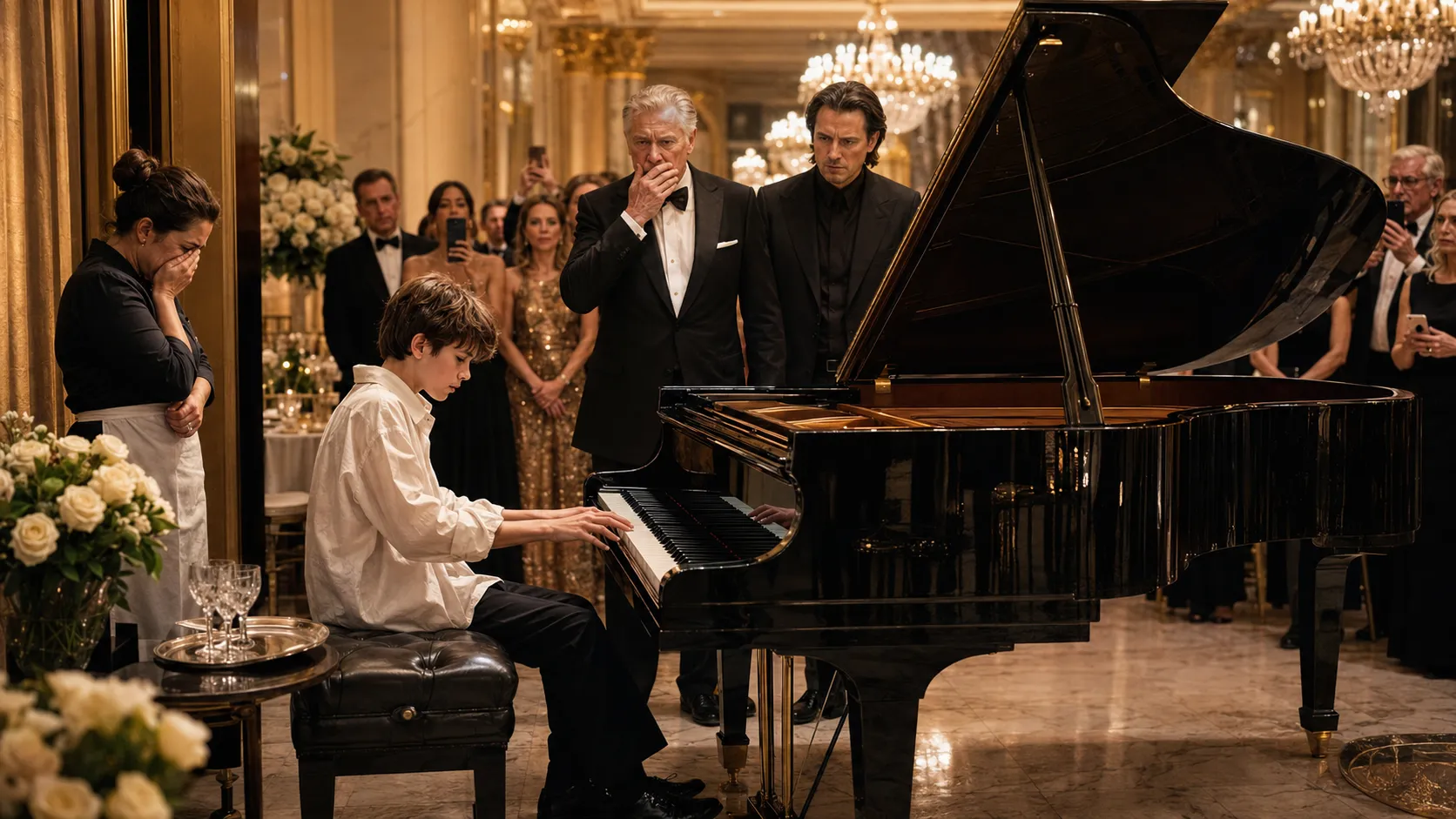
The guests thought twelve-year-old Ethan was just a poor waiter boy who didn’t belong near the hotel’s million-dollar piano. Then he sat down, played the song his dead mother left behind, and made the richest man in the room remember who he used to be.
The piano cost more than the house Ethan Brooks had never owned.
It stood beneath the largest chandelier in the Grand Wellington Hotel, black and polished enough to reflect the faces of the wealthy guests passing by it. Its gold pedals shone under the ballroom lights. Its lid was raised like a wing. A small velvet rope had been placed around it earlier in the evening, not because anyone expected a child to touch it, but because expensive things are often protected more carefully than hungry people.
Ethan stood twenty feet away with a silver tray in both hands and tried not to stare.
He was twelve years old, thin for his age, with dark hair combed badly with water and a white waiter’s shirt that was too large in the shoulders. His sleeves had been folded twice at the wrists. His black shoes had been borrowed from the hotel’s lost-and-found closet and pinched his toes every time he walked.
No one in the ballroom cared.
To them, he was part of the background.
A small boy carrying glasses.
A servant child.
A detail.
The ballroom itself glittered like another world. Crystal chandeliers burned above white roses and gold table settings. Women in evening gowns laughed behind diamond bracelets. Men in tailored tuxedos shook hands with the seriousness of people who believed every handshake might become money. A string quartet had played during dinner. Photographers waited near the marble staircase. Reporters stood along the wall hoping for a quote from Richard Calloway.
Everyone knew Richard Calloway.
He was the richest businessman in New York, a man whose name appeared on hotels, hospitals, museums, and charity foundations. That night, he was hosting a gala for the Calloway Arts Trust, a foundation that claimed to discover young talent from poor neighborhoods and give children “a path into beauty.”
The words were printed on banners around the ballroom.
Ethan had read them three times while carrying water glasses.
A path into beauty.
He wondered who got to walk that path.
Not boys like him, probably.
Boys like him carried trays beside it.
“Keep moving,” a voice muttered.
Ethan turned.
Mr. Bell, the catering supervisor, stood behind him with a tight face and nervous eyes.
“Guests are watching,” Bell whispered. “Don’t stand there staring at things.”
“I’m sorry.”
“You’re here because your aunt begged me for a favor. Don’t make me regret it.”
Ethan nodded quickly.
His aunt Maria worked in the hotel laundry. She had begged for Ethan to be allowed to help that evening because their rent was late, the electric bill had gone red, and the landlord had already left one notice taped to their apartment door.
“He’s careful,” Aunt Maria had promised. “He won’t bother anyone.”
Ethan had promised too.
He would keep his head down.
He would carry trays.
He would not ask questions.
He would not touch anything.
Especially not the piano.
But the piano seemed to pull at him every time he passed.
It was not just beautiful.
It sounded beautiful even before anyone played it.
Earlier that evening, a famous concert pianist named Sebastian Voss had performed a flawless piece on it while the guests applauded politely, then returned to their conversations before the last note had fully died.
Ethan had watched from behind a service curtain.
Sebastian played perfectly.
Too perfectly, maybe.
Every note was clean. Every movement elegant. Every pause measured.
But something about it felt like polished glass.
Beautiful, cold, and impossible to enter.
Ethan knew that was a foolish thought. He had no right judging a famous pianist. He had never taken a real lesson in his life.
His mother had been his first teacher.
And even she had not called it teaching.
She had called it surviving.
Her name was Clara Brooks.
During the day, she cleaned offices. At night, she cleaned a small church on Mercer Street. Ethan used to sleep on a blanket near the pews while she worked, but when he was six years old, he began waking to the sound of her playing the old upright piano in the corner.
It was a battered thing, brown wood scratched by decades of children and church furniture, with three chipped keys and one pedal that squeaked.
To Ethan, it was magic.
His mother would sit there after mopping the floors, still in her cleaning gloves sometimes, and play quietly because she thought no one was listening.
But Ethan always listened.
“Don’t tell Father Michael,” she whispered once when she caught him awake. “That piano is probably older than both of us. If I break it, we’ll owe the church our souls.”
“Can you teach me?”
She laughed softly.
“I barely taught myself.”
But she moved over on the bench anyway.
That was how it began.
No sheet music.
No lessons.
No teacher with a ruler or a metronome.
Only Ethan beside his mother in an empty church, learning where the notes lived.
Clara taught him old hymns first. Then little melodies she remembered from childhood. Then songs she invented on nights when the rain was hard and the heat in their apartment had gone out again.
One melody stayed with Ethan more than all the others.
His mother called it The Window Song.
“Why?” Ethan had asked.
Clara smiled.
“Because sometimes music is the only window poor people can afford.”
When she got sick, she played less.
When she got weaker, Ethan played for her.
At the end, when the hospital room smelled like bleach and plastic and fear, she held his hand and whispered, “Don’t let the world make you small.”
Ethan had tried.
But the world was very good at making children small when they had no money.
After Clara died, Ethan went to live with Aunt Maria in a one-bedroom apartment above a closed pharmacy in Queens. His aunt loved him in a tired way, the way people love when they are fighting too many battles at once. She worked early, slept little, and did not have time for dreams.
Ethan stopped talking about music.
But he did not stop playing.
At school, he found the old keyboard in the auditorium and stayed after class until the janitor told him to leave. At church, he played when Father Michael let him in. In department stores, he touched display keyboards until employees shooed him away.
He played because when his hands were on keys, hunger became quieter.
Grief became something he could shape.
And his mother felt less gone.
Now, inside the Grand Wellington Hotel, he stood near the kind of piano he had only seen in videos.
A million-dollar Steinway.
The hotel manager had said it twice that evening, loudly enough for staff to understand the danger.
“One scratch,” he had warned, “and none of you earn enough in your lifetime to fix it.”
Ethan looked away and forced himself to keep serving.
At Table 12, a woman waved without looking at him.
“Water.”
He filled her glass.
At Table 9, a man snapped his fingers.
“Champagne.”
Ethan brought it.
Near the bar, two young men laughed when he nearly tripped over the carpet edge.
“Careful, kid,” one said. “Those glasses are worth more than your shoes.”
Ethan lowered his eyes.
“Yes, sir.”
That was usually safest.
By ten o’clock, the gala had reached the part of the evening where people became louder and kinder to themselves. Donations had been announced. Cameras had flashed. Richard Calloway had given a speech about opportunity, art, and the moral obligation of the fortunate.
The guests applauded.
Ethan had stood behind a pillar holding empty plates and listened.
Richard Calloway looked impressive from a distance.
Tall, silver-haired, sharp-eyed, wearing a black tuxedo that seemed cut from authority itself. He had the kind of voice that made people lean in even before they knew whether he was saying anything important.
“Talent,” Richard said from the stage, “must never be wasted simply because a child was born without access.”
The ballroom applauded again.
Ethan looked at the piano.
Then down at his tray.
A strange ache moved through him.
Not jealousy.
Not exactly.
Something closer to longing mixed with anger.
Because he was talent without access, standing ten feet from a foundation built to find children like him, and not one person in the room had asked his name.
After the speech, Sebastian Voss played one more short piece. The guests listened for a minute, then drifted back into talk. When he finished, Richard shook his hand near the piano while photographers captured the moment.
Sebastian smiled with perfect teeth.
“The instrument is magnificent,” he said loudly. “Too magnificent for this room, frankly.”
Richard laughed.
“It belongs where people can admire it.”
Ethan passed nearby holding a tray of empty champagne flutes.
He did not mean to stop.
But Sebastian lifted one hand and played three soft notes as a joke, casual and careless, and the piano answered with a sound so rich it seemed to open the air.
Ethan stopped breathing.
Sebastian noticed him.
So did Richard.
For one terrible second, Ethan was caught staring.
Sebastian’s smile thinned.
“Can we help you?”
Ethan should have apologized and walked away.
He knew that.
He had promised Aunt Maria.
But grief, hope, and music can make a child brave in reckless ways.
He looked at the piano.
Then at Richard Calloway.
“Sir,” he said softly.
Richard barely glanced at him.
“Yes?”
Ethan’s hands tightened around the tray.
“Can I play it once?”
The small group around Richard fell silent.
Then laughter burst through them.
A woman in emerald earrings actually leaned against her husband’s shoulder as if Ethan had told the funniest joke of the night.
Sebastian Voss looked him up and down.
“You?”
Ethan’s face burned.
“I know how to be careful.”
Richard stared at him now, amused.
“How old are you?”
“Twelve, sir.”
“And you work for the hotel?”
“I’m helping catering.”
“Helping catering,” Richard repeated, as if the phrase explained everything.
More people nearby began turning toward them.
Ethan felt the room growing larger around him.
He should stop, he thought.
He should bow his head, apologize, carry the tray away, and make sure Aunt Maria did not lose her job.
But then he thought of his mother in the church.
Her hands on chipped keys.
Her voice saying, Don’t let the world make you small.
So he lifted his chin slightly.
“Please,” he said. “Just one song.”
Sebastian laughed.
“This is a Steinway Model D, not a toy keyboard in a subway station.”
Richard gave him a look, but not to correct the cruelty.
Only to enjoy the scene longer.
Mr. Bell rushed over from the service area, pale with panic.
“I’m sorry, Mr. Calloway. He’s a child. He doesn’t understand—”
“I understand,” Ethan said.
Bell glared at him.
“Ethan, step back.”
Richard lifted a hand.
“No. Let’s hear him.”
Bell froze.
The room quieted with predatory curiosity.
Richard turned toward the guests.
“Ladies and gentlemen,” he announced, smiling, “our young waiter here believes he can play the million-dollar piano.”
Laughter rolled through the ballroom again.
Ethan stood very still.
Richard looked back at him.
“I’ll make you a deal.”
Sebastian crossed his arms, still smirking.
Richard’s eyes shone with the dangerous pleasure of a powerful man performing generosity without expecting it to cost him anything.
“If you can play something worth hearing,” he said, “I’ll pay for your music education.”
A few guests murmured.
Then Richard smiled wider.
“And if you can play something that moves this room, I’ll give you one million dollars.”
Gasps, laughter, and applause broke out together.
Someone near the bar shouted, “Let him try!”
Another guest lifted a phone.
“This is going viral either way.”
Bell leaned close to Ethan.
“Do not embarrass us.”
Ethan placed the tray carefully on a side table.
His hands were shaking now.
Not because of the money.
The money felt unreal, like a number from another language.
He was shaking because everyone was watching, and not one of them believed he belonged near the piano.
Except maybe one person.
An elderly woman sitting near the front, wearing a dark blue dress and a pearl brooch, looked at him without laughter.
Her expression was sad.
As if she had already understood something the others had not.
Ethan walked toward the piano.
Each step across the marble floor sounded too loud.
The velvet rope was moved aside by a hotel attendant who looked terrified to touch anything. Sebastian stepped back with theatrical patience. Richard folded his arms. Phones rose around the ballroom like small glowing windows.
Ethan sat on the bench.
It was too high.
His feet barely reached the pedals properly.
A ripple of laughter moved through the room.
He lowered his head.
For a moment, he did not see the ballroom.
He saw the old church.
The dim light.
The mop bucket near the aisle.
His mother’s sweater hanging over the back of a pew.
He placed his fingers on the keys.
The piano felt cold at first.
Then familiar.
All pianos, he had learned, were different bodies holding the same hidden language.
He closed his eyes.
And began with The Window Song.
The first notes were soft.
So soft that the ballroom did not understand what had happened at first.
A few people kept whispering.
Someone coughed.
A phone camera adjusted focus.
Then the melody opened.
It moved quietly through the hall, not showing off, not begging, not racing to impress. It was simple at first, almost like a lullaby. A minor phrase rising toward something hopeful, then falling back as if remembering pain too soon.
The whispering stopped.
Ethan’s left hand found the deeper notes. His right hand moved above them, delicate and trembling but clear. The million-dollar piano responded to him differently than it had responded to Sebastian. Not better in the technical sense, perhaps.
But warmer.
Human.
The notes seemed to carry the smell of rain on church steps, the ache of empty apartments, the memory of a mother humming while pretending not to cry.
Ethan forgot the guests.
He forgot Richard.
He forgot the phones.
He played what he had never been able to say out loud.
He played the winter nights when Aunt Maria turned on the oven because the heat had been cut.
He played the hospital room where his mother smiled at him with lips too dry to move properly.
He played the old church piano, the chipped keys, the pedal squeak, the way Clara Brooks used to close her eyes as if the music were the only place nobody could evict her from.
Halfway through, the melody changed.
The lullaby became something larger.
Stronger.
Not angry exactly, but no longer asking permission.
Ethan’s small hands moved faster now, crossing and returning, building from grief into defiance. He did not know the names for what he was doing. He had never studied composition. He only knew that the song had always felt unfinished when his mother played it.
So he finished it for her.
A woman near the bar lowered her phone.
Another guest wiped her eyes.
A waiter stopped in the doorway with a tray still balanced in one hand.
Mr. Bell stood frozen near the service curtain.
Sebastian Voss no longer smiled.
Richard Calloway’s face had changed completely.
At first, he looked shocked.
Then troubled.
Then almost afraid.
Because the music had found something in him he had spent forty years burying under success.
He was no longer in the Grand Wellington Hotel.
He was eighteen again, wearing a busboy jacket in a restaurant where men in suits laughed at his accent. He was standing near a piano he had wanted to play but never dared touch. He was remembering an old cook named Mrs. Alvarez who had once slipped him leftover soup and said, “One day, if you become rich, do not become hard.”
Richard had become rich.
He had also become hard.
And suddenly, listening to Ethan, he knew it.
The final section of the song rose slowly, painfully, beautifully. It was not polished like concert music. It had rough edges, strange turns, places where instinct replaced training. But those imperfections made it feel alive.
When Ethan played the last note, he held the silence afterward with his hands still resting on the keys.
The note faded.
No one moved.
For three full seconds, the ballroom was silent.
Then the elderly woman in the blue dress stood.
She began clapping.
Once.
Twice.
Slowly.
Then others rose.
The applause came like a wave breaking through a wall.
People stood from every table. Some clapped because they understood music. Others clapped because they understood shame. Staff members along the walls wiped their faces. A few guests who had laughed loudest now avoided looking at the boy.
Ethan turned on the bench, startled by the sound.
He had heard applause before on television.
Never for him.
Richard did not clap.
He could not.
His hands hung at his sides.
Sebastian Voss stepped closer to the piano, pale and tense.
“What was that piece?” he demanded.
Ethan flinched slightly.
Richard noticed.
So did the elderly woman.
Ethan answered quietly, “My mother’s.”
Sebastian frowned.
“Who composed it?”
“My mother.”
“That is not a child’s answer.”
“It’s the only one I have.”
Richard finally moved.
He walked toward the piano slowly, as if approaching something sacred.
“What was your mother’s name?”
Ethan swallowed.
“Clara Brooks.”
The elderly woman in blue gasped.
It was soft, but Richard heard it.
He turned toward her.
“Margaret?”
The woman pressed a hand to her mouth.
“Clara Brooks,” she whispered. “Mercer Street Church.”
Ethan’s head turned sharply.
“You knew my mom?”
The woman, Margaret Ellison, was eighty-one years old and one of the largest donors to the Calloway Arts Trust. She stepped forward with tears already gathering.
“I heard her play once,” she said. “Years ago. In a church basement. I never forgot it.”
Ethan stood slowly.
Richard looked between them.
Margaret’s voice shook.
“She applied for the Calloway Young Artists Grant almost fifteen years ago. She sent a recording. I remember arguing about it with the review board.”
Sebastian’s face tightened.
Richard looked at him.
“What review board?”
Sebastian adjusted his cuff.
“The trust receives thousands of applications. Most are not suitable.”
Margaret’s eyes hardened.
“She was suitable.”
Sebastian’s jaw flexed.
“She was a cleaning woman with no formal training.”
The sentence was spoken too quickly.
Too naturally.
The ballroom heard it.
Richard turned fully toward him now.
“What did you say?”
Sebastian’s face changed as he realized the mistake.
“I mean only that the foundation has standards.”
Margaret stepped closer.
“The recording disappeared. I asked about it twice. I was told the applicant withdrew.”
“She did not withdraw,” Sebastian said sharply. “She was unqualified.”
Ethan stared at him.
A new silence formed in the ballroom.
Not awe now.
Judgment.
Richard’s voice dropped.
“You rejected her because she cleaned churches.”
Sebastian looked around, searching for the safe answer.
“She had no references. No conservatory history. No credentials.”
“She had the music,” Margaret said.
Sebastian let out a bitter laugh.
“Talent is everywhere. Discipline is rare.”
Ethan lowered his eyes.
Richard saw it and felt something hot move through him.
Not pride.
Not pity.
Anger.
The useful kind.
He looked at Sebastian Voss, the polished face of the arts trust, the man who had spent years deciding which children deserved access while using words like standards and discipline to hide class cruelty.
“How many?” Richard asked.
Sebastian blinked.
“What?”
“How many children like him did you turn away?”
“Richard, this is not the place—”
“It became the place when you humiliated a twelve-year-old in front of the room.”
Sebastian’s mouth tightened.
“I humiliated him? You were laughing too.”
The accusation landed cleanly.
Richard did not deny it.
“No,” he said quietly. “I was worse. I gave the room permission.”
The guests went still.
For the first time all evening, Richard Calloway did something no one expected from a man like him.
He looked at Ethan.
And lowered his head.
“I owe you an apology.”
Ethan did not know what to do with that.
Rich adults did not apologize to boys carrying trays.
Richard continued, “I mocked you because I thought I knew what you were before I heard you. That was my failure.”
Ethan’s throat tightened.
“It’s okay.”
“No,” Richard said. “It is not.”
He turned toward the ballroom.
“Ladies and gentlemen, I made a promise.”
Murmurs spread.
Richard looked back at Ethan.
“One million dollars.”
Ethan’s eyes widened.
Mr. Bell looked as if he might faint.
Aunt Maria, who had been watching from the service entrance with one hand over her mouth, took one step forward.
Ethan shook his head quickly.
“I don’t want that.”
Richard blinked.
“You don’t want a million dollars?”
The room seemed confused by this, as if a poor child refusing money was more astonishing than the music.
Ethan looked at the piano.
Then at the guests.
Then toward the service entrance where he finally saw his aunt standing, crying silently.
“I don’t know what to do with a million dollars,” he said. “And my mom always said money without people around it can turn bad.”
A few guests gave sad smiles.
Richard’s expression softened.
“What do you want?”
Ethan hesitated.
It was the first time anyone in that room had asked him the question seriously.
Not as a joke.
Not as a trick.
As if his answer mattered.
He looked at Margaret.
Then at Richard.
Then at the piano.
“There’s an old piano at Mercer Street Church,” he said. “The keys stick. The roof leaks over it when it rains. Kids still come there after school because it’s warmer than outside. Some of them like music.”
He swallowed.
“Can you fix that piano?”
Richard stared at him.
The room went quiet in a different way now.
“Ethan,” Aunt Maria whispered from the service entrance.
He kept going.
“And maybe… maybe let kids there have lessons. Not fancy ones. Just someone patient.”
Richard looked at the boy who had just been promised a fortune and asked instead for a broken church piano to be repaired.
Something in him gave way.
“Done,” he said.
Ethan blinked.
“And not just that.”
Richard turned toward his attorney, who stood near the front table already typing notes into his phone.
“The Calloway Arts Trust will establish the Clara Brooks Community Music Fund tonight. Ten million dollars. Annual grants for children without access to formal training. No application fee. No conservatory references required. Every audition blind for the first round.”
Sebastian went pale.
Richard looked at him.
“And effective immediately, Sebastian Voss is removed from the foundation’s review board pending a full audit of past rejections.”
Gasps passed through the room.
Sebastian stepped forward.
“You cannot do that in front of donors.”
Richard’s smile was cold.
“I just did.”
The applause began again, but Ethan barely heard it.
His eyes had filled.
“My mom’s name?”
Richard nodded.
“Yes.”
“She gets a fund?”
“She gets more than that,” Margaret said, her voice thick with emotion. “She gets heard.”
Aunt Maria reached Ethan then and pulled him into her arms. He held on like the twelve-year-old he was, no longer brave enough to stand alone.
“I’m sorry,” she whispered in Spanish. “I’m sorry you had to be brave tonight.”
Ethan buried his face in her shoulder.
“I played her song.”
“I know.”
“They listened.”
Maria looked at the piano, then at Richard Calloway, then at the room full of people who had watched her nephew like entertainment until the music made them ashamed.
“Yes,” she said softly. “They listened.”
That night, the video spread across the country.
At first, people shared the humiliating beginning.
The waiter boy asking to play.
The laughter.
Richard’s public wager.
Sebastian’s smirk.
Then they shared the music.
Millions watched Ethan close his eyes and play a song no one had heard before except a dead woman, a little boy, and maybe God in an empty church.
News anchors called him a prodigy.
Music critics called him extraordinary.
Social media called him “the waiter boy who silenced a ballroom.”
Ethan hated that name at first.
He was not a waiter boy.
He was Clara’s son.
But names given by the internet rarely ask permission.
The next morning, photographers stood outside Aunt Maria’s apartment building before sunrise. Reporters called the hotel. Music schools sent offers. Agents left messages. Strangers mailed checks. A television producer offered Ethan a special interview titled From Trays to Triumph.
Richard Calloway refused all of it on Ethan’s behalf until Maria could find proper legal help.
“I created enough spectacle,” he told her quietly outside Mercer Street Church the next afternoon. “I won’t let them turn him into another one.”
Maria studied him carefully.
She did not trust rich men easily.
Life had not taught her to.
“What do you want from him?” she asked.
Richard looked through the church doors.
Inside, Ethan sat at the old upright piano, playing softly while Father Michael watched from the back pew.
“I want to do one thing right before money convinces me again that I am a good man simply because I write checks.”
Maria gave him a long look.
“At least you know the danger.”
Richard almost smiled.
“Yes.”
The old church piano was inspected that week.
The technician said it was beyond saving.
Ethan heard him and went quiet.
Richard saw the boy’s face and understood before anyone spoke.
“No,” Ethan said. “You can’t throw it away.”
The technician looked uncomfortable.
“The soundboard is cracked. The frame is warped. It will never play properly.”
“It played for my mom.”
Richard stepped closer.
“Then it stays.”
The technician sighed.
“It can be restored as a memorial piece, but not as a reliable teaching instrument.”
“Fine,” Richard said. “Restore it. And bring in three teaching pianos.”
Ethan looked up.
“Three?”
Richard nodded toward the church basement.
“More kids than you, right?”
For the first time since the gala, Ethan smiled.
A real one.
Small, quick, almost embarrassed.
“Yes.”
Within two months, the basement of Mercer Street Church changed.
The leaking roof was repaired. The lights were replaced. The cracked linoleum was covered. Three new practice rooms were built along one wall. A retired music teacher named Mrs. Alvarez agreed to teach there four afternoons a week. Margaret Ellison volunteered to help with applications. Maria handled the sign-in sheets, though she claimed she was only there to keep Richard from “making everything too expensive and ugly.”
The old upright piano was placed near the entrance after restoration, no longer perfect, but shining softly under a small plaque.
CLARA BROOKS PLAYED HERE
SHE OPENED THE WINDOW
Ethan stood before the plaque for a long time on the day it was installed.
Richard stood beside him.
“What does it mean?” Richard asked.
Ethan traced the words with one finger.
“My mom used to say music was the only window poor people could afford.”
Richard said nothing.
Ethan looked at him.
“Is that sad?”
Richard thought about it.
“Yes,” he said. “But it is also beautiful.”
“Can something be both?”
“At my age,” Richard said quietly, “most things are.”
Ethan began formal lessons that fall.
He hated them for the first three weeks.
Not because he hated learning.
Because learning from a teacher meant discovering everything he did not know.
Scales.
Posture.
Counting.
Reading notes.
Wrist position.
Breathing.
The names of things he had been doing by instinct and the names of things he had been doing wrong.
One afternoon, he slammed both hands onto the practice piano and said, “I played better before.”
Mrs. Alvarez, who was seventy-four and had no patience for dramatic children, folded her arms.
“No. You played freer before. That is not the same as better.”
Ethan glared at the keys.
“My mom didn’t make me do scales.”
“Your mother gave you the door. I am giving you stairs.”
“I hate stairs.”
“Most people do when they have been climbing walls.”
He did not understand that sentence until years later.
Richard visited once a week at first.
Then twice a month.
Then whenever Ethan had a recital, a problem, or a silence too heavy for Maria to carry alone.
Their relationship did not become simple.
Ethan remained wary.
Richard remained awkward.
Sometimes Richard tried to solve emotional problems with money, and Maria had to tell him to stop. Sometimes Ethan resented him for being able to fix roofs and buy pianos when he had not been there to save Clara. Sometimes Richard looked at Ethan and saw not only talent, but a second chance he did not deserve.
But slowly, something like trust formed.
Not dramatic.
Not perfect.
A chair saved near the back of a recital hall.
A ride to a competition.
A hand on Ethan’s shoulder after a failed audition.
A quiet sentence outside a conservatory office when Ethan was fifteen and certain he had embarrassed himself.
“Failure is not proof you don’t belong,” Richard told him.
Ethan looked at him.
“What is it?”
Richard adjusted his coat.
“Usually? Proof you’re finally in a room where you can grow.”
Ethan hated how often the old man said useful things.
At sixteen, Ethan performed The Window Song publicly for the first time since the gala.
This time, he did not play it at a fundraiser.
He played it at Mercer Street Church, on the restored old upright piano, in front of neighborhood children, church elders, Aunt Maria, Father Michael, Margaret, Mrs. Alvarez, and Richard Calloway sitting in the back row without cameras.
The piano still had a slightly uneven middle register.
One note buzzed faintly when struck too hard.
Ethan loved it more than any perfect instrument.
Before playing, he spoke into a small microphone.
“My mother wrote this song,” he said. “Not on paper. She wrote it by playing it when she thought no one was listening.”
He looked down at the keys.
“I used to think she left it unfinished because she died. But now I think maybe she left space for me.”
Maria began crying before the first note.
Richard looked down at his hands.
The song had changed over the years. Lessons had refined it. Pain had deepened it. Youth had sharpened it. The ending was no longer desperate to be heard. It had learned patience.
When Ethan finished, the room was silent in the old church way, the kind of silence that felt like prayer even to people who were unsure what they believed.
Then the children applauded first.
The sound was smaller than the Grand Wellington ballroom.
It mattered more.
Years passed.
The Clara Brooks Community Music Fund grew beyond Mercer Street. It placed pianos in community centers, paid teachers in neighborhoods where arts programs had vanished, and created auditions that listened before looking at resumes. Sebastian Voss disappeared from foundation leadership after the audit revealed dozens of rejected applicants whose tapes had never been reviewed because they lacked “proper background.”
Some were found.
Some were not.
Richard carried those names quietly.
He put them in a folder he kept on his desk labeled: What We Missed.
At eighteen, Ethan won admission to one of the best conservatories in the country.
Reporters wanted the old story again.
The poor waiter boy.
The million-dollar piano.
The viral night.
Ethan agreed to one interview only.
The journalist asked, “Do you feel lucky Richard Calloway discovered you?”
Ethan paused.
Then answered carefully.
“Mr. Calloway did not discover me. My mother did. The church did. My aunt did. Mrs. Alvarez did. He finally heard me.”
Richard, watching later from his office, smiled.
It was a fair correction.
At twenty-four, Ethan Brooks returned to the Grand Wellington Hotel.
Not as a waiter.
Not as a curiosity.
As the headline performer for the tenth anniversary of the Clara Brooks Fund.
The ballroom looked much the same. New flowers, new donors, new banners, but the same chandeliers, same marble floor, same sense of money trying to look generous.
The million-dollar piano still stood beneath the lights.
Ethan arrived early, before guests filled the room.
He stood near the place where he had once placed his tray.
For a moment, he could almost see the boy he had been.
Oversized shirt.
Borrowed shoes.
Shaking hands.
A small child asking for one chance in a room that had already decided he was funny.
Richard entered quietly behind him.
He was older now. Slower. His hair fully white. His posture still straight, but the years had begun to speak through his body.
“You alright?” he asked.
Ethan nodded.
“Just remembering.”
Richard stood beside him.
“I’ve thought about that night more than I like admitting.”
“So have I.”
Richard’s expression tightened.
“I am still sorry.”
“I know.”
“I laughed.”
“Yes.”
“I used your courage as entertainment.”
Ethan looked at him.
“You also changed what happened next.”
Richard did not accept comfort easily.
Neither did Ethan.
Maybe that was why they understood each other.
Guests began arriving soon after.
Among them were children from the first Mercer Street program, now older. A girl who had become a violin teacher. A boy who now repaired pianos for a living. A young composer whose father once brought him to the church because he had nowhere safe to go after school.
Maria sat in the front row wearing a dark green dress Ethan had bought her despite her protests that it cost “criminal money.” Mrs. Alvarez sat beside her with a cane across her lap, still terrifying. Margaret’s seat had a white rose on it; she had died the previous winter at eighty-nine.
When the lights dimmed, Richard walked to the stage.
He spoke briefly.
For once.
“Ten years ago,” he said, “a child asked to play this piano, and I made the mistake of thinking I was giving him permission.”
He looked toward Ethan.
“The truth is, he gave this room permission to become honest.”
The audience grew still.
Richard continued, “The Clara Brooks Fund exists because talent should not have to beg at the edge of wealth to be heard. And because I, like many people in rooms like this, once confused access with merit.”
He stepped back.
Ethan walked to the piano.
No borrowed shoes now.
No waiter’s shirt.
No tray.
But when he sat on the bench, he placed both hands in his lap for a moment just as he had done at twelve.
Then he began The Window Song.
The first notes were the same.
Soft.
Careful.
A window opening.
But the man playing now carried more than grief. He carried years of training, discipline, love, anger, forgiveness, failure, and every child who had sat at a donated piano because one hungry boy had asked to touch an expensive one.
When the song reached its final passage, Ethan added something new.
A phrase from an old church hymn Clara used to hum while mopping.
Maria recognized it first.
Her hand flew to her mouth.
Then Father Michael.
Then Richard, though he did not know why it mattered, only that it did.
Ethan finished with one clear note held long enough for the room to remember silence.
This time, no one rushed to clap.
They waited.
They let the note die properly.
Only then did the applause rise.
Ethan stood and looked toward the front row.
Maria was crying.
Mrs. Alvarez was trying not to.
Richard was not trying at all.
After the performance, donors pledged more money than the foundation had ever raised in one night. Reporters called it a triumph. Critics called the composition “a modern American prayer.” Several people asked Ethan when the piece would be published.
He gave them the same answer every time.
“Soon.”
But after the ballroom emptied and staff began clearing glasses from the tables, Ethan returned to the piano alone.
The room was quieter now.
More honest.
He sat down and opened the small leather folder he had carried all evening.
Inside was a handwritten dedication for the official publication of The Window Song.
For Clara Brooks, who found music after work.
For every child listening from the doorway.
And for the people who finally learn to open it.
Ethan placed the page on the music stand.
Then, very softly, he played the first three notes again.
Behind him, Maria approached and rested one hand on his shoulder.
“You did it,” she whispered.
Ethan looked at the keys.
“No,” he said. “She did.”
Maria kissed the top of his head.
For a moment, he was twelve again.
For a moment, he was six, sitting beside his mother in an empty church.
For a moment, he was every age at once.
Then Richard’s voice came from the doorway.
“Ethan.”
He turned.
Richard stood there with a small velvet case in his hands.
“I have something for you.”
Ethan gave him a look.
“If it’s a watch, I don’t want it.”
Richard smiled faintly.
“I learned that lesson.”
He opened the case.
Inside was a small brass key.
Ethan stood slowly.
“What is that?”
“The piano.”
Ethan stared at him.
Richard glanced toward the instrument.
“The Grand Wellington is donating it to the Clara Brooks Fund. It belongs at Mercer Street now.”
Ethan could not speak.
Richard’s voice softened.
“Expensive things should be admired, yes. But they should also be used by people who know why they matter.”
Ethan looked at the piano, then at the key.
The million-dollar instrument that had once been protected from him by rope, laughter, and class now belonged to the place where his mother had cleaned floors and played after work.
Maria began crying again.
Ethan took the key.
His fingers closed around it carefully.
“Thank you,” he said.
Richard nodded.
“No,” he said quietly. “Thank you for asking.”
One month later, the piano arrived at Mercer Street Church.
Children lined the sidewalk to watch it being carried in by professional movers. Mrs. Alvarez supervised as if she were directing a military operation. Maria told everyone not to breathe too close to it. Father Michael pretended not to cry and failed.
The old upright was not removed.
Ethan insisted.
It stayed near the entrance with Clara’s plaque.
The Steinway was placed in the main hall, where sunlight from the stained-glass windows fell across its polished black lid every afternoon.
The first person to play it was not Ethan.
It was a nine-year-old girl named Lucy who had been taking free lessons for six months and still pressed too hard on every key when nervous.
Ethan lifted her onto the bench.
She looked terrified.
“What if I mess up?”
He smiled.
“Then the piano will survive.”
She placed her fingers on the keys.
Played one note.
Then laughed.
The sound filled the hall.
Ethan stood beside her and thought of his mother.
Of the night she first moved over on the church bench and made room for him.
Of the ballroom that laughed.
Of the song that opened a door.
Outside, the city moved as it always had, loud and unequal and impatient.
Inside, a child played a million-dollar piano in a church basement without asking permission.
And Ethan Brooks understood, finally, what his mother had meant.
Music was a window.
But kindness was the hand that opened it.