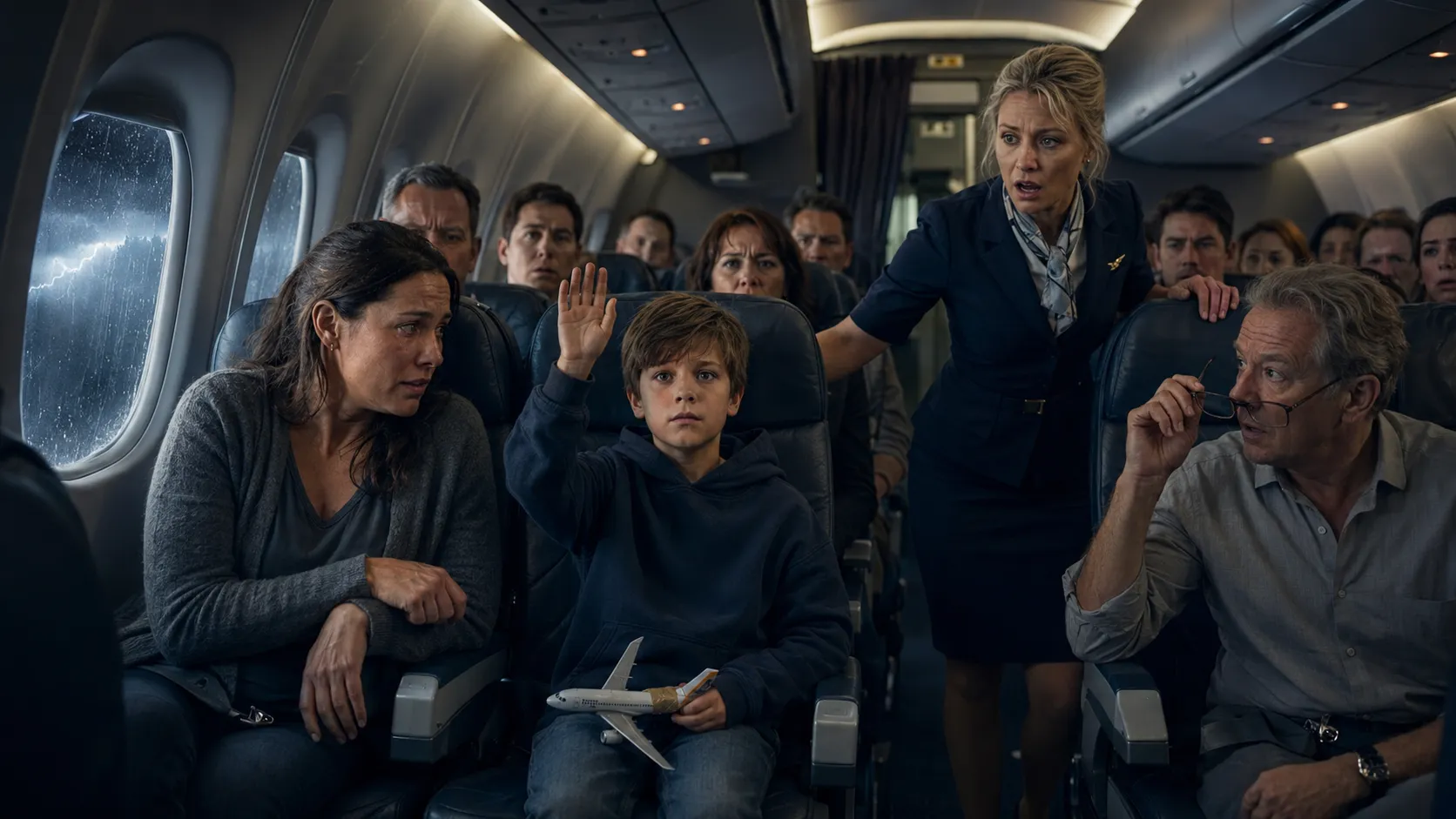
When Flight 728 began falling through a violent storm, the crew asked if anyone understood aircraft systems. A tiny hand rose from seat 14A — and everyone laughed until the boy said the name of the engineer who had warned them this would happen.
The first scream came from seat 18C.
At first, everyone thought it was turbulence.
Passengers had already been nervous for twenty minutes. Flight 728 from Chicago to Los Angeles had entered a wall of black clouds somewhere over the plains, and the airplane had been shaking hard enough to rattle drink cups against tray tables.
The seatbelt sign had been on since the first flash of lightning.
A baby cried near the back.
A businessman in first class muttered that the airline should have delayed takeoff.
A teenage girl recorded the storm through the window until her mother slapped the phone down and told her to stop tempting God.
Then the plane dropped.
Not dipped.
Dropped.
The kind of sudden, stomach-tearing fall that makes strangers grab one another without thinking.
A coffee cart slammed sideways into the aisle. Plastic cups scattered across the floor. A flight attendant hit her shoulder against a row of seats and barely caught herself before falling.
The overhead lights flickered.
Once.
Twice.
Then for one terrible second, the cabin lights turned dark red.
A metallic alarm sounded faintly from the front of the plane.
That was when fear changed shape.
Before, people had been annoyed.
Now they were afraid.
A man shouted, “What was that?”
Nobody answered him.
The aircraft lurched again, this time tilting hard enough that several passengers cried out at once. Luggage thumped inside the overhead bins. A child began sobbing loudly. Somewhere near row twenty, a woman whispered the Lord’s Prayer with her eyes squeezed shut.
In seat 14A, a nine-year-old boy named Ethan Brooks pressed both hands against his knees and tried not to look scared.
His sneakers did not reach the floor.
His hoodie was too big because it had belonged to his father.
Inside the front pocket was a folded photograph, two peppermint candies from his mother, and a small plastic airplane model with one wing repaired by tape.
Ethan stared out the window, but there was nothing to see.
Only storm.
Black clouds swallowed the wing. Rain streaked sideways across the glass. Lightning flashed so close that for a split second, the entire cabin glowed white.
Beside him, his mother gripped the armrest.
Her name was Claire Brooks, and she had spent the last six months learning how to look calm while falling apart.
“Ethan,” she whispered, “look at me.”
He did.
Her face was pale, but her voice stayed gentle.
“It’s just rough air.”
Ethan nodded.
He wanted to believe her.
He wanted to be a normal boy who could be comforted by normal words.
But he had spent too many nights beside his father’s desk watching flight system diagrams move across three monitors. He knew the difference between ordinary turbulence and a plane fighting itself.
His father, Daniel Brooks, had been an aircraft systems engineer.
Not a pilot.
Not famous.
Not rich.
But brilliant in the quiet, exhausting way that made other men take credit for his work while calling him difficult behind closed doors.
Daniel designed emergency stabilization logic for commercial and military aircraft. He understood how planes behaved when pilots were tired, weather was violent, sensors disagreed, or software made a decision faster than a human could correct it.
Ethan had grown up under that desk.
When other children fell asleep to bedtime stories, Ethan fell asleep to his father murmuring about redundant control channels, sensor conflicts, power buses, and fail-safe sequencing.
His mother used to say, “Daniel, he’s seven. He doesn’t need to know how to land a damaged aircraft.”
His father would smile without looking away from the screen.
“He doesn’t need to know,” he’d say. “But he likes knowing.”
Ethan did.
He liked the patterns.
He liked the logic.
He liked that every warning light had a reason, every system had a backup, and every backup had a deeper backup if someone smart enough had cared to build one.
Then six months ago, Daniel Brooks died.
Officially, it was a heart attack.
That was what the company letter said.
Stress-related cardiac event.
Unexpected.
Tragic.
The airline technology firm sent flowers. Executives came to the funeral. One of them shook Claire’s hand and said, “Daniel gave everything to aviation safety.”
Ethan remembered wanting to scream at him.
Because his father had not simply given everything.
He had been ignored until it killed something inside him.
For months before his death, Daniel had warned his company that a new emergency stabilization update had a flaw. Under rare storm conditions — severe electrical load, partial sensor corruption, rapid autopilot disengagement — the system could reroute power incorrectly and cause backup channels to fight the manual controls.
His bosses called it theoretical.
Daniel called it inevitable.
Then he died before anyone admitted he had been right.
Now, thirty-seven thousand feet above the earth, Flight 728 was shaking exactly the way his father’s final simulation had shaken on the screen.
Ethan could still hear him.
If Channel B corrupts under storm load, you don’t fight the plane harder. You stop the false correction.
The cockpit door opened.
The entire cabin went quiet.
A blonde flight attendant stepped out.
Her name tag read MARA.
She looked like she had been trained to smile through anything. But now her face was drained of color, and one hand was trembling so badly she had to hide it against her skirt.
She looked down the aisle.
“Ladies and gentlemen,” she began, then stopped because the plane jerked again.
She grabbed the nearest seatback.
Someone shouted, “Are we crashing?”
Mara swallowed.
“Is there anyone onboard who understands aircraft electrical or stabilization systems?”
The question stunned the cabin.
Not a doctor.
Not an air marshal.
An engineer.
People looked around wildly.
A man in row nine raised his hand halfway.
“I’m a civil engineer,” he said. “Bridges mostly.”
Mara looked desperate enough to almost consider it.
Then another passenger said, “I work in software.”
“What kind?” Mara asked.
“Marketing analytics.”
Her face fell.
A heavy silence moved through the cabin.
Then a tiny hand rose slowly from seat 14A.
“I do.”
At first, nobody understood.
Then heads turned.
Passengers stared at the small boy with curly brown hair, oversized hoodie, and sneakers swinging above the floor.
A nervous laugh came from somewhere behind him.
Then another.
A man across the aisle leaned forward.
“Kid, sit down.”
Ethan’s mother grabbed his wrist.
“Ethan,” she whispered.
But Ethan kept his hand raised.
Mara stared at him, almost offended by the timing.
“Sweetheart, this is serious.”
“I know.”
“This is not a joke.”
“I’m not joking.”
The man across the aisle scoffed.
“You’re nine.”
“Yes, sir.”
That made a few people laugh again, but the laughter died quickly when another alarm sounded from the cockpit.
The plane tilted left.
Too far.
People screamed.
A woman in row fifteen began crying into her hands.
Ethan unbuckled his seatbelt.
His mother held his arm tighter.
“No.”
He looked at her.
“Mom.”
“No, Ethan.”
“It’s Dad’s system.”
Her eyes filled instantly.
That name, in that moment, seemed to hurt more than the turbulence.
“Ethan…”
“It’s happening.”
Claire looked toward the cockpit, then back at her son.
For six months, she had tried to protect him from being swallowed by his father’s unfinished fight. She had hidden documents, closed laptops, ignored calls from journalists, and told Ethan over and over that he did not have to carry Daniel Brooks’s burden.
But looking at him now, she saw something she had seen only once before.
The night Daniel stood in their kitchen, exhausted and pale, saying, “Claire, if this flaw reaches the sky before they fix it, people will die.”
Ethan had the same look.
Not childish excitement.
Responsibility.
An older man seated in 13C suddenly leaned into the aisle.
“Wait.”
Mara turned.
The old man stared at Ethan.
“What’s your name, son?”
“Ethan Brooks.”
The old man’s face changed.
“Oh my God.”
Passengers looked between them.
“You know him?” someone asked.
The old man slowly removed his glasses.
“I knew his father.”
Claire looked up sharply.
The man’s voice dropped.
“Daniel Brooks designed part of the stabilization architecture on this aircraft series.”
The cabin went still.
A passenger whispered, “Designed it?”
The old man nodded.
“I worked with him years ago at Aerodyne Systems. If that boy is Daniel’s son…” He looked at Ethan again. “He may know things no one else on this flight knows.”
Mara stared at Ethan as if seeing him for the first time.
Ethan stepped into the aisle.
“What failed?” he asked.
Mara hesitated.
Then answered.
“Autopilot disconnected. The pilots are reporting unstable backup stabilization and electrical routing errors.”
Ethan’s face changed.
Not fear exactly.
Recognition.
“Is Channel B cycling?”
Mara blinked.
“I don’t know.”
“Is the plane rolling left after correction?”
The old engineer stood now, gripping the seatback for balance.
Mara went pale.
“Yes.”
Ethan looked toward the cockpit.
“Then you have to take me there.”
A man behind him shouted, “Absolutely not! He’s a child!”
Ethan turned toward him.
His voice was quiet, but it carried.
“If nobody stops the false correction, the pilots will keep fighting the aircraft until it overcompensates.”
The man opened his mouth.
No words came out.
Another violent shake hit the plane.
Mara looked at Claire.
Claire’s face was wet with tears now.
“He knows the system,” she whispered. “His father taught him.”
Mara made a decision no manual had prepared her to make.
“Come with me.”
Ethan followed her forward.
The aisle seemed endless.
Every passenger watched him pass.
Some with disbelief.
Some with hope.
Some with the shame of having laughed too early.
Claire tried to follow, but Mara stopped her gently.
“Ma’am, please stay seated.”
“That’s my son.”
“I know.”
Claire looked past her at Ethan.
He turned once.
For a second, he looked nine years old again.
Small.
Scared.
Her baby.
Then he said, “I’ll come back.”
Claire nodded because she had no choice.
Mara opened the cockpit door.
Inside, the storm sounded louder.
The cockpit glowed with warning lights. Rain hammered the windshield. Lightning flashed beyond the glass. The captain, Robert Hayes, sat rigid in the left seat, one hand on the controls, the other reaching across the panel. His co-pilot, Jenna Morris, was reading out warnings in a voice that was starting to fray at the edges.
“Altitude deviation.”
“Autopilot disconnected.”
“Secondary flight control fault.”
“Backup stabilization not responding cleanly.”
Captain Hayes turned when Mara entered.
“What are you doing?”
“He says he can help.”
Then he saw Ethan.
For one full second, the captain looked ready to explode.
“Get him out.”
Ethan stepped forward before Mara could speak.
“Don’t force more left correction.”
The captain froze.
Co-pilot Morris looked up.
“What did you say?”
“The plane is rolling because Channel B is corrupted. If you keep correcting manually against it, the system will push back.”
Captain Hayes stared at him.
“You have ten seconds to explain who you are.”
“My name is Ethan Brooks. My father was Daniel Brooks.”
The cockpit changed.
The captain’s expression hardened first.
Then shifted.
“You’re Daniel’s boy?”
Ethan nodded.
Co-pilot Morris whispered, “Daniel Brooks from Aerodyne?”
“Yes.”
The captain’s jaw tightened.
“I read his memo.”
Ethan stepped closer to the console.
“Then you know he was right.”
The plane dropped again.
Morris grabbed her controls.
“Captain, we’re losing altitude.”
Ethan pointed to the panel.
“Show me the Channel B status.”
The captain hesitated.
No captain wants to take instruction from a child.
No professional wants to admit the impossible has entered the room wearing sneakers.
But the warning lights were still flashing.
The controls still felt wrong.
And Robert Hayes had been flying long enough to know that pride can kill faster than weather.
He tapped the display.
Ethan leaned in, eyes moving across the symbols.
His father’s voice returned in his mind.
Don’t look at the loudest warning. Look at the one that doesn’t make sense.
There.
A repeating auxiliary power reroute.
Secondary bus conflict.
Stabilization channel cycling in and out of fault mode.
Ethan swallowed.
“Turn off stabilization Channel B.”
Morris stared.
“That could remove backup balancing.”
“It’s not backup anymore. It’s giving false input.”
Captain Hayes said, “If we shut it down and you’re wrong—”
“If you don’t shut it down and Dad was right, the plane will keep fighting you.”
Another alarm screamed.
The aircraft rolled again.
The captain’s hands tightened.
“Jenna?”
Co-pilot Morris looked at the panel, then at Ethan.
“I hate that this makes sense,” she said.
Captain Hayes flipped the guarded switch.
For half a second, nothing happened.
Then the plane shuddered.
Hard.
The nose dipped.
Someone screamed in the cabin behind them.
Then the shaking eased.
Not completely.
But enough that Morris’s eyes widened.
“Control response improving.”
Captain Hayes exhaled once.
Ethan was already pointing again.
“Now manually reroute auxiliary power through emergency bus three.”
Morris shook her head.
“That’s not standard in this configuration.”
“It exists.”
“How do you know?”
“Because my dad built it for failure testing. He said nobody used it because it made the checklist ugly.”
For the first time since the cockpit door opened, Captain Hayes almost smiled.
“That sounds like Daniel.”
He executed the reroute.
Two red warnings disappeared.
Then three.
The aircraft steadied further, still battered by the storm, but no longer jerking like a wounded animal.
Outside the cockpit, passengers felt the difference before anyone announced it.
The screams faded.
Prayers became whispers.
Hands slowly loosened from armrests.
Claire sat in seat 14B, staring toward the closed cockpit door and silently counting every second her son was away.
In the cockpit, Ethan was not done.
“Fuel imbalance warning next,” he said.
Morris looked at him.
“How do you know?”
“Left intake pressure likely dropped when ice hit the wing during the power surge. Dad’s simulation showed it after stabilization recovery.”
As if summoned by his words, another warning blinked.
FUEL IMBALANCE.
Morris went pale.
Captain Hayes looked at Ethan differently now.
Not as a strange child.
Not even as Daniel Brooks’s son.
As someone who knew the shape of the failure before the instruments finished admitting it.
“What do we do?” Morris asked.
Ethan hesitated.
For the first time since entering the cockpit, his confidence faltered.
The display in front of him blurred slightly.
He was nine.
He knew diagrams.
He knew simulations.
He knew his father’s notes.
But these were real people.
Real altitude.
Real storm.
Real consequences.
If he guessed wrong, his mother would die behind that cockpit door with everyone else.
Captain Hayes saw the change.
He lowered his voice.
“Ethan.”
The boy looked at him.
“You are not flying this aircraft. We are. You are helping us understand a system your father knew better than anyone. Tell us what you know. We make the call.”
That steadied him.
It also freed him from something too heavy for any child.
Ethan nodded.
“Reduce feed pressure from left. Balance through right auxiliary until you clear storm load. Do not engage auto-balance until the bus reset is confirmed stable.”
Morris followed the instruction while Hayes monitored response.
The fuel warning remained for several seconds.
Then changed from red to amber.
Then stabilized.
Morris let out a breath that sounded almost like a sob.
“Fuel balance holding.”
Captain Hayes looked out through the rain-streaked windshield.
“We’re turning toward Denver.”
He pressed the radio.
“Denver Center, Flight 728 declaring emergency. We have partial stabilization recovery, electrical system fault contained, requesting priority descent and emergency landing.”
The voice from air traffic control crackled back, steady and professional.
Flight 728, Denver Center, you are cleared direct. Emergency services will be standing by.
The words moved through the cockpit like oxygen.
They were not safe yet.
But there was a path now.
Ethan stepped back from the panel.
His hands were shaking.
Mara noticed first.
“You okay?”
He nodded too quickly.
Captain Hayes turned slightly.
“Ethan.”
The boy looked at him.
“How old are you?”
“Nine.”
Morris gave a breathless laugh.
“That is the worst answer I have ever heard after the smartest thing I have ever seen.”
Ethan almost smiled.
Then his eyes dropped.
“My dad would have known faster.”
The cockpit went quiet.
Captain Hayes looked back at the instruments.
“I knew your father,” he said.
Ethan looked up.
“You did?”
“Not well. But I was in a simulator test he ran eight years ago. He was the only engineer in the room who cared more about the pilots than the executives.”
Ethan’s throat tightened.
“He died.”
“I heard.”
“They said his flaw warning was exaggerated.”
The captain’s face hardened.
“They were wrong.”
Ethan blinked.
It was the first time anyone outside his mother had said it so plainly.
Captain Hayes continued, “And when we land, I’m going to make sure every investigator in Denver hears that.”
The cabin announcement came five minutes later.
Captain Hayes kept his voice calm, but no one missed the strain beneath it.
“Ladies and gentlemen, this is your captain. We experienced a serious electrical and stabilization malfunction caused by the storm. The aircraft is now under improved control, and we are diverting to Denver for an emergency landing. Please remain seated with your seatbelts fastened. Emergency crews will meet us on arrival.”
The cabin erupted in nervous sound.
Questions.
Crying.
Relief.
Fear.
Then the captain added one sentence that made the plane go silent again.
“We also received assistance from a passenger with exceptional knowledge of the aircraft system.”
Everyone knew who he meant.
Claire closed her eyes and covered her mouth.
A woman across the aisle whispered, “The boy.”
The man who had mocked him earlier stared down at his hands.
Ethan returned to the cabin ten minutes before landing.
When the cockpit door opened, every passenger turned.
He walked down the aisle quietly, too embarrassed to look at anyone.
Then someone began clapping.
Not loudly.
Just one pair of hands.
The old engineer from 13C.
Then another passenger joined.
Then another.
Soon the cabin filled with applause.
Not the empty applause people give after landing.
Something heavier.
Something grateful and ashamed.
Ethan stopped at row 14.
His mother unbuckled and pulled him into her arms before the flight attendant could stop her.
For a few seconds, Ethan stayed stiff.
Then he broke.
He pressed his face into her shoulder and cried like the child he still was.
“I was scared,” he whispered.
Claire held him tighter.
“I know.”
“I thought I would mess it up.”
“You didn’t.”
“I heard Dad.”
Her breath caught.
Ethan pulled back, wiping his face with his sleeve.
“Not like a ghost. I just… I remembered him.”
Claire touched his cheek.
“That still counts.”
The emergency landing in Denver was hard but controlled.
The runway lights appeared through rain like a string of stars.
People held hands across aisles.
The wheels hit the runway with a violent thud.
The plane bounced once.
Then again.
The engines roared in reverse.
The aircraft slowed.
Finally, it came to a stop surrounded by flashing emergency vehicles.
For several seconds, nobody moved.
Then the cabin erupted.
People cried openly. Strangers hugged. A man kissed the top of his sleeping child’s head. Mara leaned against the galley wall and wiped tears with the back of her hand.
Captain Hayes came over the speaker one last time.
“Ladies and gentlemen… welcome to Denver.”
A laugh rippled through the cabin.
Then his voice softened.
“And to Ethan Brooks — your father would be very proud.”
Ethan looked down at his hands.
For the first time in six months, the thought of his father did not feel only like loss.
It felt like inheritance.
The airport terminal became chaos.
Paramedics checked passengers. Airline staff tried to control the crowd. Federal investigators arrived within minutes. News crews were already gathering outside because one passenger had livestreamed part of the panic before the signal cut out.
Ethan and Claire were escorted into a private room near the emergency operations center.
For the first time since boarding, the room was quiet.
Too quiet.
Ethan sat in a chair with a blanket over his shoulders. His feet still did not touch the floor.
Claire sat beside him, holding his hand.
A woman in a navy blazer entered with Captain Hayes and two federal aviation investigators.
Her name was Nora Bell, and she introduced herself as the lead investigator.
She spoke gently to Ethan, but not condescendingly.
That helped.
“We need to ask you some questions about what you saw in the cockpit,” she said.
Ethan looked at his mother.
Claire nodded.
“Okay,” he said.
Nora placed a tablet on the table.
“Did your father discuss this specific failure pattern with you?”
Ethan nodded.
“He said Channel B could corrupt under storm overload if the secondary bus rerouted wrong. He said the system would look like hydraulics at first, but it wasn’t.”
Captain Hayes leaned against the wall, arms folded.
“He was exactly right.”
Nora looked at him.
“We’ll determine that through data.”
Hayes’s voice hardened.
“With respect, ma’am, I was in the cockpit. The boy was right.”
Nora held his gaze for a moment, then looked back at Ethan.
“Do you know where your father kept his work?”
Claire stiffened.
“What does that mean?”
Nora’s expression changed.
“We reviewed preliminary maintenance records before coming in. Daniel Brooks filed multiple internal safety complaints before his death.”
Claire’s face went pale.
“You know about those?”
“Yes.”
“Because when I tried to get someone to listen after he died, no one would return my calls.”
Nora’s jaw tightened.
“I’m sorry.”
Claire gave a humorless laugh.
“People say that after ignoring widows. It doesn’t help much.”
Nora accepted the blow.
“You’re right.”
Ethan reached into his hoodie pocket.
He removed the little plastic airplane model with the taped wing.
Everyone stared as he turned it over and opened a hidden slot near the base.
Inside was a tiny memory card.
Claire’s eyes widened.
“Ethan…”
He looked down.
“Dad gave it to me before he went to the hospital. He said if people kept pretending, I should give it to someone who cared more about planes than companies.”
The room went silent.
Nora slowly extended her hand.
“May I?”
Ethan hesitated.
“Will it help?”
“Yes.”
“Will it get my dad in trouble?”
Captain Hayes answered before Nora could.
“No, son.”
Ethan placed the memory card in Nora’s palm.
“What is on it?” she asked.
Ethan swallowed.
“His final simulation. And the memo they deleted.”
Claire covered her mouth.
Daniel had told her once that he had kept copies.
She had never known where.
Nora closed her fingers around the card.
“This will be handled properly.”
Claire looked at her.
“People said that before.”
Nora nodded.
“Then judge me by what happens next.”
What happened next became national news.
At first, the story was simple enough for television.
NINE-YEAR-OLD HELPS SAVE EMERGENCY FLIGHT.
Boy genius.
Storm terror.
Hero child.
Miracle in the sky.
Ethan hated the headlines almost immediately.
He did not feel like a hero.
He felt tired.
He felt scared.
He felt angry that people were suddenly praising the same knowledge adults had dismissed when it came from his father.
Within forty-eight hours, the story changed.
Federal investigators confirmed that Flight 728 suffered a rare but severe electrical and stabilization malfunction matching warnings submitted months earlier by Daniel Brooks.
The deleted memo surfaced.
Then the simulation.
Then internal emails.
Executives at Aerodyne Systems had known the flaw existed. They had delayed a recall because the probability was considered low, the patch was expensive, and grounding affected aircraft would cost airlines millions.
One email used the phrase acceptable exposure.
Captain Hayes read that line on the news and threw a coffee mug across his hotel room.
Claire read it sitting beside Ethan in a Denver airport hotel.
She did not throw anything.
She simply went very still.
Ethan looked at her.
“Mom?”
She turned off the television.
“They knew,” she whispered.
Ethan nodded.
“Dad knew they knew.”
Claire closed her eyes.
For six months, grief had been heavy.
Now it became sharp.
Daniel had not died only from stress, not only from work, not only from being unable to let go.
He had died carrying a warning powerful people found inconvenient.
The congressional hearing came three months later.
By then, Flight 728 had become a symbol.
The aircraft model was temporarily grounded for inspection and software correction. Other pilots reported minor incidents that suddenly made sense in light of the flaw. Lawsuits began. Executives resigned. Aerodyne Systems issued statements full of careful regret.
Claire refused to let Ethan testify at first.
“He is nine,” she told the investigators.
Nora Bell agreed.
“He does not need to appear.”
Ethan listened from the hallway.
Then he walked in.
“I want to say one thing.”
Claire turned.
“No.”
“Mom.”
“No, Ethan. They already took enough from this family.”
He looked down at the floor.
Then said, “They called Dad exaggerated.”
Claire’s face changed.
Ethan’s voice trembled, but he kept going.
“They said he was difficult. They said he worried too much. They said his warning was theoretical. I want them to hear me say he was right.”
Claire sat down slowly.
She had spent months trying to protect her son from grief.
But grief had already found him.
Maybe what he needed now was not protection from truth.
Maybe he needed a way to stand beside it.
In the end, Ethan spoke for less than two minutes.
The hearing room was full of cameras, attorneys, reporters, officials, and executives who looked smaller under fluorescent lights than they had in company portraits.
Ethan wore a navy sweater and sat beside his mother.
Captain Hayes sat behind them.
So did Mara, Co-pilot Morris, and the old engineer from row 13C.
When it was his turn, Ethan stood behind a microphone too tall for him until someone lowered it.
He unfolded a small piece of paper.
His hands shook.
“My dad was Daniel Brooks,” he began. “He was not difficult. He was careful.”
The room went silent.
“He told me planes are full of promises. Every wire, every bolt, every backup system is a promise that someone cared before the emergency happened.”
Claire began crying quietly.
Ethan continued.
“He cared. He warned people. They didn’t listen because listening cost money.”
One executive looked down.
Ethan’s voice broke slightly.
“On Flight 728, the pilots saved us. The crew helped us. I only remembered what my dad taught me. So if you call me a hero and still call him a problem, then you learned nothing.”
No one spoke.
Then Captain Hayes stood.
Not applauding.
Just standing.
Co-pilot Morris stood beside him.
Then Mara.
Then passengers from Flight 728.
Soon half the room was on its feet.
The committee chair had to call for order twice.
Ethan sat down and leaned against his mother.
“I’m done,” he whispered.
Claire kissed the top of his head.
“Yes,” she said. “You are.”
But the story was not done.
The official report took nearly a year.
It confirmed what Daniel Brooks had warned: under a rare but foreseeable combination of lightning-induced electrical stress, sensor conflict, and backup stabilization cycling, the affected system could produce dangerous control interference if not isolated quickly.
The report did not say a nine-year-old saved the plane alone.
Captain Hayes was grateful for that.
He made sure every interview corrected the myth.
“Ethan did not fly the aircraft,” he said. “My crew did. But Ethan recognized the failure pattern because his father had documented it. Without that information, we might have spent too long fighting the wrong problem.”
That distinction mattered.
Especially to Claire.
Especially to Ethan.
Daniel Brooks’s name was formally cleared.
Then honored.
Aviation safety groups created the Daniel Brooks Systems Integrity Award for engineers who raise critical safety concerns despite institutional pressure.
Aerodyne Systems paid settlements to affected families and established an independent reporting channel, though Claire said privately that companies always discovered ethics more easily after subpoenas.
She was not wrong.
Life afterward did not become easy.
For a while, Ethan was known everywhere.
At school, some children treated him like a celebrity. Others mocked him for thinking he was smarter than everyone. A boy in sixth grade called him “Captain Baby” until Ethan punched him in the nose and earned his first suspension.
Claire did not approve of the punch.
But when she picked him up, she admitted the nickname was stupid.
They both laughed in the car and then cried without discussing why.
Therapy helped.
So did time.
So did Captain Hayes, who became an unexpected part of their lives. He visited twice the first year after the flight, then sent postcards from different cities. On Ethan’s tenth birthday, he mailed him a real pilot’s checklist laminated inside a frame.
The note said:
For the engineer who reminded us to read the warnings before the storm.
Mara sent a flight attendant pin.
Co-pilot Morris sent a handwritten note that said:
You made me trust a child in the cockpit. I am still mad about that. Also grateful.
Ethan kept all of them in a shoebox under his bed.
The memory card stayed with investigators for months, then was returned to Claire after copies were archived. She placed it beside Daniel’s photograph on the bookshelf.
Not hidden anymore.
One evening, nearly two years after Flight 728, Ethan found his mother standing in Daniel’s old office.
The room had been left almost untouched after his death.
Three monitors.
A cluttered desk.
A coffee mug with a cracked handle.
Stacks of notebooks filled with diagrams Ethan understood better every year.
Claire held one of Daniel’s old sweaters against her chest.
Ethan stood in the doorway.
“Mom?”
She turned quickly, wiping her face.
“I’m okay.”
He gave her the look she usually gave him.
She sighed.
“Fine. I’m not okay.”
He walked in and sat on the floor beside the desk.
After a moment, she sat beside him.
For a while, they said nothing.
Then Ethan asked, “Do you wish I never helped on the plane?”
Claire looked horrified.
“No.”
“Because then we wouldn’t be in the news. People wouldn’t talk about Dad all the time. You wouldn’t have to go to hearings.”
She reached for his hand.
“Ethan, what happened on that plane was not your fault.”
“I know.”
But his voice said he did not always know.
Claire squeezed his hand.
“I wish you never had to be brave like that. I wish your father had lived. I wish adults had done the right thing before a child had to remember his notes in a storm. But I do not wish you stayed silent.”
Ethan looked down.
“Dad didn’t stay silent.”
“No,” she said. “He didn’t.”
“They punished him for it.”
“Yes.”
“Will they punish me?”
Claire’s eyes filled.
The honest answer was complicated.
The world often punished people who told the truth.
Even children sometimes.
But that was not all the world did.
“No,” she said softly. “Not alone.”
Ethan leaned against her.
That answer was enough for that night.
Years passed.
Ethan grew taller.
His sneakers reached the floor.
His father’s hoodie finally fit him, then became too small.
He still loved aircraft systems, though for a while he pretended he did not. At twelve, he told everyone he wanted to become a marine biologist. At thirteen, he said maybe a chef. At fourteen, he secretly rebuilt a flight simulator in the basement and Claire found him there at midnight surrounded by wires.
She stood at the bottom of the stairs.
He froze.
“I can explain.”
Claire looked at the simulator, then at him.
“Does it have proper grounding?”
He blinked.
“What?”
“I married an engineer. I learned some words.”
Ethan smiled.
“Yes. It has proper grounding.”
“Good. Then explain after breakfast.”
By seventeen, Ethan was working with a youth aviation safety program created in Daniel’s name. He did not like speeches, but he liked teaching younger kids how aircraft worked.
He always began with the same sentence:
“Planes stay in the sky because thousands of people do their jobs before the pilot ever touches the controls.”
Then he would pause and add:
“And if one of those people tells you something is wrong, listen.”
On the tenth anniversary of Flight 728, Denver International Airport unveiled a small plaque near the emergency operations wing.
Not in the public terminal where tourists would take selfies.
Near the training center, where pilots, mechanics, engineers, and flight safety crews passed every day.
Claire, Ethan, Captain Hayes, Mara, Co-pilot Morris, Nora Bell, and several passengers from the flight attended the ceremony.
The plaque read:
IN HONOR OF DANIEL BROOKS
WHO WARNED BEFORE THE STORM
AND ALL WHO LISTEN WHEN SAFETY SPEAKS QUIETLY
Beneath it, in smaller letters:
Flight 728 — No lives lost.
Ethan stood before the plaque for a long time.
He was nineteen now, taller than his mother, with his father’s eyes and the same crease between his eyebrows when he was thinking too hard.
Captain Hayes, older and retired, stood beside him.
“You know,” Hayes said, “your father would have hated all this attention.”
Ethan smiled.
“He would have corrected the wording.”
“Probably.”
“He’d say safety doesn’t speak quietly. People make it quiet.”
Hayes considered that.
“He’d be right.”
Ethan looked toward the training center windows, where a group of young pilots were walking past with coffee cups and checklists.
“I used to think I saved that plane,” he said.
Hayes turned to him.
“And now?”
Ethan took a breath.
“I think Dad saved it. You flew it. Mara made the wrong-looking right choice. Mom let me go even though it scared her. I just remembered.”
Hayes smiled.
“Remembering at the right time is not a small thing.”
Ethan looked at the plaque again.
“No,” he said. “I guess not.”
Later that afternoon, Ethan and Claire sat near the huge airport windows watching planes take off.
For years after Flight 728, Claire had hated airports.
Too many cameras.
Too many memories.
Too many announcements that sounded like the beginning of panic.
But that day, sitting beside her son, she felt something shift.
A plane lifted from the runway into a clear blue sky.
Ethan watched it climb.
Claire watched him.
“You still want to study aerospace engineering?” she asked.
He laughed softly.
“You already know.”
“I want to hear you say it.”
He looked at her.
“Yes.”
“Because of your father?”
Ethan thought about that.
“Yes,” he said. “But not only because of him.”
“Then why?”
He looked back at the airplane rising into sunlight.
“Because someday there will be another storm. And I want the warnings fixed before a kid has to stand up in row fourteen.”
Claire’s eyes filled, but she smiled.
“That sounds like a good reason.”
He reached into his jacket pocket and removed the old plastic airplane model with the taped wing. He had carried it for the ceremony without telling her.
The hidden slot was empty now.
No memory card.
No secret.
No burden too large for a child.
Just a toy plane his father had once repaired with him at the kitchen table.
Ethan placed it gently against the window ledge.
Outside, another aircraft rolled toward the runway.
Claire slipped her hand into his.
Together, they watched it take off.
This time, neither of them felt the storm first.
They felt the sky.