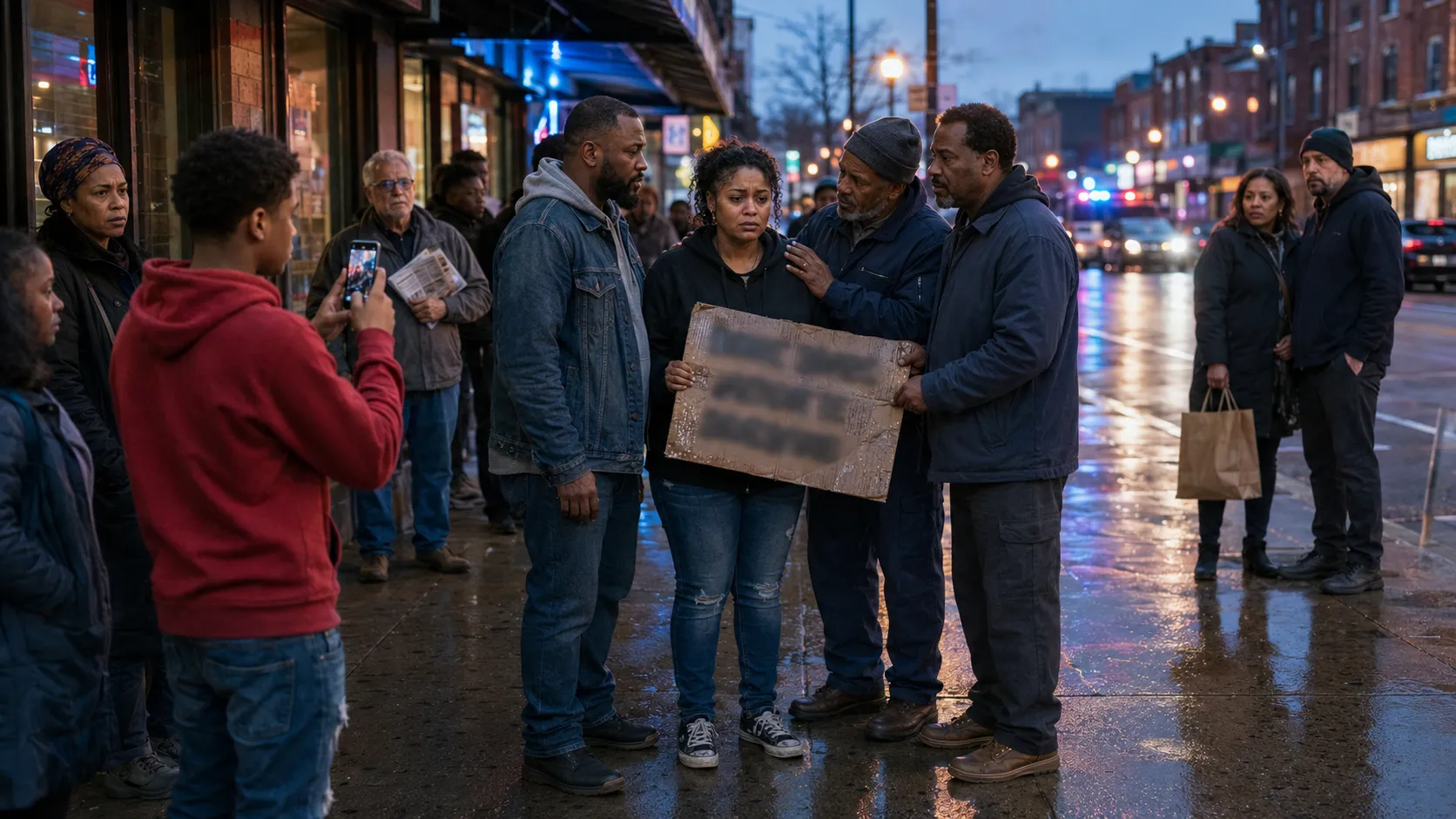
Danielle only wanted to stand quietly on the sidewalk with four words on a cardboard sign. But when a stranger shoved her into the wet street and everyone watched in silence, one teenager’s phone captured the moment that would change everything.
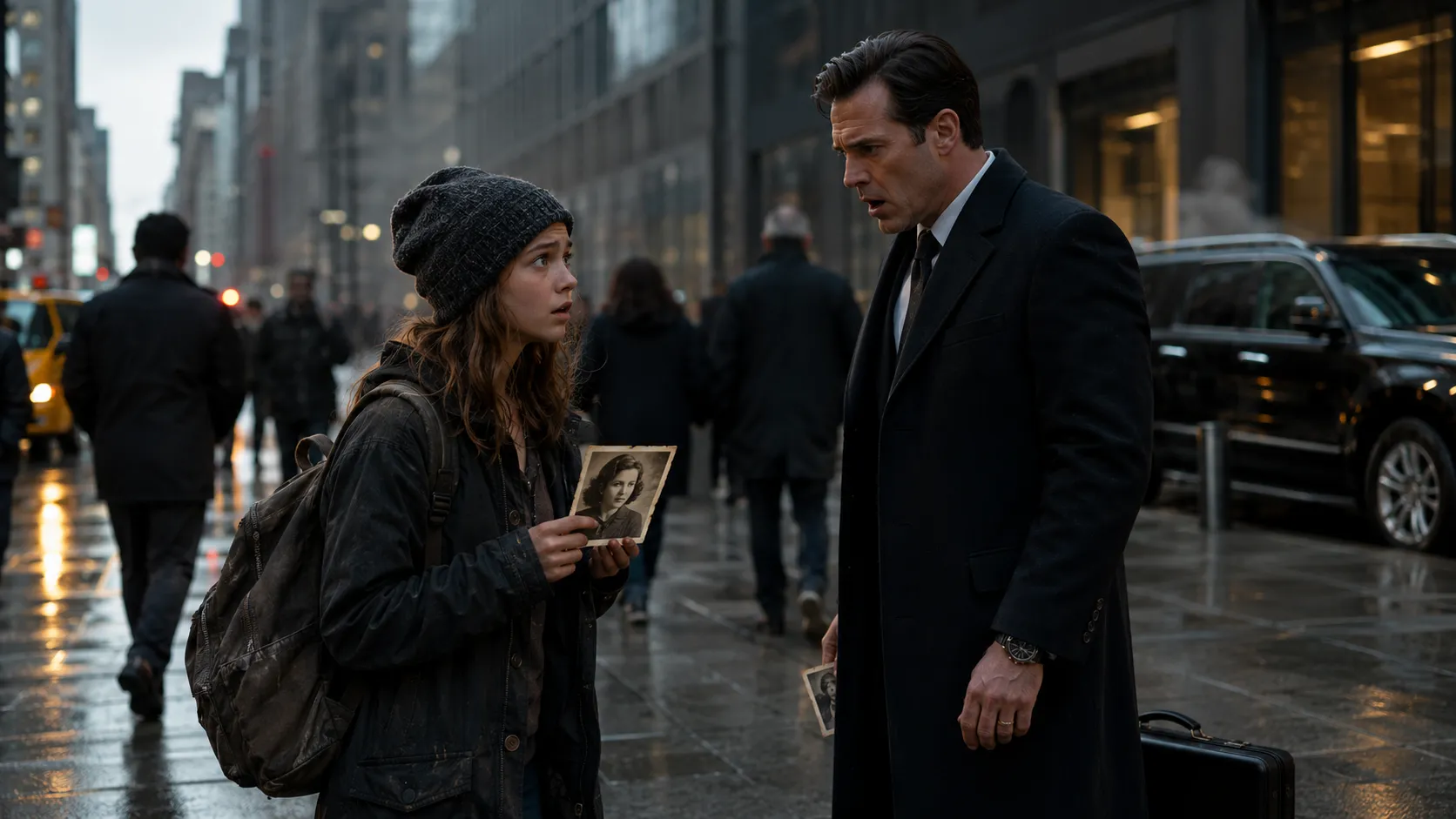
The rain had stopped an hour earlier, but downtown Baltimore still looked bruised.
Puddles stretched along the curb. Neon signs trembled in the water. Tires hissed over wet asphalt, and somewhere several blocks away, police sirens moved through the city like a warning nobody wanted to hear too clearly.
Danielle Brooks stood beneath a streetlamp on Franklin Street, holding a cardboard sign with both hands.
The sign was simple.
Four words written in thick black marker.
BLACK LIVES MATTER
Nothing violent.
Nothing threatening.
Nothing complicated.
Just four words.
But Danielle knew, before she lifted it over her head, that four words could make strangers hate you if those strangers had already decided your pain was an inconvenience.
She was twenty-six years old, wearing a black sweatshirt, jeans, and old sneakers darkened by the wet sidewalk. Her hair was tucked under her hood. Her hands were cold. Her throat still hurt from arguing with herself all afternoon about whether she should come at all.
Her best friend Maya had begged her not to go alone.
“People are angry right now,” Maya had said. “You saw what happened last month. Don’t stand out there by yourself.”
Danielle had seen it.
Everyone had seen it.
The video of a young Black father pinned to the pavement outside a grocery store while his daughter screamed from the back seat had been shared millions of times. The news called it an incident. The family called it murder. Commentators argued for days. Politicians offered statements carefully built to offend as few donors as possible.
Then the city moved on.
Or tried to.
Danielle could not.
The man in the video had been named Jordan Ellis.
He had worked nights at a hospital laundry service. He had fixed bicycles for neighborhood children on weekends. He had once helped Danielle carry groceries up three flights of stairs when the elevator in her aunt’s building broke.
He had not been famous.
That was partly why his death stayed with her.
Famous people became symbols.
Ordinary people became statistics.
Danielle was tired of statistics.
So she had come to Franklin Street after work, carrying a cardboard sign and a grief she did not know where else to put.
She lifted the sign.
“Black lives matter,” she said.
Her voice sounded smaller than she expected.
A bus rolled past.
A woman with a red umbrella glanced at her and kept walking.
A man in a business coat looked at the sign, shook his head, and turned away.
Danielle swallowed.
Then she said it louder.
“Black lives matter.”
A taxi honked.
She could not tell if it was support or mockery.
That was how everything felt lately — impossible to read, dangerous to trust.
She kept walking slowly along the sidewalk, raising the sign above her head. Most people ignored her. That hurt more than open anger somehow. Hatred at least admitted it saw you. Silence made you feel like you had disappeared while still standing in public.
At the corner near a convenience store, four men leaned under the awning smoking cigarettes.
They were young, maybe mid-twenties, dressed in hoodies and jackets, laughing over something on a phone. They had the careless energy of men who believed the sidewalk widened for them automatically.
Danielle saw them too late.
One of them noticed her sign.
He nudged the tallest one.
“Yo,” he said, laughing. “Look at this.”
Danielle kept her eyes forward.
Her mother had taught her that when men wanted trouble, eye contact could become an invitation.
“Black lives matter,” Danielle said again, quieter now despite herself.
The tallest man stepped away from the wall.
“Oh, wow,” he called. “Another hero.”
His friends laughed.
Danielle kept walking.
“Hey,” another one shouted. “You getting paid for that?”
She did not answer.
“Or is this a volunteer victim thing?”
More laughter.
Danielle’s fingers tightened around the cardboard.
Walk past, she told herself.
Just walk past.
Then the tallest man said, “So tell me, one of them your boyfriend or something?”
The group exploded laughing.
Danielle stopped.
Not because she wanted to.
Because humiliation has a way of freezing the body before the mind can choose dignity.
Slowly, she turned toward them.
“That’s not funny,” she said.
The tall man spread his arms.
“Relax. It’s a joke.”
“No,” Danielle said. “It isn’t.”
His smile changed.
A crowd had begun forming in the cowardly way crowds form — not close enough to help, only close enough to watch.
A couple at the bus stop looked uncomfortable.
An older man glanced over his newspaper.
A woman with shopping bags slowed, then pretended to check a message on her phone.
Nobody spoke.
The men noticed.
Bullies always notice silence.
It feeds them.
The tallest one stepped closer.
“You can shout in public, but we can’t talk?”
“You’re not talking,” Danielle said. “You’re harassing me.”
“Oh, harassing,” he repeated, turning toward his friends. “You hear that? Words are harassment now.”
One of the others pointed at her sign.
“Maybe all lives matter, sweetheart.”
Danielle looked directly at him.
“Then act like mine does.”
That quiet sentence changed the air.
The tallest man’s face hardened.
For a second, Danielle saw something ugly behind his eyes. Not disagreement. Not even anger.
The need to put her back in place.
She turned to leave.
That should have ended it.
It did not.
A rough hand slammed into her shoulder from behind.
Danielle stumbled forward, her foot sliding on the wet pavement. The cardboard sign bent in the middle. Her knee struck the curb hard enough to send pain up her leg.
For one second, the world went white.
Then sound rushed back.
Laughter.
Someone gasped.
A car horn.
Her own breath.
She turned around, shaking.
“Don’t touch me!”
The man who had shoved her lifted both hands as if innocent.
“She tripped.”
His friends laughed louder.
“She’s acting like a victim.”
Danielle looked around.
The bus stop couple stared.
The older man lowered his newspaper.
The woman with shopping bags took one step back.
No one came forward.
That was the part that cut deepest.
Not the push.
Not the laughter.
The watching.
Everyone claimed courage online. Everyone posted quotes. Everyone wrote long comments about justice, kindness, decency, and standing up for what was right.
But on a wet sidewalk, when one woman was shoved for holding a sign, silence suddenly became very popular.
The tall man moved closer again.
“You want attention?” he said. “Now you got it.”
Danielle stepped backward.
Her hands were trembling so badly the sign shook.
Then a voice thundered from across the street.
“HEY!”
Everyone turned.
Four Black men were crossing Franklin Street at a fast walk.
Not running wildly.
Not posturing.
Moving with purpose.
The man in front wore a gray hoodie under a denim jacket. He was tall, broad-shouldered, maybe thirty-five, with a trimmed beard and eyes that had gone cold with anger. Beside him was an older man in a navy work jacket, a younger man carrying a grocery bag, and a heavyset man wearing a Baltimore Ravens cap.
The man in the gray hoodie pointed at the tall bully.
“Back away from her.”
The bully scoffed, but his confidence had shifted.
“Mind your business.”
“It became my business when you put your hands on her.”
The sidewalk went quiet.
The older man in the navy jacket stopped beside Danielle.
“You okay, miss?”
Danielle nodded, though she was not okay at all.
The man in the Ravens cap picked up her bent sign from the wet pavement. He looked at it, then at the men under the awning.
“You pushed a woman because of this?”
Nobody answered.
The younger man with the grocery bag shook his head.
“That’s weak.”
The bully who had shoved Danielle tried to smile.
“She’s exaggerating.”
The man in the gray hoodie took one step closer.
“Did you touch her or not?”
Silence.
That silence told the truth more clearly than any confession.
More people had stopped now.
Phones came out.
But this time, the cameras did not feel like vultures.
They felt like witnesses.
The bully noticed the phones.
His jaw tightened.
“Whatever,” he muttered. “This is stupid.”
“Yes,” the older man said. “It is. And you made it that way.”
For a moment, Danielle thought the violence would continue.
She could feel it in the air — pride looking for a way not to lose in public.
Then one of the harassers grabbed his friend’s sleeve.
“Come on, man. Let’s go.”
The tall one stared at Danielle a few seconds longer.
Not sorry.
Not ashamed.
Only angry that the room had changed against him.
Then he backed away.
One by one, the men left the awning and disappeared down the block, throwing insults over their shoulders that sounded weaker with every step.
Danielle finally exhaled.
She had not realized she had been holding her breath.
The man in the gray hoodie turned to her.
“You sure you’re okay?”
She looked down at her knee. Her jeans were torn, and blood had begun showing through the fabric.
“I think so.”
“You shouldn’t have had to deal with that alone.”
Danielle looked around at the bystanders beginning to disperse now that danger had passed.
“Apparently I did.”
The man gave a bitter smile.
“That’s America sometimes.”
The older man handed her sign back gently.
“Still readable.”
The cardboard was bent, wet along one corner, but the words remained clear.
BLACK LIVES MATTER
Danielle took it with both hands.
“Thank you,” she whispered.
The man in the gray hoodie nodded toward the convenience store.
A teenage boy stood near the door, phone still raised.
“Don’t thank only us,” he said. “That kid recorded everything.”
Danielle turned.
The teenager looked nervous when everyone glanced at him. He was maybe sixteen, skinny, wearing a red hoodie and a backpack hanging off one shoulder.
“I didn’t know if I should,” he said.
The older man replied, “You should.”
The teen swallowed.
“My mom says don’t get involved.”
The man in the gray hoodie looked at the wet sidewalk, then at Danielle’s bleeding knee.
“Sometimes recording is getting involved.”
The teenager looked at Danielle.
“Do you want me to delete it?”
Danielle almost said yes.
She hated the thought of strangers watching her fear.
She hated the idea of becoming a clip, a debate, a face people argued over while eating dinner.
But then she looked at the sidewalk.
At the spot where she had stumbled.
At the people who had watched and done nothing.
At the sign in her hands.
“No,” she said quietly. “Post it.”
The teenager nodded.
“What should I write?”
Danielle looked at the men who had helped her.
Then at the bystanders walking away now that the moral emergency had ended.
“Write what happened.”
The video appeared online at 11:14 that night.
By midnight, it had two million views.
The caption read:
Woman holding peaceful sign gets shoved in Baltimore. Watch who helps — and who just watches.
Danielle sat alone on the edge of her bathtub with a bag of frozen peas pressed against her knee while the view count climbed.
Her phone would not stop vibrating.
Maya called first.
Then Danielle’s aunt.
Then three coworkers.
Then a local reporter.
Then someone from a national morning show.
She ignored most of them.
The video was clear.
Too clear.
The mocking.
The shove.
Her stumble.
The silence.
The four men crossing the street.
The exact moment the bully’s confidence disappeared when someone finally chose to stand beside her.
Danielle watched it once.
Then again.
Then a third time.
Not because she wanted to relive it.
Because something about the silence behind her would not leave her alone.
Dozens of people had watched before anyone moved.
In the comments, strangers argued as if argument itself could repair the moment.
Some called her brave.
Some called her dramatic.
Some said she was asking for attention.
Some said the men who helped her were heroes.
Some said the video proved everything wrong with America.
Others said it proved nothing at all.
By morning, the internet had identified the man who shoved her.
His name was Tyler Grant.
Twenty-seven years old.
Sales manager at a luxury car dealership.
Son of a retired police captain.
Volunteer assistant coach for a youth baseball team.
Smiling in photos beside charity banners, golf carts, and his mother at church.
Danielle stared at one of the images until her stomach turned.
That was what frightened her most about cruelty.
How ordinary it looked in good lighting.
The second man was identified next.
Then the third.
One was enrolled in a criminal justice program at a local college.
Another worked private security downtown.
The irony spread quickly.
So did the consequences.
By noon, Tyler Grant’s dealership suspended him.
By three o’clock, the college announced an investigation.
By evening, the private security company released a statement saying the employee had been terminated.
Everyone wanted to sound shocked.
Danielle was not shocked.
She wondered how many people had seen those men say smaller versions of the same things before and decided it was not worth the discomfort of naming it.
The teenage boy who recorded the video was identified too.
His name was Luis Rivera.
His mother called Danielle crying.
“He’s scared,” she said. “People online are praising him, but some are threatening him too.”
Danielle felt a new kind of guilt.
“I’m sorry.”
“No,” Luis’s mother said. “He did what adults didn’t.”
That sentence followed Danielle all day.
The men who helped her came forward reluctantly.
The one in the gray hoodie was Marcus Reed, a firefighter on medical leave after injuring his shoulder during a warehouse rescue.
The older man was his uncle, Raymond.
The man in the Ravens cap was DeShawn Ellis.
When Danielle saw that last name, she stopped breathing.
Ellis.
Jordan Ellis — the man from the video, the man whose death had brought Danielle to Franklin Street — had been DeShawn’s younger brother.
That was why he had crossed the street so fast.
Not for politics.
For grief.
Danielle met him three days later outside a community center where local organizers had arranged a meeting after the video went national.
DeShawn was forty-one, tired-eyed, and quiet in the way grief makes some people quiet when crying has become too expensive.
He recognized her immediately.
“You’re Danielle.”
“And you’re Jordan’s brother.”
He nodded.
“I’m sorry,” she said.
He looked down.
“Everybody says that.”
“I know.”
He looked back at her.
“But you went out there.”
She swallowed.
“It didn’t feel like enough.”
“It never does.”
For a moment, neither spoke.
Then DeShawn said, “My mother saw the video.”
Danielle’s chest tightened.
“What did she say?”
“She cried when she saw your sign. Then she cried harder when she saw you get pushed.”
Danielle lowered her eyes.
“I’m sorry.”
“She said, ‘That girl was standing for my son when I was too tired to stand.’”
Danielle covered her mouth.
The words struck somewhere deeper than shame, deeper than fear.
DeShawn continued quietly.
“She wants to meet you.”
Danielle nodded because speaking would have broken her.
The meeting happened the following Sunday.
Jordan Ellis’s mother, Ruth, lived in a narrow row house with white curtains, plastic-covered furniture, framed Bible verses, and photographs of her son on nearly every wall.
Jordan as a little boy with missing front teeth.
Jordan in a hospital laundry uniform.
Jordan holding his daughter.
Jordan standing beside his mother on her birthday, one arm around her shoulders.
Ruth Ellis opened the door herself.
She was sixty-eight, short, gray-haired, and carried a grief so visible that Danielle almost stepped backward from the weight of it.
Instead, Ruth pulled her into an embrace.
Not politely.
Not carefully.
Like a mother grabbing someone from a storm.
Danielle began crying immediately.
“I’m sorry,” she kept saying. “I’m so sorry.”
Ruth held her tighter.
“You got nothing to apologize for, baby.”
“I couldn’t do anything.”
“You stood there.”
“It wasn’t enough.”
Ruth pulled back and looked at her with wet eyes.
“It was more than most.”
They sat at the kitchen table while Ruth made tea nobody drank.
DeShawn leaned against the counter.
Marcus Reed stood near the doorway.
Luis Rivera and his mother had come too, though Luis stayed quiet, overwhelmed by the adults and the cameras waiting outside.
Ruth looked at all of them.
“My son died in a video,” she said.
The room went still.
“That’s how the world knows him now. Thirty-eight seconds of fear. People slow it down, freeze it, argue over it. They don’t know his laugh. They don’t know he fixed my sink with duct tape and told me it was engineering. They don’t know he sang old Motown songs off-key when he cleaned.”
Her hands trembled around the teacup.
“Videos show what happened. But they don’t always show who somebody was.”
Danielle looked down.
Ruth reached across the table and touched her hand.
“Now there’s a video of you too. Don’t let them turn you into only that moment.”
That advice saved Danielle in the weeks that followed.
Because the world tried very hard to turn her into a moment.
News networks called.
Podcasts called.
Activists called.
Opponents called.
People who had never heard her name before wanted her to represent everything they already believed.
Some wanted her angry.
Some wanted her forgiving.
Some wanted her symbolic.
Some wanted her silent.
A national morning show producer said, “We’d love for you to come on and tell America how that moment felt.”
Danielle almost laughed.
America had watched how it felt.
That was part of the problem.
She agreed to only one interview.
Local.
Live.
No dramatic music.
No edited tears.
She sat beside Ruth Ellis, DeShawn, Marcus, and Luis in a small studio with blue chairs and too-bright lights.
The host asked Danielle, “What do you want people to take away from the video?”
Danielle looked into the camera.
For a second, she saw the sidewalk again.
The wet pavement.
The sign bending.
The faces watching.
“I don’t want people to watch it and only ask why those men were cruel,” she said. “Cruel people exist. We know that.”
The studio was silent.
“I want people to ask why so many decent people stood there waiting for someone else to be brave first.”
The host did not interrupt.
Danielle continued, “Because that’s the part we can change. Not with a hashtag. Not with a speech. In real life. On the sidewalk. In the grocery store. At work. At school. Around the dinner table. When someone gets treated like they don’t matter, somebody has to move first.”
Luis looked down at his hands.
Marcus nodded slightly.
Ruth whispered, “Amen.”
The clip from that interview went viral too.
But this time Danielle did not feel only exposed.
She felt heard.
The legal process moved slowly.
Tyler Grant was charged with misdemeanor assault after public pressure forced the police department to explain why no arrest had been made on the night of the incident. His lawyer called it “a moment of poor judgment.” His father called it “youthful emotion,” though Tyler was twenty-seven.
Danielle sat in the courtroom during the hearing.
She did not want to go.
Maya told her she did not have to.
Ruth told her the same.
But Danielle went because she was tired of people describing moments she had lived through as if she were not in the room.
Tyler stood before the judge wearing a dark suit and a face arranged into regret.
When offered the chance to speak, he turned toward Danielle.
“I apologize for putting my hands on you,” he said. “I let the situation get out of control.”
Danielle felt nothing.
Not because the apology failed.
Because it had been written by someone else.
The judge asked if she wished to make a statement.
Danielle stood.
Her knee had healed by then, though a faint scar remained.
She looked at Tyler.
“You didn’t let the situation get out of control,” she said. “You controlled it until people started watching.”
Tyler’s eyes flickered.
She continued, “You pushed me because you thought nobody would stop you. You apologized because everyone saw you. I hope someday you learn the difference.”
The courtroom went silent.
Then she sat down.
The sentence was modest: community service, anger intervention, probation, a fine.
Online, people argued again.
Too light.
Too harsh.
Political correctness.
Accountability.
Cancel culture.
Justice.
Danielle turned off her phone for two days.
She had learned that strangers could make anything into a cage if you let them.
A month after the push, the city council announced a public forum on bystander intervention, hate harassment, and police accountability. Danielle almost refused to attend because the phrase public forum sounded like three hours of officials saying important things while doing very little.
Ruth convinced her.
“Go,” she said. “But don’t let them talk you into being decoration.”
So Danielle went.
The room was packed.
Some came to support her.
Some came to oppose her.
Some came because cameras were there.
The council members sat at a long table with microphones, bottled water, and serious expressions.
A councilman opened with a speech about unity.
Danielle listened for two minutes before realizing he had said nothing.
When her turn came, she walked to the microphone with the same bent cardboard sign in her hands.
The room quieted.
“This is the sign I carried that night,” she said.
She held it up.
The crease from the shove still cut through the middle.
“People keep asking me if I’m proud that the video made a difference. I’m not proud. I’m tired. A woman should not have to be shoved on camera for a city to discuss whether public harassment matters.”
Several people clapped.
Danielle waited until they stopped.
“I don’t want a plaque. I don’t want a day named after me. I want training for transit workers, store employees, school staff, and city workers on how to interrupt harassment safely. I want better reporting systems. I want protection for people who record violence without becoming targets themselves. I want Jordan Ellis’s case reopened by people with no connection to the department that defended itself before it defended the truth.”
The room erupted.
Some applause.
Some boos.
The council chair struck the gavel.
Danielle did not step back.
She turned toward Ruth Ellis in the front row.
“And I want his mother to stop being told to be patient by people who go home at night to children who are still alive.”
That ended the speechmaking.
Ruth lowered her head and cried into both hands.
DeShawn put an arm around her.
Within weeks, pressure from the video and the public forum forced the state attorney general’s office to review the Jordan Ellis case. The review did not bring Jordan back. It did not heal Ruth. It did not magically fix a city where people had been taught to choose silence for safety.
But it opened doors officials had tried to keep closed.
Body camera gaps were questioned.
Witnesses were reinterviewed.
Old reports changed under new scrutiny.
A young officer came forward anonymously at first, then publicly, saying he had been pressured to describe the incident in language that protected the department.
Ruth called Danielle after the announcement.
“They’re looking again,” she said.
Danielle closed her eyes.
“I know.”
“I don’t know if it’ll change anything.”
“Me neither.”
Ruth’s voice trembled.
“But they’re looking.”
Sometimes that was all justice offered at first.
Not an answer.
A forced second look.
Six months later, Franklin Street looked different.
Not physically.
The convenience store was still there. The bus stop bench still leaned slightly to one side. The same streetlamp flickered at the corner. Cars still hissed through puddles when it rained.
But people remembered now.
On the wall near the convenience store, someone had painted a small mural.
Not of Danielle.
She had refused that.
The mural showed many hands lifting a bent cardboard sign together.
Below it were the words:
MOVE FIRST.
The phrase became a local campaign.
Maya designed the first flyers.
Luis spoke at schools about filming safely and knowing when to call for help.
Marcus Reed and DeShawn Ellis helped lead community bystander trainings at churches, libraries, and recreation centers.
Ruth came to the first one and sat quietly in the back.
At the end, she stood and said only one sentence.
“If somebody had moved first for my son, he might still be here.”
Nobody spoke after that.
Nobody needed to.
A year after the push, Danielle returned to Franklin Street.
This time, hundreds of people came with her.
Black, white, Latino, Asian.
Young and old.
Some carried signs.
Some carried candles.
Some carried photographs of people whose names had become hashtags before they had been properly mourned.
Ruth stood beside Danielle with Jordan’s granddaughter holding her hand.
Luis stood near the convenience store, older now, taller, still recording — not because he expected violence, but because memory mattered.
Marcus Reed stood near the curb, arms folded, watching the crowd with the steady calm of a man who knew how quickly peace could change shape.
Danielle held the same cardboard sign.
It had been dried, flattened, and reinforced from the back, but the crease remained.
Maya had offered to make her a new one.
Danielle said no.
Some things should not be made clean too quickly.
At 6:14 p.m., the same time Tyler Grant had shoved her one year earlier, Danielle stepped into the center of the sidewalk.
The crowd quieted.
She lifted the sign.
For a moment, her hands trembled again.
Then Ruth reached over and touched her wrist.
Not to steady the sign.
To steady the woman holding it.
Danielle took a breath.
“Black lives matter,” she said.
This time, hundreds of voices answered.
“Black lives matter.”
Again.
Louder.
“Black lives matter.”
The sound moved down Franklin Street, past the convenience store, past the bus stop, past the wet curb where Danielle had once stumbled while strangers watched.
A few people cried.
Some raised fists.
Some stood silently with eyes closed.
This was not victory.
Danielle knew better than that.
Victory was too clean a word for grief.
This was witness.
This was memory.
This was a city admitting, at least for one evening, that silence had consequences.
After the gathering, Danielle stayed behind while volunteers collected candles and folded signs.
The street emptied slowly.
Luis approached her with his phone in his hand.
“I recorded it,” he said.
She smiled.
“I figured.”
“Do you want to see?”
Danielle looked down at the sidewalk.
The pavement was dry tonight.
No puddles.
No blood.
No bent sign falling from her hands.
Only chalk hearts children had drawn near the curb.
“Not yet,” she said.
Luis nodded.
Then he hesitated.
“Do you ever wish I hadn’t posted the first one?”
Danielle looked at him.
He was seventeen now, but in that moment he looked younger.
“No,” she said.
He exhaled.
“Sometimes I think I made your life harder.”
“You did.”
His face fell.
She touched his arm gently.
“And you made the truth harder to bury.”
He looked at her for a long moment.
Then nodded.
Ruth came over next, holding a small paper bag.
“I brought you something.”
Danielle opened it.
Inside was a slice of homemade pound cake wrapped in foil.
“Jordan’s favorite,” Ruth said.
Danielle’s eyes filled.
“I don’t deserve this.”
Ruth gave her a look only mothers can give.
“Baby, if people only ate what they deserved, half this city would starve.”
Danielle laughed through tears.
Marcus joined them near the mural.
For a while, the four of them stood beneath the words MOVE FIRST.
Then DeShawn walked up carrying two folding chairs.
Ruth frowned.
“Why are you carrying chairs?”
“Because you keep pretending your knees are twenty-five.”
“My knees are none of your business.”
“They became my business when you refused to sit down for three hours.”
Danielle smiled.
It was strange how grief built families out of people who might never otherwise have spoken.
Not replacement families.
Nothing replaced what was lost.
But circles.
People who knew where the wound was and did not keep asking why it hurt.
That night, after everyone left, Danielle walked home instead of taking the bus.
The city felt quieter.
Not safer exactly.
She did not trust the world that much.
But quieter.
Her phone buzzed.
A message from Maya.
You okay?
Danielle typed back:
I think so.
Then she stopped and looked at the answer.
For once, it felt true.
She reached her apartment and leaned the cardboard sign against the wall near her door.
It no longer felt like proof that she had been hurt.
It felt like proof that she had stayed.
Weeks later, the attorney general’s review released its first findings in the Jordan Ellis case. The report was not enough. Reports rarely are. But it confirmed inconsistencies, failures, and decisions that had protected officers from questions the family had been asking from the beginning.
Ruth cried when she read it.
Not because it healed her.
Because the official language finally admitted what a mother’s heart had known all along: her son’s life had been treated as something to manage instead of something to honor.
The fight continued.
Court dates.
Press conferences.
Requests.
Delays.
Small victories.
Fresh disappointments.
Danielle remained involved, but not as a symbol anymore.
As a person.
She returned to work. She visited Ruth on Sundays. She helped with trainings when she could. She watched Luis graduate high school. She stood beside Marcus and DeShawn when the city passed its first bystander safety ordinance requiring public-facing city employees to receive intervention training.
The ordinance was not magic.
No law is.
But it was something.
And sometimes something was the first crack in a wall built to look permanent.
Two years after the push, Danielle stood again on Franklin Street.
No cameras this time.
No crowd.
Just her, Ruth, Maya, Marcus, DeShawn, and Luis.
They had gathered because the mural needed repainting after winter damaged the lower corner.
Luis brought brushes.
Maya brought paint.
DeShawn brought coffee.
Ruth brought too much food, as usual.
Danielle knelt and began filling in the chipped letters.
MOVE FIRST.
A little girl walking past with her grandmother stopped to watch.
“What does that mean?” the child asked.
The grandmother looked at the mural, then at Danielle.
Danielle smiled softly.
“It means when someone is being hurt, don’t wait for somebody else to care first.”
The girl thought about that.
Then she nodded with the seriousness children give to simple truths adults spend lifetimes avoiding.
As Danielle painted, she thought about the video.
One push.
One recording.
One moment that exposed more than one man’s cruelty.
It exposed silence.
It exposed fear.
It exposed who looked away, who stepped forward, who filmed, who lied, who apologized only after consequences arrived, who kept showing up after the cameras left.
People often asked whether she was glad it happened.
She never knew how to answer.
No one should have to be harmed for others to learn.
No one should need a viral video to be believed.
No mother should need strangers chanting before officials reconsider her son’s death.
But Danielle had learned that pain, once survived, could become a door.
Not automatically.
Not easily.
Only if people walked through it together.
She finished painting the final letter and sat back on her heels.
The words looked strong again.
MOVE FIRST.
Ruth handed her a cup of coffee.
“You did good, baby.”
Danielle looked at the mural.
“We did.”
Across the street, traffic moved as usual.
People hurried past with bags, phones, coffee cups, and private worries.
Most did not stop.
That was alright.
Not every lesson needed an audience.
But when an older man struggled near the curb with a heavy grocery cart, a teenager walking by paused, turned back, and helped him lift it onto the sidewalk.
Danielle noticed.
So did Ruth.
The teenager kept walking afterward, unaware that anyone had seen.
Ruth smiled faintly.
“Look at that.”
Danielle watched the boy disappear down Franklin Street.
A small act.
Almost nothing.
Except it was not nothing.
It was movement.
The opposite of silence.
And for the first time since the night she was shoved, Danielle looked at the sidewalk and did not see only the place where people failed her.
She saw the place where some people finally learned to move.