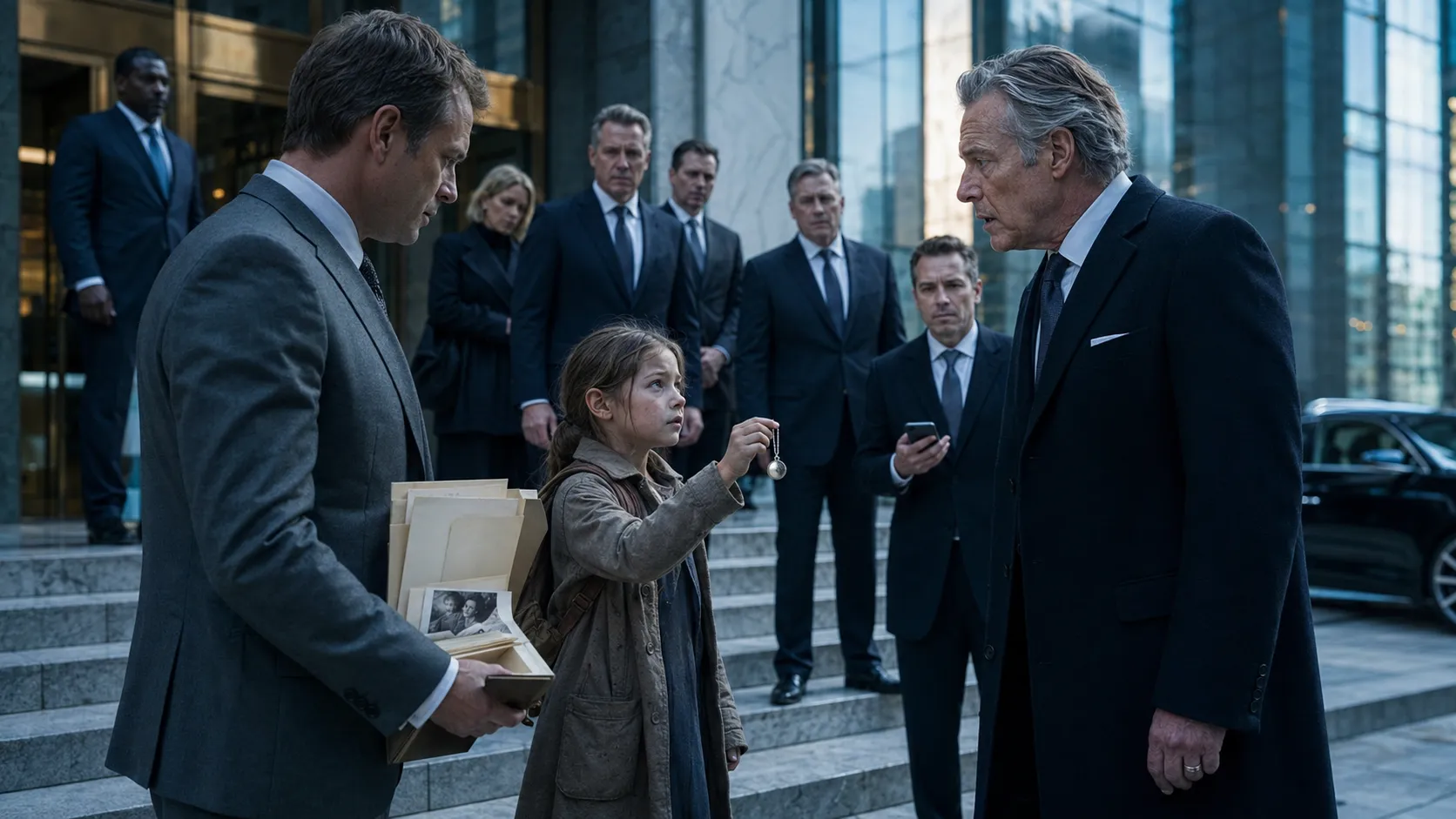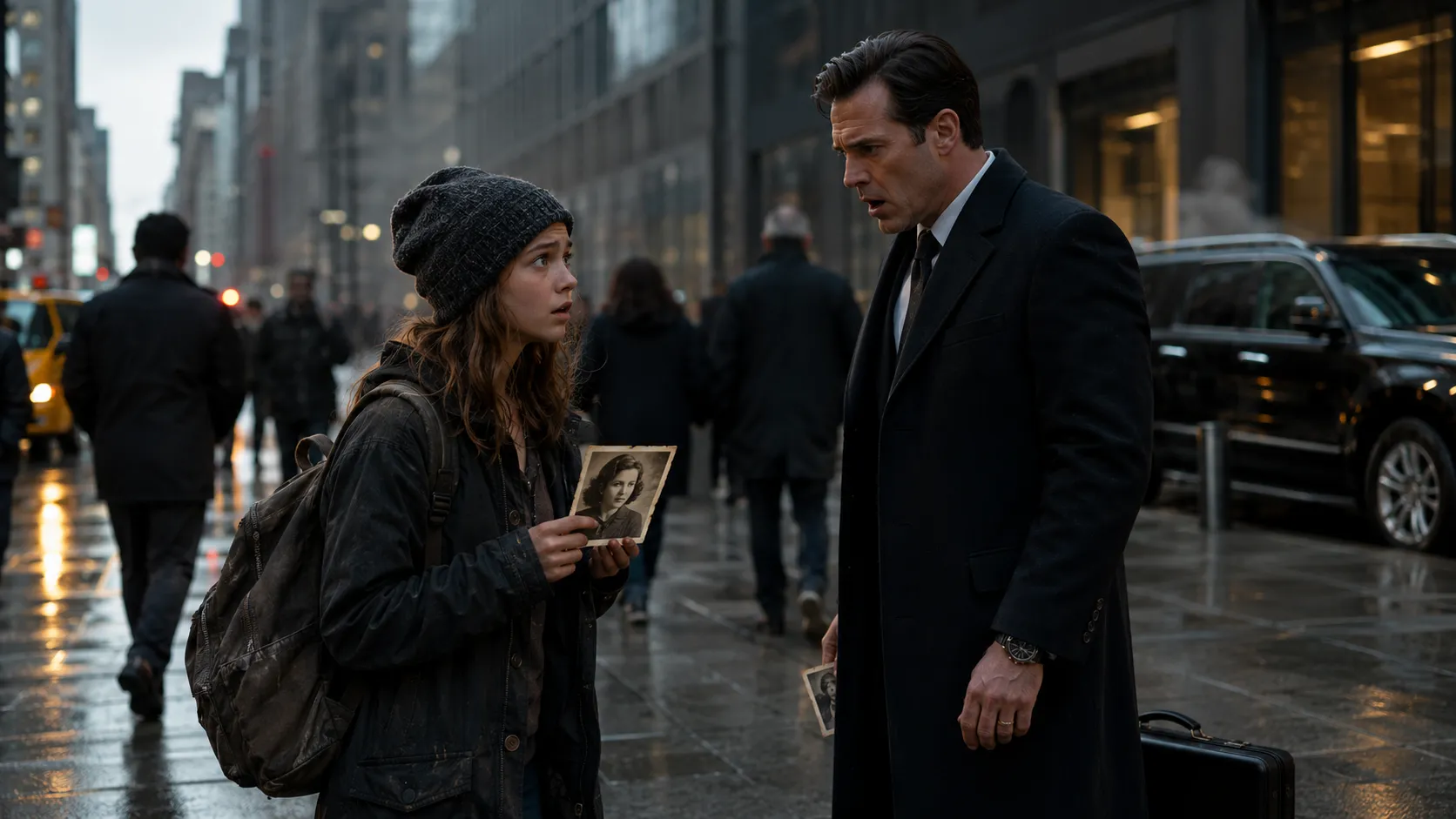
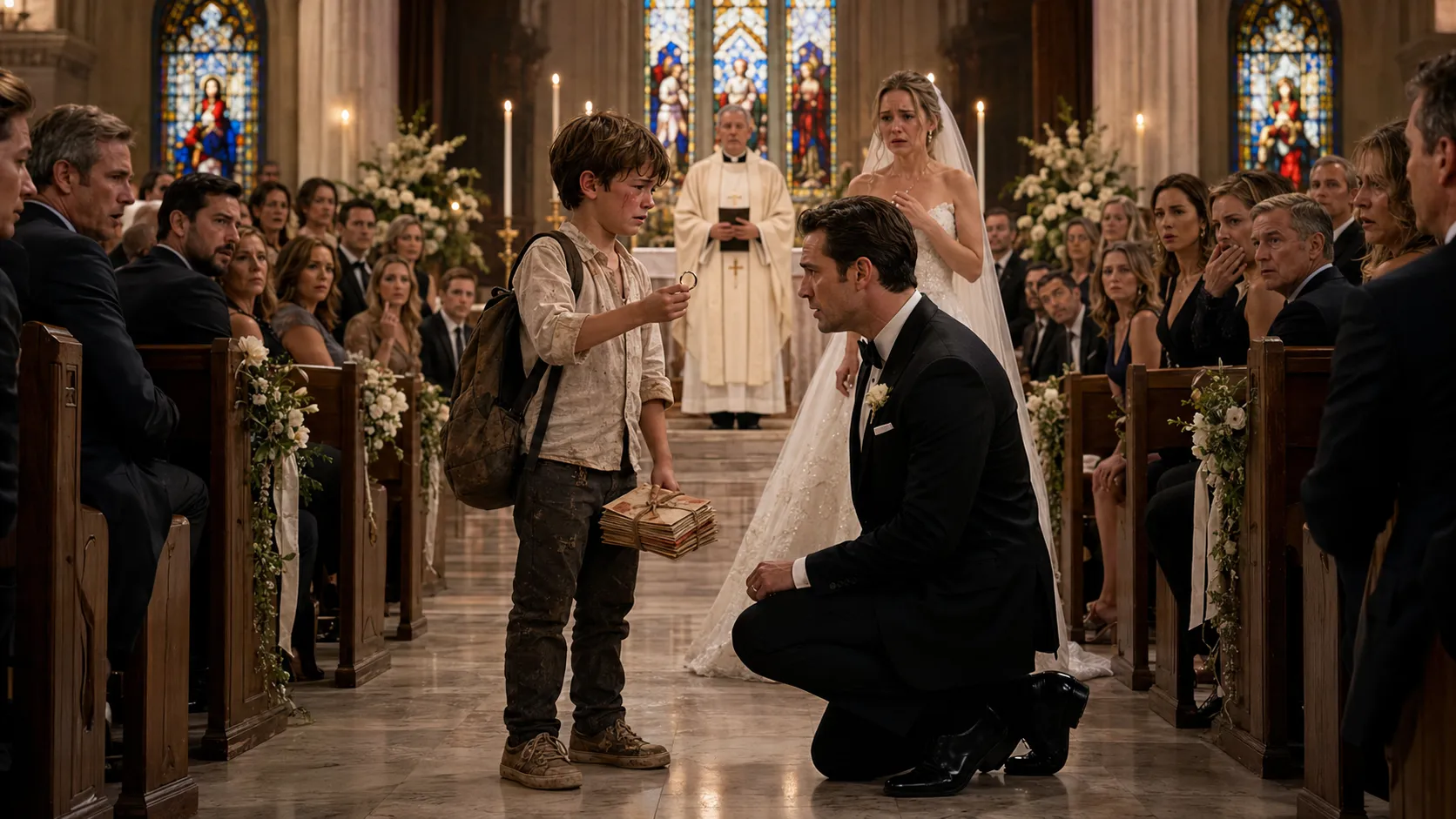
Ethan Walker was seconds away from marrying into the perfect life he had built for himself. Then a trembling boy burst through the church doors, held up an old silver ring, and said the words Ethan had spent years avoiding: “My mom said you promised to come back.”
The church was silent except for the piano.
Soft notes drifted through the enormous hall, rising beneath stained-glass windows and white flowers arranged so perfectly they looked almost unreal. Sunlight broke through the colored glass and scattered across the marble floor in red, blue, and gold.
Every guest had a phone ready.
Every smile looked rehearsed.
Every detail had been chosen, checked, corrected, and polished until the wedding no longer felt like a wedding at all.
It felt like a public announcement of victory.
At the altar stood Ethan Walker.
Thirty-seven years old.
Self-made millionaire.
Founder of Walker Urban Development.
One of the youngest real estate moguls in Chicago.
He wore a black tuxedo tailored so sharply it seemed to understand power. His hair was neatly combed. His hands rested calmly in front of him. To the guests, he looked like a man who had mastered his life completely.
Beside him stood Sophia Reynolds.
Beautiful.
Elegant.
Composed.
Her white wedding gown sparkled faintly under the church lights, and the diamond at her finger looked cold enough to cut glass. She came from a respected family, knew every donor in the room, and had spent the last two years helping Ethan turn his public image from ruthless developer into polished philanthropist.
Together, they looked perfect.
That was the problem.
They looked too perfect.
Sophia glanced at Ethan and smiled nervously.
He smiled back.
Not because he felt calm.
Because Ethan Walker had spent most of his adult life learning how to look calm when something inside him was moving in the opposite direction.
He had built everything that way.
Through control.
Through silence.
Through never looking back long enough for the past to recognize him.
The priest opened his book.
“Dearly beloved, we are gathered here today—”
BANG.
The giant church doors slammed open.
The sound tore through the ceremony like a gunshot.
Everyone turned.
At the far end of the aisle stood a boy.
He was small, no older than nine or ten, with messy dark hair, wet cheeks, and a backpack hanging from one shoulder. His shirt was wrinkled. His sneakers were muddy. He looked completely out of place among the silk dresses, tuxedos, polished shoes, white roses, and gold-trimmed programs.
For one second, nobody moved.
Then the boy screamed:
“PLEASE DON’T SAY YES!”
The piano stopped instantly.
A woman gasped.
Someone dropped a phone.
Sophia’s smile vanished.
Ethan’s face hardened.
The boy began running down the aisle.
Security moved from both sides of the church, but the aisle was long, and the child was desperate. His breathing came in broken bursts. He nearly tripped once on the runner, caught himself, and kept going.
“You can’t marry her!” he shouted.
A wave of whispers rolled through the church.
“Who is that?”
“Is this a protest?”
“Somebody stop him.”
Sophia turned toward Ethan.
“Do you know him?”
“I have no idea,” Ethan said.
But something had already tightened inside him.
Not recognition.
Not yet.
Something older than recognition.
Fear.
The boy reached the front of the church before the guards caught him. One grabbed his arm. Another reached for his backpack.
“No!” the boy cried. “Please! I have to show him!”
Ethan stepped down from the altar.
His face burned with humiliation now. Hundreds of people were watching him. Investors. Reporters. board members. Sophia’s family. His own executives. The mayor’s wife. Men who had smiled at him for years because money had trained them to.
And now a child was ruining the cleanest moment of his life.
Ethan walked toward him.
“Let him speak,” he said coldly.
The guards stopped.
The boy looked up at Ethan.
Up close, he seemed even smaller.
His face was pale. His eyes were red from crying. His hands trembled as he reached into his pocket.
Sophia stepped closer.
“Ethan, what is happening?”
“I said I don’t know.”
The boy pulled something from his pocket.
An old silver ring.
It was cheap.
Scratched.
Dull around the edges.
The kind of ring no one in that church would have noticed on any other day.
But Ethan noticed it.
His whole body went still.
The anger drained from his face so suddenly that Sophia saw it and stopped breathing.
The boy held the ring out with shaking fingers.
“Do you remember this?”
Ethan stared at it.
The church disappeared.
The flowers.
The guests.
The cameras.
The marble floor.
All of it fell away.
He was twenty-six again.
Standing under a broken bus stop light in a neighborhood he had spent years pretending he had escaped.
Rain pouring off the roof.
No money in his account.
No plan that made sense.
A girl standing in front of him with a paper bag of groceries in one hand and belief in her eyes that he had not earned.
Claire Thompson.
Ethan could hear her laugh.
Could smell the rain.
Could feel the cheap silver ring in his palm when he gave it to her.
“It isn’t real,” he had told her, embarrassed.
Claire had smiled anyway.
“Neither are half the things rich people wear. At least this one means something.”
“It’s not an engagement ring.”
“I know.”
“It’s a promise.”
“What kind?”
Ethan had taken her hand then, young and desperate and certain that wanting something badly enough made a man honorable.
“One day I’m getting out of here. I’m going to build something real. And when I do, I’m coming back for you.”
Claire had looked at him for a long time.
Then she had slipped the ring onto her finger.
“Don’t become the kind of man who forgets the people who knew him before he mattered.”
Ethan had laughed then.
As if that were impossible.
Now, ten years later, a child stood in a church holding that same ring.
Ethan’s voice barely worked.
“Where did you get that?”
The boy swallowed.
“My mom.”
Sophia’s eyes moved from Ethan to the ring.
“What is he talking about?”
Ethan did not answer.
The boy’s hand shook harder.
“She told me to give it back to you.”
The silence in the church became heavier than the music had ever been.
Ethan looked at the boy properly for the first time.
Dark hair.
Brown eyes.
A stubborn set to the jaw.
A small crease between the eyebrows.
Something in him resisted what he was seeing.
No.
No.
Not here.
Not now.
Not after everything.
“What’s your name?” Ethan asked.
“Noah.”
“Noah what?”
The boy hesitated.
“Noah Thompson.”
The name hit him in the chest.
Thompson.
Claire’s last name.
Sophia whispered, “Ethan.”
He still could not look at her.
“How old are you?”
Noah’s eyes filled again.
“Nine.”
Ethan stepped backward.
Nine.
A number can destroy a life faster than an accusation.
Nine years old.
Ten years since he left Claire.
Ten years since he changed cities, numbers, offices, assistants, homes, circles, habits, and eventually the entire story of who he had been.
Sophia understood before anyone said it.
Her face lost color.
“No,” she whispered. “No, Ethan.”
Noah looked at her, confused and frightened.
“My mom said he’s my father.”
The church erupted.
People stood.
Whispers became loud voices.
Phones rose into the air.
Sophia’s mother covered her mouth.
One of Ethan’s executives lowered his eyes.
A reporter near the back moved closer, already recording.
The priest shut his book slowly.
Ethan could not move.
Noah clutched the silver ring in one fist and reached into his backpack with the other.
“She said you might not believe me.”
Ethan’s throat tightened.
The boy pulled out a bundle of old envelopes tied with string.
He held them up.
“She tried to tell you.”
Ethan took the envelopes with numb fingers.
The first one had his old name written across it.
ETHAN WALKER
WALKER & BELL STARTUP OFFICE
SOUTH CLARK STREET
Stamped in red across the front:
RETURN TO SENDER.
UNDELIVERABLE.
He opened another.
Same handwriting.
Same red stamp.
Another.
Another.
Some had old office addresses.
Some had apartment buildings he had left years earlier.
One was addressed to his first company headquarters before the merger that made him rich.
One was sent care of a law firm he had stopped using after he hired a larger one.
Claire had tried.
Again and again.
Ethan’s hands began to tremble.
Noah spoke softly.
“My mom said she didn’t want money. She just wanted you to know I existed.”
Sophia took a step back.
The movement was small.
Ethan felt it like a door closing.
“Sophia,” he said.
She looked at him with tears in her eyes.
“Did you know?”
“No.”
“Did you know about her?”
He opened his mouth.
Nothing came out.
Because there were different kinds of knowing.
He had not known about Noah.
That was true.
But Claire?
He had known.
He had known the way a man knows a room in his house is burning but keeps the door closed because the rest of the house still looks beautiful.
He had known she existed.
Known he left.
Known he stopped answering.
Known he let success become an excuse for cowardice.
Ethan’s voice broke.
“I knew her.”
Sophia closed her eyes.
The answer was enough.
Noah looked between them, panicking now.
“My mom said I had to come before the wedding. She said if you got married, maybe it would be too late.”
Ethan turned sharply toward him.
“Where is Claire?”
Noah’s face changed.
The question seemed to take what little strength he had left.
“She died.”
The church went completely silent again.
Ethan stared at him.
“No.”
Noah nodded, tears falling freely now.
“Three days ago.”
A woman in the front row sobbed.
Sophia’s hand went to her chest.
Ethan felt the marble floor tilt beneath him.
“How?”
“She was sick.”
“What kind of sick?”
Noah looked down at the ring.
“She didn’t tell me everything. She said grown-up sickness. She said hospitals cost too much when people don’t have anyone.”
The sentence struck Ethan harder than any accusation.
Hospitals cost too much when people don’t have anyone.
He had donated millions to medical charities.
He had attended galas.
Shaken hands with hospital directors.
Smiled beside oversized checks.
And somewhere in the same city, Claire Thompson — the woman who once bought him groceries when he had nothing — had been dying without calling him because all her letters came back red-stamped and unopened.
Noah reached into his backpack again.
“There’s one more thing.”
He pulled out a folded letter.
The paper was worn from being opened and closed too many times.
On the front was one word.
Ethan.
His name in Claire’s handwriting.
His knees almost gave out.
He opened it slowly.
The church remained silent.
Even the people filming seemed to understand that something sacred and terrible was happening now.
Claire’s letter began simply.
Ethan,
If you are reading this, then I am gone, and Noah found you.
I don’t know what he saw when he reached you. Maybe a good man. Maybe a stranger. Maybe someone too far from who he was to remember who he promised to become.
I am not writing to punish you.
Life already does that if a person listens long enough.
Ethan pressed one hand over his mouth.
The words blurred.
He forced himself to continue.
I tried to tell you about him. I wrote to every address I had. I called numbers that no longer belonged to you. Once, I stood outside one of your buildings for three hours, but the security guard said I needed an appointment, and the woman at the desk looked at me like poverty was contagious.
I went home that day and decided I would not beg.
That was pride, maybe.
Or dignity.
Or both.
Noah was four then. He asked if the tall building was where his father lived. I told him no. I told him his father lived somewhere inside a story I had not finished telling yet.
Ethan closed his eyes.
A memory came.
Claire in a laundromat, folding his shirts because he had an investor meeting the next morning and could not afford dry cleaning.
Claire laughing when he practiced speeches in front of her.
Claire holding his face after his first rejection letter and saying, “You are not finished because someone with money said no.”
He kept reading.
You once gave me a silver ring and called it a promise.
I kept it.
Not because I believed you would come back.
For a long time, I didn’t.
I kept it because I wanted Noah to know he came from a moment when we were young, poor, foolish, and still capable of believing love would make us better.
He is a good boy, Ethan.
He gives away food when he is hungry.
He talks too much when he is nervous.
He clenches his fists exactly like you.
He asks questions I cannot answer anymore.
And lately, he has started asking why his father never came.
I told him the truth I could bear.
That you were not a monster.
That you were once kind.
That people sometimes get lost inside ambition.
That if there was any goodness left in you, he should not grow up believing he had been unwanted.
So I am asking one thing.
Not money.
Not pity.
Not guilt dressed as love.
If you can be his father, be his father.
If you cannot, then at least tell him the truth gently and help him find people who can love him without making him feel like a mistake.
Please do not let our son inherit your silence.
Claire
Ethan stopped reading.
His tears fell onto the letter.
For years, he had not cried.
Not when his first company almost collapsed.
Not when his mother died and he had to speak at the funeral.
Not when the newspapers called him ruthless.
He had believed self-control was strength.
Now he understood that sometimes self-control was only the polished version of fear.
Noah stood in front of him, small and exhausted, clutching the old silver ring.
“Mom said maybe you wouldn’t want me,” he whispered.
That broke Ethan completely.
He sank to his knees in the middle of the church aisle.
The guests gasped.
The millionaire groom, whose life had been arranged to look untouchable, knelt in front of a boy he had never met and cried like a man who had finally understood the cost of becoming unreachable.
“No,” Ethan said. “No, Noah.”
The boy looked frightened.
Ethan held the letter in one hand and reached for the ring with the other.
Noah let him take it.
Ethan stared at it.
Cheap silver.
Scratched from years of wear.
Still here.
Still accusing him.
Still offering him the last possible chance to become someone Claire had not been wrong to remember.
“I failed your mother,” Ethan said.
Noah’s lips trembled.
Ethan looked into his eyes.
“And I failed you before I even knew your name.”
Sophia was crying silently now.
Her veil trembled against her shoulders.
Ethan turned toward her.
“Sophia…”
She removed her engagement ring.
Not angrily.
That almost made it worse.
She took his hand and placed the ring in his palm.
“I can’t marry you today,” she whispered.
He nodded, because there was no defense.
She continued, voice breaking, “Maybe you didn’t know about the child. But you knew there was a woman in your past who loved you before you were all of this.”
Ethan lowered his eyes.
“And you let me stand beside you not knowing I was stepping over someone’s grave.”
The church went still.
Ethan looked up sharply.
“Sophia, I am sorry.”
“I believe you.”
That hurt.
She took a breath.
“But I don’t know if sorry is enough to build a marriage on.”
He had no answer.
Sophia looked at Noah.
The boy immediately lowered his gaze, as if he believed this was his fault.
Sophia saw it.
She stepped toward him, crouched carefully despite her wedding gown, and touched his shoulder.
“Noah,” she said softly, “you did not ruin anything.”
He looked at her uncertainly.
“Then why are you crying?”
Sophia smiled through tears.
“Because sometimes truth arrives late and still knocks everything down.”
Noah looked at the floor.
“My mom said I had to be brave.”
“She was right,” Sophia said. “You were.”
Then she stood, looked once at Ethan, and walked down the aisle.
The guests parted for her.
No one stopped her.
Her mother followed.
Then her father.
Then half the wedding party.
The piano remained silent.
The flowers looked ridiculous now.
The white marble floor seemed too bright for so much pain.
Ethan barely noticed the cameras anymore.
He looked only at Noah.
The boy had begun shaking.
Not from cold.
From the collapse that comes after a child has held himself together too long.
Ethan reached out slowly.
“Would you let me call someone for you? Food, a doctor, whatever you need?”
Noah wiped his face with his sleeve.
“I don’t need a doctor.”
“When did you last eat?”
The boy hesitated.
That was answer enough.
Ethan closed his eyes.
“Okay.”
He stood and turned toward his assistant, Mark, who had been frozen beside the front pew.
“Get my car to the side entrance. No cameras. Call Dr. Patel and ask her to meet us at the house. And find someone from family services we can trust — not for paperwork first, for guidance.”
Mark nodded quickly.
“Yes, sir.”
Ethan looked toward the reporters near the back.
“And if anyone posts his face, I will spend the rest of my life making them regret it.”
Several phones lowered at once.
For the first time that day, Ethan sounded like the man people feared.
But this time, the power had a purpose other than protecting his image.
Noah watched him carefully.
“You have a house?”
“Yes.”
“Is it big?”
Ethan almost laughed, but the sound came out broken.
“Too big.”
“My mom said rich houses are usually lonely.”
Ethan looked at him.
“She was right.”
Noah’s face softened for a fraction of a second.
Ethan held out his hand, then stopped halfway.
He had no right to assume the boy would take it.
Noah looked at the hand.
Then at the silver ring.
Then at the letter.
Finally, he asked, “Are you mad at me?”
Ethan shook his head immediately.
“No.”
“Because I stopped your wedding.”
Ethan swallowed.
“You stopped me from making the worst mistake of my life after already making the first.”
Noah did not fully understand.
But he understood enough.
He stepped forward.
Not into Ethan’s arms.
Not yet.
Just close enough to let Ethan place one hand carefully on his shoulder.
That small permission felt heavier than anything Ethan had ever signed.
They left through the side entrance while the guests remained inside the church whispering over the wreckage of a perfect day.
Outside, gray clouds had gathered over Chicago.
The air smelled of rain.
Noah climbed into the back seat of Ethan’s black car and immediately pressed himself into the corner, backpack on his lap.
Ethan sat beside him, not too close.
Mark closed the door, and the driver pulled away from the church.
For a while, neither spoke.
Noah stared out the window as the city passed.
Finally, he said, “My mom watched videos of you sometimes.”
Ethan looked at him.
“She did?”
Noah nodded.
“When you were on the news. She said you looked tired.”
Ethan’s chest tightened.
“What else did she say?”
“She said money made your suits better but not your eyes.”
That sounded so much like Claire that Ethan had to turn toward the window.
Noah continued, “She didn’t hate you.”
“She should have.”
The boy looked confused.
“Why would she hate you?”
Ethan did not answer quickly.
Children deserved truth, but not all at once. Not in a moving car after burying a mother and interrupting a wedding.
So he said, “Because I hurt her by disappearing.”
Noah touched the ring in his pocket.
“She said disappearing is sometimes louder than yelling.”
Ethan closed his eyes.
Claire had left him no easy places to hide.
The car pulled up to Ethan’s house twenty minutes later.
Noah stared through the window.
The house stood behind iron gates on a quiet street lined with old trees. It had stone steps, tall windows, a fountain Ethan had never liked but never removed, and enough empty rooms to make footsteps echo.
Noah’s expression changed.
Not wonder.
Suspicion.
“Do kids live here?”
“No.”
“Then why is it so big?”
Ethan looked at the house.
“I used to think big meant safe.”
Noah considered that.
“Does it?”
“No.”
The answer seemed to satisfy him more than a lie would have.
Inside, the housekeeper, Mrs. Alvarez, met them at the door.
She was sixty-eight, broad-faced, calm-eyed, and the only person in Ethan’s house who had ever spoken to him as if his money were irrelevant. She took one look at Noah and understood more than Ethan had explained over the phone.
“Come in, niño,” she said gently. “You are wet through.”
Noah held his backpack tighter.
“I’m okay.”
“People who are okay still need towels.”
She brought him into the kitchen instead of the formal sitting room, which Ethan silently thanked her for. The kitchen was warmer. Less terrifying. Less like wealth trying to prove a point.
Mrs. Alvarez made grilled cheese and tomato soup without asking what anyone wanted.
Noah ate carefully at first, as if someone might stop him.
Then faster.
Ethan sat across from him and watched the hunger Claire had written about become real.
Every bite was an indictment.
Dr. Patel arrived within an hour. She examined Noah gently, spoke to him directly, and told Ethan privately that the boy was exhausted, underweight, dehydrated, and grieving, but not in immediate medical danger.
“He needs stability,” she said quietly in the hallway. “Not spectacle. Not guilt-driven generosity. Stability.”
Ethan nodded.
“I understand.”
She looked at him sharply.
“Do you?”
He accepted the question because he deserved it.
“I’m trying to.”
That night, Noah fell asleep in the guest room closest to the kitchen because he refused the larger rooms upstairs.
Mrs. Alvarez left the hallway light on.
Ethan stood outside the door for a long time, listening to the soft sound of the boy breathing.
His son.
The word did not yet feel like something he had earned.
Downstairs, he found Claire’s letter on the kitchen table.
He read it again.
Then again.
At 2:00 in the morning, he walked into his private office, the room where so many decisions had been made without human cost entering the conversation.
On the walls were awards, framed magazine covers, architectural renderings, photographs with politicians, donors, developers, men in expensive suits who looked proud of things that had displaced people they would never meet.
Ethan opened the bottom drawer of his desk.
Inside was an old cardboard box he had not touched in years.
He had moved it from apartment to apartment without opening it, then from his first condo to this house, then into the drawer because throwing it away felt cruel and opening it felt dangerous.
Now he lifted the lid.
Inside were pieces of a life he had buried.
A photograph of him and Claire outside a laundromat.
A bus pass.
A folded napkin with a business plan scribbled across it.
A grocery receipt from the night she had spent her last twenty dollars feeding him because he had lied and said he was not hungry.
A small Polaroid of Claire sitting on the floor of his old apartment, laughing beside a stack of application forms.
Ethan sat down heavily.
He had not forgotten her because time erased memory.
He had worked at forgetting.
That was worse.
In the morning, Noah found him asleep in the office chair, Claire’s photographs spread across the desk.
The boy stood in the doorway.
Ethan woke slowly.
“Noah?”
“You knew her.”
Ethan looked at the photos.
“Yes.”
“Before I was born.”
“Yes.”
“Were you poor?”
Ethan nodded.
“Very.”
Noah stepped inside carefully.
“Mom said you were hungry a lot.”
“She knew?”
“She always knew when people were hungry.”
Ethan felt that sentence settle inside him.
Noah came closer and picked up the Polaroid of Claire laughing.
“She looked younger here.”
“She was.”
“Happy?”
Ethan swallowed.
“I think so.”
Noah looked at him.
“Did you make her sad?”
Ethan closed his eyes briefly.
“Yes.”
The boy absorbed that.
Then placed the photo back on the desk.
“I don’t know if I like you yet.”
Ethan nodded.
“That’s fair.”
“But Mom said I should give you a chance if you listened.”
Ethan leaned forward.
“I’m listening.”
Noah looked around the office.
At the awards.
The rich furniture.
The framed magazine covers.
Then back at Ethan.
“Then don’t put me in a room and forget me.”
The words landed with terrifying precision.
Ethan shook his head.
“I won’t.”
Noah’s eyes narrowed.
“Adults say things when they feel bad.”
“Yes,” Ethan said. “They do.”
“So how do I know?”
Ethan looked at Claire’s letter.
“You don’t. Not today.”
That answer surprised the boy.
Ethan continued, “I have to show you. Not with one speech. Not with one day. With a lot of days.”
Noah watched him for a long time.
Then nodded once.
“Okay.”
That was the beginning.
Not a happy ending.
Not yet.
Beginnings are usually messier than stories admit.
The first weeks were full of paperwork, appointments, awkward silences, and grief that entered rooms without knocking. A family court judge ordered temporary guardianship pending DNA confirmation and child welfare review. Ethan cooperated with everything, though every form reminding him that he needed legal permission to care for his own son felt like punishment he had no right to resent.
The DNA test came back two weeks later.
Probability of paternity: 99.9998%.
Ethan read it alone first.
Then gave it to Noah.
The boy studied the paper, frowning.
“So science says yes?”
“Yes.”
“Did you need science?”
Ethan looked at him.
“No.”
Noah folded the paper.
“I did.”
Ethan nodded.
“That’s fair too.”
Noah kept the result in his backpack beside Claire’s letter and the silver ring.
He still slept with the hallway light on.
He still woke some nights calling for his mother.
The first time it happened, Ethan ran into the room and found Noah sitting upright, sobbing so hard he could barely breathe.
“I forgot her voice,” the boy cried.
Ethan sat on the edge of the bed, helpless.
He had no fatherly instinct to guide him. No script. No easy comfort.
Then he remembered Claire singing while washing dishes in his old apartment. Off-key. Loud. Unembarrassed.
“She used to sing badly,” Ethan said softly.
Noah looked up through tears.
“What?”
“Your mom. She sang badly.”
The boy froze.
“She did?”
“Very badly.”
“No, she didn’t.”
“Yes, she did.”
Noah sniffled.
“What song?”
Ethan sang the first line of an old soul song Claire used to hum whenever it rained.
His voice was awful.
Noah stared.
Then, unexpectedly, laughed through tears.
“That is bad.”
“She sounded better than me.”
“She sounded a lot better than you.”
Ethan smiled.
Noah cried again, but quieter now.
Ethan stayed until he fell asleep.
The next day, Noah asked for the song.
Ethan found it online.
They played it in the kitchen while Mrs. Alvarez made pancakes.
Noah said his mother used to dance to it when rent was late because “worry needed somewhere to go.”
Ethan turned away and pretended to get coffee.
Mrs. Alvarez saw everything.
She said nothing.
Sophia called three weeks after the wedding.
Ethan almost did not answer.
Then he thought of all the calls Claire had made that he never received.
He picked up.
For a moment, neither spoke.
Finally, Sophia said, “How is he?”
Ethan looked through the glass doors toward the backyard, where Noah sat on the steps drawing in a notebook.
“Quiet,” he said. “Smart. Angry sometimes. He misses her.”
“He should.”
“Yes.”
Sophia exhaled.
“I watched the videos once. Then I stopped. People online are turning it into entertainment.”
“I know.”
“You need to protect him from that.”
“I’m trying.”
A pause.
Then Sophia said, “Good.”
Ethan closed his eyes.
“Sophia, I am sorry.”
“I know.”
“I humiliated you.”
“Yes.”
“I lied by omission.”
“Yes.”
“I let you stand beside someone I had not been honest about.”
“Yes.”
Her honesty was clean and painful.
Ethan waited.
Sophia’s voice softened slightly.
“But I also think that boy saved you from becoming completely unreachable.”
Ethan looked at Noah through the window.
“I think so too.”
“I hope you become worthy of him.”
“So do I.”
Sophia did not forgive him that day.
He did not ask her to.
But six months later, when the media began circling Noah’s school after someone leaked his enrollment, Sophia used her family’s legal connections to help shut the story down.
She sent Ethan one message afterward:
Children should not pay for adult cowardice.
He replied:
Thank you.
She did not answer.
That was enough.
Ethan took Noah to Claire’s grave for the first time in early spring.
The cemetery stood outside the city, near a line of bare trees and a narrow road that hummed with passing traffic.
Claire’s grave was modest.
Too modest.
Ethan hated himself for noticing that thought.
As if more expensive stone could repair neglect.
Noah carried white daisies because Claire had liked flowers that looked “like they weren’t trying to impress anybody.”
They stood together before the grave.
For a long time, Noah said nothing.
Then he placed the flowers down carefully.
“I found him,” he whispered.
Ethan bowed his head.
Noah touched the silver ring in his pocket.
“He listened a little.”
Ethan swallowed hard.
Noah looked at him.
“You can talk too.”
Ethan stared at the name on the stone.
CLAIRE THOMPSON
BELOVED MOTHER
SHE KEPT HER PROMISES
The words nearly broke him.
“I’m sorry,” he said.
It was not enough.
No sentence could be.
Still, he continued.
“I became exactly what you warned me not to become. I let people disappear from my life if they didn’t fit the future I wanted. I told myself success was survival, but it became an excuse to abandon anything that made me feel ashamed.”
Noah listened quietly.
Ethan’s voice shook.
“You gave me more chances than I deserved. The last one is standing beside me now.”
He looked down at his son.
“I don’t know if I can make it right.”
Noah looked back at the grave.
“Mom said you can’t fix yesterday.”
Ethan closed his eyes.
“What else did she say?”
“That you can stop making tomorrow worse.”
Ethan laughed once, brokenly.
“Of course she did.”
They visited every Sunday after that.
Not because Noah asked.
Because Ethan did.
Sometimes they talked.
Sometimes they sat in silence.
Sometimes Noah told stories about Claire that made Ethan smile and suffer at the same time.
She burned toast.
She hated phone trees.
She cried during commercials with old dogs.
She kept envelopes in a shoebox.
She once walked three miles in the snow because Noah wanted cupcakes for his school birthday and she could not afford delivery.
Each detail became a gift and a punishment.
Ethan accepted both.
Months passed.
Noah began school again.
He struggled.
Not with grades.
With people.
Children whispered. Parents recognized his father. Teachers treated him too gently. One boy asked if his mother had really died “right before the rich wedding thing,” and Noah punched him in the stomach.
Ethan was called to the principal’s office.
He walked in expecting to handle it with money, authority, and solutions.
Then he stopped himself.
Noah sat in a chair with crossed arms and red eyes.
The other boy’s parents looked furious.
The principal looked nervous because Ethan Walker sitting in a school office was apparently a legal event.
Ethan asked Noah only one question.
“What happened before you hit him?”
Noah stared at the floor.
“He said my mom was lucky I found a rich dad.”
The room went silent.
The other parents looked uncomfortable.
Ethan felt anger rise.
Old anger.
The kind that wanted to use power like a weapon.
Instead, he knelt in front of Noah.
“That was cruel,” he said. “And hitting him was wrong.”
Noah’s face twisted.
“So I just let him say it?”
“No.”
“Then what?”
Ethan had no perfect answer.
He wished Claire were there.
Then he realized she had left enough of herself in Noah for the answer to be possible.
“You tell the truth,” Ethan said. “Loud enough that adults have to hear it. And if they don’t, you come get me. I’m done being unreachable.”
Noah stared at him.
The principal lowered her eyes.
The other parents apologized badly.
Not enough.
But enough to begin.
That night, Noah left his bedroom door open for the first time.
Ethan noticed but said nothing.
Some progress, Mrs. Alvarez later told him, should not be frightened by applause.
A year after the wedding that never happened, Ethan held a small gathering at a community center in the neighborhood where he and Claire had grown up.
No photographers.
No champagne.
No marble.
No white roses.
Just folding chairs, old friends, neighborhood families, teachers, and children from the after-school program Claire used to volunteer with when Noah was little.
Ethan stood at a microphone with Noah beside him.
On the wall behind them was a banner:
THE CLAIRE THOMPSON FAMILY ACCESS FUND
Not charity, Ethan had insisted.
Access.
Food support.
Legal help for single parents.
Medical advocacy.
Stable housing assistance.
A direct outreach office for families who had been told to leave messages no one returned.
When Ethan stepped to the microphone, the room quieted.
He had given speeches in front of thousands.
This one scared him most.
“I used to think success meant leaving places like this behind,” he said.
Noah looked at him.
Ethan continued, “Claire Thompson taught me differently before I was ready to learn. She believed people should not have to become important before someone answers the phone.”
A few older women nodded.
“She tried to reach me for years. She should not have had to try that hard. No one should.”
His voice tightened.
“This fund exists because unanswered letters can change a child’s life. Because medical bills should not decide whether a mother suffers quietly. Because pride and poverty can isolate people until they disappear in plain sight.”
He looked down at Noah.
“And because my son had to walk into a church alone before I finally listened.”
Noah looked embarrassed by the attention, but he did not step away.
After the speech, an elderly man approached Ethan.
He had known Claire’s mother years earlier.
“She would’ve liked this,” he said.
Ethan swallowed.
“Would she have forgiven me?”
The old man looked at him for a long moment.
“Son, sometimes the dead leave us work instead of answers.”
Ethan carried that sentence for years.
Life did not become simple.
Noah still missed Claire.
Ethan still made mistakes.
Sometimes he overcompensated and bought things Noah did not want. Sometimes Noah accused him of trying to replace love with money. Sometimes Ethan became too quiet when guilt returned, and Noah would say, “Don’t disappear while sitting right there.”
That sentence became their warning bell.
Ethan learned.
Slowly.
Awkwardly.
He learned Noah liked pancakes without syrup but with powdered sugar.
He learned Noah hated large parties.
He learned Noah drew buildings with tiny people in the windows because, as he said once, “Buildings shouldn’t forget people live in them.”
That changed Ethan’s work more than any consultant ever had.
He started reviewing his developments differently.
Affordable housing requirements became personal.
Tenant relocation stopped being a line item.
Community meetings stopped being performance.
His board hated some of it.
Investors called it emotional.
Ethan answered calmly, “Good.”
One executive said, “This will cost us.”
Ethan replied, “So did becoming men who didn’t care.”
Three executives resigned.
The company survived.
Better than before, though not as brutally profitable.
Ethan discovered that less brutal was not the same as weak.
Five years later, Noah stood in the same church where he had stopped the wedding.
He was fourteen now.
Taller.
Still serious.
Still carrying Claire’s ring on a chain beneath his shirt.
But this time, the church was not filled with wedding flowers.
It was filled with families served by the Claire Thompson Fund.
Children ran between pews. Volunteers arranged food tables. An old choir sang near the altar. The marble floor looked less cold with life moving across it.
Ethan stood beside Sophia near the back.
She had married someone else two years earlier — a teacher with kind eyes and no interest in society pages. She had come that day with her husband because the foundation was funding a legal clinic at his school.
She looked toward Noah.
“He looks more like you now.”
Ethan smiled faintly.
“He acts more like her.”
“That’s probably good.”
“Yes,” Ethan said. “It is.”
A pause settled between them.
Not painful this time.
Simply honest.
Sophia said, “I hated you for a while.”
“I know.”
“I hated that people pitied me more than they talked about her.”
Ethan looked down.
“She deserved better.”
“So did I.”
He nodded.
“Yes.”
Sophia studied him.
“You’re different.”
“I hope so.”
“Noah did that?”
Ethan looked toward his son, who was helping a little girl fix a paper airplane.
“No,” he said. “Noah gave me a reason. Claire left me the instructions. I still had to decide whether to follow them.”
Sophia smiled gently.
“That sounds like something a man says after years of therapy.”
“It was not optional.”
“I’m glad.”
Across the church, Noah waved Ethan over.
Ethan excused himself and walked down the aisle.
The same aisle where his old life had collapsed.
The same aisle where a boy had stood with shaking hands and a ring.
Noah held out a folded paper.
“What’s this?” Ethan asked.
“My speech.”
“You’re giving a speech?”
“No. You are.”
Ethan blinked.
“I already gave one.”
“This one is shorter.”
Ethan opened the paper.
In Noah’s handwriting were three sentences.
My mother kept her promises.
My father is learning how.
This place is for people still waiting for someone to answer.
Ethan read it twice.
Then looked at Noah.
The boy shrugged.
“Too much?”
Ethan’s eyes burned.
“No.”
“You sure?”
“I’m sure.”
Noah studied him.
“You’re doing the crying face.”
“I am not.”
“You are.”
Ethan folded the paper carefully.
“Your mother would have loved this.”
Noah touched the chain beneath his shirt.
“Yeah?”
“Yes.”
The boy nodded, trying to look casual and failing.
That afternoon, Ethan read Noah’s three sentences to the room.
He did not add anything.
He had learned, finally, that not every silence needed to be filled by him.
Years later, people still talked about the boy who stopped the millionaire’s wedding.
Some told it like scandal.
Some like punishment.
Some like a miracle.
Noah hated all versions that made his mother sound like a plot twist.
“She was the story,” he would say.
And he was right.
Claire Thompson was not the dead woman who interrupted a wedding through a letter.
She was the woman who fed Ethan when he was hungry.
The woman who believed in him before investors did.
The mother who raised Noah with honesty, warmth, and just enough hope to send him into a church alone.
The woman who kept a cheap silver ring not because it was valuable, but because promises matter most when they are made by people who have nothing else.
On Noah’s eighteenth birthday, Ethan gave him the ring properly.
Not as inheritance.
As truth.
They stood at Claire’s grave at sunset.
Noah had grown taller than Ethan by then, though Ethan refused to admit it without measurement.
Ethan placed the ring in Noah’s palm.
“She gave this back to me through you,” he said. “But I think it belongs with you.”
Noah looked at the ring.
The scratches were still there.
The silver still dull.
The promise still complicated.
“I used to hate it,” Noah said.
Ethan nodded.
“I understand.”
“Then I thought it was proof you owed us.”
“I did.”
Noah looked up.
“And now?”
Ethan waited.
Noah closed his fingers around the ring.
“Now I think it’s proof Mom believed people could come back from who they became.”
Ethan could not speak.
Noah slipped the ring back onto the chain and tucked it beneath his shirt.
Then he looked at the grave.
“I’m going to college,” he said.
Ethan blinked.
“You got the letter?”
Noah smiled.
“Architecture.”
Ethan laughed once.
“Of course.”
“I want to build housing that doesn’t make people feel small.”
Ethan looked toward Claire’s name.
“She would be proud.”
Noah nodded.
Then after a long pause, he said, “So am I.”
Ethan turned.
Noah looked embarrassed by his own words but did not take them back.
“You stayed,” he said. “A lot of days.”
Ethan closed his eyes briefly.
A lot of days.
The only proof that had ever mattered.
When they left the cemetery, the sky was turning gold over the city.
Ethan walked beside his son, not ahead of him.
The old silver ring rested against Noah’s chest.
Claire’s promise had traveled through poverty, silence, illness, grief, a ruined wedding, and years of difficult repair.
It had survived all of them.
Not because Ethan kept it.
He had not.
Not because life was fair.
It was not.
It survived because Claire Thompson had been right about one thing until the end.
There was still goodness left.
It had just taken a child brave enough to walk into a church and demand that a man remember it.