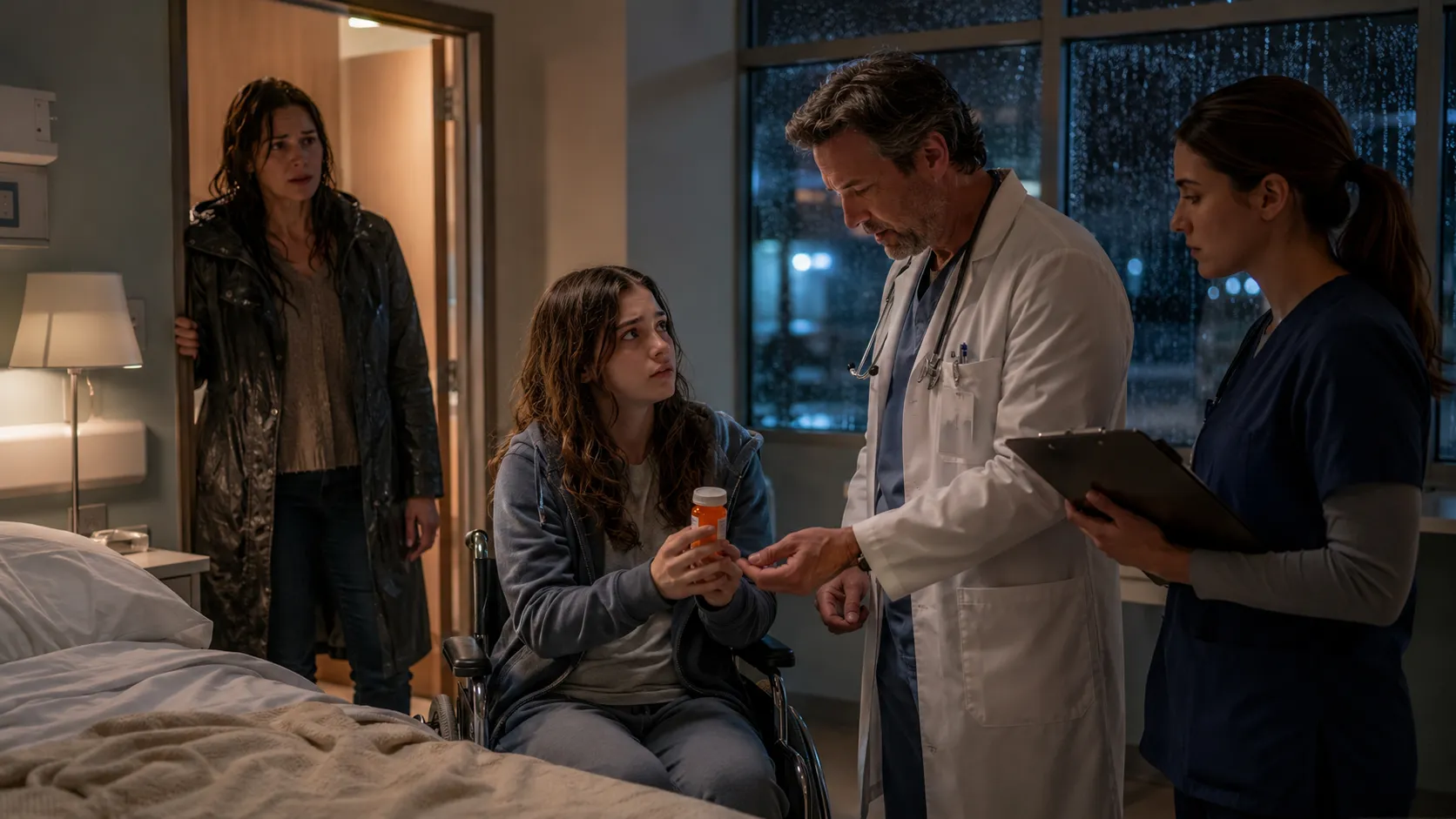
Fourteen-year-old Emily thought the orange bottle in her hand was the medicine keeping her alive. Then a kind doctor read the label, turned pale, and told her the truth no child should ever hear: the person giving it to her was not healing her.
The rain began just before midnight.
It struck the windows of Saint Mercy Hospital in hard silver lines, blurring the city lights outside Room 214 until Chicago looked like it was melting into the dark. Ambulance sirens echoed through the streets below. Nurses moved quickly past the open doorway. Somewhere down the hall, a monitor beeped in a steady rhythm that made the silence inside Emily Carter’s room feel even heavier.
Emily sat alone in a wheelchair by the window.
She was fourteen years old.
Too young to be afraid the way she was afraid now.
Her pale hands trembled around a small orange medicine bottle. The plastic was warm from being held too long. Her thumb kept moving over the white label, rubbing the strange printed code until the paper began to wrinkle.
No pharmacy name.
No doctor’s name.
No dosage instructions she could understand.
Only a number.
NX-47B.
Emily stared at it again.
For two months, her mother had placed one pill from that bottle into her hand every night and said the same thing.
“This will help your nerves heal, sweetheart.”
At first, Emily believed her.
Of course she did.
Julia Carter was her mother. She had packed her lunches, braided her hair badly before school, cried at her seventh-grade choir concert, and worked double shifts after Emily’s father died so they could keep their apartment.
Emily trusted her more than anyone alive.
But trust can begin to crack quietly.
For weeks, Emily’s legs had grown weaker.
At first, she blamed exhaustion. Then the stairs at school became impossible. Then she began falling in the hallway. Then one morning she tried to stand beside her bed and collapsed so suddenly that her forehead struck the dresser.
Her mother took her to Saint Mercy that afternoon.
The doctors said it looked like a rare nerve disorder.
Julia nodded too quickly.
“Yes,” she said. “That’s what the clinic told us.”
Emily remembered looking at her mother then.
“What clinic?”
Julia squeezed her hand.
“A private one. I told you, honey. The one helping with the medicine.”
Emily did not remember being told.
But pain makes memory uncertain, and fear makes children want to believe adults know what they are doing.
So she stayed quiet.
Until tonight.
Earlier that evening, Emily had been half-asleep when two nurses stopped outside her door.
They thought she could not hear them.
“She’s too young,” one whispered.
“I know,” the other said. “And that medicine bottle? Something about this case doesn’t feel right.”
The words had entered Emily’s chest like cold water.
Something doesn’t feel right.
After the nurses left, Emily reached into the drawer beside her hospital bed, took out the medicine bottle her mother had hidden under a folded sweater, and rolled herself to the window where the light was better.
She read the label.
Again.
And again.
NX-47B.
No prescription number.
No pharmacy.
No name she recognized.
Only the code.
That was when she made a decision.
She would ask someone else.
Not her mother.
Not tonight.
The door opened softly.
Dr. Michael Reeves stepped into the room holding a tablet under one arm.
He was in his early forties, with tired eyes, rolled-up sleeves, and a voice that always seemed to lower the temperature of fear. Nurses said he was one of the kindest doctors at Saint Mercy. Patients said he remembered names. Emily liked him because he never talked to her like she was too young to understand her own body.
He smiled when he saw her awake.
“You should be sleeping.”
“I couldn’t.”
“Pain?”
“A little.”
He glanced at the bottle in her hands.
“What do you have there?”
Emily’s fingers tightened around it.
For a moment, courage almost left her.
Then she lifted the bottle.
“Dr. Reeves?”
“Yes?”
“What is this medicine used for?”
He crossed the room casually, expecting vitamins perhaps, or an outside prescription he would need to add to her chart.
He took the bottle.
Read the label.
And froze.
The change in his face was small at first.
A tightening around the eyes.
A pause too long for a simple answer.
Then the color drained from his cheeks.
Emily’s stomach twisted.
“What is it?” she whispered.
Dr. Reeves did not answer.
He turned the bottle slowly in his hand, read the code again, then looked at the pills inside.
His voice became careful.
“Emily, where did you get this?”
“My mom gives it to me.”
His eyes lifted.
“Every day?”
She nodded.
“At night.”
“How long?”
Emily swallowed.
“Almost two months.”
Dr. Reeves looked toward the door.
Then back at her.
“Has anyone else given it to you? A nurse? A pharmacist? Another doctor?”
“No. Only Mom.”
He closed his hand around the bottle so tightly his knuckles whitened.
Emily felt tears fill her eyes before she understood why.
“You’re scaring me.”
The doctor immediately knelt beside her wheelchair.
“I’m sorry. I don’t want to scare you.”
“What is it?”
He hesitated.
That frightened her more than anything.
Adults lied quickly when truth was simple.
Dr. Reeves looked at the bottle again and spoke slowly.
“This is not a standard medication.”
Emily’s throat tightened.
“But it’s medicine.”
“It is a compound used in experimental neurological research.”
“I don’t know what that means.”
“It means it should never have been given to you at home. It should never have been given without hospital supervision. And it should never have been given to a child without very strict legal approval.”
Her hand moved to her lap.
“My mom said it was helping.”
Dr. Reeves’s face softened with pain.
“Emily, I need to run tests immediately.”
She stared at him.
“Is it making me sick?”
He did not answer fast enough.
That was answer enough.
Emily looked down at her legs.
The legs that had once run across soccer fields.
The legs that had carried her up the apartment stairs two at a time.
The legs that now felt like someone had slowly erased them from her body.
Her voice cracked.
“Am I going to walk again?”
Dr. Reeves placed one hand gently on the arm of the wheelchair.
“I don’t know yet. But you did the right thing by showing me this bottle.”
Emily began to cry.
Not loudly.
Just silently, tears sliding down her face as the rain struck the window beside her.
“I don’t understand,” she whispered. “Why would my mom give me something bad?”
Dr. Reeves did not pretend to know.
That was one of the reasons Emily trusted him.
He stood and pressed the call button near the bed.
When Nurse Angela entered, he handed her the bottle inside a sealed specimen bag and said in a low voice, “Lock down the medication history. Draw blood for toxicology. Page neurology. And call hospital security.”
Angela’s eyes widened when she saw the label.
She looked at Emily, then back at him.
“Doctor…”
“Now.”
Emily’s heart began beating too fast.
“Security?”
Dr. Reeves turned back to her.
“Only to keep you safe.”
“From who?”
He did not answer.
Down the hallway, footsteps quickened.
Within twenty minutes, Room 214 changed from a quiet hospital room into the center of a storm.
Two nurses drew blood. A neurologist arrived in a gray sweater over scrubs. A security officer stood outside the door. Someone from hospital administration whispered urgently on a phone near the nurses’ station. Dr. Reeves kept his voice calm every time he spoke to Emily, but she could see anger moving behind his eyes.
Not at her.
That helped.
A little.
At 1:12 a.m., the first test results came back.
Dr. Reeves read them outside her room, standing beside the neurologist and a woman from hospital legal. Emily could not hear the words, but she could see their faces through the narrow window in the door.
The neurologist covered her mouth.
The legal woman closed her eyes.
Dr. Reeves looked like he wanted to put his fist through a wall.
When he returned, he pulled a chair close and sat in front of Emily.
He did not stand above her.
He did not hide behind the tablet.
“Emily,” he said softly, “the compound has been affecting your nervous system.”
She gripped the blanket over her knees.
“Can you stop it?”
“We stopped it tonight.”
“But my legs?”
“We’re starting treatment to help your body clear it and reduce further damage. Some of what you’re feeling may improve. Some of it may take time.”
“Will I be paralyzed?”
His eyes filled with something too gentle to be hope.
“I’m going to fight very hard so that does not happen.”
Emily nodded because she wanted to be brave.
Then she asked the question that had been waiting in the room from the beginning.
“Does my mom know?”
Before Dr. Reeves could answer, a voice came from the doorway.
“Know what?”
Emily turned.
Julia Carter stood there in a rain-soaked coat.
Her brown hair clung to her face. Her mascara had smudged beneath one eye. She looked exhausted, frightened, and angry all at once.
For one moment, Emily wanted to throw herself into her mother’s arms.
Then she saw Julia’s eyes move to the sealed medicine bag on the counter.
Panic flashed across her face.
Only for a second.
But Emily saw it.
And something inside her broke.
“Mom?” she whispered.
Julia forced a smile too quickly.
“Sweetheart, what is going on? Why is there security outside your door?”
Dr. Reeves stood.
“Mrs. Carter, we need to speak privately.”
“No,” Emily said.
Her own voice surprised her.
Everyone turned.
Emily looked at her mother.
“No more private talking about me. I want to hear.”
Julia’s face tightened.
“Emily, you’re sick. You need rest.”
“I want to hear.”
Dr. Reeves looked at Julia.
“So do I.”
The silence that followed felt colder than the rain.
Julia stepped into the room slowly.
“What did you do?” she asked the doctor.
His expression hardened.
“I was going to ask you the same question.”
Julia’s mouth opened, then closed.
Dr. Reeves lifted the sealed bag.
“Where did you get NX-47B?”
Julia stared at the bottle as if it were a snake.
“I don’t know what that is.”
Emily flinched.
Dr. Reeves noticed.
“Mrs. Carter.”
Julia’s voice rose.
“I said I don’t know.”
“Your daughter says you gave it to her every night.”
Julia turned sharply toward Emily.
“Why would you say that?”
Emily shrank back.
The look on her mother’s face was not worry now.
It was betrayal.
As if Emily had done something wrong by telling the truth.
“I didn’t lie,” Emily whispered.
Julia’s eyes filled with tears instantly.
“No, baby, I didn’t mean—”
The doorway filled with two police detectives and a hospital administrator.
Detective Harris, a woman in her fifties with silver hair pulled into a low bun, stepped in first.
“Julia Carter?”
Julia looked from the detective to Dr. Reeves.
“What is this?”
Detective Harris held up a badge.
“We need to ask you some questions.”
Julia turned pale.
Emily’s hands went numb around the blanket.
“Mom,” she said, voice breaking. “What did you give me?”
Julia looked at her daughter.
For a long moment, the room held its breath.
Then Julia began to cry.
Not a few tears.
Not the controlled crying of someone caught in a misunderstanding.
She folded inward like a person whose last wall had finally collapsed.
“I didn’t know,” she sobbed. “I swear I didn’t know it would get this bad.”
Emily stared at her.
The words did not make sense at first.
Then they made too much sense.
“You knew?”
Julia reached for her.
Emily pulled back.
That tiny movement devastated them both.
Julia covered her mouth.
“Emily, please.”
“You knew?”
Detective Harris stepped forward.
“Mrs. Carter, sit down.”
Julia sank into the chair by the bed.
Rainwater dripped from her coat onto the floor.
For a moment, she did not look like a villain.
She looked like a mother drowning in a decision she had made one lie at a time.
“I was scared,” she whispered.
Dr. Reeves’s voice was low.
“That is not an answer.”
Julia looked at him.
“You think I don’t know that?”
Emily’s eyes burned.
“Then tell me.”
Julia turned back to her daughter.
“After your father died, everything collapsed.”
Emily said nothing.
Her father’s name was Thomas Carter. He had died two years earlier from a sudden heart attack while driving home from work. He had been a gentle man with wide hands, a bad singing voice, and a habit of leaving sticky notes on the refrigerator that said things like Buy milk and Emily is smarter than both of us.
After he died, Julia changed.
Not all at once.
At first, she only cried when she thought Emily was asleep. Then bills piled up on the kitchen table. Then the car was sold. Then they moved from their old apartment into a smaller one near the train tracks. Then Julia started staring at Emily sometimes with a look Emily did not understand.
A mixture of love, grief, resentment, and fear.
Julia wiped her face.
“The insurance didn’t pay what we thought. Your father had debts I didn’t know about. Medical bills from before he died. Credit cards. The rent. School fees. Everything.”
Emily whispered, “I knew we were poor.”
“No,” Julia said. “You knew we were careful. You didn’t know we were drowning.”
Detective Harris asked, “Who contacted you?”
Julia’s shoulders shook.
“A man named Dr. Nolan.”
Dr. Reeves stiffened.
The neurologist at the door exchanged a glance with him.
Detective Harris noticed.
“You know that name?”
Dr. Reeves’s jaw tightened.
“I know of him.”
Julia looked at him.
“He said he worked with a private neurological foundation. He said they were testing a treatment for rare nerve weakness in adolescents. He said Emily qualified because her father had a family history of autoimmune issues.”
“That was false,” Dr. Reeves said.
“I know that now.”
“You should have known it then.”
Julia flinched.
Emily stared at the floor.
The room blurred.
The words came in pieces.
Private foundation.
Monthly payments.
Home monitoring.
Confidential participation.
No outside doctors.
No questions.
Julia said the first envelope of money arrived two days after she signed the papers.
Five thousand dollars.
Enough to stop the eviction.
Enough to pay the electric bill.
Enough to buy groceries without calculating every dollar at the register.
At first, Emily had no symptoms.
Then fatigue.
Then numbness.
Then falls.
Julia called Dr. Nolan.
He told her those symptoms were expected.
Temporary.
Proof the treatment was “retraining” the nervous system.
When Julia wanted to stop, he threatened her.
“He said I signed consent forms,” Julia whispered. “He said I had already accepted payment. He said if I exposed the study, they would sue me for fraud and medical neglect. He said they would take Emily away.”
Emily looked up.
“So you kept giving it to me?”
Julia began crying harder.
“I thought if I stopped, they would come for us.”
“They already did,” Dr. Reeves said.
Julia looked at him helplessly.
He did not soften.
“They came through you.”
Emily closed her eyes.
The sentence was too painful because it was true.
Her mother had not injected her with hatred.
Not exactly.
She had done something almost worse.
She had loved her, feared losing her, and still handed her poison every night because fear had been stronger than courage.
Detective Harris asked for the contact information, payment records, messages, clinic address, anything Julia had kept.
Julia nodded repeatedly.
“I have everything,” she said. “I didn’t delete it. I was afraid to delete it.”
Emily stared at her.
“Were you afraid for me?”
Julia looked at her.
The answer was supposed to be yes.
But after everything, Emily needed more than the answer that sounded like love.
Julia whispered, “I was afraid of everything.”
That honesty hurt more than another lie.
The police did not arrest Julia in the room.
Not immediately.
Detective Harris read her rights softly in the hallway while another officer took her phone. Julia kept looking back through the open door at Emily, but Emily turned her wheelchair toward the window.
She could not watch.
“Emily,” Julia cried from the hallway. “Please, sweetheart. Please look at me.”
Emily pressed both hands over her ears.
The rain hit the glass harder.
Dr. Reeves closed the door.
For a long time, Emily said nothing.
Then she asked, “Am I bad for not wanting to see her?”
Dr. Reeves sat beside her.
“No.”
“She’s my mom.”
“Yes.”
“I still love her.”
“I know.”
“But I hate her right now.”
He nodded slowly.
“Both can be true.”
Emily began to sob.
Not quietly this time.
The kind of sobs that take the whole body because the heart has finally understood something the mind was trying to delay.
Dr. Reeves did not tell her to calm down.
He did not say everything would be okay.
He only stayed.
That was the first night Emily understood that safety was not the same as comfort.
Comfort was her mother’s hand giving her a pill and saying, This will help.
Safety was a doctor who told the truth even when the truth destroyed the room.
The investigation began before sunrise.
By morning, police had raided a rented office suite on the west side listed under the name New Horizon Neurological Foundation. The sign on the glass door looked professional. The waiting room had pale blue chairs, framed certificates, and a brochure rack full of smiling children riding bicycles.
Behind the locked inner door, investigators found refrigerated samples, patient files, burner phones, forged consent documents, and payment ledgers.
Emily was not the only child.
That was the part that made Dr. Reeves sit down when Detective Harris told him.
Fourteen names were found in the first batch of files.
Children in Chicago, Milwaukee, Indianapolis, and Detroit.
Ages eleven to sixteen.
All from families under financial pressure.
All receiving “compassionate experimental care.”
All showing progressive nerve weakness.
By noon, federal agents were involved.
By evening, the story broke.
Not Emily’s name.
Dr. Reeves made sure of that.
But the scandal itself.
ILLEGAL NEUROLOGICAL TRIAL TARGETED LOW-INCOME FAMILIES.
CHILDREN USED IN SECRET DRUG STUDY.
PRIVATE FOUNDATION LINKED TO MAJOR PHARMACEUTICAL INVESTORS.
The name behind New Horizon surfaced two days later.
Aurexon Biotherapeutics.
A pharmaceutical company worth billions.
Publicly, it specialized in rare disease treatments.
Privately, investigators alleged, a hidden research group had been testing a paralysis-inducing compound connected to an old government restraint project, hoping to repurpose it for military and correctional contracts.
They needed human data.
They chose families nobody expected to be able to fight back.
That detail haunted Emily even before she fully understood it.
They chose her because she was poor enough.
Not sick enough.
Not special enough.
Poor enough.
The first week after the truth came out, Emily’s body became a battlefield.
Doctors started counter-treatment. Physical therapists moved her legs carefully. Neurologists tested reflexes. Nurses checked her breathing. Blood tests came every morning. She hated the needles. Hated the questions. Hated being told she was brave when she felt like she was only lying still while other people decided whether her future still had stairs in it.
Julia was held for questioning, then charged with child endangerment and participation in an illegal medical trial. Her attorney argued coercion. Prosecutors argued choice. The news argued everything.
Emily did not watch television anymore.
But she heard enough.
A nurse left the breakroom door open one afternoon, and Emily heard two commentators debating whether Julia Carter was “a desperate mother or a criminal accomplice.”
Emily threw the water cup from her bedside table.
It shattered against the wall.
Nurse Angela ran in.
“I’m sorry,” Emily said instantly, horrified by herself.
Angela looked at the broken plastic cup, then at Emily’s shaking hands.
“Do you want another cup?”
Emily began crying.
“I don’t want them talking about her.”
Angela picked up the pieces slowly.
“About your mother?”
“I don’t want them defending her. I don’t want them hating her. I don’t want them knowing anything.”
Angela nodded.
“That makes sense.”
“No, it doesn’t.”
“It does to me.”
Emily wiped her face angrily.
“Do you think she’s a monster?”
Angela paused.
“I think she made choices that hurt you terribly.”
“That’s not what I asked.”
Angela sat on the edge of the chair.
“No. I don’t think she’s a monster.”
Emily’s throat tightened.
“Then why do I feel safer when she’s gone?”
Angela’s eyes softened.
“Because sometimes people who love us can still become dangerous.”
Emily turned toward the window.
Nobody had ever told her something so painful with so much care.
Two weeks after the first test, Emily moved her right foot.
Only a little.
A twitch beneath the blanket.
But she felt it.
Dr. Reeves was in the room when it happened.
He had been explaining her nerve conduction results when Emily’s eyes widened.
“What?”
“My foot.”
He stopped.
“What about it?”
“It moved.”
The physical therapist hurried in. They tested again. Nothing happened for three minutes.
Then, almost shyly, her big toe lifted.
Emily screamed.
Not from pain.
From disbelief.
Her nurse cried.
Dr. Reeves covered his mouth and turned away for a second.
The therapist laughed out loud.
Emily stared at her foot like it had returned from the dead.
“Does this mean I’ll walk?”
Dr. Reeves smiled carefully, but this time hope was not hidden.
“It means your nerves are still talking. And we’re going to help them get louder.”
Recovery was not cinematic.
It did not happen in one swelling moment with music and applause.
It was ugly.
Slow.
Boring.
Humiliating.
Emily learned to lift her feet in bed.
Then bend her knees.
Then stand between parallel bars with two therapists holding her hips.
The first time she stood, her legs shook so badly she panicked and begged to sit down.
The second time, she lasted four seconds.
The third time, seven.
By the tenth, she could stand long enough for Dr. Reeves to walk in, see her, and freeze in the doorway.
Emily smiled at him, breathless.
“Don’t say I’m brave.”
He lifted both hands.
“I would never.”
“You were about to.”
“I was about to say your socks are terrible.”
She looked down at the yellow hospital socks with rubber grips.
“They are terrible.”
“Deeply.”
She laughed.
It was the first real laugh since the night of the bottle.
Three months later, Julia Carter testified in federal court.
Emily did not attend.
She was not ready.
But she asked Dr. Reeves to tell her afterward if her mother lied.
He came to her hospital room that evening carrying two hot chocolates from the cafeteria.
Emily sat by the window again, no longer in the wheelchair all day, but still using it when her legs tired.
“Did she lie?” Emily asked.
Dr. Reeves placed the cup in her hands.
“No.”
Emily looked down.
“What did she say?”
He sat across from her.
“She told them everything. The payments. The threats. The names. The dates. She cried through most of it.”
Emily swallowed.
“Did she say she was sorry?”
“Yes.”
Emily’s eyes filled.
“I hate that I wanted to know.”
“That doesn’t make you weak.”
“I’m not forgiving her.”
“I didn’t ask you to.”
She looked at him.
“Do you think I should?”
Dr. Reeves was quiet for a long time.
Then he said, “I think forgiveness is too often demanded from the wounded because everyone else wants the room to feel peaceful again.”
Emily stared at him.
He continued, “You don’t owe anyone peace at the expense of your own truth.”
She held the hot chocolate with both hands and cried silently.
That answer stayed with her.
The trial revealed more than anyone expected.
Aurexon executives had built layers of shell foundations and fake clinics. They targeted parents with debt, medical bills, unstable housing, or legal fears. Some parents were lied to completely. Some were pressured. A few, like Julia, kept cooperating after signs of harm appeared because by then shame and fear had trapped them as effectively as any contract.
Dr. Nolan was not a doctor.
His real name was Peter Walsh.
Former pharmaceutical recruiter.
Professional liar.
He pleaded guilty after federal agents found recordings of him threatening three parents who tried to withdraw their children.
Aurexon’s CEO resigned, then was indicted.
Two research directors were arrested.
The company’s stock collapsed.
Reporters called Emily and the other children victims.
Emily hated that word some days.
Needed it on others.
Six months after the night she gave Dr. Reeves the bottle, Emily walked twelve steps without the parallel bars.
The rehab room was not supposed to become emotional.
It did anyway.
Nurse Angela was there.
So was Dr. Reeves.
So was Detective Harris, who had pretended she was only stopping by to drop off paperwork and then stood in the corner wiping her eyes with a tissue.
Emily’s legs shook on step eight.
On step nine, she almost fell.
The therapist tightened her grip.
“You can stop.”
Emily clenched her jaw.
“No.”
Step ten.
Step eleven.
Step twelve.
Then she collapsed into the chair behind her, laughing and crying so hard she could barely breathe.
Everyone applauded.
Emily let them.
For once, applause did not feel like pressure.
It felt like witnesses.
That evening, she asked to visit the hospital chapel.
Dr. Reeves pushed her wheelchair there, though she insisted she could walk part of the way.
The chapel was small and nearly empty, with wooden pews, one stained-glass window, and a candle stand near the front.
Emily stared at the candles.
“My dad used to bring me here when Mom was sick once,” she said.
“Your father?”
She nodded.
“Before he died. Mom had pneumonia. I was little. Dad brought me down here and told me hospitals are full of people asking for more time.”
Dr. Reeves sat beside her.
“Do you remember what you asked for?”
Emily smiled faintly.
“I asked God to make the vending machine take my wrinkled dollar.”
“That’s reasonable.”
“It did.”
“Miracle confirmed.”
She laughed softly, then became serious.
“Do you think my mom asked for more time?”
Dr. Reeves looked toward the candles.
“I think she asked for help and accepted the wrong hand.”
Emily nodded slowly.
That was not forgiveness.
But it was something more complicated than hatred.
A year after the medicine bottle, Emily moved into her Aunt Rachel’s house in Oak Park.
Rachel was her father’s older sister, a practical woman in her fifties who wore reading glasses on a chain and believed most problems could be improved with soup, clean sheets, and direct conversation.
Emily liked her immediately.
Rachel did not treat her like glass.
On the first morning, she placed a basket of laundry in Emily’s room and said, “You can fold sitting down. Being injured doesn’t exempt you from towels.”
Emily stared at her.
Then smiled.
“Yes, ma’am.”
Rachel attended therapy sessions. She argued with insurance companies. She made sure Emily’s school arranged accommodations. She placed a chair in the shower and then did not make a speech about it.
At night, when Emily woke from nightmares about her mother standing beside the bed with a pill in her hand, Rachel sat with her until the shaking stopped.
Sometimes she said, “You’re safe.”
Sometimes she said nothing.
Both helped.
Julia wrote letters from the county facility where she awaited sentencing.
Emily kept them unopened in a shoebox for three months.
Then one rainy night, she opened the first.
My Emily,
I do not know how to begin without sounding like I am asking for something.
I am not asking you to forgive me.
I am not asking you to understand.
I am writing because your father once told me that silence is where shame grows teeth, and I have already let silence hurt you enough.
I gave you the pills.
No fear, no threat, no debt changes the fact that my hand gave them to you.
I thought I was protecting us from losing everything, and in doing that, I became the person you needed protection from.
I love you.
I know love does not undo harm.
I know saying sorry is smaller than what I did.
But I am sorry, Emily.
Every hour.
Mom
Emily read the letter three times.
Then put it back in the envelope.
She did not cry until Rachel found her sitting in the hallway outside the linen closet.
Rachel sat down beside her with difficulty.
“My knees are too old for dramatic hallway moments,” she said.
Emily leaned into her.
“I miss her.”
“I know.”
“I don’t want to.”
“I know.”
“I’m so angry.”
“You should be.”
“I’m scared if I stop being angry, it means what she did was okay.”
Rachel put an arm around her.
“Anger is not the only thing protecting you. Truth is protecting you now too.”
That became another sentence Emily carried.
At Julia’s sentencing, Emily chose to speak.
She was fifteen by then.
She walked into the courtroom with a cane.
The room noticed.
Cameras were not allowed, but reporters filled the benches. Julia sat beside her attorney, thinner than Emily remembered, hair streaked with gray, eyes fixed on the table until Emily entered.
Then she looked up.
The sight of her mother nearly knocked the strength out of Emily’s legs.
Not because Julia looked frightening.
Because she looked like Mom.
The woman who made pancakes shaped like letters.
The woman who sewed Emily’s choir dress too tight and laughed while fixing it.
The woman who had held her hand during thunderstorms.
The woman who had given her the pills.
All the same woman.
Emily gripped the cane and walked to the front.
The judge asked if she wanted to read her statement.
Emily unfolded the paper.
Her voice shook at first.
“My name is Emily Carter. I was fourteen when I found out the medicine my mother gave me was hurting me.”
Julia began crying silently.
Emily kept reading.
“I have spent a year learning to walk again. I have also spent a year learning that people can love you and still harm you. That is the hardest thing I know.”
The courtroom was silent.
“I don’t want my mother erased as if she was always cruel. She wasn’t. She loved me. She also failed me in a way that almost took my future. Both are true.”
Emily looked at Julia for the first time.
“I am not ready to forgive you.”
Julia covered her mouth.
Emily’s voice broke, but she continued.
“But I am ready to stop carrying the part of this that was never mine. I did not cause your fear. I did not cause your debt. I did not cause your choices. I was your child. I should have been protected.”
She lowered the paper.
The judge waited.
Emily added one sentence not written there.
“I hope someday you become safe enough for me to miss you without being afraid.”
Then she sat down.
Julia was sentenced to prison, reduced for cooperation but not erased by it. Her testimony helped convict the people who designed and profited from the trial. The judge said coercion mattered, but so did Emily’s life.
Emily agreed with that.
Years passed in uneven steps.
Emily’s body recovered better than doctors first expected, though cold weather made her legs ache and exhaustion sometimes brought back weakness. She kept using a cane on difficult days, and eventually stopped feeling embarrassed by it.
A cane was not proof she was broken.
It was proof she was still moving.
She returned to school.
Graduated.
Studied public health and medical ethics.
At nineteen, she gave her first speech at Saint Mercy Hospital to new medical residents. Dr. Reeves invited her, then sat in the back row pretending not to be proud.
Emily stood at the podium with the orange medicine bottle beside her inside a clear evidence case.
It had been returned to her after the trials ended.
She hated it.
She also needed people to see it.
“This bottle almost taught me not to trust anyone,” she said.
The room was quiet.
“But the truth is more complicated. A bad system used my mother’s fear. A fake clinic used poverty as a weapon. A company used science without conscience. And a doctor saved my life because he listened to a child who asked one question.”
She looked toward Dr. Reeves.
He lowered his eyes.
Emily continued, “When patients ask what something is, answer them. When children say something feels wrong, believe they may know more than the chart. When families are desperate, do not assume consent is freedom.”
Afterward, residents lined up to shake her hand.
Emily hated that part a little.
But one young doctor said, “I will remember the bottle.”
That made it worth it.
At twenty-three, Emily helped launch the Carter Patient Safety Fund.
She chose the name carefully.
Not Julia’s name.
Not Thomas’s name.
Hers.
Carter.
The name she had inherited from both parents.
The fund helped low-income families review medical trial documents, report suspicious clinics, and get second opinions before accepting experimental treatment. It also trained hospitals to recognize coercive research recruitment.
Dr. Reeves served on the advisory board.
Detective Harris, retired by then, volunteered with investigations.
Aunt Rachel ran the office like a benevolent military commander and terrified pharmaceutical lawyers into returning calls promptly.
Julia was released from prison when Emily was twenty-four.
They did not reunite immediately.
Emily needed time.
Julia wrote first.
Not asking to meet.
Only saying she was living in a supervised reentry program, working in a church kitchen, and still attending counseling.
Emily waited six months.
Then one autumn afternoon, she agreed to meet her mother in the garden behind Saint Mercy Hospital.
Not Room 214.
Not the courthouse.
Neutral ground.
Emily arrived with her cane, though she did not need it much that day.
Julia was sitting on a bench near a maple tree, hands folded in her lap.
She looked older.
Much older.
When she saw Emily, she stood too quickly, then stopped herself.
“Hi,” Julia said.
Emily nodded.
“Hi.”
They sat with space between them.
For a while, neither spoke.
Then Julia said, “You look strong.”
Emily almost laughed.
Of all the things to say.
“I am.”
Julia nodded, tears filling her eyes.
“I’m glad.”
Emily looked at the hospital windows.
“I don’t know what this is.”
Julia folded her hands tighter.
“It doesn’t have to be anything today.”
“I’m still angry.”
“I know.”
“I still have nightmares.”
Julia’s eyes closed.
“I know.”
“No,” Emily said. “You don’t get to say that like you understand all of it.”
Julia opened her eyes.
“You’re right.”
That surprised Emily.
Julia looked at her daughter.
“I don’t know what it was like to be you. I only know what it is like to be the person who caused part of it. Those are not the same.”
Emily swallowed.
For the first time, her mother sounded less like someone begging for forgiveness and more like someone trying to tell the truth without touching it up.
Julia reached into her bag and removed an envelope.
Emily stiffened.
Julia placed it on the bench between them.
“These are the letters I never sent while I was inside.”
Emily stared at it.
“I wrote every week. My counselor told me sending them would keep putting my need in your hands. So I kept them.”
Emily did not pick up the envelope.
“Why give them now?”
“So you can decide what happens to them.”
Emily looked at her.
“I might throw them away.”
Julia nodded.
“That would be your right.”
“I might never read them.”
“That would be your right too.”
The wind moved through the maple leaves.
Emily looked at the woman who had nearly destroyed her future and had somehow also been the woman who gave her life, bedtime stories, soup when she was sick, and the first version of love she had ever known.
Nothing about it was simple.
Maybe it never would be.
“I can’t call you Mom yet,” Emily said.
Julia’s face trembled.
“Okay.”
“I don’t know if I ever will the same way.”
Julia nodded through tears.
“Okay.”
“But we can sit here for ten minutes.”
Julia bowed her head.
“Thank you.”
So they sat.
Ten minutes became twenty.
They did not hug.
They did not solve the past.
They did not become a neat story people could share online with soft music underneath.
But when Emily left, she took the envelope.
That was enough for one day.
Years later, Emily Carter returned to Room 214.
She was thirty-two then.
A patient advocate.
A speaker.
A woman who walked with a slight limp on rainy days and had learned not to hate her body for remembering what happened.
Saint Mercy had renovated the room, but the window was the same.
Chicago rain slid down the glass.
Dr. Reeves, older now, stood beside her.
“You really wanted to see it?” he asked.
Emily smiled faintly.
“I thought I should.”
“Why?”
She looked toward the corner where the wheelchair had once been.
“Because for a long time, this was the room where everything ended.”
“And now?”
She reached into her coat pocket and removed the empty orange medicine bottle.
NX-47B.
The label had faded, but the code remained visible.
She held it in her palm.
“Now it’s the room where I asked the right question.”
Dr. Reeves smiled.
“That question saved your life.”
“No,” Emily said softly. “You listening saved it.”
He looked out the window.
“We both did our parts.”
Downstairs, the Carter Patient Safety Fund was opening a new office inside Saint Mercy, offering free support to families approached for experimental treatments. Aunt Rachel was already arguing with facilities staff about chair placement. Detective Harris had sent flowers. Julia had sent a handwritten note that Emily had read privately that morning.
I am proud of the woman you became.
I know I do not get credit for it.
I am grateful I get to witness it.
Emily had cried.
Then placed the note in her desk drawer.
Not forgiveness exactly.
Not punishment either.
Something living in between.
She looked once more at the rain against the hospital window.
The girl who sat there years ago had believed the truth would destroy her.
In some ways, it had.
It destroyed the mother she thought she had.
The safety she believed in.
The childhood certainty that love and protection always lived in the same hands.
But it also saved her.
It gave her doctors who listened.
An aunt who stayed.
A future built around protecting other children from quiet rooms, coded bottles, and adults too frightened or greedy to tell the truth.
Emily set the medicine bottle on the windowsill.
For a moment, it caught the gray light.
Small.
Ugly.
Powerless now.
Then she picked it back up and walked out of Room 214 on her own two feet.