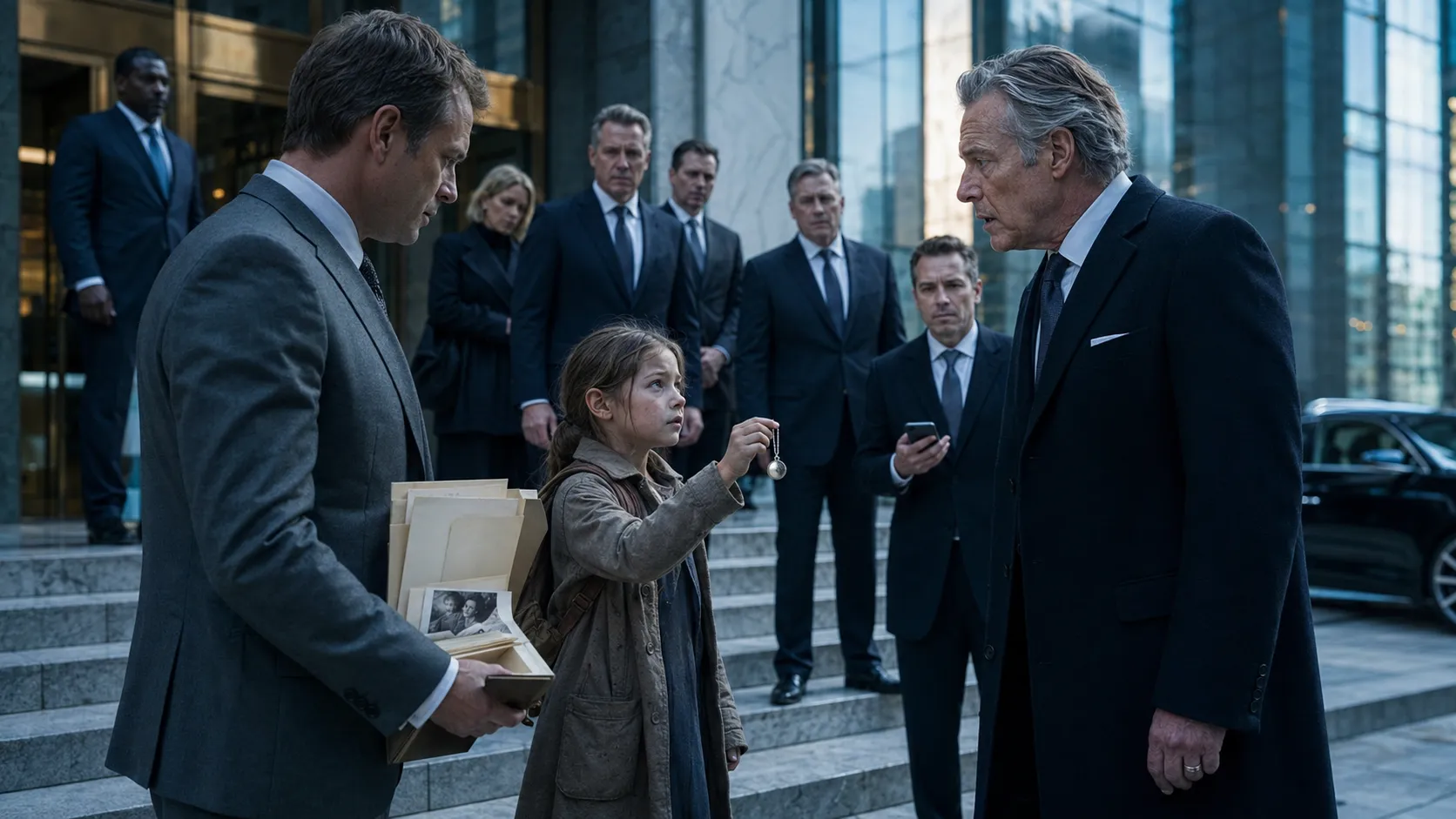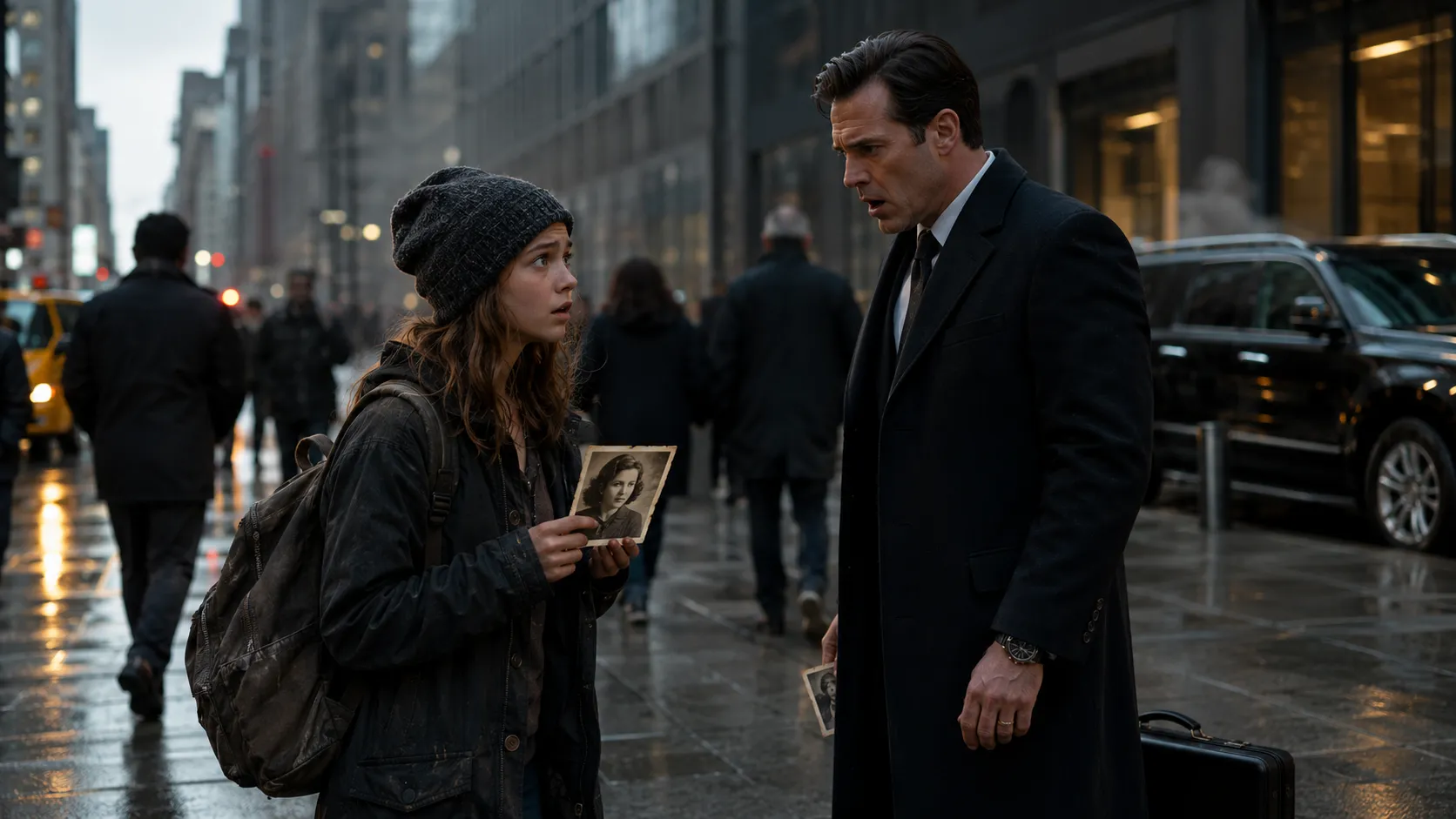
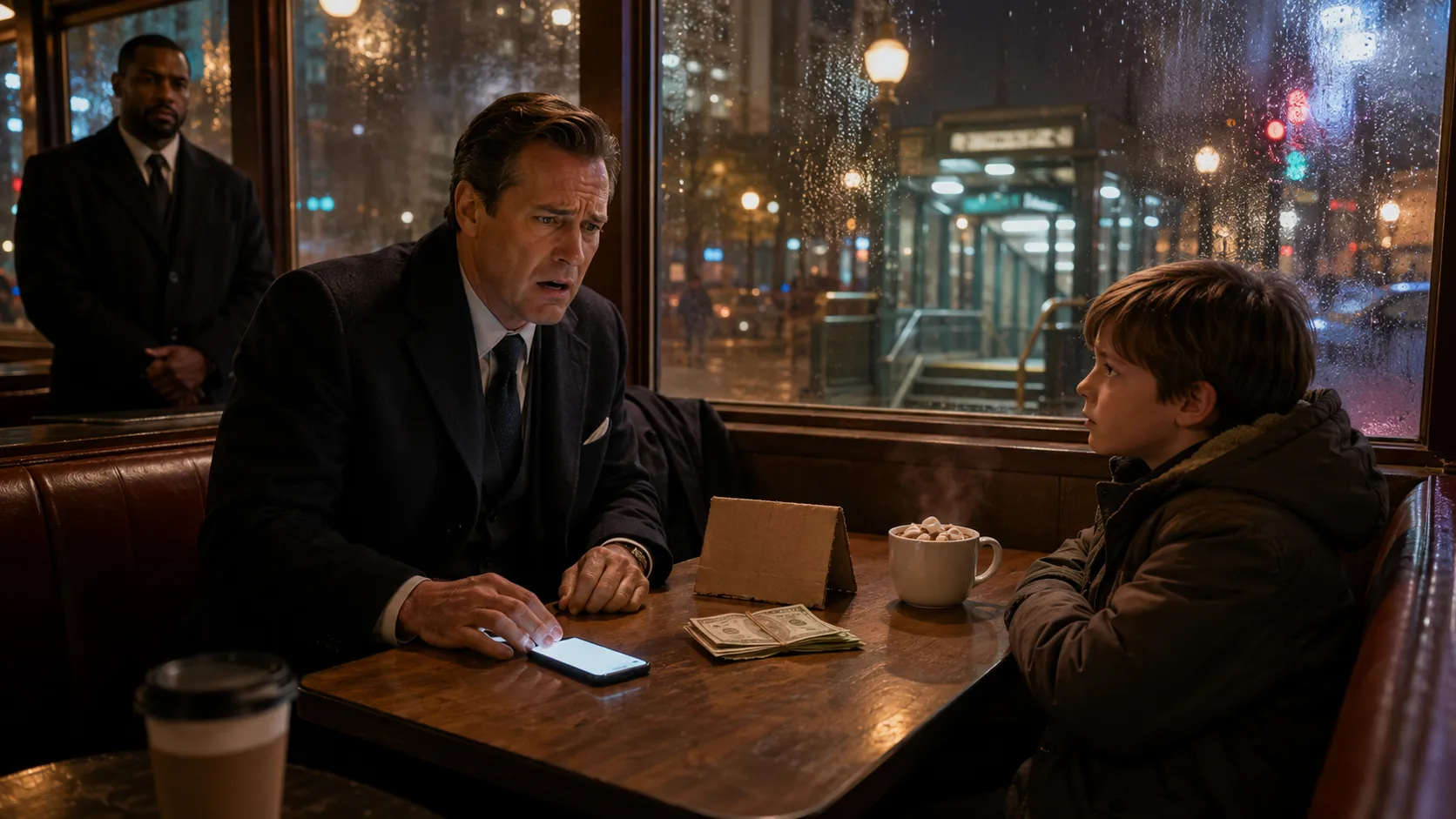
Daniel Harper thought the hungry boy on the sidewalk should be grateful for a few hundred dollars. But when the child looked up and said, “Keep it. You’ll need it soon,” Daniel’s phone rang — and the empire he had built on forgetting his past began to collapse.
The boy sat beneath the subway sign as if the cold no longer belonged to him.
Rain had stopped only minutes earlier, leaving downtown Chicago shining under yellow streetlights. Cars rushed through puddles. Office workers hurried past in dark coats. Steam lifted from sewer grates and disappeared into the night air.
Near the entrance of Ashland Station, the child sat with his knees drawn to his chest.
He could not have been older than eight.
His hoodie was too thin for the weather, his hair wet and tangled, his face pale beneath the dirt. A torn blanket lay beside him. In front of his sneakers sat a cardboard sign with one word written in black marker.
HUNGRY.
Most people did what people usually do when suffering appears too close to dinner reservations.
They looked away.
A few dropped coins.
One woman slowed, opened her purse, then changed her mind when her husband touched her elbow.
The boy did not beg.
He did not call after anyone.
He only watched the city with eyes too calm for a child sitting alone in the cold.
Across the street, a black SUV pulled to the curb.
The door opened, and Daniel Harper stepped out.
Even people who did not know his name could tell he was important. His suit fit like money. His watch flashed silver under the streetlight. His shoes looked too clean for the wet sidewalk. Two people near the subway stairs recognized him immediately and stepped aside as if the pavement belonged to him.
Daniel Harper was thirty-nine years old and one of the most feared investment owners in Chicago.
He owned apartment buildings, private equity stakes, medical office parks, warehouse lots, and enough influence to make city officials return his calls before voicemail picked up. Business magazines called him disciplined. Former employees called him ruthless. Competitors called him dangerous.
Daniel called himself practical.
He was walking toward a private restaurant three blocks away, already irritated because his assistant had failed to move a dinner meeting ten minutes earlier. He checked his phone, saw six missed calls from his CFO, ignored them, and kept walking.
Then he saw the boy.
For one second, Daniel slowed.
Not because he was moved.
Not exactly.
The child was sitting under a sign that said ASHLAND, and something about that word struck an old part of Daniel’s mind before he could lock it away.
Ashland.
Ashbury.
No.
He pushed the thought down.
The boy looked up at him.
Daniel stopped.
A few people nearby noticed. Someone lifted a phone. Daniel was used to being watched, and part of him knew how generosity looked when performed in public.
He reached into his wallet and pulled out several hundred-dollar bills.
“Here,” he said, holding them out. “Buy yourself some food.”
The boy looked at the money.
Then at Daniel.
He did not reach for it.
Daniel frowned.
“Take it.”
The boy’s voice was quiet.
“Keep it.”
Daniel blinked.
“What?”
“You’ll need it soon.”
A couple nearby slowed down.
Daniel felt heat rise in his face.
The boy’s expression had not changed. He was not mocking him. That somehow made it worse.
Daniel gave a short, humorless laugh.
“You homeless kids think you’re prophets now?”
The boy said nothing.
Daniel shoved the money closer.
“I said take it.”
The boy shook his head.
“Keep it,” he repeated. “You’re about to lose everything.”
The words landed with such calm certainty that Daniel’s anger sharpened.
He looked around and saw people watching.
That was what truly angered him.
Not the refusal.
The audience.
“Who do you think you’re talking to?” Daniel snapped.
The boy’s eyes remained fixed on him.
“You don’t remember me.”
Daniel’s jaw tightened.
“I don’t know you.”
“You knew me once.”
A cold thread moved up Daniel’s spine.
Before he could answer, his phone rang.
The sound cut through the street.
Daniel glanced at the screen.
MARTIN LAWSON.
His business partner.
Daniel nearly declined, then saw the tenth missed call beneath it and answered sharply.
“What?”
The voice on the other end was not Martin’s.
It was Rachel, his executive assistant.
She was crying.
“Sir… where are you?”
Daniel turned away from the boy.
“What happened?”
“Federal investigators are at the office.”
His irritation vanished.
“What?”
“They froze the company accounts. The board is calling emergency counsel. Investors are pulling out. Someone leaked internal documents to the press.”
Daniel stared across the street at his SUV.
“That’s impossible.”
“I’m looking at it right now, sir. Every news channel has it.”
“Where’s Lawson?”
A pause.
Too long.
“Rachel.”
Her voice dropped.
“Mr. Lawson is gone.”
“What do you mean gone?”
“He emptied the Cayman account this afternoon. Legal says he transferred control documents before the freeze. Sir… they’re saying you signed off on the fund movement.”
Daniel’s mouth went dry.
“I didn’t.”
“I know.”
“No, Rachel. I did not.”
“There are signatures.”
Daniel’s heart began hammering.
He looked down at his hand.
The money was still there.
Several hundred-dollar bills, now damp from the night air.
The boy was watching him from the sidewalk.
Daniel lowered the phone slowly.
For a moment, the city sounded very far away.
Cars.
Rainwater.
Footsteps.
A man laughing outside a bar.
Daniel turned back to the boy.
“How did you know?”
The boy looked at the money.
Then at Daniel’s face.
“How did you know?” Daniel repeated, softer now.
The child did not answer immediately.
Then he asked, “Do you remember Ashbury Shelter?”
Daniel’s breath stopped.
The name tore through him with the violence of a door kicked open inside his chest.
Ashbury Shelter.
South Side.
Twelve years earlier.
A brick building with cracked windows, bad heat, and a metal sign that swung in the wind.
A place Daniel had spent years pretending never existed.
He stared at the boy.
“How do you know that name?”
The child’s voice stayed calm.
“You slept near the back window because the radiator worked sometimes.”
Daniel stepped back.
Nobody knew that.
Nobody in his current life even knew he had once been homeless. His official biography used cleaner words.
Difficult childhood.
Financial instability.
Self-made.
Nobody wrote that at fifteen, Daniel had slept on a cot beside a broken window in a shelter that smelled of bleach, soup, wet socks, and fear.
Nobody wrote that he used to hide bread in his pillowcase.
Nobody wrote that he once shared half his dinner every night with a smaller boy named Caleb.
Daniel’s voice became almost inaudible.
“Who are you?”
The boy tilted his head.
“You really don’t remember?”
Daniel’s knees weakened.
The streetlight flickered above them.
For one second, the boy sitting on the sidewalk was not this boy.
He was another child.
Smaller.
Sickly.
Always cold.
Always watching Daniel with silent trust.
Caleb.
Caleb Reed.
Seven years old.
Daniel had been fifteen when they met at Ashbury. He had hated the shelter at first, hated the noise, hated the pity, hated the way adults spoke about children like misplaced furniture. Caleb had followed him anyway.
“You look angry,” Caleb had said the first night.
Daniel had glared at him.
“You look annoying.”
Caleb had smiled.
“I am.”
After that, the boy became his shadow.
Daniel shared food with him because Caleb’s cough was too deep and his hands shook when he ate too fast. Caleb saved Daniel a place near the radiator when he could. Daniel pretended not to care. Caleb knew better.
Then came the fire.
Daniel had spent twelve years not remembering the fire clearly.
But now it returned in pieces.
The smell of smoke.
Children screaming.
A locked side door.
An old heater sparking near a pile of donated blankets.
Adults shouting in panic.
Caleb trapped beneath a fallen beam near the rear room.
Daniel climbing through a broken window into the alley.
Caleb coughing behind him.
“Danny! Help me!”
Daniel turning back.
The heat against his face.
Smoke burning his eyes.
His own hands shaking.
“I’ll come back!” Daniel had shouted.
Then he ran.
Not for help.
Not really.
He ran because he was fifteen years old and terrified of dying.
By the time firefighters arrived, half the building was burning. Six people died, including one unidentified child whose body was found near the rear room.
Daniel had given a statement.
He did not mention the promise.
He did not mention Caleb’s hand reaching through smoke.
He did not mention that he kept running even after reaching the alley.
He told himself he was a child.
He told himself he could not have saved him.
He told himself survival was not a crime.
Then he built an entire life on not hearing Caleb call his name.
Now a boy with the same eyes sat beneath a subway sign and looked at him as if twelve years had not passed at all.
Daniel whispered, “You died.”
The boy smiled faintly.
“Maybe.”
Daniel’s phone buzzed again.
Then again.
Then again.
The empire was burning behind the glass of that little screen.
But Daniel could not look away from the child.
“What do you want from me?”
“Nothing.”
“Then why are you here?”
The boy looked toward the people stepping around them on the sidewalk.
“Because you became the kind of man who would have stepped over us.”
Daniel flinched.
The words were worse because they were true.
He saw faces then.
Tenants forced from buildings he had bought and “repositioned.”
Employees dismissed with severance letters written by other people.
Old women crying in community hearings while Daniel looked at projected profit margins.
Shelters his company promised to replace with “mixed-use development” and then delayed for years because funding the replacement had no urgency once the permits were approved.
He had not become powerful so he could hurt people.
Not at first.
He became powerful because weakness had once left him coughing in smoke and running from a child who trusted him.
But power, if worshiped long enough, begins to demand sacrifices.
Daniel had simply stopped asking who was being sacrificed.
He slowly sank onto the wet sidewalk beside the boy.
His expensive pants darkened with rainwater.
For once, he did not care who saw him.
“I’m sorry,” he whispered.
The boy watched the street.
“I should have gone back,” Daniel said.
The child did not answer.
“I should have tried.”
Still silence.
Daniel’s eyes burned.
“I was scared.”
The boy finally looked at him.
“I know.”
That was not forgiveness.
It was worse.
It was understanding.
Daniel covered his face with one hand.
“I’ve spent my whole life trying not to be that boy anymore.”
“The one who ran?”
Daniel nodded.
Caleb’s voice softened.
“You became him anyway.”
Daniel looked up.
The boy stood, pulling the torn blanket around his shoulders.
“Wait.”
Caleb stepped back.
Daniel reached for his wallet again.
“Please. Let me help you.”
The boy looked at the money in Daniel’s hand.
“You still think help is what you can hand someone without changing.”
Daniel froze.
The words entered him quietly and stayed.
“What am I supposed to do?” Daniel asked.
Caleb glanced toward the street, where a bus was pulling up beside the curb.
“You still have time.”
“To save the company?”
The boy’s eyes saddened.
“To become human again.”
The bus passed between them.
For only two seconds, Daniel lost sight of him.
When the bus moved on, the boy was gone.
Daniel shot to his feet.
“Caleb!”
People turned.
He looked toward the subway entrance.
The alley.
The storefronts.
The street.
Nothing.
Only the cardboard sign remained on the wet pavement.
Daniel picked it up with trembling hands.
The word HUNGRY was gone.
In its place, written in the same black marker, were four new words.
NOT HUNGRY ANYMORE.
Daniel stood beneath the subway sign until the rain began again.
By midnight, Daniel Harper was no longer untouchable.
The news had already decided he was guilty.
His face appeared beside headlines calling Harper Lawson Capital a fraud machine, a predatory fund, a criminal partnership. Reporters played clips of Daniel leaving charity galas, shaking hands with city leaders, walking past protesters outside developments his company controlled.
Federal investigators had frozen accounts connected to three funds. Investors were suing. Lawson had vanished. Daniel’s board was distancing itself. His attorney left seven urgent voicemails before Daniel called back.
“Where are you?” the attorney snapped.
Daniel sat in the back of his SUV holding the wet cardboard sign in his lap.
“Outside Ashland Station.”
“What?”
“Nothing.”
“You need to come to the office now.”
Daniel looked through the window at the subway entrance.
“I need to go somewhere first.”
“Daniel, listen to me. This is not the moment for disappearing. You are personally exposed. If Lawson forged signatures, we need to build that defense immediately. If you knew anything—”
“I didn’t know he stole the money.”
The attorney paused.
“That answer was too narrow.”
Daniel closed his eyes.
That was the problem with lawyers.
Sometimes they found the truth by noticing what you refused to say.
The attorney’s voice lowered.
“What did you know?”
Daniel thought of tenants.
Documents.
Political donations.
Delayed safety repairs.
Agreements worded to make cruelty legal.
“I knew enough,” he said.
“Daniel, do not say that to anyone else.”
Daniel looked at the cardboard sign.
“Why?”
“Because it sounds like guilt.”
“It is.”
The attorney was silent.
Then, very carefully, he said, “Come to the office.”
Daniel ended the call.
His driver, Marcus, looked at him in the rearview mirror.
“Where to, sir?”
Daniel almost gave the office address.
Then he heard Caleb’s voice.
You still think help is what you can hand someone without changing.
“Ashbury,” Daniel said.
Marcus frowned.
“The old shelter site?”
Daniel looked up.
“You know it?”
“My aunt died in that fire.”
The sentence filled the car.
Daniel stared at the back of Marcus’s head.
“What was her name?”
“Denise Bell.”
Daniel remembered her.
A woman with silver hoop earrings who worked nights at the shelter and used to save apples for the children. She had once slapped Daniel lightly on the back of the head for calling Caleb useless.
“Little ones aren’t useless,” she had said. “They’re just waiting for bigger ones to stop being fools.”
Daniel swallowed.
“I’m sorry.”
Marcus’s eyes met his in the mirror.
“For what, sir?”
Daniel had no answer yet.
The old Ashbury Shelter was no longer a building.
It had been demolished years earlier and replaced by a fenced-off lot covered in weeds, broken concrete, and faded signs promising a luxury residential project that had never begun. Daniel’s company did not own that particular lot, but he knew the type. He had built a career on properties like it.
He stepped out of the SUV and walked to the fence.
Rain whispered against his coat.
The old shelter had stood where the weeds now grew wild.
Daniel saw it as it had been.
The front steps.
The cracked brick.
The dining room where Caleb used to sit with both hands around a paper cup of soup.
The back window.
The fire.
Marcus stood a few feet behind him.
“My aunt was on night duty,” he said. “They said she went back in for the kids.”
Daniel gripped the fence.
“She did.”
Marcus looked at him.
“You were there?”
Daniel nodded.
“I was fifteen.”
Marcus said nothing.
“I got out through the rear window.”
The rain grew harder.
“There was a boy,” Daniel continued. “Caleb. He was trapped. I told him I’d come back.”
His voice broke.
“I didn’t.”
Marcus was silent for so long that Daniel finally turned.
The driver’s face had changed.
Not with hatred.
With something heavier.
Recognition of a wound too old for simple anger.
“You were a child,” Marcus said.
Daniel looked back at the lot.
“So was he.”
Neither spoke for a while.
Then Marcus asked, “Why come here tonight?”
Daniel opened his hand.
The cardboard sign was already softening in the rain.
“Because I saw him.”
Marcus did not laugh.
That was another mercy Daniel did not deserve.
The next morning, Daniel Harper entered his office building through the front doors instead of the private garage.
Cameras were waiting.
Reporters shouted questions.
“Mr. Harper, did you know about the offshore transfers?”
“Where is Martin Lawson?”
“Did your firm forge investor documents?”
“Did you profit from illegal evictions?”
Daniel did not answer.
Not yet.
He walked past security, past the marble lobby, past employees whose faces showed fear, anger, and the private hope that blame would land somewhere above them.
Rachel met him outside the conference room.
Her eyes were swollen from crying.
“Sir, legal is waiting. The board too.”
Daniel paused.
“How many employees are going to lose their jobs?”
She looked startled.
“I don’t know yet.”
“Find out.”
“Sir?”
“And get me a list of all current tenants in properties affected by our development funds. Any pending evictions. Any safety complaints. Any relocation agreements delayed.”
Rachel stared at him as if he had started speaking another language.
“Daniel, the federal investigation—”
“I know.”
“Legal said not to generate anything new without counsel.”
Daniel looked through the glass wall at his board members seated around the conference table, each one already distancing themselves in their posture.
“For years, I had counsel to tell me what I could get away with,” he said. “Today I need records that tell me what I did.”
Rachel did not know what to say.
He entered the conference room.
The room erupted before he sat.
Board members shouted over each other. Lawyers urged silence. A crisis consultant explained media strategy. Someone suggested suspending all public statements until they could identify a “single responsible party.”
Daniel stood at the head of the table and listened.
For fifteen minutes, he said nothing.
Then he asked, “How many families did the West Lennox acquisition displace?”
The room went quiet.
His attorney, Paul Whitman, blinked.
“That is not our immediate exposure.”
Daniel looked at him.
“It is mine.”
A board member named Ellen Shaw leaned forward.
“Daniel, with respect, this is not the moment to discuss housing optics. Lawson stole from the fund. We need to focus on criminal containment.”
“Criminal containment,” Daniel repeated.
“That is not an admission.”
“No. It’s worse. It’s a habit.”
Paul spoke carefully.
“Daniel, if you are experiencing stress, we should recess before you make statements that could damage—”
“I want full cooperation with federal investigators.”
The room froze.
Paul’s face went pale.
“Do not say another word.”
Daniel continued anyway.
“I want all documents released. Not selectively. Not after review designed to bury what embarrasses us. Everything.”
Ellen stood.
“You’ll destroy the company.”
Daniel looked at her.
“It may already be destroyed.”
“Then salvage what you can.”
He thought of Caleb’s face.
Of the sign.
Of the fire.
Of a woman named Denise running back into smoke while a fifteen-year-old boy ran away.
“No,” Daniel said. “Not this time.”
By evening, half the board had resigned.
By the end of the week, Daniel had been removed as CEO.
By the end of the month, he was under investigation, sued by investors, hated by former partners, and abandoned by nearly every person who had once laughed at his jokes in private dining rooms.
Lawson was arrested in Geneva three weeks later.
He had tried to move through Switzerland under a passport with another name. Federal investigators found him because Daniel handed over internal communications that no one expected him to disclose.
Those documents did not make Daniel innocent.
They made the truth larger.
Lawson had stolen.
But Daniel had built the machine Lawson used.
Daniel’s choices had not always been illegal.
That made some of them harder to face.
A courtroom can punish crimes.
It cannot always punish a man for becoming cruel efficiently.
That part Daniel had to live with himself.
The press called his cooperation a strategy.
His enemies called it desperation.
His attorneys called it suicidal.
Daniel did not know what to call it.
He only knew that every night, when he closed his eyes, he saw Caleb beneath the subway sign saying, You still have time.
The first person Daniel tried to find was Caleb Reed’s mother.
Her name was Angela Reed.
In the old shelter records, she appeared only twice. First as Caleb’s emergency contact. Later as deceased, though no details were included. Daniel hired investigators, then fired them when their reports sounded too much like corporate risk summaries.
Marcus helped instead.
His aunt’s old friends knew people.
People knew churches.
Churches knew names.
Within two weeks, Daniel stood in a small cemetery outside the city before a flat stone nearly hidden by grass.
ANGELA REED
BELOVED MOTHER
1978–2015
Daniel stood there for a long time.
Caleb had died in 2014.
Angela had lived one more year.
One year after losing a child in a fire Daniel had escaped.
Had she looked for answers?
Had she wondered who had been with him?
Had anyone told her about the older boy who promised to come back?
Marcus stood beside him, holding an umbrella neither of them really used.
“My aunt said Angela came to the memorial every week,” Marcus said.
Daniel closed his eyes.
“I never went.”
“You were fifteen.”
Daniel opened his eyes.
“I was fifteen at the fire. I was twenty-seven when I made my first million. I was thirty-two when I donated to three museums. I was thirty-five when I bought a building two miles from here and never came to this grave.”
Marcus did not argue.
That was why Daniel had kept him close.
Not because Marcus comforted him.
Because he didn’t do it cheaply.
Daniel placed flowers on Angela’s grave.
Then, beside them, he placed a small toy car he had found in an old box at his penthouse.
Caleb’s toy.
Daniel had taken it from the shelter after the fire. He told himself he was keeping it to remember him. Then he hid it so well he almost forgot it existed.
Almost.
The car was blue, chipped on one side, missing a wheel.
Daniel set it gently on the stone.
“I’m sorry,” he whispered.
Wind moved across the cemetery.
No answer came.
No ghost.
No sign.
Only the grass, the rain, and a grave that had waited years for a man to become ashamed enough to visit.
Legal consequences came slowly.
Daniel avoided prison because the evidence showed Lawson had forged transfer authorizations and concealed offshore movement. But Daniel was fined heavily, barred from managing investor funds for years, and forced to liquidate most of his personal assets to satisfy settlements and restitution agreements.
The penthouse went first.
Then the lake house.
Then the art.
Then the cars.
He kept a small apartment, a few boxes, and the cardboard sign sealed between two sheets of glass.
HUNGRY had vanished.
NOT HUNGRY ANYMORE remained.
Daniel did not know whether anyone else would believe where it came from.
He barely cared.
One afternoon, Rachel came to his temporary office — a rented room above a bakery, nothing like the glass tower he had once ruled from — carrying a stack of documents.
“You should see this,” she said.
Daniel looked up from settlement paperwork.
“What is it?”
“The tenant restitution fund numbers.”
He took the folder.
His chest tightened as he read.
Hundreds of families.
Repairs ignored.
Deposits withheld.
Relocation payments delayed.
Some actions legal.
Some not.
All ugly.
Rachel stood by the desk, arms crossed.
“You know, for years I thought this was how business worked.”
Daniel did not look up.
“So did I.”
“No,” she said. “I mean, I thought being uncomfortable meant I wasn’t smart enough to understand the adult version of things.”
He looked at her then.
She continued, “I watched calls come in from tenants. Mothers. Old men. People begging for time. I forwarded them to legal. Legal forwarded them to property management. Property management forwarded them into nowhere.”
Daniel swallowed.
“I taught you that.”
“Yes,” Rachel said.
The answer was not cruel.
It was true.
“I’m sorry.”
“I know.”
“Are you leaving?”
She looked around the small room.
“I should.”
“But?”
“But someone has to make sure you don’t turn redemption into another project named after yourself.”
For the first time in weeks, Daniel almost smiled.
“What do you suggest?”
Rachel placed another folder on the desk.
“Ashbury House.”
He stared.
“What?”
“A housing and legal support center. Not a shelter with your name on it. Not a charity gala. A real place. Families facing eviction. Youth leaving foster care. People who need documents, food, temporary beds, legal help, and someone who answers the phone.”
Daniel touched the folder.
“Ashbury.”
Rachel nodded.
“It was Marcus’s idea.”
Daniel looked toward the window, where Marcus stood beside the parked SUV outside, drinking coffee under the awning.
“He didn’t tell me.”
“He said you needed to hear it from someone less forgiving.”
Daniel gave a faint laugh.
“You are all very honest now that I’m broke.”
Rachel’s expression softened.
“You’re not broke, Daniel. You’re just not insulated.”
Ashbury House opened nine months later.
Not with cameras.
Not at first.
It began in a former medical office near the South Side, a plain brick building with bad lighting and too many small rooms. Rachel coordinated operations. Marcus handled safety and outreach. Denise Bell’s name was painted on a small plaque near the entrance because Marcus insisted his aunt should not disappear into the old fire records.
Daniel wanted Caleb’s name there too.
Marcus advised waiting.
“Not because he doesn’t matter,” Marcus said. “Because you need to understand this place before you use his name to heal yourself.”
Daniel hated that sentence.
Then accepted it.
The first night Ashbury House opened, fourteen people came in from the cold.
A mother with two children.
A retired bus driver facing eviction after medical debt.
A teenager who had aged out of foster care and carried everything in a trash bag.
A man who had slept under the train tracks for three months and apologized every time he asked for water.
Daniel worked in the kitchen that night.
Badly.
He burned soup, dropped a tray, and cut his finger opening boxes.
Mrs. Alvarez, an old volunteer from a nearby church, finally took the ladle from his hand.
“Rich men should not be allowed near large pots without supervision,” she said.
“I’m not rich anymore.”
She looked him up and down.
“You still move like a man expecting doors to open.”
Daniel stepped back.
“Yes, ma’am.”
The teenager with the trash bag laughed quietly.
That was the first laugh Daniel heard in Ashbury House.
He remembered it.
Over time, Daniel learned that help was not what he had thought it was.
It was not one dramatic act.
Not a check.
Not a speech.
Not a building opening.
Help was forms.
Phone calls.
Bus passes.
Court dates.
Broken washing machines.
Children who refused to sleep in beds because beds had disappeared from their lives too many times.
Mothers who cried only after their children fell asleep.
Old men who pretended they did not need reading glasses because shame lasted longer than hunger.
Help was showing up again the next morning.
And the morning after that.
It was also being disliked.
Daniel had imagined gratitude would be easier.
But many people who came through Ashbury House did not trust him, and they were right not to. Some knew his name. Some had been harmed by companies like his. One woman recognized him from a housing protest years earlier and threw a paper cup of coffee at his chest.
“You don’t get to stand here like a saint,” she said.
Daniel looked down at the coffee spreading across his shirt.
“I know.”
She seemed disappointed that he did not defend himself.
That was progress too.
Two years after the night beneath the subway sign, Daniel testified at Lawson’s sentencing.
The courtroom was full.
Investors filled the front rows. Reporters lined the back. Former employees sat together in quiet clusters. Several tenants affected by Harper Lawson properties attended too, though no one had invited them officially.
Lawson looked thinner than Daniel remembered.
Less polished.
But still angry.
Men like Lawson rarely regretted harm.
They regretted exposure.
The prosecutor asked Daniel to explain the structure of the fund.
He did.
Then she asked, “Mr. Harper, do you consider yourself a victim of Mr. Lawson’s fraud?”
Daniel looked toward the investors.
Then toward the tenants.
Then at Lawson.
“Yes,” he said. “But not only that.”
His attorney shifted uncomfortably behind him.
Daniel continued.
“I was deceived by Martin Lawson. That is true. But I also created a company where deception was useful because conscience was considered inefficient.”
The courtroom went silent.
The prosecutor asked, “What do you mean?”
Daniel took a breath.
“I mean I rewarded profit without asking enough questions about harm. I ignored warnings because they slowed deals. I treated legal permission as moral permission. Mr. Lawson committed crimes. But he did not create my blindness. He used it.”
Lawson’s jaw tightened.
The judge leaned forward slightly.
Daniel looked at the room.
“I cannot undo what happened. But I want the court to understand that fraud like this does not grow only from one criminal decision. It grows in rooms where everyone learns not to ask who is being hurt.”
The testimony made headlines.
Some praised it.
Some called it performance.
Daniel no longer knew how to measure public opinion.
He measured other things now.
How many families kept their apartments.
How many children enrolled in school after getting documents.
How many people returned to Ashbury House not because they were desperate, but because they wanted to volunteer.
On the third anniversary of Ashbury House, Rachel placed a file on Daniel’s desk.
“What is this?”
“Caleb Reed.”
Daniel’s hands went still.
Rachel sat across from him.
“I found something.”
The file was thin.
Too thin for a child’s life.
Birth certificate.
Shelter intake form.
Fire report.
Newspaper clipping.
And one photograph.
Daniel picked it up with both hands.
Caleb stood beside Angela Reed in front of Ashbury Shelter, wearing a coat too large for him and holding the blue toy car. He was smiling without showing teeth.
The same eyes.
Daniel’s throat closed.
Rachel said quietly, “The unidentified child from the rear room was later matched to him through dental records. It was Caleb.”
Daniel nodded.
He had known.
Still, part of him had carried an impossible hope that the boy under the subway sign had been real in a way records could explain.
Rachel waited.
“There’s more,” she said.
He looked up.
“Caleb’s mother filed complaints before the fire. Heating failure. Locked exits. Overcrowding. No response from the city. No follow-up from the shelter board.”
Daniel stared at the documents.
“The board?”
Rachel nodded.
“One of the board members later joined a housing advisory group. Years after that, he helped approve one of Harper Lawson’s tax incentive packages.”
Daniel’s mouth went dry.
The chain had been longer than he knew.
Ashbury had not only been a tragedy.
It had been a warning ignored by the same civic machine Daniel later learned to profit from.
He stood abruptly and walked to the window.
Rachel did not speak.
Finally, Daniel said, “I want his name on the wall.”
Rachel’s voice was gentle.
“Why?”
He turned.
She held his gaze.
Not because she opposed it.
Because she needed him to answer honestly.
Daniel looked at the photo again.
“Not to make me feel forgiven.”
Rachel waited.
“To make sure this place remembers who adults failed before we arrived.”
She nodded.
“That answer is better.”
One week later, Ashbury House placed two names near the entrance.
DENISE BELL
Who ran back in.
CALEB REED
Who should have been carried out.
Beneath them, smaller words:
No locked doors. No forgotten children.
Marcus stood beside Daniel during the small ceremony.
No press came.
Only staff, residents, volunteers, and a few family members connected to the old fire.
Daniel spoke briefly.
Not because he had nothing to say.
Because he had learned restraint.
“I promised Caleb I would come back,” he said. “I didn’t. This place exists because promises to children do not expire when adults fail to keep them.”
That was all.
Afterward, an elderly woman approached him.
She introduced herself as Mrs. Parker, a former volunteer at Ashbury Shelter.
“I remember you,” she said.
Daniel stiffened.
“You do?”
“You were angry.”
He gave a sad smile.
“Yes, ma’am.”
“You shared food with Caleb when you thought nobody saw.”
Daniel looked away.
“I also left him.”
Mrs. Parker’s face softened, but not enough to let him escape.
“Yes,” she said. “You did.”
His eyes burned.
She touched his sleeve.
“But you are here now. That does not erase then. It answers it.”
Daniel kept that sentence close.
Years passed.
Ashbury House grew.
Not too fast, because Rachel refused to let Daniel’s old ambition wear charity clothes. They added a legal clinic first. Then a family search program. Then transitional apartments. Then a youth mentorship program named for Caleb, but only after staff and former residents agreed.
Daniel did not become poor.
Not truly.
Even after settlements and fines, he had advantages most people never receive. He knew that now and said it plainly when donors tried to praise his sacrifice.
“I gave up excess,” he would say. “Not survival.”
That irritated wealthy donors.
Rachel liked when he said it.
Marcus eventually stopped driving for him and became operations director. He still called Daniel “sir” when annoyed.
One winter evening, five years after the night at the subway station, Daniel returned alone to Ashland Station.
Snow was falling lightly.
The sidewalk was almost empty.
A new coffee shop had opened across the street. The old storefront near the subway had become a pharmacy. The city had changed in small ways, as cities always do, pretending change means progress.
Daniel stood beneath the same sign.
In his coat pocket was the sealed cardboard sign, protected now inside a thin case.
NOT HUNGRY ANYMORE.
He did not know why he had brought it.
Maybe because the anniversary hurt.
Maybe because Ashbury House had just helped its thousandth client, and everyone kept telling him he should feel proud.
Pride still made him uneasy.
He stood there until his hands grew cold.
Then a voice beside him said, “You came back.”
Daniel closed his eyes.
He did not turn immediately.
When he did, the boy was there.
Sitting in the same place beneath the subway sign.
Same thin hoodie.
Same calm eyes.
Same impossible face.
Caleb.
Daniel could not speak.
The boy looked at him.
“You’re older.”
Daniel laughed once, and it broke into tears almost immediately.
“So are you,” he said, though it was not true.
Caleb smiled.
“No.”
Daniel crouched in front of him.
Snow fell between them.
People passed without looking.
Or maybe they could not see him.
Daniel did not know.
This time, he did not care.
“I put your name on the wall,” Daniel said.
“I know.”
Of course he did.
“I built Ashbury House.”
“No,” Caleb said. “A lot of people built it.”
Daniel bowed his head.
“Yes. They did.”
“You still like taking credit?”
The boy’s voice was gentle enough that Daniel almost smiled.
“I’m learning not to.”
Caleb looked toward the street.
“Good.”
Daniel reached into his coat and removed the sign.
He held it carefully.
“I kept this.”
Caleb studied it.
“You finally understood it?”
“I think so.”
“What does it mean?”
Daniel swallowed.
“At first, I thought it meant you weren’t hungry because you were dead.”
Caleb waited.
“Then I thought it meant you didn’t need anything from me.”
The boy tilted his head.
“And now?”
Daniel looked toward the subway stairs, where a young mother was helping a small child adjust his scarf.
“Now I think it means hunger is bigger than food,” he said. “And smaller too. Sometimes a sandwich matters. Sometimes a bed. Sometimes a lawyer. Sometimes someone coming back when they said they would.”
Caleb’s expression softened.
Daniel’s voice broke.
“I’m sorry I didn’t come back for you.”
“I know.”
“Do you forgive me?”
The question had lived in him for five years.
Maybe longer.
Caleb looked at him for a long time.
Then said, “That’s not why I came.”
Daniel closed his eyes.
The answer hurt.
But not as much as he expected.
When he opened them, Caleb was standing.
“Then why?”
The boy pointed across the street.
Daniel turned.
Near the coffee shop, a teenage boy stood under the awning with a backpack clutched to his chest. He wore no coat, only a sweatshirt. His face carried the same hard, frightened look Daniel had once worn at fifteen.
People stepped around him.
No one stopped.
Daniel looked back.
Caleb was watching him.
“You still have time,” the boy said.
Daniel turned again toward the teenager.
This time, he did not hesitate.
He crossed the street.
The boy stiffened as Daniel approached.
“I’m not asking for money,” the teen said quickly.
Daniel stopped a few feet away.
“I didn’t say you were.”
“I can leave.”
“You can,” Daniel said. “Or you can come inside and get warm.”
The boy’s eyes narrowed.
“Why?”
Daniel thought of all the answers.
Because I once ran.
Because a child died.
Because money failed me.
Because guilt is useless unless it changes where your feet go.
Because someone came back for me after death, or memory, or whatever mercy uses when men are too stubborn to listen.
But he said only, “Because it’s cold.”
The boy looked at him for a long moment.
Then nodded.
Daniel took him into the coffee shop and bought soup, bread, and hot chocolate. He called Marcus. He called Rachel. He did not call reporters. He did not turn the moment into a story.
While the teen ate, Daniel looked across the street.
Caleb was still there beneath the sign.
For one brief second, the boy lifted a hand.
Then a bus passed.
When it moved on, he was gone.
Again.
Daniel did not run after him this time.
He understood.
Some people return only long enough to make sure you do.
Ten years after the collapse of Harper Lawson Capital, Ashbury House had become three buildings, two legal clinics, and one stubborn network of volunteers who refused to let bureaucracy become another locked door.
Daniel was no longer famous for wealth.
He was famous in quieter, less useful ways.
Some still hated him.
Some forgave him too easily.
He trusted neither extreme.
He spent most mornings in the Ashbury House office, answering calls that once would have been filtered through three assistants. He was not always good at it. Sometimes he still sounded too corporate. Sometimes Rachel threw paper clips at him when he used phrases like “resource alignment” with frightened families.
On the tenth anniversary ceremony, Marcus made him speak.
Daniel refused twice.
Rachel told him refusal was beginning to look dramatic.
So he stood in the courtyard before residents, former residents, staff, donors, and families from the old Ashbury fire.
Behind him, the names of Denise Bell and Caleb Reed were engraved into brick.
Daniel held the original cardboard sign.
Not Hungry Anymore.
He looked at it for a long time before speaking.
“When I was fifteen,” he said, “I made a promise to a child and broke it.”
The courtyard quieted.
“For many years after that, I told myself survival excused everything. Then I became successful and started using success the same way.”
He looked toward the people seated in front.
“I cannot tell you that one good thing erases one terrible thing. It doesn’t. Ashbury House does not erase Caleb’s death. It does not erase Denise Bell’s sacrifice. It does not erase the families hurt by my old company.”
His voice steadied.
“But I have learned this: the past does not ask us to perform sorrow. It asks us to stop repeating the conditions that made sorrow possible.”
Rachel lowered her eyes.
Marcus stood very still.
Daniel lifted the sign slightly.
“A hungry child once refused my money because money was the only form of help I understood. He taught me that change begins when help costs more than what we can spare.”
He paused.
“So today, if you came here to praise me, please don’t. Praise the staff who answer phones at midnight. Praise the lawyers who show up in housing court. Praise the drivers who bring families to appointments. Praise the volunteers who cook without needing applause. Praise the people who walk through these doors with nothing and still find the strength to trust us one more time.”
For once, he stopped before saying too much.
The applause that followed was not thunderous.
It was warm.
Human.
Enough.
That evening, after the courtyard emptied, Daniel stayed behind near Caleb’s name.
Marcus joined him with two cups of coffee.
“You did alright,” Marcus said.
“High praise.”
“Don’t get used to it.”
Daniel smiled faintly.
They stood together in silence.
Then Marcus asked, “Do you still see him?”
Daniel looked at Caleb’s name on the wall.
“Sometimes.”
“Do you think he’s real?”
Daniel took the coffee.
“I stopped needing that answered.”
Marcus nodded.
Across the courtyard, a little boy staying at Ashbury House ran after a red ball. His mother called him back before he got too close to the gate. A staff member laughed. Someone in the kitchen burned toast.
Life continued.
Not repaired perfectly.
But held.
That night, Daniel walked home instead of calling a car.
Snow had begun falling again.
At Ashland Station, he stopped.
The subway entrance glowed under the streetlight.
The sidewalk was empty.
No boy.
No blanket.
No sign.
Daniel stood there for a moment, then reached into his coat pocket and pulled out several folded bills.
A younger version of himself would have looked for someone to give them to and called that redemption.
Instead, he put the money back.
Then he walked down the subway stairs, where two volunteers from Ashbury’s night outreach team were speaking with a woman sheltering near the platform entrance. Daniel joined them quietly, asked what was needed, and listened before doing anything.
Above them, the city moved on.
Below, in the cold tunnel, someone was finally being seen.
And somewhere in the part of the world where promises wait for the living to catch up, a little boy was not hungry anymore.