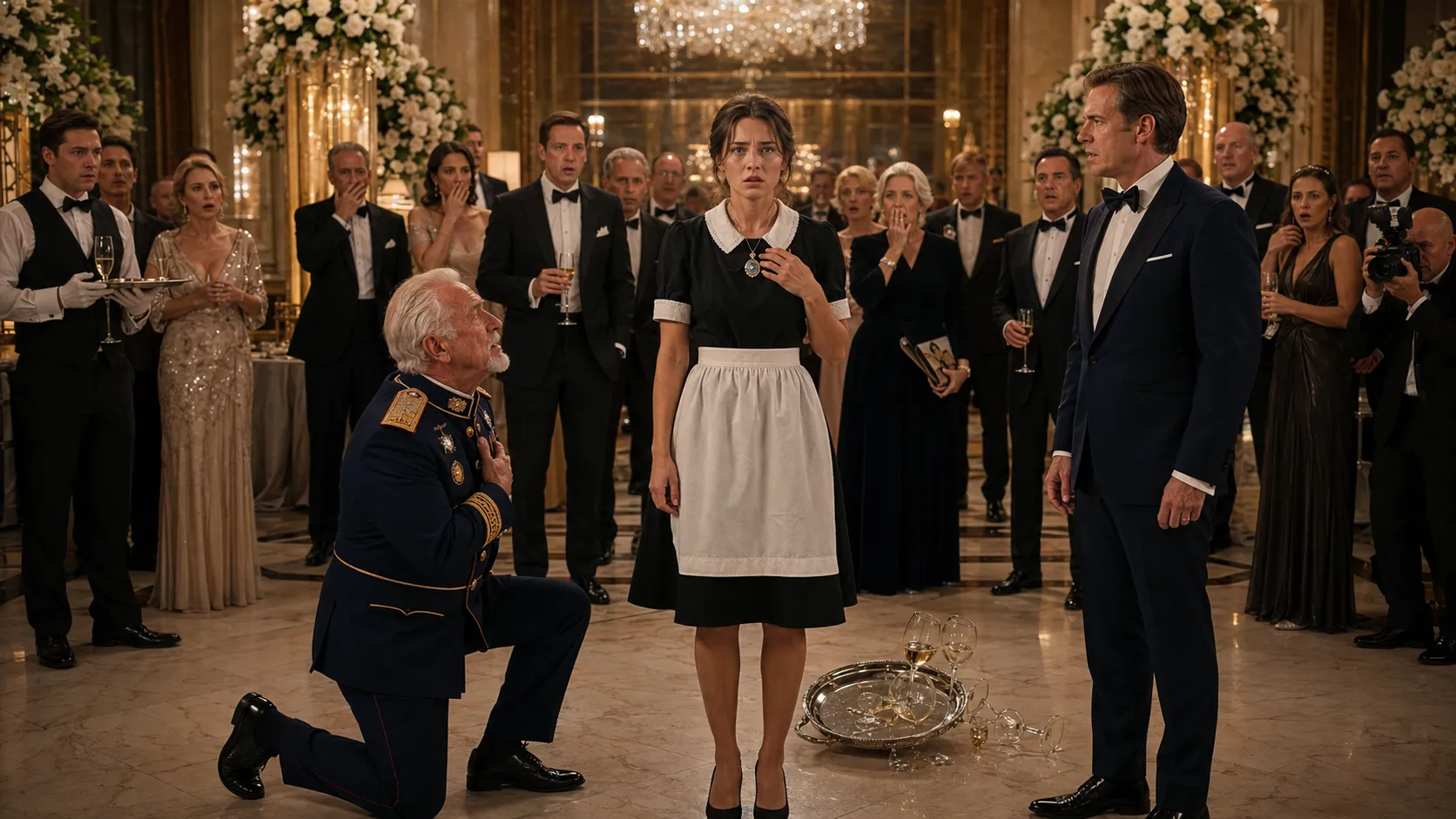
Alina had spent three years hiding in plain sight, serving champagne to the same rich men who once profited from her family’s fall. But when an old general recognized the silver crest beneath her collar, the whole ballroom learned the maid was the missing princess everyone thought had died.
Alina learned early that the easiest place to hide was among people who never looked down.
The rich looked across rooms.
They looked at jewels, cameras, champagne towers, important handshakes, familiar surnames, and anyone useful enough to deserve recognition.
But servants?
Servants passed through the background like furniture with hands.
That was why Alina had survived three years in New York wearing a black-and-white maid uniform, carrying silver trays through luxury hotels, lowering her eyes, and answering to names that were not hers.
Anna.
Lina.
Miss.
You there.
Sometimes no name at all.
She accepted every version because none of them was the truth.
The truth was too dangerous.
Her real name was Alina Elena Marovic.
Princess Alina of Velkria.
Last living daughter of King Stefan and Queen Elena.
The child the world believed had died in the palace fire twenty years earlier.
On the night of the Grand Bellemore Hotel gala, Alina stood in a staff corridor with a tray of champagne glasses balanced against one hip and forced herself to breathe slowly.
The ballroom beyond the doors glittered under crystal chandeliers. Jazz music floated through the warm air. Wealthy guests moved across the marble floor in tuxedos and silk gowns, laughing as if history itself had been invited to entertain them.
Tonight’s event celebrated a billion-dollar merger between Vale Global Holdings and Black Meridian Energy, a private investment company with deep political ties in Eastern Europe.
The papers called it a business triumph.
Alina called it a warning.
She had seen the name Black Meridian before.
Not in American newspapers.
In old documents her mother had hidden beneath the nursery floor before soldiers stormed the palace.
Black Meridian had funded the coup in Velkria.
Not publicly.
Not cleanly.
Never in a way ordinary courts could easily prove.
But Alina knew the symbol stamped on the old letters. A black sun inside a broken circle. The same symbol appeared in the private crest of Black Meridian’s founding family.
Her mother had whispered the name once during the escape.
“If you ever see the black sun again, run.”
For twenty years, Alina had run.
From Velkria to Austria.
From Austria to Italy.
From Italy to Canada.
From Canada to America.
Fake names.
Cheap rooms.
Burned passports.
Friends she could never keep.
Jobs she could leave in one hour if a face in a crowd looked too familiar.
But tonight, for the first time, she had walked toward the danger.
Not because she wanted revenge.
Revenge was too simple a word for what remained after a childhood burned.
She came because the merger papers being signed that evening would move control of several Velkrian mineral ports into Black Meridian’s hands. Once that happened, the men who murdered her parents would own the last economic lifeline of the country they had stolen.
Alina did not have an army.
She did not have a throne.
She barely had rent money.
But she had one thing they did not know survived.
A silver necklace hidden beneath her uniform collar.
Inside the crest pendant was a microfilm her mother had placed there the night the palace fell — banking records, sealed orders, names of officers who betrayed the crown, proof that the coup was purchased.
For years, Alina had been too afraid to use it.
Then she saw Richard Vale’s face on a business channel, smiling beside Black Meridian executives, calling the merger “a bridge between nations.”
A bridge.
That word made her laugh so bitterly that her neighbor knocked on the wall.
Bridges could also carry armies.
Now Richard Vale stood inside the ballroom, the American billionaire everyone wanted to impress.
Alina had taken the catering job to get close enough to him.
She planned to slip the pendant into his coat pocket with a note. Let the billionaire discover the truth privately. Let his lawyers test the evidence. Let him decide if his reputation was worth the blood tied to Black Meridian.
It was a desperate plan.
But desperation had kept her alive longer than hope.
“Alina,” the catering supervisor snapped behind her. “You’re frozen. Move.”
She nodded.
“Yes, sir.”
He frowned at her. “And stop touching your collar. You look nervous.”
Her hand dropped from the necklace immediately.
“Sorry.”
He pushed open the ballroom doors.
Light washed over her.
The Grand Bellemore ballroom looked like a palace pretending not to be one.
White roses climbed golden columns. Crystal chandeliers sparkled above the crowd. Waiters moved between guests with trays of champagne, caviar, and tiny desserts no hungry person would ever call food. A jazz singer hummed near the stage while photographers waited for the formal announcement.
Alina stepped inside.
No one noticed.
That was good.
She moved carefully through the room, offering drinks with a soft smile.
“Champagne, ma’am?”
“Sparkling water, sir?”
“Of course.”
“Right away.”
Every few minutes, she glanced toward Richard Vale.
He was taller than she expected, silver at the temples, dressed in a midnight-blue tuxedo, speaking with the relaxed authority of a man whose life had rarely required him to ask twice.
Alina hated him before meeting him.
Not because she knew he was guilty.
Because men like him could change the fate of small countries over dinner without ever learning how the widows pronounced their dead husbands’ names.
Near the marble staircase, two guests laughed as she passed.
One of them, Marcus Kane, a wealthy investor with a red face and too much confidence, stopped her with two fingers raised.
“You,” he said. “Champagne.”
Alina turned politely.
“Yes, sir.”
As she leaned forward with the tray, Marcus looked at her face longer than necessary.
“You’re new.”
“Yes, sir.”
“Accent?”
She stiffened.
“European.”
He smiled. “Europe is not a country.”
“I know, sir.”
His friends laughed.
Marcus took a glass but did not move aside.
“Where from?”
Alina lowered her eyes.
“Many places.”
“That sounds suspicious.”
“It is only boring.”
More laughter.
Marcus seemed entertained now.
“What are you hiding from, sweetheart?”
For one dangerous second, Alina almost answered truthfully.
Men with guns.
Men with flags.
Men who smile in boardrooms after burning palaces.
Instead, she smiled faintly.
“Long shifts.”
Marcus laughed and stepped away.
Alina moved on, heart pounding.
She had nearly reached Richard when an old man near the front of the ballroom turned and saw her.
He froze so completely that the woman beside him touched his sleeve.
“General?”
The man did not answer.
He was in his late sixties or early seventies, tall despite his age, wearing a formal navy jacket with small military medals pinned over his chest. His white hair was combed back. His face, stern a moment earlier, had gone pale.
Alina saw him.
The tray trembled in her hands.
No.
She knew that face.
Older now.
Heavier with grief.
But still unmistakable.
General Stefan Orlov.
Commander of her father’s royal guard.
The man who had carried her through the burning west corridor when she was eight years old.
The man who had placed her into a laundry cart and told her not to make a sound.
The man she believed died at the northern gate.
His champagne glass slipped from his fingers and shattered on the marble floor.
The music continued for two more notes.
Then stopped.
Guests turned.
The general took one step toward her.
Alina shook her head almost imperceptibly.
Please don’t.
His eyes filled.
He took another step.
Then another.
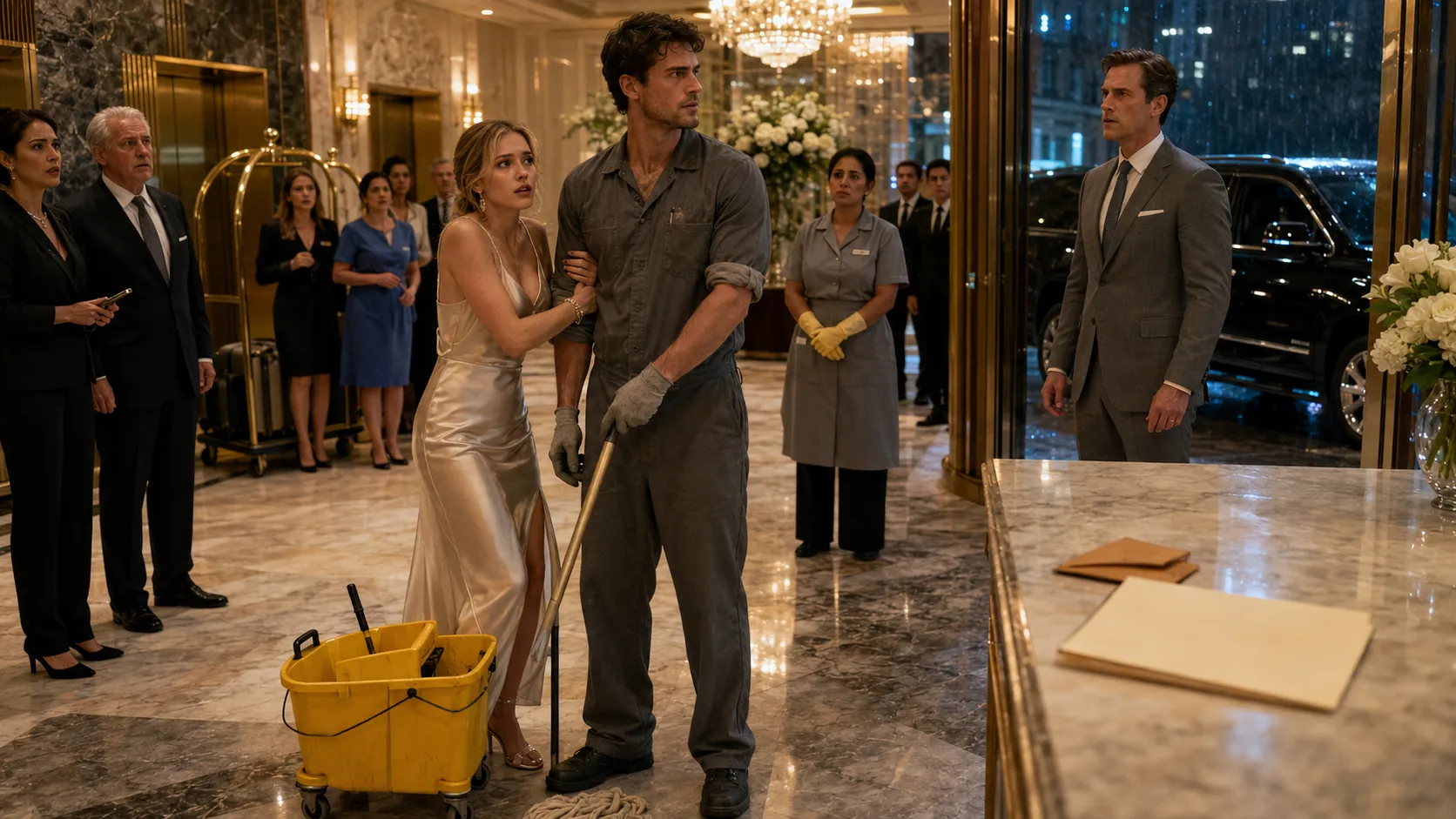
The ballroom quieted as people noticed the old military man walking toward a maid as if approaching an altar.
Alina whispered, “No.”
General Orlov stopped in front of her.
For one second, they looked at each other across twenty years of fire.
Then he bowed.
Deeply.
His voice broke.
“Your Highness.”
The tray fell from Alina’s hands.
Champagne glasses exploded across the marble.
The ballroom went silent.
Then the whispers began.
“What did he say?”
“Your Highness?”
“Is this part of the event?”
Marcus Kane laughed first.
It was a sharp, cruel laugh.
“Oh, come on.”
He stepped forward, looking from the general to Alina.
“This is absurd. She’s a maid.”
Alina bent quickly to pick up the fallen glasses, but her hands shook too badly.
“Please,” she whispered to Orlov. “You’re mistaken.”
He lowered himself to one knee.
“No,” he said, loud enough for the room to hear. “I served your father for twenty-two years. I carried you from the palace the night Velkria burned. I would know Queen Elena’s daughter if I were blind.”
The ballroom erupted.
Phones rose.
Guests backed away.
Several people laughed nervously because laughter is what frightened people use when disbelief feels safer than truth.
Richard Vale crossed the room with irritation on his face.
“What is happening here?”
Marcus gestured toward Alina as if presenting a joke.
“This man says your waitress is a missing princess.”
Richard’s eyes moved to Alina.
At first, he looked annoyed.
Then his gaze dropped to her collar.
The broken chain had shifted when she bent down.
The silver crest pendant lay visible against the white fabric of her uniform.
Richard’s expression changed.
He stepped closer.
“Where did you get that necklace?”
Alina covered it with one hand.
“It belonged to my mother.”
General Orlov looked up.
“Queen Elena wore that crest the night the palace fell.”
Richard stared at the pendant.
He knew the crest.
Everyone who studied European political history knew it.
Twenty years earlier, the royal family of Velkria had been assassinated during a military coup. The palace burned. The king and queen were found dead. Their eight-year-old daughter vanished. Officially, she was declared dead without a body.
But for years, rumors survived.
The hidden princess.
The lost heir.
The child who might one day return and challenge the men who had turned her country into a private estate.
Richard looked at Alina’s face again.
This time, not as a servant.
As evidence.
Marcus scoffed.
“Anybody can buy old jewelry.”
Orlov stood with difficulty and pulled a photograph from inside his jacket.
His hands trembled as he gave it to Richard.
The photograph was old and creased.
A little girl stood on a palace balcony between a dark-haired queen and a king in formal uniform. The child wore a white dress, her hair pinned badly because she had clearly tried to escape whoever styled it. Around her neck was the same silver crest.
Richard looked from the photograph to Alina.
The resemblance was undeniable.
Same eyes.
Same mouth.
Same slight tilt of the chin when she was trying not to cry.
Alina’s vision blurred.
The room disappeared again.
She heard her mother’s voice.
Alina, listen to me. Whatever happens, you must live.
She smelled smoke.
She saw red curtains burning.
She felt Orlov’s arms carrying her through a hallway while bullets struck the stone behind them.
A guest’s voice cut through the memory.
“My God. It’s really her.”
Alina stepped backward.
“I am no one,” she said.
But the sentence had no power anymore.
The whole room had already seen her.
Richard’s voice lowered.
“Who are you really?”
Before she could answer, the ballroom doors burst open.
Three men in black suits entered fast, moving with the discipline of trained killers.
Hotel security stepped in front of them.
One attacker struck the guard in the throat and shoved him into the wall.
A woman screamed.
The leader of the three men looked directly at Alina.
His mouth curved into a cold smile.
“There she is.”
Alina’s blood turned to ice.
General Orlov grabbed her arm.
“They found you.”
Richard looked at the men.
“Who are they?”
Alina’s voice shook.
“The people who killed my parents.”
Chaos exploded.
Guests screamed and scattered between tables. Chairs overturned. Champagne spilled across white linen. The jazz musicians fled from the stage. Security rushed forward, but one gunman fired a shot into the ceiling.
The sound cracked through the ballroom.
Everyone dropped.
“Nobody moves!” the leader shouted.
Marcus Kane crouched behind a flower arrangement, his face white.
“This can’t be real,” he whispered.
The leader stepped over broken glass toward Alina.
“You’ve hidden long enough, Princess.”
Alina backed away.
Richard moved without thinking.
He stepped between her and the gunman.
The attacker smiled.
“You don’t know what she is worth.”
Richard’s jaw tightened.
“I know what a woman being hunted looks like.”
The gunman raised his weapon.
Orlov lunged.
Old or not, the general moved like a soldier whose body still remembered orders his bones had forgotten. He struck the attacker’s arm just enough to throw off his aim. The shot hit a chandelier chain above them. Crystals rained down over the marble.
Alina ran.
Not toward the front entrance.
Toward the kitchen.
She knew service corridors. She knew staff routes. She knew how invisible people moved through buildings powerful people thought they owned.
Richard followed.
Behind them, Orlov shouted something in Velkrian that made Alina’s chest tighten.
Run, little lion.
She had not heard that name since childhood.
Alina shoved through the swinging kitchen doors.
Cooks shouted and jumped back. A pot crashed to the floor. Steam filled the room.
Richard caught up beside her.
“This way,” he said, grabbing her wrist.
She pulled away instantly.
“Don’t touch me.”
He lifted both hands.
“Fine. But if you know the way out, lead.”
A bullet shattered the kitchen window behind them.
Alina ran again.
They sprinted through a service corridor lined with carts, linen bins, and staff lockers. Alina’s shoes slipped on the tile. Richard caught her elbow once, then let go as soon as she steadied.
“You should have stayed in the ballroom,” she said breathlessly.
“I was bored there.”
“This is not a joke.”
“No,” Richard said. “It’s worse than I thought.”
They reached a freight elevator.
Alina pressed the button.
Nothing.
Security lockdown.
Footsteps pounded behind them.
Richard looked left, then shoved open a door marked MAINTENANCE.
“Stairs.”
They ran upward.
One floor.
Two.
Three.
Alina’s lungs burned.
She had spent years surviving, but survival mostly meant avoiding capture, not sprinting in a maid uniform up hotel stairwells while assassins closed in behind her.
At the tenth floor, Richard stopped.
She almost crashed into him.
“Why are you stopping?”
He opened a panel beside the stairwell.
Inside was a private access keypad.
“This hotel belongs to my company’s hospitality division.”
Alina stared at him.
“Of course it does.”
He punched in a code.
A hidden door unlocked.
They entered a narrow executive corridor that led to a private elevator.
Richard pressed the roof button.
The elevator doors closed just as the stairwell door below slammed open.
For several seconds, neither spoke.
Alina leaned against the elevator wall, breathing hard, one hand pressed to the pendant.
Richard watched her carefully.
“So it’s true,” he said.
She looked at him with exhaustion and anger.
“What?”
“You’re Princess Alina.”
She laughed bitterly.
“That girl died in a palace corridor.”
“You look alive.”
“I look like a maid being chased through your hotel because rich men keep making deals with murderers.”
That struck him.
The elevator rose in silence.
Finally, Richard said, “Black Meridian.”
Alina looked up.
He continued, “That’s why you came tonight.”
She did not answer.
His face darkened.
“What do you know?”
The elevator doors opened to the rooftop.
Cold night air rushed in.
Alina stepped out into the wind. The city spread around them in a sea of glass, lights, sirens, and indifferent height.
“There are records,” she said.
“What records?”
“Proof Black Meridian funded the coup. Proof their current chairman, Viktor Dragan, paid General Radek to murder my parents. Proof the merger tonight is not business. It is the final theft of Velkria.”
Richard stared at her.
“Viktor Dragan is downstairs.”
“I know.”
“He is signing a deal with me tonight.”
“I know.”
The rooftop door at the far end burst open.
The three gunmen emerged.
Behind them stood Viktor Dragan himself.
He was in his sixties, elegant, silver-haired, wearing a black tuxedo and the calm expression of a man who believed violence was simply another form of negotiation.
He clapped slowly.
“Well,” he said. “The little princess found the roof.”
Alina stepped backward.
Richard moved beside her.
Not in front this time.
Beside.
Dragan smiled at him.
“Mr. Vale. You have wandered into a family matter.”
Richard’s voice was cold.
“Your men fired weapons in my hotel.”
“A regrettable misunderstanding.”
“You tried to abduct a woman.”
“I am retrieving a fugitive from history.”
Alina’s fear changed then.
It did not vanish.
It hardened.
She looked at Dragan and saw not a monster from her nightmares, but an old man afraid of a necklace.
“You burned my home,” she said.
Dragan sighed.
“Your father refused reform. Your mother refused exile. History moved.”
“You murdered them.”
“History often requires fire.”
Richard looked at him with disgust.
“I was about to sign a billion-dollar deal with you.”
Dragan did not look worried.
“Then you understand practicality.”
“No,” Richard said. “I understand due diligence has failed me.”
Dragan’s eyes narrowed.
“You will step aside now.”
Richard glanced at Alina.
“What happens if I don’t?”
Dragan smiled.
“You will discover that even billionaires bleed at the same rate as servants.”
One of the gunmen raised his weapon.
Alina stepped forward before Richard could stop her.
Her voice carried through the wind.
“No more.”
Dragan’s smile faded slightly.
She reached for the pendant.
The gunmen stiffened.
Dragan’s voice sharpened.
“Do not touch that.”
Alina held the silver crest in her palm.
For twenty years, this necklace had been a burden.
A warning.
A grave marker.
A piece of her mother she could not bury.
Now, finally, it became what Queen Elena intended.
Alina pressed the hidden hinge.
The crest opened.
Inside was a tiny black strip sealed beneath old glass.
Richard stared.
Dragan’s face went white.
Alina lifted it.
“My mother left proof.”
Dragan recovered quickly.
“Old stories. No court will accept fantasy from a kitchen girl.”
Richard removed his phone.
“They might accept it from me.”
Dragan looked at him.
Richard smiled without warmth.
“The rooftop cameras are running. Audio too. You just admitted more than enough to justify an emergency injunction on the merger.”
For the first time, Dragan looked afraid.
Sirens wailed below.
Helicopter blades thudded in the distance.
General Orlov’s voice came through the rooftop door.
“Drop your weapons!”
He emerged with hotel security and two police officers behind him.
One of the gunmen panicked and turned.
The police shouted.
Dragan took one step toward Alina.
Not with a weapon.
With his hand out, as if he could still reach the proof and crush twenty years in his fist.
Richard hit him first.
Not elegantly.
Not like a movie hero.
Like a businessman who had never thrown a serious punch in his life but had finally found one man worth disappointing his tailor for.
Dragan fell hard.
The microfilm stayed in Alina’s hand.
Within minutes, the rooftop filled with police, federal agents, hotel security, and trembling staff. The gunmen were arrested. Dragan was handcuffed beside the door, his face no longer elegant.
As they led him past Alina, he stopped.
“You think this makes you queen?”
Alina looked at him.
“No.”
Her voice was steady now.
“It makes me alive.”
The story broke before dawn.
At first, the headlines were chaotic.
MAID REVEALED AS MISSING PRINCESS AT NEW YORK GALA.
GUNMEN ARRESTED AFTER ROOFTOP STANDOFF.
BILLIONAIRE MERGER TIED TO EUROPEAN COUP EVIDENCE.
Then the evidence began to speak.
Richard Vale halted the merger publicly and turned the microfilm over to federal authorities, European investigators, and an international tribunal already reviewing war-crime allegations tied to Velkria’s coup.
The old records were authenticated.
Bank transfers.
Signed orders.
Private communications between Black Meridian founders and military officers.
A list of payments made three days before the palace attack.
And one recording, damaged but recoverable, of Queen Elena dictating names while explosions sounded in the distance.
Alina listened to it once.
Only once.
In a secure government office with General Orlov seated beside her.
Her mother’s voice filled the room.
Calm.
Rushed.
Terrified but royal to the end.
If my daughter lives, let this reach a court before it reaches a crown. Velkria needs truth before it needs a throne.
Alina covered her mouth.
Orlov wept openly.
Richard stood near the back of the room, silent.
When the recording ended, Alina asked everyone to leave except Orlov.
The old general sat beside her.
“You saved me,” she said.
He lowered his head.
“Not enough.”
“You carried me out.”
“And left your parents behind.”
“My father ordered you to.”
“My heart did not obey as well as my body.”
Alina looked at him.
For twenty years, she had believed she was the only survivor carrying guilt.
Now she saw it in him too.
Old.
Heavy.
Faithful.
“You thought I died,” she said.
“Yes.”
“Then how did you live?”
He looked toward the covered window.
“Badly.”
She reached for his hand.
The general, who had faced armies, nearly broke at that small mercy.
In the weeks that followed, Alina’s life ceased to belong to her.
Reporters camped outside safe houses. Governments issued statements. Velkrian exile groups filled the streets with flags. Old royalists cried on television. Young activists warned against restoring monarchy. Historians argued. Lawyers negotiated. Conspiracy channels invented things faster than facts could correct them.
Everyone wanted the hidden princess to become their version of justice.
A queen.
A symbol.
A victim.
A miracle.
A weapon.
Alina wanted sleep.
She wanted to walk into a grocery store without security.
She wanted to sit in a laundromat and hear machines hum without scanning every reflection.
She wanted her mother.
Instead, she had meetings.
Richard Vale visited three days after the gala.
He was admitted into the safe apartment only after Orlov inspected him like a hostile border crossing.
Alina met him in a plain sitting room overlooking the East River.
No chandeliers.
No champagne.
No staff.
She wore a gray sweater and black pants. Without the maid uniform and without jewels, she looked younger.
Richard stood awkwardly near the door.
“I came to apologize.”
She folded her arms.
“For the merger?”
“For that. For not seeing what Black Meridian was. For not seeing you until someone called you royal.”
Alina studied him.
“You saw me when men chased me with guns.”
“I saw you too late.”
She looked away.
“At least you saw.”
He took a folder from under his arm and placed it on the table.
“What is that?”
“Everything Vale Global has on Black Meridian. Internal communications, prior negotiations, consultants, offshore structures, legal opinions, private risk assessments. My lawyers are furious.”
“Good.”
He almost smiled.
“Yes. I thought so too.”
Alina did not touch the folder.
“Why help me?”
Richard answered too quickly.
“Because it’s right.”
She looked at him.
He sighed.
“And because I nearly became the respectable face of their theft. Because I’ve spent thirty years believing money made me careful when it mostly made me protected. Because a woman in a maid uniform had to risk her life before I asked where my profits were coming from.”
That answer was better.
Still not enough.
But better.
Alina opened the folder.
For months, the investigation widened.
Dragan was extradited to Europe. Black Meridian collapsed under sanctions and criminal probes. Several Velkrian officials resigned. Two retired generals were arrested. A former minister fled and was caught in Lisbon using a false passport.
In Velkria, people filled the capital square.
Some carried portraits of Alina’s parents.
Some carried signs saying NO MORE KINGS.
Some carried both.
Alina watched from New York on a secure television feed.
Velkria was smaller than she remembered.
Or maybe memory had made it enormous.
The palace ruins still stood above the capital, blackened stones preserved for twenty years as a monument controlled by the regime that created them. Alina had avoided images of it most of her adult life.
Now she could not look away.
One month after the gala, the provisional Velkrian council formally invited her home.
Home.
The word frightened her more than the gunmen had.
She did not sleep the night before the flight.
Orlov found her in the kitchen at 3:00 a.m. making tea badly.
“You put the leaves in the kettle,” he observed.
“I have survived assassins. I cannot be expected to master tea.”
He smiled faintly.
Then grew serious.
“You don’t have to go.”
“Yes, I do.”
“No,” he said. “The princess does. Alina does not.”
That made her turn.
He continued, “Your parents wanted you alive. Not sacrificed to symbols.”
She looked at the dark window.
“What if I go back and they hate me?”
“Some will.”
“What if they love me for someone I’m not?”
“Some will.”
“What if I can’t give them what they want?”
Orlov’s voice softened.
“Then give them the truth. It is the only inheritance your mother clearly asked you to deliver.”
Alina returned to Velkria on a cold morning in March.
The plane descended through gray clouds over mountains, forests, and the narrow silver river that curved around the capital. From above, the country looked peaceful in the dishonest way landscapes often do. They hide graves well.
At the airport, thousands waited behind barriers.
Flags.
Flowers.
Cameras.
Old women crying.
Young men chanting.
Children on their parents’ shoulders.
When Alina stepped from the aircraft, the sound rose like weather.
“Alina!”
“Princess!”
“Long live Velkria!”
She stopped at the top of the stairs.
For one terrible second, she was eight years old again, standing in smoke.
Then Orlov touched her elbow.
“Breathe.”
She did.
She walked down the steps.
At the bottom, an elderly woman broke through the security line holding a small faded photograph.
Guards moved to stop her.
Alina lifted a hand.
The woman approached trembling.
“My son guarded the west corridor,” she said in Velkrian. “He died that night.”
Alina’s throat closed.
The woman held up the photograph of a young soldier.
“He wrote once that you gave him a drawing of a horse because he looked sad.”
Alina remembered.
Not clearly.
A young guard outside the nursery. A bad drawing. Her mother laughing because the horse looked like a goat.
The woman took Alina’s hands.
“I thought no one was left to remember him.”
Alina bent her head.
“I remember.”
The woman began sobbing.
That was how Alina came home.
Not with a crown.
With grief recognizing grief.
The palace ruins were worse than she expected.
Stone walls blackened by smoke. Empty windows open to the mountain wind. The great hall roof gone. Marble stairs cracked. Bullet marks still visible near the west corridor.
Alina walked through it with Orlov, Richard, investigators, and a small group of council officials.
She did not want Richard there at first.
Then she decided he should see what business reports could not show.
He walked quietly behind her, face pale.
In the nursery, nothing remained except part of a painted wall.
Blue sky.
White birds.
A faded sun.
Alina stood in the center of the room where her bed had been.
Her knees nearly failed.
Orlov reached for her, but she shook her head.
“I need a minute.”
Everyone left except Richard, who stopped at the doorway.
She looked at him.
“You too.”
He nodded and turned.
Then she said, “No. Stay.”
He faced her again.
Alina looked at the burned wall.
“This was my room.”
Richard said nothing.
“My mother used to sit there when storms came. She told me thunder was only the sky moving furniture.”
A small, broken laugh escaped her.
“I believed her.”
Richard lowered his eyes.
“My mother died in a hospital suite with machines worth more than most houses,” he said quietly. “I still thought wealth should have been able to buy one more day. It didn’t.”
Alina looked at him.
“Is that why you collect companies?”
He considered lying.
Then did not.
“Maybe. If enough things belong to you, loss feels temporarily confused.”
She almost smiled.
“That is a very expensive way to be afraid.”
“Yes,” he said. “It is.”
For the first time, Alina saw him not as the billionaire from the ballroom, but as another person hiding behind a costume.
His costume was just better tailored.
The public hearing began two weeks later.
It was held in the old parliament chamber, restored after years of regime control. Survivors testified. Former soldiers confessed. Families of the dead brought photographs. Economists explained how Black Meridian and its allies drained Velkria through contracts signed after the coup.
Alina testified on the fourth day.
She wore no crown.
Only a dark dress and her mother’s necklace.
The chamber was silent when she stood.
“My name is Alina Elena Marovic,” she began. “For twenty years, I was told survival was enough.”
Her voice shook, but did not break.
“I now understand survival is only the first duty of the living. The second is testimony.”
She told them about the palace.
The escape.
The years hiding.
The fear of being recognized.
The shame of wishing, sometimes, that the lost princess truly had died because dead children are not asked to become symbols.
People cried openly.
She continued.
“My mother left evidence, not a crown. She asked that truth reach a court before it reached a throne. I will honor that.”
The chamber grew still.
“I do not return to demand power. I return to give back what was stolen: proof, names, memory, and whatever part of myself belongs not to fear, but to Velkria.”
That sentence changed the country more than any claim to royalty could have.
The provisional council offered Alina a ceremonial regency while constitutional reforms were debated.
She refused executive authority.
Instead, she agreed to serve as witness, cultural patron, and temporary guardian of royal archives until the people voted on the future of the monarchy.
Some royalists were furious.
Some republicans were suspicious.
Most ordinary people were tired and quietly grateful that, for once, someone offered less power than they could demand.
Richard remained in Velkria for three months.
At first, officially, to assist the investigation.
Then because his company’s exposure was larger than expected.
Then because he began funding legal reconstruction and restitution through a foundation he refused to name after himself after Alina mocked the idea for ten straight minutes.
“You Americans discover shame and immediately build a building with your name on it,” she said.
“It’s not only Americans.”
“No. But you have perfected the architecture.”
He laughed.
That surprised both of them.
Their friendship grew slowly, unevenly, and with regular arguments.
Richard wanted systems.
Alina wanted names.
Richard wanted funds.
Alina wanted widows paid before consultants.
Richard wanted to move efficiently.
Alina reminded him that efficiency had helped erase her country once.
He listened more often than he liked admitting.
One evening, they stood together in the restored archive room beneath the old parliament building. Boxes of royal documents surrounded them. Alina had spent the day reading letters from her parents — state notes, personal cards, nursery lists, ordinary traces of people history had turned into portraits.
She handed Richard a small paper.
“What is this?”
“A shopping list my father wrote.”
Richard read it.
Tea. Ink. Blue ribbons. Elena says no more hunting dogs.
He smiled.
“Your father sounds less frightening in groceries.”
“They were people before they were murdered,” Alina said.
Richard looked at her.
“Yes.”
“That is what men like Dragan steal first. Not life. Personhood. They turn people into obstacles, symbols, necessary losses.”
He folded the paper carefully.
“And men like me help when we call the theft strategic.”
She looked at him.
“Yes.”
The honesty no longer startled him.
It steadied him.
Six months after Alina’s return, Viktor Dragan was sentenced by an international tribunal for conspiracy, political murder, financial crimes, and crimes against humanity connected to the coup and its aftermath.
He did not apologize.
Men like Dragan rarely do.
At sentencing, he called himself a patriot.
Alina watched from the gallery.
When the judge finished, Dragan turned once and looked at her.
“You are still only a girl who ran,” he said.
Alina stood.
The courtroom tensed.
She answered calmly.
“No. I am the woman who came back.”
That line reached every newspaper in Velkria by morning.
A year later, Velkria held its referendum.
The people voted not to restore absolute monarchy.
Alina was relieved.
They also voted to preserve the Marovic line as a ceremonial constitutional house with no governing power but formal responsibility for national memory, cultural restoration, and protection of archives.
That part made her laugh.
“So I inherit paperwork and ghosts,” she told Orlov.
He smiled.
“Your mother would say that is government.”
On the first anniversary of her return, Alina stood before the palace ruins as workers prepared to begin restoration.
Not as a royal residence.
As a museum, archive, and public hall.
A place for schoolchildren, survivors, historians, and anyone who needed to see what power without conscience had done.
Thousands gathered on the hill below.
Alina wore a simple white coat.
Around her neck was the silver crest.
General Orlov stood to her right, older and frailer now, but proud. Richard stood farther back among the guests, not wanting the cameras to turn him into the story.
Alina stepped to the microphone.
For a moment, wind moved across the burned stones behind her.
She looked at the crowd and saw faces she knew now.
The mother of the west corridor guard.
A man who had hidden her first passport.
Children born after the coup.
Widows.
Students.
Soldiers.
Skeptics.
People who wanted a princess.
People who wanted no princess at all.
Her people, whether she deserved that word or not.
“For many years,” she said, “I believed hiding kept me alive.”
The crowd quieted.
“It did. For a while. But hiding also taught me to make myself smaller than grief, smaller than fear, smaller than the name my parents gave me.”
She touched the pendant.
“My mother did not leave me proof so I could rule over you. She left it so none of us would have to live under lies.”
Orlov lowered his head.
Alina continued.
“This palace will not be rebuilt as a monument to royalty. It will be rebuilt as a house of memory. Every name we can recover will be recorded. Every document will be preserved. Every child who enters will learn that countries are not destroyed only by guns, but by silence, greed, and people who decide truth is too expensive.”
Applause rose.
Not wild.
Deep.
Alina waited.
Then she said, “I was called a princess before I understood what it meant. Then I was called a maid by people who never saw me. Today, I choose something harder than both.”
She looked over the crowd.
“A servant of memory.”
The applause became thunder.
Richard, standing at the back, clapped slowly.
Not for the princess from the gala.
For the woman who had refused to let pain turn into a throne.
After the ceremony, Alina walked alone through the west corridor.
The stones had been cleared. The roof remained open to the sky. Wild grass grew between cracks where fire once lived.
At the end of the corridor, a small plaque had been placed for the royal guard who died there.
General Orlov had asked for no mention of himself.
Alina planned to ignore him later and add one anyway.
She stopped before the nursery door.
A little girl stood there.
Maybe eight.
Dark hair.
White dress.
Silver crest.
For one impossible second, Alina saw herself.
Then she blinked and saw only sunlight on dust.
Her breath trembled.
Behind her, Orlov’s cane tapped softly against stone.
“You saw her?” he asked.
Alina turned.
The old general’s eyes were gentle.
“I saw who I had to stop being only dead.”
He nodded.
They stood together in silence.
Then Orlov reached into his coat and removed a folded piece of paper.
“What is that?”
“Something your father gave me the night before the palace fell. I was ordered to deliver it if you survived.”
Alina stared at him.
“You waited twenty-one years?”
“I thought you were dead for most of them. And when I found you, there was never a quiet moment.”
Her hands shook as she unfolded it.
The letter was short.
My Alina,
If this reaches you, then history has been cruel, and you have survived something no child should carry.
Do not spend your life proving you deserved to live.
No child must earn survival.
If Velkria calls you home, listen carefully — not to those who shout crown, blood, revenge, or destiny, but to those who whisper bread, school, grave, truth, and peace.
A ruler hears applause.
A servant hears need.
Be whatever helps you hear better.
Your father,
Stefan
Alina pressed the letter to her chest.
For a long time, she could not speak.
Orlov stood beside her, crying quietly.
Months later, Richard returned to New York.
Before leaving, he met Alina at the airport.
No cameras.
No diplomats.
Only Orlov pretending not to watch from twenty feet away.
Richard handed her a folder.
She raised an eyebrow.
“If this is another foundation proposal—”
“It’s a personal apology fund.”
“That sounds terrible.”
“I know. Rachel, my counsel, hated the name too.”
Alina opened it.
It contained restitution commitments from Vale Global for communities harmed by Black Meridian-linked contracts, including Velkrian port workers, displaced families, and archives recovery.
No Vale name attached.
No branding.
No gala.
She looked up.
“You learned.”
“Slowly.”
“That is better than not at all.”
He smiled.
“I’ll accept that as praise.”
She hesitated.
Then embraced him.
Richard went still, surprised.
Then carefully hugged her back.
“Thank you,” she said.
“For what?”
“For not staying in the ballroom.”
His voice softened.
“Thank you for not staying hidden.”
When he left, Alina stood by the window and watched the plane lift into the gray sky.
Orlov came beside her.
“He loves you, I think.”
Alina gave him a sharp look.
“He respects me. Do not become sentimental in old age.”
“I was sentimental in youth also. I hid it better.”
She smiled despite herself.
Life did not become simple.
Velkria argued constantly.
About monarchy.
Republic.
Memory.
Restitution.
Trials.
Flags.
Textbooks.
Whether palace stones should remain burned or be cleaned.
Alina discovered that democracy was less romantic than exile and much louder.
She liked that.
Noise meant people were no longer afraid to disagree in public.
She split her time between Velkria and New York for several years, though she never again worked as a maid.
Not because the work was beneath her.
Because hiding no longer fit.
Still, whenever she passed hotel staff carrying trays through grand rooms, she looked at them directly.
She thanked them by name when name tags were visible.
She tipped too much.
Once, at a diplomatic dinner in Paris, a minister laughed rudely when a young server dropped a glass.
Alina turned to him in front of the entire table and said, “Careful. History has a habit of entering rooms through service doors.”
No one laughed after that.
Five years after the gala, the Palace of Memory opened in Velkria.
Children flooded the halls first.
Alina insisted.
No donors before children.
No politicians before survivors.
The restored nursery was not turned into a shrine. It became a classroom where students learned how propaganda begins, how financial crimes support violence, how ordinary workers hide children, preserve documents, resist quietly, and save nations without statues.
In one display case lay the maid uniform Alina wore at the Grand Bellemore.
Beside it, the silver serving tray she had dropped.
Beside that, a copy of the photograph Orlov carried.
And in the center, under dim protective glass, Queen Elena’s crest pendant.
The label read:
THE OBJECT THAT CARRIED THE TRUTH WHEN THE CHILD COULD NOT.
Alina stood before the case after the opening ceremony.
A little girl beside her read the label slowly.
“Were you scared?” the child asked.
Alina looked down.
“Yes.”
“But you still did it.”
“Not always,” Alina said. “For many years, I only hid.”
The girl considered this.
“My grandmother says hiding can be brave if bad people are looking.”
Alina smiled faintly.
“Your grandmother is wise.”
The child looked back at the pendant.
“Are you still a princess?”
Alina crouched to her level.
“Sometimes.”
“What are you the rest of the time?”
Alina thought of her mother.
Her father.
Orlov.
Richard.
The maid uniform.
The rooftop.
The burned corridor.
The thousands of names being restored one by one.
Then she answered honestly.
“Someone trying to be worthy of what others saved.”
The girl nodded as if that made perfect sense.
Maybe to a child, it did.
That evening, after the museum closed, Alina walked alone to the balcony where the old photograph had been taken.
The city below glowed softly under the mountain dusk.
Velkria was not healed.
No country heals as quickly as speeches promise.
But the palace no longer looked only like a wound.
Lights burned in its windows.
Children’s drawings hung in the classroom.
Survivors’ names lined the hall.
Truth had entered the building and refused to leave.
Alina touched her bare neck.
The pendant was no longer there.
For the first time since childhood, she did not wear it.
It belonged behind glass now, where no one person had to carry it alone.
Footsteps approached.
Orlov joined her, leaning heavily on his cane.
“You will catch cold,” he said.
“You sound like my mother.”
“I served your mother. I learned from the best.”
Alina looked at the city.
“Do you think they would be proud?”
The old general stood quietly for a long time.
Then he said, “Your mother would say pride is too small. Your father would ask whether the schools are funded.”
Alina laughed softly.
Then cried.
Orlov placed one hand over hers on the balcony rail.
Below them, the capital bells began to ring.
Not for a coronation.
Not for a funeral.
For the opening of a public house built from a palace that had once burned.
Alina listened.
For years, she had believed the hidden princess was a ghost story.
A child who died but kept moving.
A name whispered by exiles.
A danger to anyone who recognized her.
Now she understood something different.
The hidden princess had never been hidden because she was weak.
She had been hidden because too many people had given their lives to keep one child alive long enough for truth to grow teeth.
And at last, the girl who had carried a kingdom’s secret beneath a maid’s collar could set it down.
Not forgotten.
Not erased.
Set down among her people.
Where it belonged.