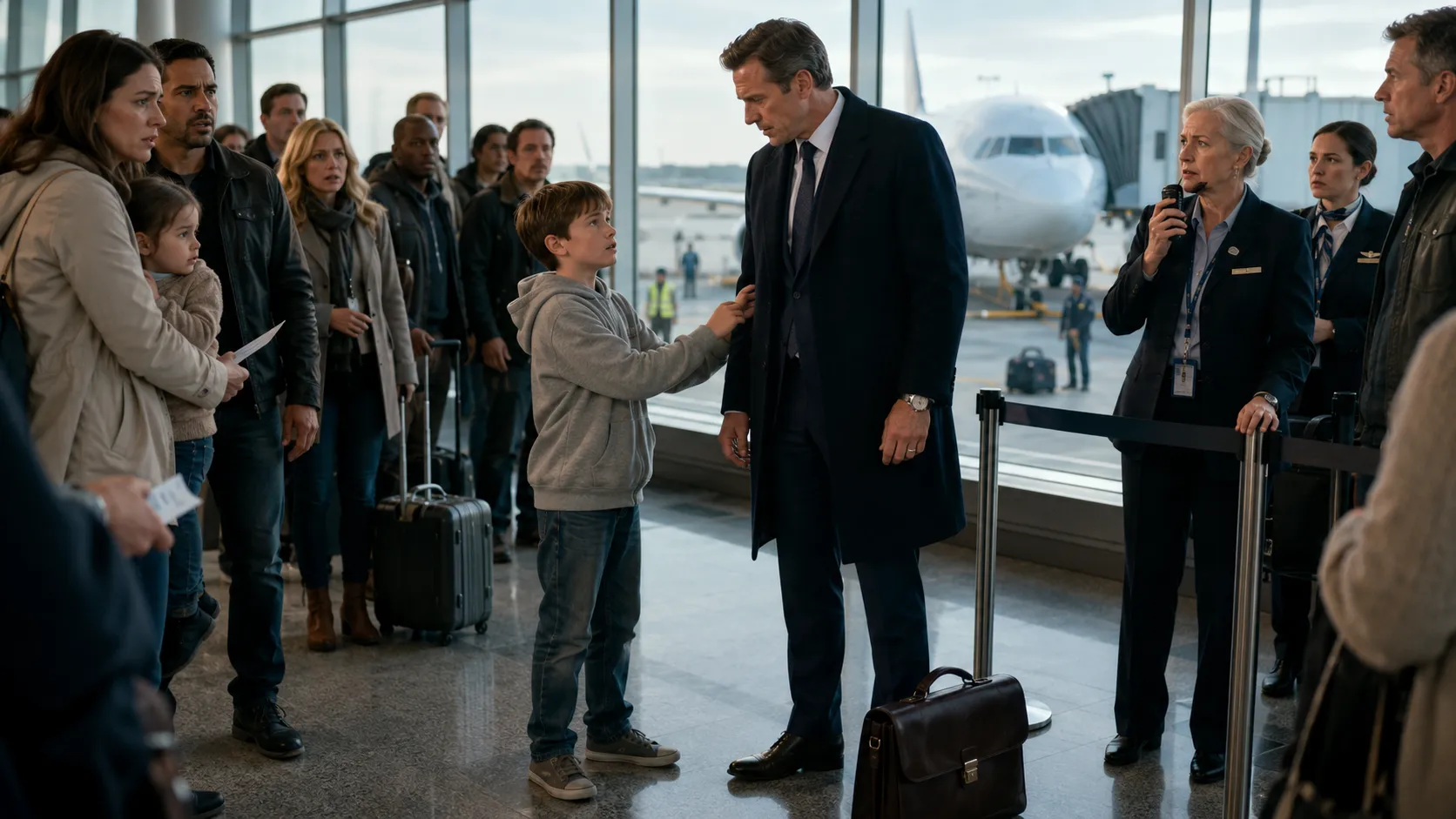
Daniel Harper was minutes from boarding Flight 782 when a shaking nine-year-old boy grabbed his sleeve and whispered, “Please don’t get on that plane.” Everyone tried to drag the child away — until his warning led security to a black bag that was never supposed to be there.
The sliding glass doors of Terminal 4 opened and closed like the airport was breathing.
People came through in waves: business travelers with polished shoes, families dragging overstuffed suitcases, students with headphones, flight crews in pressed uniforms, and tired parents carrying sleeping children against their shoulders.
At John F. Kennedy International Airport, nobody truly stood still.
Everyone was going somewhere.
Everyone except the boy near the far window.
He was small, no more than nine, wearing a faded gray hoodie, jeans too short at the ankles, and sneakers with the rubber peeling loose at the toes. His hair was dark and messy. His face had the thin, watchful look of a child who had learned to read adults before adults remembered children were watching.
His name was Ethan Miller.
For three months, Terminal 4 had been the closest thing he had to a safe place.
Not home.
Ethan knew better than to call it that.
A terminal was not a home. It had no bed, no kitchen, no mother humming while making tea, no one to ask if you had brushed your teeth. But it had bright lights, cameras, bathrooms, people everywhere, and corners where a small boy could disappear if he understood timing.
Ethan understood timing.
He knew which cleaning crew came through at 4:15 a.m.
He knew when the overnight guards changed shifts.
He knew which café threw away sandwiches still wrapped in plastic and which trash bins were too visible to search.
He knew the best window to watch planes push back from the gate.
And he knew something most people in the terminal never noticed:
Real airport workers moved with purpose.
They were tired, rushed, annoyed, distracted, but they moved like people who belonged to the invisible machine around them. They did not stop in strange places. They did not stare too long at doors. They did not look over both shoulders before touching something.
His mother had taught him that.
Her name was Rosa Miller, and she had cleaned floors at JFK for nine years.
“Airports are like beehives,” she used to tell him on the mornings she brought him with her because childcare had failed again. “Everybody has a job, even the people who look like they’re just walking.”
Ethan would sit on a bench with a coloring book while she mopped, watching pilots, gate agents, luggage crews, mechanics, supervisors, officers, and travelers move through the building.
“How do you know if someone doesn’t belong?” he once asked.
Rosa smiled without looking up from the mop.
“They look too normal.”
That had made no sense to him then.
Now, at nine years old, alone in the airport after his mother’s death, it made perfect sense.
Danger often dressed like it had nothing to hide.
That morning, Daniel Harper walked toward Gate B27 like a man who believed the world should make room for him.
He wore a navy suit tailored perfectly to his shoulders, a white shirt, polished brown shoes, and a watch expensive enough to buy Ethan food for a year. His leather briefcase swung at his side with smooth confidence. His phone was pressed to his ear.
“No,” Daniel said sharply. “The Los Angeles meeting is not optional. Tell Lawson I’ll sign after landing.”
He listened, jaw tightening.
“Then tell him to wait.”
He ended the call and checked his watch.
Ten minutes to boarding.
Perfect.
Daniel Harper liked perfection.
At forty-one, he had built his career around control: controlling meetings, money, schedules, risk, weakness, emotion, and anything else that threatened to slow him down. He owned a private logistics investment firm with contracts in airports, freight handling, security technology, and transport infrastructure.
He did not think of himself as cruel.
He thought of himself as efficient.
Cruelty, in Daniel’s world, was usually renamed.
Budget discipline.
Operational pressure.
Necessary restructuring.
Security optimization.
He passed a young mother struggling with two suitcases and a stroller. She looked at him as if hoping for help.
Daniel did not slow down.
He had a plane to catch.
At Gate B27, passengers were already gathering for Flight 782 to Los Angeles. The screen showed ON TIME. A gate agent smiled with professional exhaustion while answering the same question from three different people. A businessman complained into his headset. A little girl pressed her face to the glass to watch the plane outside.
Daniel glanced at the aircraft.
A clean white jet.
Morning light touched its wing.
He should have felt nothing.
Instead, for reasons he did not understand, he felt a small unease.
He ignored it.
Then the boy came running.
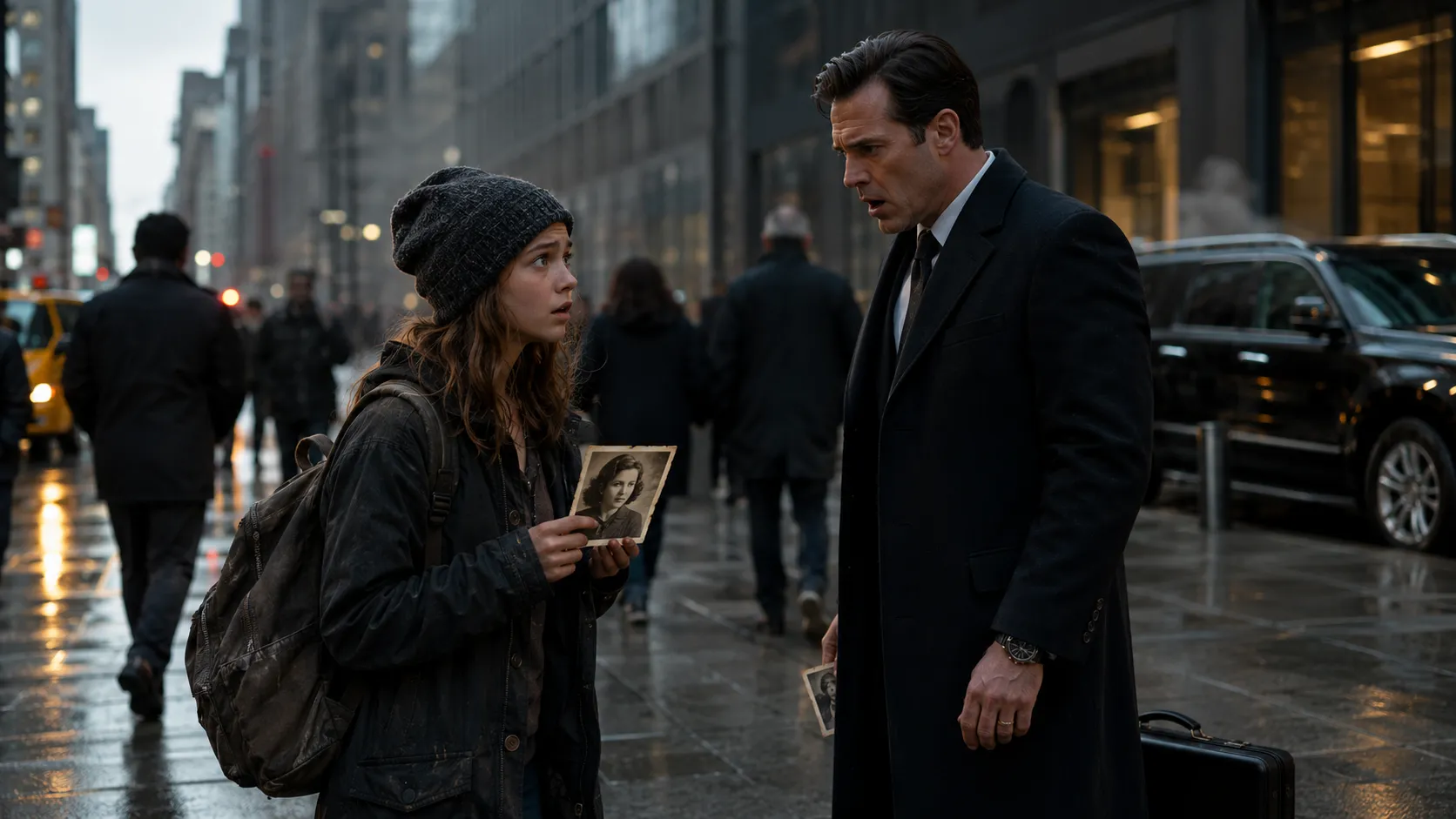
Ethan broke through the moving crowd so suddenly that one passenger cursed and lifted her coffee out of the way. He dodged a rolling suitcase, slipped once on the polished floor, caught himself, and kept running straight toward Daniel.
“Please!” the boy shouted. “Please don’t board this plane!”
Daniel stopped.
Not because he understood.
Because the boy had grabbed his sleeve.
Tiny fingers clutched the fabric of his suit jacket with desperate strength.
“Don’t get on,” Ethan gasped. “Please. Don’t let them board.”
Two ground staff members rushed after him.
“Hey!” one barked. “Stop him!”
The second grabbed Ethan by the arm.
The boy twisted hard, panic exploding across his face.
“Let me go! You don’t understand!”
“Sir, we’re sorry,” the staff member said to Daniel. “He keeps wandering around. He shouldn’t be here.”
Daniel looked down at his sleeve.
The boy’s dirty fingers had left wet marks on the expensive fabric.
His first instinct was irritation.
Then he looked at Ethan’s face.
The child was not playing.
He was not performing.
He was terrified.
“Please,” Ethan said, looking directly at him now. “I saw something.”
Daniel’s jaw tightened.
“What did you see?”
“Sir, we need to remove him,” the staff member said.
Daniel did not take his eyes off the boy.
“Let him speak.”
The staff member hesitated.
Daniel turned his head slowly.
“I said let him speak.”
People like Daniel were not used to being ignored. The staff knew it. The man released Ethan’s arm, though he kept a hand near the boy’s shoulder as if he expected him to bolt.
Ethan rubbed his wrist.
Daniel crouched slightly, lowering his voice.
“What did you see?”
Ethan swallowed.
“A man put a bag near the plane.”
A few passengers nearby stopped talking.
Daniel frowned.
“What kind of bag?”
“Black. A duffel bag. He had a badge, but he wasn’t right.”
One of the staff members sighed.
“Sir, kids imagine things. He’s been hanging around the airport all week.”
Ethan’s face flushed with anger and fear.
“I didn’t imagine it.”
Daniel stood.
“Where?”
Ethan pointed toward the glass, past the jet bridge, toward the service area near the aircraft.
“Near the cargo door before people started lining up. He looked around first. Then he put it inside.”
A woman nearby whispered, “Cargo door?”
The word moved through the gate area quickly.
Cargo.
Bag.
Plane.
Security.
Daniel looked at the staff.
“Call airport police.”
The older staff member shook his head.
“Sir, we can’t delay a flight because a child says—”
Daniel stepped closer.
“Call them.”
His voice was quiet enough to be more dangerous than shouting.
The gate agent lifted the phone.
Ethan stood near Daniel now, breathing too fast, his eyes darting across the terminal.
Daniel noticed.
“Do you see him?”
Ethan shook his head.
“No.”
“You saw his face?”
“A little.”
“What did he look like?”
“Normal.”
Daniel almost snapped at him.
Then Ethan added, “That’s why I watched him.”
Daniel stopped.
“What does that mean?”
Ethan’s eyes lifted.
“He looked normal, but he didn’t look busy.”
That answer unsettled Daniel more than he wanted to admit.
Within three minutes, two airport police officers arrived. Then a supervisor. Then a Transportation Security officer with a radio clipped to her vest.
The passengers at Gate B27 grew restless.
“What’s happening?”
“Are we delayed?”
“Is there a security issue?”
“Did someone say a bag?”
The supervisor, a woman named Harris with tight gray hair and a controlled expression, looked at Ethan skeptically.
“You’re the child who made the report?”
Ethan nodded.
“What is your name?”
“Ethan.”
“Ethan what?”
He hesitated.
“Miller.”
“Where are your parents?”
His face changed.
Daniel saw it immediately.
The question landed somewhere deep.
“My mom’s dead,” Ethan said.
The supervisor’s expression softened for less than a second, then returned to procedure.
“Who are you traveling with?”
“No one.”
The staff member folded his arms.
“See? He’s not a passenger.”
Ethan looked toward the window.
“I saw the bag.”
Harris looked at Daniel.
“Sir, we’ll handle this. You may proceed when boarding resumes.”
Daniel glanced at the aircraft.
Then at Ethan.
“No.”
The supervisor blinked.
“No?”
“I’m not boarding until the aircraft is checked.”
“Sir, there are protocols.”
“Use them.”
“Without credible evidence—”
Daniel’s face hardened.
“A child just reported a suspicious bag being placed near an aircraft. If your protocol says ignore that, your protocol is broken.”
The passengers reacted.
Some nodded.
Some looked annoyed.
One man in a black jacket snapped, “I have a connection in L.A. Are we really doing this?”
Daniel turned to him.
“You’re welcome to gamble with your life. I’m not.”
The man shut his mouth.
Harris spoke into her radio.
“Pause boarding. Request ramp inspection near Flight 782 cargo access. Possible unmanifested bag report.”
The gate area changed instantly.
The bright airport noise became tense and fragmented.
Passengers were moved back from the boarding lane. The jet bridge door was secured. More officers arrived. A mother began crying quietly while holding her toddler. A teenager filmed until his father told him to put the phone away.
Ethan stayed close to Daniel’s side.
Not because he knew Daniel.
Because Daniel was the only adult who had not dismissed him.
Daniel noticed that too.
“What were you doing near the window?” he asked.
Ethan looked down.
“Watching planes.”
“Do you do that often?”
“Yes.”
“Why?”
The boy’s voice became smaller.
“My mom used to work here.”
Daniel did not know what to say to that.
A radio crackled.
“Ramp unit to supervisor. We’re checking now.”
Everyone waited.
The silence stretched.
Daniel felt his phone buzz.
He ignored it.
The radio crackled again.
“Cargo team confirms all listed baggage accounted for.”
The staff member beside Harris gave Ethan a look.
“There. See?”
Ethan’s face went pale.
“No. It was there. I saw it.”
Harris lifted the radio.
“Ramp unit, continue visual inspection. Check access panels and nearby equipment carts.”
There was no answer for several seconds.
Then:
“Stand by.”
Daniel’s unease sharpened.
Passengers began murmuring again.
Ethan stared through the glass so hard it looked painful.
Daniel said quietly, “Breathe.”
The boy did not.
“Ethan.”
The child looked at him.
“Breathe.”
Ethan inhaled shakily.
Then the radio came alive.
“Supervisor.”
Harris straightened.
“Go ahead.”
A pause.
Then a different voice, tighter now.
“We have an untagged black duffel near the forward cargo area. Not on manifest. Not claimed by ground crew.”
The gate area froze.
Ethan grabbed Daniel’s sleeve again.
“That’s it,” he whispered. “That’s the bag.”
Harris’s face drained of color.
“Do not touch it. Clear the ramp. Request bomb squad and federal response.”
The word did not need to be said aloud.
Everyone understood.
Panic did not erupt immediately.
It arrived in waves.
First a gasp.
Then a chair scraping.
Then a man cursing.
Then a woman crying, “My daughter is on that flight.”
Passengers were pushed farther back. Airport police widened the perimeter. The gate agent’s hands shook as she made an announcement asking people to remain calm and follow instructions.
Nobody remained calm.
Daniel stood still in the middle of it, staring at the plane he had been seconds from boarding.
Flight 782.
Los Angeles.
On time.
Perfect.
A perfect machine with a black bag inside it.
Ethan’s small hand remained locked on his sleeve.
Daniel did not pull away this time.
Bomb technicians arrived in heavy protective gear.
Time became strange.
Ten minutes felt like an hour.
Passengers were moved to a secure area where they could still see too much through the distant glass. Some prayed. Some called family. Some demanded answers. Some stared at Ethan as if he were a miracle, a nuisance, or a ghost.
Daniel watched the boy absorb those looks.
“Don’t look at them,” he said.
Ethan’s voice trembled.
“They didn’t believe me.”
“They do now.”
“That’s different.”
Daniel looked at him.
The boy was right.
Being believed only after disaster nearly happens is not the same as being trusted.
Forty minutes later, a federal agent approached Harris and spoke quietly.
Harris closed her eyes for one second.
Then she turned to the gathered passengers.
“The suspicious item has been confirmed as a dangerous device. Flight 782 will not depart. Everyone here will need to provide statements.”
The room reacted all at once.
Sobs.
Shouts.
Relief.
Fear.
A man dropped to his knees.
The mother with the toddler hugged her child so tightly the little girl complained.
Someone said, “That boy saved us.”
The words spread.
That boy.
The boy.
The kid.
Ethan.
Daniel looked down.
Ethan did not smile.
He looked exhausted.
Older than nine.
Like being right had cost him something no one else could see.
Hours passed.
Statements were taken.
Passengers were interviewed and reinterviewed. Federal agents examined gate footage. Airport police reviewed access logs. The airline issued cautious statements. News vans gathered outside the terminal before noon. Rumors ran faster than facts.
Daniel gave his statement in a small office near the gate.
When asked why he insisted the report be taken seriously, he looked through the interior window at Ethan, who sat alone in a chair holding a juice box.
“Because he was afraid,” Daniel said.
The agent waited.
Daniel continued, “Children lie badly when they want attention. He wasn’t trying to be seen. He was trying to stop something.”
The agent wrote that down.
By late afternoon, Ethan was still in the terminal.
No parent had arrived.
No guardian.
No social worker yet.
Only a tired officer standing nearby with paperwork.
Daniel found the boy near the same window where the day had begun.
Outside, Flight 782 sat isolated near a distant service area, surrounded by official vehicles.
“You still watching planes?” Daniel asked.
Ethan shrugged.
“I don’t know what else to do.”
Daniel sat in the chair beside him.
He had missed the Los Angeles meeting. His phone had nearly died from calls and messages. His assistant had rescheduled what she could. His business partner had sent one message:
This is turning into a media circus. Be careful.
Daniel turned the phone off.
For once, he had no interest in control.
Ethan sipped the juice box slowly.
Daniel asked, “How did you notice him?”
“The man?”
“Yes.”
Ethan looked out at the runway.
“My mom said people who belong at airports are always a little tired.”
Daniel waited.
“She said real workers know where their hands go. They don’t look at signs too much. They don’t check if people are watching. They just work.”
“And he didn’t?”
Ethan shook his head.
“He touched his badge too much. Like he wanted people to see it. And he kept looking at the glass.”
Daniel leaned back.
“Your mother taught you that?”
“She cleaned here.”
“For how long?”
“Nine years.”
“What was her name?”
“Rosa.”
Daniel glanced at him.
“Rosa Miller?”
Ethan looked at him sharply.
“You knew her?”
Daniel did not.
But he knew the name.
He had seen it once in a report.
A maintenance safety complaint from a terminal cleaning contractor. A woman named Rosa Miller had reported that access badges were being shared among temporary staff near cargo-service corridors. Daniel remembered the issue because his firm had acquired part of the contractor two years earlier and ordered a cost-reduction review.
The report had been labeled low-priority.
He had skimmed it.
Maybe not even that.
His throat tightened.
“I saw her name in company documents.”
Ethan’s face changed.
“My mom wrote reports?”
“I think so.”
“She said people didn’t listen.”
Daniel’s chest felt suddenly heavy.
“When did she die?”
“Three months ago.”
“I’m sorry.”
Ethan looked down at the juice box.
“She got hit by a service truck after her shift.”
Daniel went still.
“At the airport?”
“Near the employee parking road.”
Daniel remembered another document.
An accident settlement.
A contractor fatality.
Minimal exposure.
Resolved quietly.
He had signed off on the settlement summary without reading the details because the amount had been small and the liability had been contained.
Contained.
That was the word they used when someone’s death did not threaten the company.
Daniel looked through the glass.
For the first time in years, a business term made him feel sick.
“Where have you been living?” he asked.
Ethan shrugged.
“Around.”
“That isn’t an answer.”
“It’s the one I have.”
Daniel studied him carefully.
“You’ve been sleeping here?”
“Not inside all the time.”
“Ethan.”
The boy’s eyes hardened.
“I don’t steal.”
“I didn’t say you did.”
“People always think that.”
Daniel had no defense.
Because he had thought it too.
Before the boy grabbed his sleeve, Daniel would have walked past him without stopping. If he had noticed him at all, he would have filed him silently under problem, nuisance, someone else’s responsibility.
Someone else’s responsibility had nearly boarded a plane full of people.
A woman in a navy blazer approached them.
“Ethan Miller?”
The boy stiffened.
“My name is Karen Holt,” she said gently. “I’m with child protective services. We need to make sure you have somewhere safe tonight.”
Ethan gripped the juice box until it collapsed.
Daniel saw the fear immediately.
Karen noticed too.
“I’m not here to punish you.”
“That’s what people say before they move you,” Ethan whispered.
Daniel looked at Karen.
“What happens to him?”
She gave the cautious look of someone who had seen too many adults become suddenly interested in a child after cameras appeared.
“That depends on his records, available relatives, and emergency placement options.”
“He has relatives?”
“We’re checking.”
Daniel stood.
“I want to help.”
Karen studied him.
“With respect, Mr. Harper, many people will want to help for the next twenty-four hours. Most will disappear before the paperwork does.”
The sentence struck him cleanly.
Ethan looked from one adult to the other.
Daniel nodded slowly.
“That’s fair.”
Karen turned back to Ethan.
“Do you have anyone we should call?”
Ethan hesitated.
“My mom had a friend. Mrs. Alvarez. She lives in Queens. I don’t know her number.”
“Do you know the address?”
“Maybe.”
Karen crouched to his level.
“Can you tell me?”
Ethan glanced at Daniel.
The glance was small.
But it asked a question.
Will you disappear too?
Daniel answered before the boy could speak.
“I’ll stay until they find her.”
Karen looked at him.
“That may take time.”
“I have time.”
For Daniel Harper, those words would have been unthinkable that morning.
By evening, they found Mrs. Alvarez.
Her full name was Teresa Alvarez. Seventy-one years old. Former airport cafeteria worker. Rosa’s closest friend. She lived in a small apartment in Queens and had been looking for Ethan since he ran from the temporary placement he had been sent to after his mother died.
When she arrived at JFK, she came faster than her knees liked.
“Ethan!”
The boy turned.
For the first time all day, his face became a child’s face.
“Mrs. A.”
She pulled him into her arms with such force that the juice box fell from his hand.
“You foolish boy,” she cried. “You scared me half to death.”
Ethan held onto her coat.
“I’m sorry.”
“You should be.”
Her voice shook.
Then she kissed the top of his head and held him tighter.
Daniel stood back.
Something loosened inside him.
Not relief exactly.
More like the first crack in a wall he had spent decades building.
Teresa Alvarez looked over Ethan’s head at Daniel.
“You’re the man who listened?”
Daniel nodded.
“Eventually.”
She gave him a sharp look.
“Eventually is better than never. But not as good as sooner.”
Daniel almost smiled.
“Yes, ma’am.”
That night, after more forms, interviews, signatures, and temporary placement arrangements, Ethan left the airport with Teresa Alvarez under emergency kinship care review.
Before leaving, he turned back to Daniel.
“You missed your plane.”
Daniel looked toward the runway.
“Yes.”
“Are you mad?”
“No.”
“You looked like the kind of man who gets mad when plans change.”
Daniel gave a quiet, tired laugh.
“I am.”
“Then why not?”
Daniel looked at the boy who had stopped a flight, exposed a device, and dragged a dead woman’s ignored warning back into the light.
“Because maybe the plan needed to change.”
Ethan seemed to accept that.
He reached into his hoodie pocket and took out a small plastic airplane.
One wing had been repaired with tape.
“My mom bought this for me from the airport gift shop when I was six,” he said.
He held it out.
Daniel frowned.
“I can’t take that.”
“It’s not to keep.”
“Then what?”
Ethan placed it in Daniel’s palm.
“So you remember.”
Daniel looked at the tiny plane.
“Remember what?”
Ethan’s voice was quiet.
“That people you don’t notice can still see what you miss.”
Then he turned and left with Mrs. Alvarez.
Daniel stood in the terminal long after they disappeared.
The next morning, Daniel walked into Harper Meridian Logistics headquarters and asked for every file connected to Rosa Miller.
His legal team resisted.
His operations director looked uncomfortable.
His business partner, Martin Lawson, laughed once.
“Daniel, please don’t tell me you’re making business decisions because a kid gave you a toy plane.”
Daniel placed the plastic airplane on the conference table.
“I’m asking for records.”
Lawson leaned back.
“We handled the airport fatality cleanly.”
Daniel stared at him.
“Cleanly?”
“You know what I mean.”
“I’m starting to think I do.”
The room quieted.
Lawson’s smile faded.
“Be careful. The press is already circling. We need distance, not more exposure.”
Daniel opened the folder his assistant had brought.
Rosa Miller’s name appeared on the first page.
Employee incident history.
Access badge complaint.
Supervisor escalation.
Unauthorized contractor movement.
Temporary badge sharing.
Recommendation: no immediate action.
Reason: insufficient corroboration.
Further reason, written in a margin by someone in Daniel’s own company:
Cost of full access audit exceeds projected risk.
Projected risk.
Daniel looked at those words until they blurred.
Projected risk had a name.
Rosa Miller.
Projected risk had a son.
Ethan.
Projected risk had almost become a plane full of families, workers, grandparents, students, flight attendants, pilots, and children.
Daniel looked up.
“Who made the decision not to audit?”
No one answered.
He already knew.
Maybe he had not signed that specific sentence.
But he had built the culture where that sentence made sense.
Lawson exhaled.
“Daniel, this is not the time for moral theater.”
Daniel closed the folder.
“No. It’s late for that.”
“What does that mean?”
“It means we cooperate fully with federal investigators. We disclose every ignored complaint. Every contractor gap. Every badge irregularity. Every security cost analysis.”
Lawson stood.
“That would destroy us.”
Daniel looked at him.
“Maybe we helped build something that deserves to be destroyed.”
Lawson’s face hardened.
“You are emotional.”
Daniel picked up the toy plane.
“No. I was emotional before, when I thought control mattered more than truth.”
Within forty-eight hours, Harper Meridian was under investigation.
Within a week, three subcontractors were suspended.
Within a month, authorities confirmed that the man who planted the device on Flight 782 had used a temporary contractor badge connected to a system Rosa Miller had warned about twice before her death.
Her death, once labeled an accident, was reopened.
Security footage previously marked corrupted was recovered from a backup server.
It showed a service truck crossing the employee road without lights.
It showed Rosa stepping back.
It showed the driver accelerating.
The driver had disappeared two days after her death.
Daniel watched the footage once.
Then went into the restroom and vomited.
He had spent years believing guilt was inefficient.
Now he understood guilt had been waiting for him, gathering interest.
The media loved the boy first.
They called Ethan “the child hero of Flight 782.”
They showed a blurred version of his face.
They interviewed passengers.
They replayed the moment the gate area froze.
They praised Daniel too, at first.
“The millionaire who listened.”
“The businessman who took a child seriously.”
Daniel hated that headline more than the criticism that followed.
Because it made him sound better than he had been.
He had not listened because he was noble.
He had listened because the boy’s fear was too precise to ignore.
And even then, he listened only after staff had tried to drag the child away.
Two months after the stopped flight, Daniel attended Rosa Miller’s memorial service.
Not the funeral.
He had missed that by three months.
A community memorial, arranged after the truth about her warnings came out.
It was held in a modest church in Queens.
No chandeliers.
No cameras inside.
No corporate podium.
Just folding chairs, flowers, photographs, neighbors, airport workers, old friends, and one nine-year-old boy in a clean blue shirt sitting beside Teresa Alvarez.
Daniel stood in the back until Teresa saw him.
She crooked one finger.
He walked forward like a boy called to the principal’s office.
“Sit,” she said.
He sat.
Ethan did not look at him at first.
At the front of the church, a photograph of Rosa stood beside a candle.
She was smiling in her airport cleaning uniform, one hand on a mop handle, head tilted with the kind of tired warmth that comes from someone used to working hard and loving anyway.
People spoke about her.
A coworker said Rosa remembered everyone’s birthdays.
A neighbor said she left soup outside doors when people were sick.
A former supervisor, crying openly, said Rosa was “difficult” because she asked questions when corners were cut.
Teresa Alvarez stood last.
She gripped the podium with both hands.
“Rosa was not difficult,” she said. “She was paying attention.”
The church fell silent.
“She saw what others ignored. And when she spoke, men with better shoes decided listening cost too much.”
Daniel lowered his eyes.
Teresa continued, “Her son saw what she taught him to see. Because of that, many people are alive. But do not call this a miracle and forget the warning. Rosa should have been heard before her child had to save a plane.”
Ethan began crying silently.
Daniel looked at the floor.
The words did not accuse him by name.
They did not need to.
After the service, Daniel stood outside near the church steps, unsure whether leaving or staying was less selfish.
Ethan approached him.
“You came.”
“Yes.”
“Why?”
Daniel looked toward Rosa’s photograph being carried carefully by one of the church volunteers.
“Because I should have come sooner.”
Ethan nodded as if that answer mattered.
Then he asked, “Did they find the man who hurt my mom?”
“Not yet.”
“Will they?”
Daniel hesitated.
Ethan’s face hardened.
“Don’t say yes if you don’t know.”
Daniel swallowed.
“I don’t know. But people are looking now.”
Ethan looked down.
“They should have looked before.”
“Yes.”
“Because she mattered before the plane.”
Daniel closed his eyes briefly.
“Yes. She did.”
That was the first honest conversation they had.
It was not the last.
The investigation widened over the following year.
The device on Flight 782 became part of a larger federal case involving stolen contractor badges, access failures, organized smuggling routes, and a violent attempt to silence a worker who had noticed too much.
The man who planted the bag was caught in Newark six months later.
The driver who killed Rosa was found in Florida.
Neither man looked like a villain.
That disturbed Daniel most.
They looked ordinary.
One had a wife.
One had a gym membership.
One had old photographs with children at a barbecue.
Ethan saw their pictures once on television and asked Teresa to turn it off.
Later, he told Daniel, “They look normal.”
Daniel remembered the gate.
The bag.
The warning.
“Yes,” he said. “They do.”
Harper Meridian Logistics did not survive unchanged.
Lawson resigned before he could be removed. Several executives followed. Contracts were lost. Lawsuits came. Investors called Daniel reckless for exposing documents without exhausting legal defenses.
Daniel accepted the losses.
Not nobly.
Painfully.
He missed certainty.
He missed the old ease of numbers behaving better than people.
But every time he considered retreating into the old language — exposure, liability, optics, risk control — he looked at the taped-wing toy plane on his desk.
Then he remembered Ethan saying:
People you don’t notice can still see what you miss.
Daniel created the Rosa Miller Aviation Safety Fund six months after the attack.
At first, Teresa refused to support it.
“You cannot buy her name,” she told him in her kitchen.
Daniel sat at the small table while Ethan did homework nearby.
“I’m not trying to.”
“That is what rich men always say right before writing their names on grief.”
Ethan looked up from his worksheet.
Daniel accepted the hit.
“No building with my name. No gala. No speeches unless the family approves. The fund would support whistleblower protection for airport workers, emergency housing for families after workplace deaths, and independent reporting channels for contractors.”
Teresa stared at him.
“Those are good words.”
“Yes.”
“Good words can be cheap.”
“Yes.”
She poured coffee into a chipped mug and set it in front of him.
“Then make them expensive.”
He did.
The fund began with money Daniel had planned to use for a second home in Napa.
Then with company settlement money.
Then with penalties redirected through legal agreements.
Then with donations from other firms that preferred quiet accountability to public scandal.
Teresa joined the advisory board only after demanding veto power over “nonsense.”
Ethan asked what nonsense meant.
Teresa said, “When rich people make sad things shiny.”
The fund did not become famous overnight.
That made Daniel trust it more.
It paid rent for a baggage handler’s widow.
It helped a food-service worker report unsafe access practices without losing her job.
It covered counseling for Flight 782 crew members who still woke shaking after dreams of the aircraft leaving the ground.
It provided legal support for contract workers whose complaints had been buried under layers of staffing agencies.
Slowly, it became useful.
Ethan changed too.
Not quickly.
No child becomes whole because adults finally start doing paperwork correctly.
He still woke some nights thinking he was back in the terminal, shouting while nobody listened. He still kept food hidden in drawers. He still avoided men in suits for almost a year, except Daniel, and even Daniel took time.
Teresa became his legal guardian after the court reviewed Rosa’s notes and Ethan’s placement history.
On the day the order was finalized, Teresa cried.
Ethan pretended not to.
Daniel drove them home and bought a cake.
Teresa said, “This cake is too expensive.”
Daniel said, “It was the least expensive one in the bakery.”
Teresa narrowed her eyes.
“That bakery has chandeliers.”
Ethan laughed.
It was the first time Daniel heard him laugh like a child.
A real laugh.
Not nervous.
Not careful.
The sound stayed with him all day.
Two years after Flight 782, Ethan returned to JFK by choice.
Not to hide.
Not to sleep.
Not to search trash bins for food.
He came with Teresa, Daniel, Captain Laura Bennett of Flight 782, and several airport workers for a safety training event named after Rosa.
The terminal looked the same and completely different.
People still rushed. Announcements still echoed. Suitcases still rolled. Planes still moved beyond the glass like enormous white birds.
Ethan stopped near the window by Gate B27.
His face went quiet.
Daniel stood beside him.
“You okay?”
Ethan looked out at the aircraft.
“I don’t know.”
“That’s allowed.”
The boy nodded.
Captain Bennett approached slowly.
She was in her fifties, silver-haired, calm-eyed, and had the grounded presence of someone who had carried responsibility at altitude for decades.
She had never met Ethan on the day of the incident because the cockpit had been locked down during the security response.
Now she crouched slightly in front of him.
“I never thanked you properly,” she said.
Ethan looked embarrassed.
“You didn’t take off.”
“No,” she said. “Because of you.”
“And my mom.”
Captain Bennett nodded.
“Yes. Because of your mother too.”
That answer mattered.
Ethan reached into his backpack and removed the taped-wing airplane.
Daniel blinked.
“I thought you gave that to me.”
“You gave it back last week.”
“I thought I was borrowing it.”
“You were.”
Ethan handed it to Captain Bennett.
“Can you keep this in the training room?”
Her eyes softened.
“I would be honored.”
He looked toward the gate.
“So people remember to listen before something happens.”
Captain Bennett closed both hands around the toy plane.
“I promise.”
The training room opened that afternoon.
On one wall hung Rosa Miller’s photograph.
Beside it was a sentence from her second ignored report:
A badge is not safety if no one checks the person wearing it.
Below that, inside a small glass case, sat the toy airplane with the taped wing.
Ethan stared at it for a long time.
Then said, “She would have said the tape job was bad.”
Teresa wiped her eyes.
“She would have said your tape job was bad. Then she would have fixed it worse.”
Ethan smiled.
Daniel stood behind them, silent.
He had learned that some moments did not need his voice.
Five years passed.
Flight 782 became one of those stories people remembered in fragments.
A boy.
A bag.
A stopped flight.
A millionaire who listened.
A mother who had warned them first.
The facts changed slightly every time strangers retold it. Ethan hated when people made him sound magical. Daniel hated when they made him sound heroic. Teresa hated nearly every version and corrected people aggressively.
“The boy was observant,” she would say. “Not magic.”
“The man listened late,” she would add. “Not heroically.”
“And Rosa taught them both.”
That became the family version.
By fourteen, Ethan had grown taller and quieter. He liked aircraft maintenance manuals, old detective shows, and fixing small electronics. He still loved airports, though now he loved them with caution. He volunteered with the safety fund, helping design posters that told workers how to report suspicious access without fear of losing their jobs.
At sixteen, he gave his first public speech.
He did not want to.
Teresa said he did not have to.
Daniel said the same.
That was probably why he agreed.
The event was held in a modest conference room at JFK, attended by airport workers, contractors, supervisors, federal officials, and families of Flight 782 passengers.
Ethan walked to the microphone with a folded paper.
His hands shook.
He looked once at Teresa.
Then at Daniel.
Then at Rosa’s photograph on the screen behind him.
“When I was nine,” he began, “people called me the boy who stopped the flight.”
The room was silent.
“I didn’t stop it alone. The gate agent made the call. The supervisor paused boarding. Security checked the plane. The bomb squad handled the bag. The crew kept everyone calm. Mr. Harper refused to board. And my mother taught me what not belonging looks like.”
He paused.
“That matters because stories about one hero can let everyone else forget their job.”
Daniel lowered his eyes.
Ethan continued, stronger now.
“My mom was not famous when she warned people. She was not rich. She did not wear a suit. She cleaned floors. That should not have made her easier to ignore.”
Teresa pressed a tissue to her mouth.
“If you remember one thing from Flight 782, don’t remember me grabbing a sleeve. Remember Rosa Miller writing reports before anything happened. Safety should not require a child to panic in public before adults act.”
He stepped back from the microphone.
The applause came slowly.
Then fully.
Ethan did not smile much.
But when he sat down between Teresa and Daniel, he looked lighter.
That evening, Daniel drove them home through Queens.
The city lights blurred through light rain.
Ethan sat in the back seat, looking out the window.
Daniel glanced at him in the mirror.
“You did well.”
Ethan nodded.
“You didn’t make it shiny.”
Daniel almost smiled.
“High praise from Mrs. Alvarez’s school of public speaking.”
Ethan smiled faintly.
After a while, he asked, “Do you ever wish you got on another flight and never learned about my mom?”
Daniel tightened his hands on the steering wheel.
“No.”
“You lost a lot.”
“Yes.”
“Your company changed.”
“It needed to.”
“People blamed you.”
“They should have.”
Ethan looked at him through the mirror.
Daniel continued carefully.
“I don’t mean I planted the bag. I don’t mean I wanted anyone hurt. But I helped build a place where warnings from people like your mother could be filed away because fixing them cost too much.”
Ethan was quiet.
Then he said, “She would have liked that answer.”
Daniel swallowed.
“Would she have liked me?”
Ethan thought about it.
“No.”
Daniel nodded.
“That’s fair.”
“But maybe eventually.”
Daniel smiled sadly.
“Eventually is better than never. But not as good as sooner.”
Ethan laughed softly.
“You stole that from Mrs. A.”
“I did.”
“Smart.”
Years later, when Ethan was twenty-one, he stood again at Gate B27.
This time, he wore an airport operations badge.
Not a borrowed one.
Not a fake one.
His own.
He had just finished his first week in an aviation safety internship funded through the Rosa Miller program. His job was not glamorous. It involved paperwork, access reviews, training logs, and walking routes most passengers never saw.
He liked it.
There was comfort in invisible systems when they were tended honestly.
Daniel, older now and less polished, met him near the window with two coffees.
“You look official,” Daniel said.
Ethan took one coffee.
“You look tired.”
“I am official in no place and tired in all places.”
Ethan smiled.
Outside, a plane pushed back slowly from its gate.
For a while, they watched in silence.
Daniel had become something between guardian, uncle, mentor, and inconvenient adult. Not father. Ethan had a mother. He had Rosa. That space did not need filling.
Daniel had learned not to try.
Teresa still ran most of their lives through sheer force of opinion. She had recently begun using a cane and hitting people lightly with it when they annoyed her, which was often.
Ethan looked at the runway.
“Sometimes I still think about that morning.”
Daniel nodded.
“So do I.”
“I used to dream the plane took off.”
Daniel said nothing.
“In the dream, I scream and nobody listens. The doors close. The plane leaves. I wake up before anything happens.”
“Do you still have it?”
“Not much.”
“That’s good.”
Ethan looked at him.
“Sometimes now I dream my mom is mopping the floor near the gate.”
Daniel’s throat tightened.
“What does she say?”
Ethan smiled faintly.
“She tells me I missed a spot.”
Daniel laughed quietly.
“That sounds like her.”
“You didn’t know her.”
“No,” Daniel said. “But I know people who loved her.”
Ethan accepted that.
The terminal moved around them.
Passengers hurried past.
A child cried.
A pilot checked her phone.
A cleaner pushed a yellow bucket near the windows, moving with purpose, tired but alert.
Ethan watched her.
Then he looked at the crowd beyond her.
Daniel noticed.
“See something?”
Ethan took a slow breath.
“No,” he said. “Just looking.”
Daniel nodded.
That was enough.
The lesson of Flight 782 had never been to live in fear.
It was to pay attention before fear became necessary.
Across the terminal, a little boy pressed his face to the glass, watching a plane rise into the gray New York sky.
His mother stood behind him, one hand on his shoulder.
Ethan watched them until the aircraft disappeared into the clouds.
Then he touched the badge on his chest.
For years, he had been the boy who stopped the flight.
Now he was becoming something quieter.
The man who made sure warnings did not have to scream.