
She tried to sell her bike for food—then the bikers found out who destroyed her mother.
“Will you buy my bike, sir… my mommy hasn’t eaten in two days.”
The words were so small they almost disappeared beneath the distant roar of engines—until Rocco Balestri heard them.
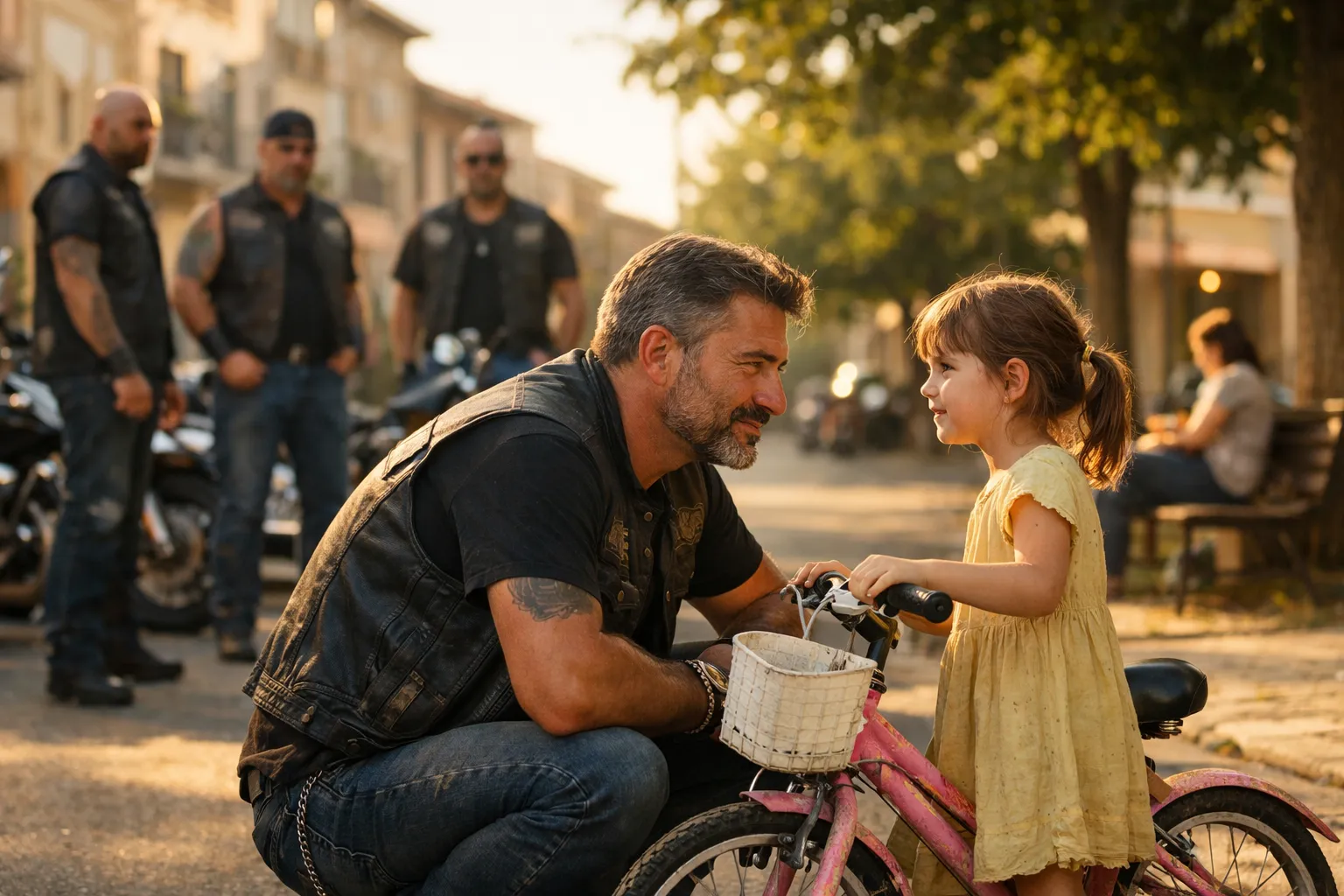
He was riding through Borgoforte, in Lombardy, with three other members of the Iron Hawks—Toro, Michele, and Vipera—returning from a charity motorcycle ride. Black vests, a red hawk patch on their backs, Harleys growling low and heavy as they rolled slowly down the avenue.
People usually reacted the same way. Children stared at them like they were both monsters and miracles. Adults pretended not to see them or stepped aside with polite fear.
But that day, a little girl stopped all four of them as if she had stretched a rope across the road.
She stood on the sidewalk in a faded yellow dress and worn-out shoes, next to a small pink bicycle. The white basket was held together with tape. A piece of cardboard hung from the handlebars, with shaky marker writing:
FOR SALE
Rocco eased off the throttle and shut off the engine. One by one, the others did the same, until the street fell suddenly silent—no more engines, no more presence—just the uneven breathing of the girl and the distant hiss of traffic.
Rocco removed his helmet and crouched down to her level. Up close, she looked about six. Maybe younger. Her hair was a tangled mix of brown curls and sweat. Her fingers twisted the cardboard like it was armor.
“What’s your name, little one?” he asked softly.
Her lips trembled. “Mia.”
“Mia,” he repeated, even softer. “Are you selling your bike?”
She nodded quickly, as if afraid he might leave if she didn’t answer fast enough.
“Yes, sir. It still works. I can clean it. I… I just…”
Her voice broke. She took a breath and forced the truth out again, even smaller than before.
“My mommy hasn’t eaten in two days… and we need money for food.”
Something tightened sharply in Rocco’s chest.
He had heard grown men beg with pride still stuck between their teeth. He had heard kids lie for money. But a child trying to sell her own bike? The one thing that could carry her away, even for a little while, when the world felt too big?
Toro, Michele, and Vipera stood behind him, suddenly silent. Tough men—tattoos, scars, faces hardened by life—but now still in that way only people become when something hits too close.
Rocco followed Mia’s glance.
A short distance away, under a tree, a woman sat slumped against the trunk. Wrapped in a blanket too light for the heat. Pale face. A body so still it looked like it had run out of energy even to pretend.
Rocco stood slowly. “Is that your mother?”
Mia nodded, clutching the cardboard to her chest.
“She says we’ll be okay,” she whispered. “But… she lies so I won’t be scared.”
That sentence struck something deep.
It wasn’t the hunger. It was the fact that this little girl had already learned the adult skill of translating someone else’s pain.
Rocco walked toward the woman.
“Ma’am,” he said gently, stopping at a respectful distance. “Are you alright?”
She lifted her head slowly. Her eyes were clouded, but there was still pride in her jaw.
“I’m fine,” she rasped automatically, then realized how absurd it sounded. “I… I’m Clara. Clara Ferri.” She glanced at Mia. “I’m sorry if she bothered you. She always thinks she has to fix everything.”
Mia rushed up behind Rocco and tugged lightly at his vest.
“Please, sir,” she said quickly. “The bike is twenty euros. I can also—”
Rocco turned to her, and for a moment his throat burned.
He had been a father once.
Not long enough to learn everything—but long enough to know what it meant.
His son had died in a car accident eight years earlier. A phone call. A siren. A small body on a hospital bed that had dropped silence over the rest of his life.
Since then, he had spent years trying to outrun that silence—with noise. Engines. Roads. Brotherhood. Charity rides that made him feel useful without ever saying the word grief.
And now, a little girl was offering her bike as ransom for her mother’s survival.
Rocco pulled out his wallet and took out money—far more than twenty euros. He folded it once and placed it in Mia’s small hands.
“You keep the bike,” he said. “You’ve already earned this.”
Mia blinked, confused. She stared at the bills like they might be a trick.
“But… sir, it’s too much.”
“No,” Rocco said gently. “It’s exactly what it needs to be.”
Toro stepped forward and added his money. Then Michele. Then Vipera, silent as always, slipping bills into Mia’s hands without taking his eyes off Clara.
Mia’s eyes widened. Her hands began to tremble.
“Mom…” she whispered, turning to Clara as if she needed permission to believe.
Clara’s pride flared instantly. She tried to push Mia’s hands down.
“No,” she said hoarsely. “We can’t—”
Rocco raised a hand. Not commanding—just firm.
“Let your daughter breathe,” he said. “This isn’t charity. It’s community.”
Clara looked at the four men in leather, unsure where to place her fear.
“Why?” she whispered. “You don’t even know who we are.”
Rocco looked at Mia’s face. “We know enough.”
Then his voice hardened slightly. “Who did this to you?”
Clara hesitated. Opened her mouth. Closed it.
Finally: “My boss.”
Rocco’s jaw tightened. “Name.”
“Riccardo Gherardi. Gherardi Industries.” She lowered her eyes. “I worked in administration. I got sick for a week. Missed two days. Asked for time… he said I was replaceable.”
Replaceable.
The word hung in the air like poison.
Rocco felt Toro stiffen behind him. Michele’s fists clenched. Even Vipera—who rarely reacted—went completely still.
Rocco kept his voice calm on purpose.
“Where’s the building?”
Clara looked up sharply. “What?”
“We’re going to have a conversation.”
Fear filled her face. “No—please. I don’t want trouble.”
“He already created the trouble,” Rocco said quietly. “You don’t owe him your silence.”
He crouched again in front of Mia.
“You stay here with your mom. And you don’t sell the bike. Understood?”
Mia nodded firmly. “Yes.”
Rocco stood.
“Toro—stay here until they have food and a safe ride somewhere.”
Toro nodded, already pulling out his phone.
Rocco looked back at Clara. “We’ll be back,” he said. “And when we are—you won’t be alone anymore.”
The engines roared back to life.
Mia hugged her pink bike as three Harleys rode away like a gathering storm.
They weren’t going to start a fight.
Rocco had buried enough of those.
They were going to deliver something else—
a reminder that cruelty doesn’t become invisible just because it wears a suit.
Gherardi Industries occupied the most elegant building in town—glass, steel, and arrogance.
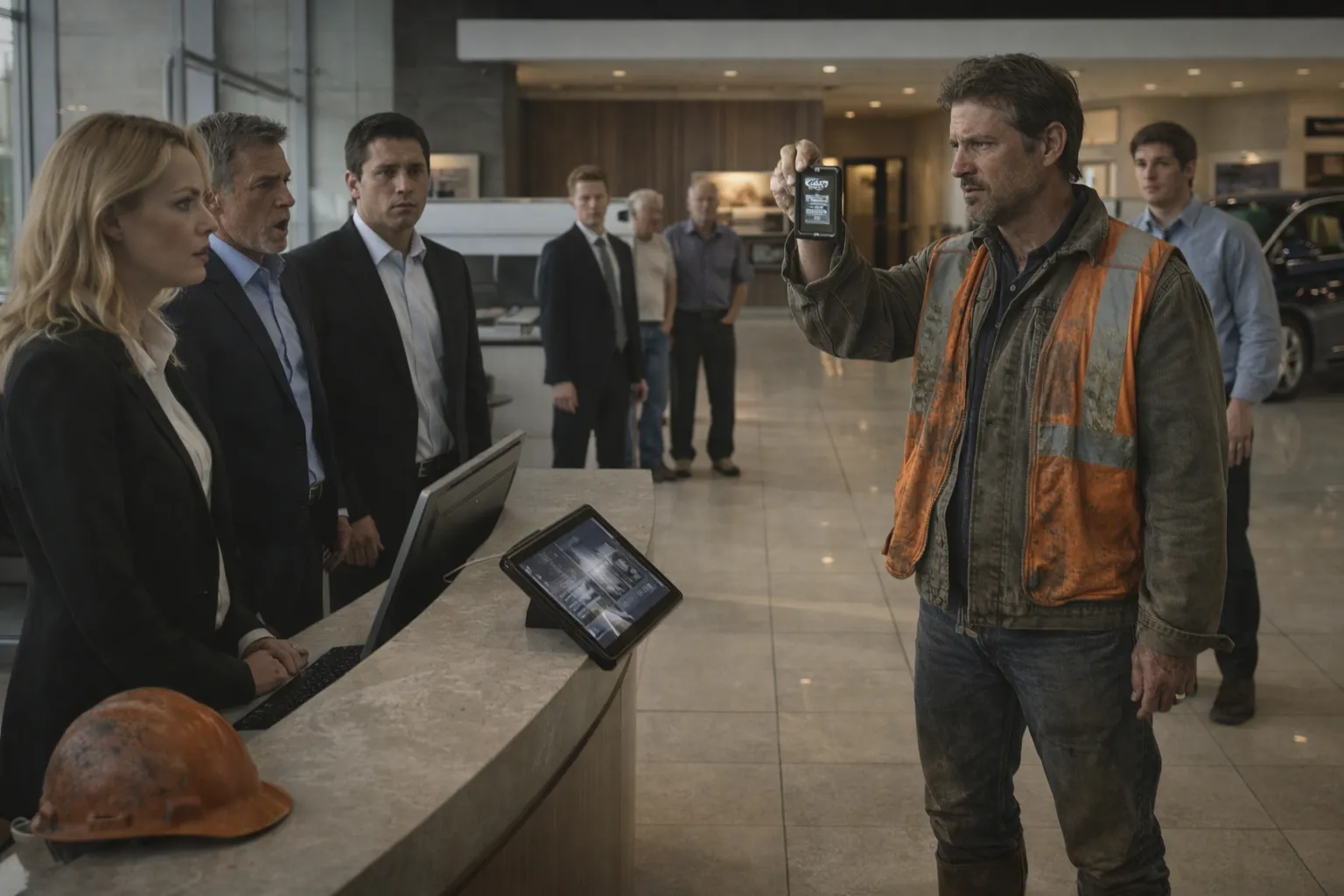
The lobby smelled of expensive perfume and polished stone. The receptionist looked up, saw the Iron Hawks’ vests, and stiffened.
“We’re here to see Riccardo Gherardi,” Rocco said calmly.
“Do you have an appointment?” her voice wavered.
“We only need five minutes,” Michele said.
A security guard started approaching, then slowed when Rocco raised a hand.
“We’re not here to cause trouble. We’re here to talk.”
That alone changed the atmosphere.
After a quick phone call, the receptionist nodded. “He’ll see you. Briefly.”
They were led into an office straight out of a magazine—polished desk, framed awards, a photo of Gherardi shaking hands with a senator.
Gherardi stood behind the desk with the composed smile of a man used to commanded respect.
“Gentlemen,” he said smoothly. “How can I help you?”
Rocco stepped forward and placed something on the desk.
It was Mia’s cardboard sign.
FOR SALE
Gherardi frowned. “What is this?”
Rocco leaned slightly forward—not threatening, just enough to break the act.
“This,” he said quietly, “is the price of your greed.”
The smile flickered.
“If this is intimidation—”
“No,” Rocco cut in. “If it were, you’d know. This is accountability.”
Michele spoke next, voice perfectly controlled.
“Three blocks from here there’s a woman under a tree. Clara Ferri. You fired her when she needed a week not to collapse. Her six-year-old daughter was trying to sell her bike so her mother could eat.”
For the first time, Gherardi’s confidence cracked.
“I don’t know what you’re talking about. Budget cuts. Difficult decisions.”
Vipera finally spoke, low and rough.
“Payroll isn’t a budget cut.”
Gherardi straightened defensively. “My company is my business.”
Rocco placed his palm flat on the desk—not a slam, just an end to excuses.
“We’re not asking you to explain,” he said. “We’re reminding you that you’re human.”
Silence filled the office.
People in the lobby were beginning to notice. Phones slowly rising.
Gherardi’s jaw tightened. “What do you want?”
“You’ll do three things,” Rocco said.
“You’ll pay Clara for the week she was sick. You’ll give her severance. And you’ll write her a reference so she can find a job somewhere that treats people like humans—not disposable parts.”
Gherardi let out a short laugh. “And if I don’t?”
Rocco didn’t raise his voice.
“Then Clara files a report. And your name becomes part of a story about a little girl selling her bike to keep her mother from starving.”
He tapped the cardboard sign.
“And your charity campaigns will start to look like what they are. A lie.”
Color drained from Gherardi’s face.
After a long moment, he swallowed.
“Bring me her details.”
Michele slid a folded paper across the desk.
Gherardi took it stiffly. “Fine. Now get out.”
Rocco turned to leave, then paused.
“Forgiveness isn’t something you can buy,” he said quietly. “But you can start earning it. Start today.”
That evening, something strange began to happen in Borgoforte.
Anonymous donations appeared to pay overdue bills. Food boxes arrived at shelters. Two employees previously laid off were quietly rehired.
Clara received a message from an unknown number:
Check your email.
Attached was a reference letter signed by Riccardo Gherardi himself.
No one knew why.
But some people understood.
As the sun dipped behind the trees, three motorcycles returned to the same street.
Mia saw them first.
“Mom!” she shouted, running across the grass. “They’re back!”
Clara stood slowly. Still weak—but standing straighter now.
Rocco stepped forward with a paper bag. Toro lifted grocery boxes from a nearby pickup.
“You didn’t have to come back,” Clara whispered.
“We just wanted to make sure you’re okay,” Rocco said.
Mia hugged her pink bike.
“I cleaned it,” she said proudly. “Look.”
Rocco smiled—soft, tired, real.
“It looks brand new. Keep it that way.”
Clara’s voice trembled.
“Why are you doing all this? You don’t even know us.”
Rocco held her gaze.
“For a moment, his throat tightened.
Then he told the truth.
“Because once, someone helped me when I didn’t deserve it,” he said. “And no mother should watch her child go to bed hungry.”
They sat under the tree as the sky turned gold.
Mia rode her bike in small circles, her laughter cutting through the silence like sunlight.
Toro watched the street. Michele joked with Mia. Vipera stood nearby, hands in his pockets, eyes softer than anyone would believe.
Clara tried to give some money back.
Rocco gently placed it back in her hands.
“You don’t owe us anything,” he said. “Just one thing.”
“What?”
“Don’t give up. Not for her. Not for yourself.”
Clara nodded, tears finally falling. “I promise.”
As the motorcycles rode away into the fading light, their sound felt like thunder moving off after a storm.
That night, Mia fell asleep holding her bike—like proof she didn’t have to sell her childhood to keep her mother alive.
And miles away, Rocco looked up at the stars, thinking of the son he had lost—
and, for once, feeling like he had done something right.
Because sometimes, real strength isn’t in fists or fear.
It’s in the courage to stand up for what’s right—
even when no one is watching.

Leave a Reply