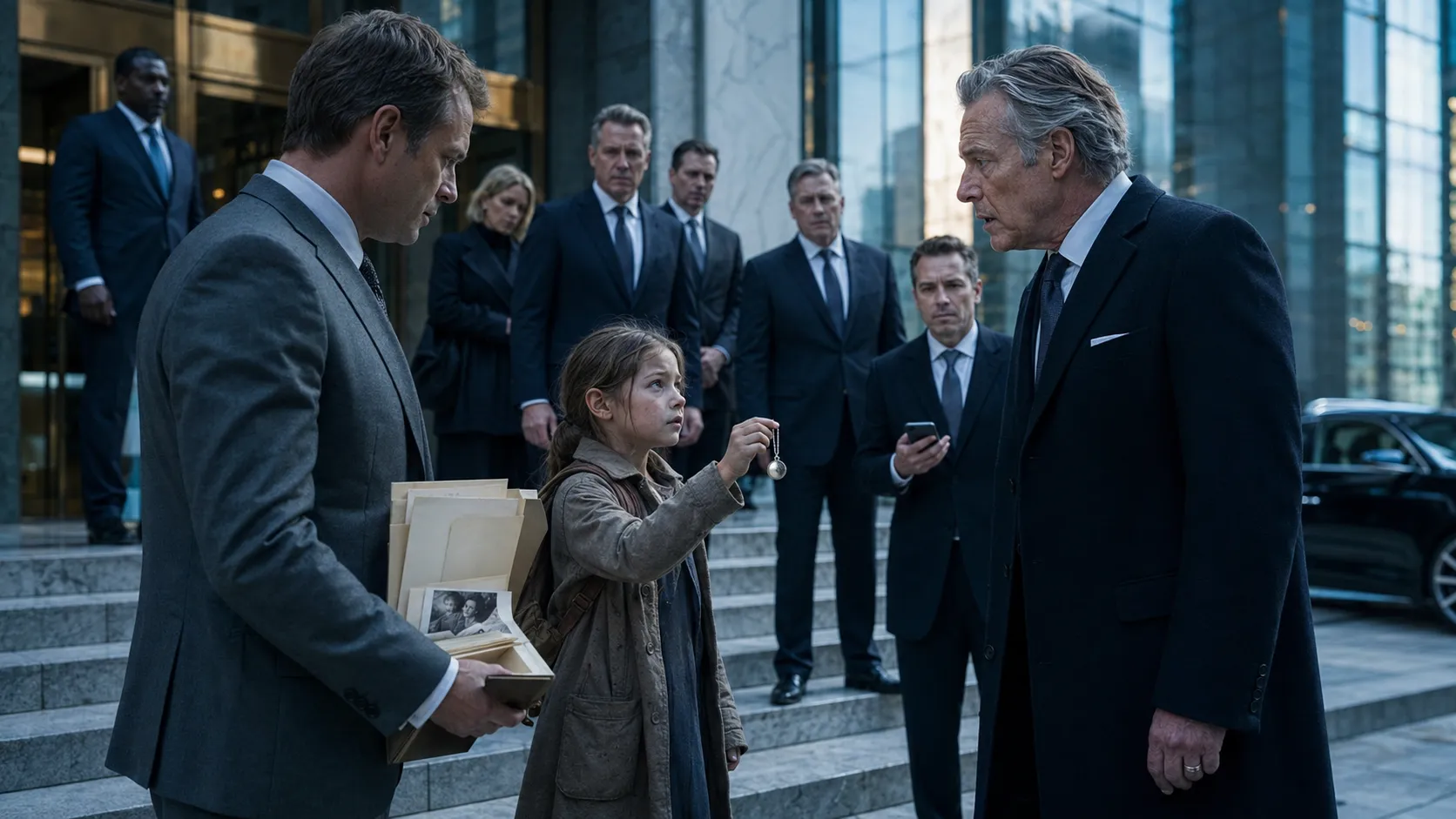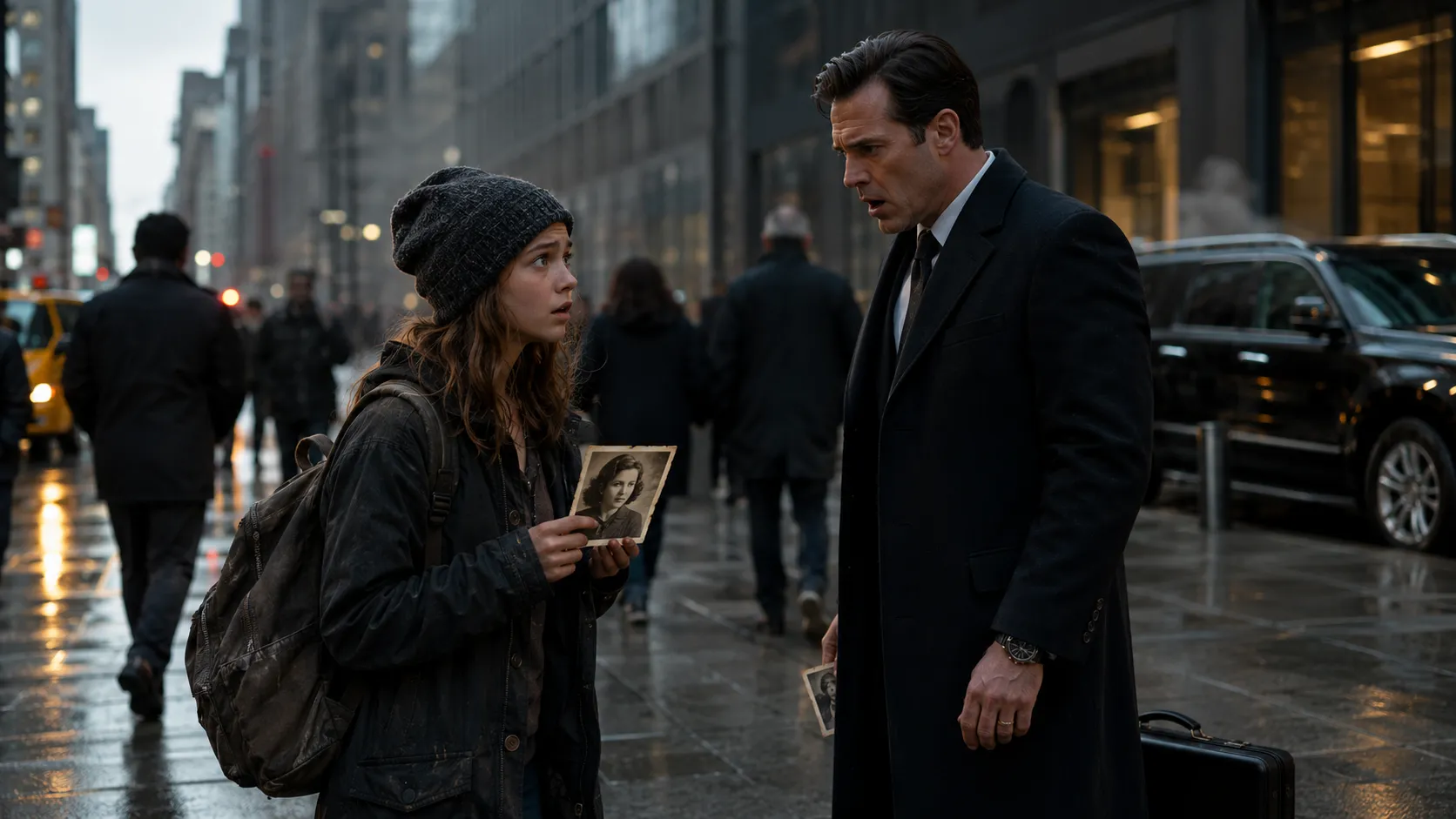
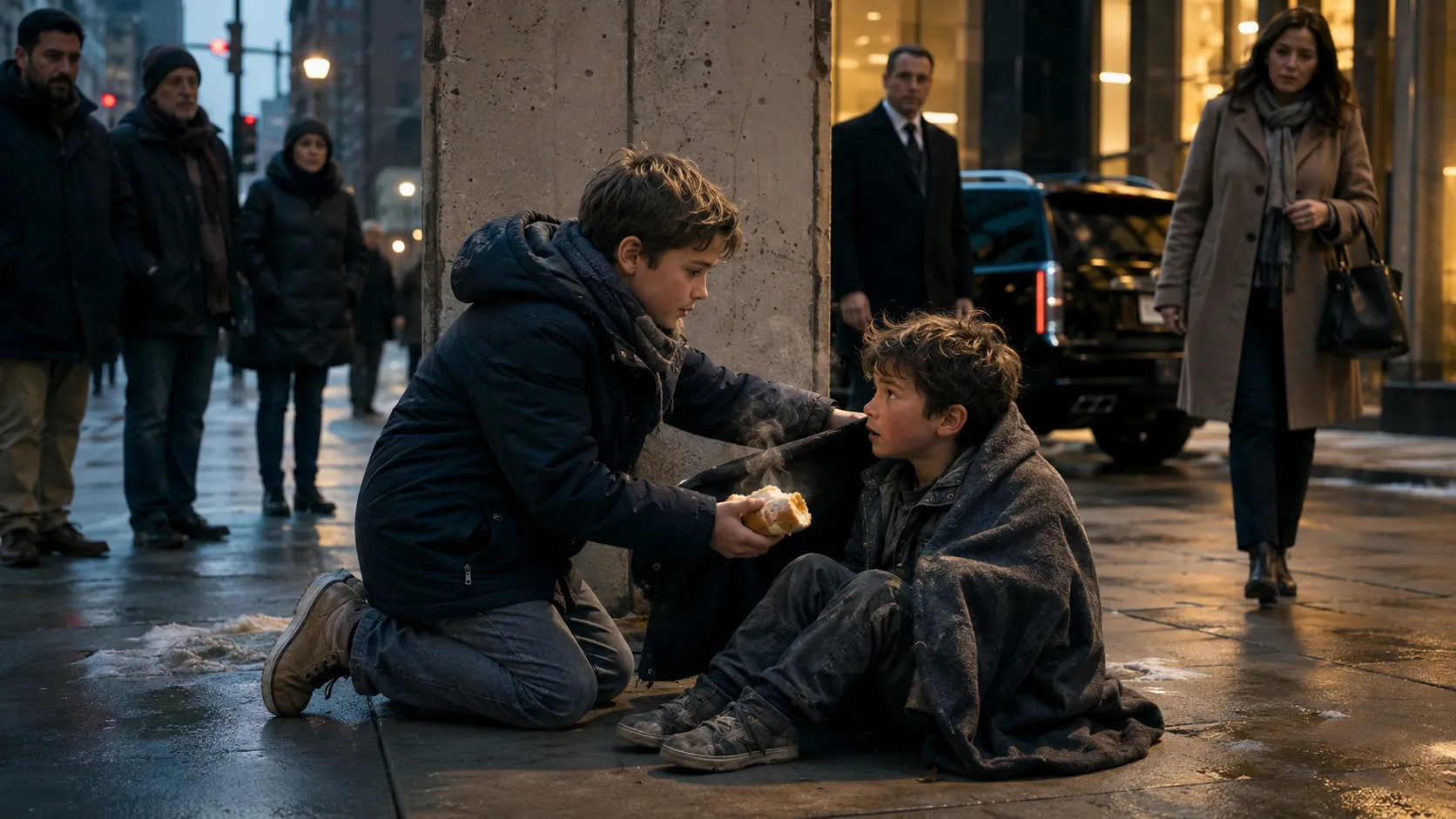
Jayden had already learned the rule of the city: people might look, but they rarely stop. Then, on a freezing Chicago sidewalk, one boy named Liam broke a loaf of warm bread in half, wrapped his own coat around him, and did the one thing the world had stopped doing for Jayden a long time ago — he treated him like he mattered.
The cold in downtown Chicago did not simply hurt.
It settled.
It moved through fabric, skin, and bone with the slow certainty of something that knew exactly how long it intended to stay. It was the kind of cold that made people walk faster, heads down, hands buried in pockets, eyes fixed on destinations warm enough to justify their indifference.
Jayden belonged to that kind of cold.
He sat beneath a flickering streetlight against a cracked concrete wall, his knees pulled tight to his chest, his thin arms wrapped around them so hard it looked as if he were trying to keep himself from coming apart. He was eight years old, but there was something in the way he held still that made him seem much older — not wiser, not stronger, just older in the exhausted way children become when the world has been teaching them the wrong lessons for too long.
His jacket was too large and badly worn, the sleeves stained and frayed at the ends. His sneakers had split open at the sides. His fingers were red with cold, but he kept them tucked in anyway, because numbness was better than admitting how badly he was shivering.
Hunger lived inside him now like a second heartbeat.
Not the ordinary kind.
Not the kind cured by waiting for dinner.
This hunger had become patient.
Permanent.
Sharp enough to blur the edges of everything else.
People passed him.
A woman in heels glanced at him, then clutched her purse tighter and looked away.
A businessman slowed for half a second, decided against compassion, and walked on.
A teenager lifted a phone, recorded, and never once lowered it to help.
Jayden did not look up for any of them.
He had learned that looking made disappointment feel personal.
And disappointment, after enough repetition, starts to feel like proof.
So he pressed his forehead against his knees and told himself what he always told himself when the world became too large and he became too small inside it:
Just wait.
Just breathe.
Don’t expect anything.
Then footsteps stopped.
At first, Jayden didn’t move.
Stopping did not mean kindness.
Sometimes it only meant curiosity.
Or disgust.
Or the beginning of another humiliation dressed up as concern.
But the silence lingered longer than usual.
Then a soft voice said, “Hey… are you okay?”
Jayden’s shoulders tightened.
The voice did not sound like the others.
Not rushed.
Not suspicious.
Not amused.
Careful.
He lifted his head just enough to see a boy standing there.
He was about Jayden’s age, maybe a little older, dressed in clothes too clean and too warm for this part of the sidewalk. His hair was neatly cut. His shoes had never known slush. Everything about him said home, heat, dinner, routine.
But in his hands was a small loaf of bread.
Fresh.
Still warm enough for steam to ghost faintly into the air.
“My name’s Liam,” the boy said.
Jayden swallowed, then whispered his own name.
“Jayden.”
Liam nodded as if the name mattered.
As if saying it had already changed something.
Without overthinking it, he broke the loaf in half and held one piece out.
“Take it.”
Jayden stared at the bread.
This, he thought, was the moment the price would reveal itself.
There was always a price.
A joke.
A trick.
A lecture.
A camera.
A condition.
Liam must have seen that expectation in his face, because he said quietly, “I won’t take it back.”
Slowly, carefully, Jayden reached out.
The bread was real.
Warm.
Soft in the middle.
He took a bite and something inside him cracked open before he could stop it.
“I was so hungry,” he whispered.
His voice broke.
Then the tears came — sudden, humiliating, unstoppable. The kind children cry when they have held too much inside for too long and one small kindness lands harder than cruelty ever did.
Liam did not step away.
He did not laugh.
He did not look embarrassed.
He did not glance around to see who was watching.
Instead, he stepped closer and hugged him.
Jayden froze.
Not because the embrace hurt.
Because it didn’t.
That was the shock.
The warmth was real.
The comfort stayed.
The moment did not turn cruel.
For a few seconds, the cold seemed to recede from the edge of the world.
Then a door slammed open.
Both boys flinched.
A tall man stepped out of the building behind them — sharp suit, hard jaw, the kind of presence that filled space without asking permission. He looked first at Liam, then at Jayden, and in that one sweep of his eyes reduced the whole scene to something he found unacceptable.
“Liam.”
The boy went stiff.
“Dad.”
“What do you think you’re doing?” the man asked.
His voice was not loud. It did not have to be. People nearby slowed anyway, sensing the shape of power and conflict long before understanding either one.
Then the man looked at Jayden.
Not as a child.
Not as someone cold and hungry.
Not even as a problem worth solving.
As contamination.
“Don’t touch people like this,” he said. “Don’t sit on the street. Don’t embarrass this family.”
Jayden lowered his eyes at once.
There it was again.
The rule.
The correction.
The reminder that the world only allowed kindness as long as it did not cost status.
But Liam did not move.
“He’s hungry,” he said.
“I don’t care,” his father replied. “That’s not your responsibility.”
Silence dropped between them.
Heavy.
Wrong.
Unignorable.
Liam’s hands curled into fists at his sides.
“He didn’t take anything,” he said quietly. “I gave it to him.”
“That’s the problem,” his father snapped. “You give too easily. You trust too quickly.”
Jayden felt the warmth draining out of the moment, watched compassion being disciplined back into obedience the way adults so often do to children who still know how to see clearly.
Then Liam looked at him.
Then back at his father.
And said, “He didn’t take anything no one else did.”
The words were soft.
But they landed.
For the first time, his father did not answer immediately.
That pause mattered.
Then he said, “Enough. We’re leaving.”
Again, Liam did not move.
The street held its breath.
Then, with slow, deliberate hands, he took off his coat.
Jayden shook his head at once. “No—”
But Liam draped it over his shoulders anyway.
“I want you to stay warm.”
Then he turned and walked away.
Jayden sat there in silence, bread in one hand, the coat around him, watching the only person who had stopped disappear back toward the waiting black SUV.
It should have felt like abandonment.
Instead, it felt like proof.
Small.
Fragile.
But real.
For the first time in a long time, Jayden did not feel invisible.
Across the street, the SUV remained parked with its engine running.
Inside, someone had been watching everything.
A woman stepped out.
She did not rush toward him. She did not tower over him with concern. She crossed the street with the slow, careful movements of someone who understood that fear startles easily when it has been living in a child for too long.
She knelt in front of him.
“My name is Sarah,” she said softly.
Jayden did not answer.
But he did not look away either.
That alone was new.
“I’m here for you,” she said.
No pity.
No sharp edges.
No performance.
Just presence.
Across the street, Liam watched.
His father stood beside him, rigid and furious in the quiet way men become when events slip outside the script they know how to control.
“Why now?” Liam asked.
Sarah looked toward him and said, “Because someone stopped.”
Then she turned back to Jayden.
“And sometimes… that’s all it takes.”
Jayden tightened his fingers in Liam’s coat. He still did not trust this moment. Trust is not a switch children like him can flip because a kind face appears. But he did not run.
Sarah reached into her bag and pulled out a tablet.
Photos.
Documents.
Maps.
“I’ve been looking for you,” she said.
Jayden frowned.
“For me?”
She nodded.
“You’re not alone.”
The words felt impossible.
Across the street, Liam’s father stepped forward sharply.
“This doesn’t concern you.”
Sarah stood.
Slowly.
Steadily.
“It does now.”
The air shifted again.
People who had pretended not to notice before were watching openly now.
Something had changed.
Liam looked at Jayden.
Then at his father.
Then made a decision.
“I’m not leaving,” he said.
His father’s anger flashed.
“You don’t understand how the world works.”
Liam shook his head.
“No,” he said. “Maybe I just don’t like how it works.”
That silence felt final.
Then Sarah opened the SUV door and turned back to Jayden.
“Come with me.”
He hesitated.
Everything he knew told him to stay where he understood the rules: cold, hunger, distrust, survival. Unknown kindness could be more dangerous than familiar suffering.
But something else had entered the equation now.
Bread.
Warmth.
A coat.
A boy who stopped.
He looked at Liam.
Liam nodded.
That was enough.
Jayden stood.
Slowly.
Cautiously.
But he stood.
And stepped toward something unknown.
This time, not entirely alone.
The car door closed behind him. The SUV pulled away from the curb, carrying him out of the cold street that had nearly forgotten him.
Liam remained standing there, watching.
His father said nothing.
For the first time, he did not control the ending.
And for the first time, Liam did not follow him just because he was told to.
Inside the car, Jayden sat still with the coat around his shoulders and the last piece of bread in his hand.
Something inside his chest felt new.
Not fear.
Not hunger.
Hope.
Because for the first time in a very long time, someone had stopped.
And sometimes, that is where everything begins.