Michael Carter came to his diner disguised as an ordinary customer, expecting to find waste, carelessness, and maybe a reason for falling numbers. Instead, he found a seventy-five-year-old dishwasher quietly feeding hungry strangers—and two cashiers planning to frame him for theft.
Michael Carter used to say you could learn more from a diner stool than from a quarterly report.
That was why, on a gray Tuesday just before the lunch rush, the owner of Carter’s Diner walked into his own restaurant wearing a faded work jacket, a low baseball cap, and the kind of expression people instinctively overlook. He had not come for theatrics. He had come because something in the numbers had been bothering him for months—small but steady cash discrepancies, rising employee turnover, and a subtle change in customer feedback that no spreadsheet could fully explain.
Carter’s Diner had been the first real thing Michael ever built. Fifteen years earlier, he had opened the original location with borrowed money, secondhand booths, and a simple promise to himself: customers would be treated with warmth, and employees with dignity. Somewhere between expansion, board meetings, and market reports, he had allowed that promise to become a slogan instead of a standard.
So he came alone.
No assistants. No district supervisors. No warning.
“Counter’s fine,” he told the waitress when she asked if he wanted a table.
From the far end of the diner, Michael had a clear view of almost everything—the register, the kitchen pass-through, the revolving door of lunch customers, and the dish station tucked behind a half wall near the back.
That was where he first noticed Henry Lawson.
Henry looked like the kind of man most people barely saw anymore: tall once, probably, but now folded slightly inward by age and pain; white hair combed carefully back; sleeves rolled just high enough to keep them dry; hands gnarled by arthritis but still precise. He moved more slowly than the younger staff, but never idly. While others rushed and clattered, Henry worked with the steady concentration of someone who took pride in even the smallest task.
The first thing Michael noticed was how customers greeted him.
“Afternoon, Henry.”
“Good to see you, Henry.”
“Tell my wife that lemon pie’s as good as ever, Henry.”
And every single time, Henry answered with the same easy kindness, as though no one had yet given him enough reason to grow hard.
“What can I get you?” asked the young cashier on register one. Her nametag read MEGAN.
“Turkey club and coffee.”
As she rang it up, Michael nodded casually toward the dish station. “He been here long?”
Megan glanced back and rolled her eyes. “Too long, if you ask me.”
A minute later, another cashier joined her—broad-shouldered, restless, and smug in the careless way some young men mistake for confidence. His tag said TROY.
Michael took his coffee and watched.
He watched Henry quietly steady a busboy who almost dropped a tray. He watched him scrub burnt cheese from casserole pans with hands that had clearly done harder things in life. He watched him pause, once, only once, to press a palm into the small of his back when no one appeared to be looking.
Then came the young mother.
She was carrying a toddler on one hip and holding the hand of a little boy with the other. Her meal could not have cost much, but when she reached the register and opened her wallet, her face changed in the familiar way poverty changes a face: quickly, privately, and with humiliation already bracing for impact.
Megan frowned. Troy leaned over. There was whispering, irritation, impatience.
Before either of them could turn the moment cruel, Henry was there.
He dried his hands on his apron, reached into his pocket, and quietly placed a few bills on the counter.
The relief in the woman’s face was so immediate it hurt to watch.
She thanked him twice. Henry only smiled and asked the little boy whether he had liked the fries.
Once she left, Troy muttered loud enough for Michael to hear, “That’s the third time this week. Old fool’s going to go broke feeding strays.”
Megan laughed under her breath. “As if he isn’t broke already.”
Michael said nothing, but something cold settled in his chest.
Over the next hour, he saw the same pattern again and again. Henry stayed late without complaint. Henry fixed what others overlooked. Henry eased embarrassment before it could become shame. When an elderly man grew confused over menu prices, Henry spoke to him gently enough to preserve his dignity. When a teenager’s card was declined, Henry slipped money into the till as discreetly as a priest dropping alms into an offertory box.
And all the while, Megan and Troy watched him with the bored contempt of people too young to understand that kindness is often the most expensive thing a poor man can afford.
Near the end of the shift, Michael struck up a conversation with a regular named Ron, a retired machinist who had been eating at the diner long enough to know the names of both the waitresses and their children.
“That dishwasher,” Michael said, nodding toward Henry. “What’s his story?”
Ron followed his gaze and sighed.
“Henry Lawson. Seventy-five, if I’m not mistaken. Lost his wife, Martha, five years ago. Cancer.”
He stirred his coffee before continuing.
“They had savings. A house too. Sold most of it trying to keep her alive. He says he got eight more months with her because of those treatments, so he doesn’t regret it. But after she passed, the bills kept coming, and Henry’s too proud to walk away from a debt he thinks is his to carry.”
Ron lowered his voice.
“He works here because it was the only place that would hire a man his age. Still sends money to the hospital every month. Lives out in a trailer not fit for winter. Daughter wants him in Seattle with her, but he won’t go. Says he doesn’t want to be a burden.”
Michael looked back at Henry.
The old man was wiping down a machine that half the staff probably walked past without seeing.
“Does management know?” Michael asked.
Ron gave him a long look.
“They should.”
That answer stayed with Michael long after he paid his bill.
He left the diner, but he did not go home.
Instead, he parked across the street and waited.
Nearly an hour later, Henry emerged, long after his shift should have ended. He climbed into an old Buick that coughed twice before starting. Michael followed him at a distance through town, past the last line of decent storefronts, past a shuttered laundromat and a row of storage units, until Henry turned down a rutted access road behind a strip of commercial lots.
There, half hidden behind trees and a sagging chain-link fence, stood a weather-beaten trailer with a patched roof and steps that looked one hard rain away from collapse.
Henry climbed them slowly, one hand on the railing, and disappeared inside.
Michael sat in the dark of his car and felt shame settle over him with a weight no business report had ever carried.
He had been worrying about margin compression and labor costs while a man who embodied everything decent about his company was going home to that.
The next afternoon he returned.
Same cap. Same jacket. Same booth.
Henry was there again.
So were Megan and Troy.
The diner was quieter at that hour, which meant voices carried farther. Michael had barely touched his pie when he heard Troy say, “So here’s the thing—Patricia’s getting jumpy about the register. All she sees is money missing and Henry hanging around the drawer.”
Megan leaned closer. “So we make sure more money goes missing.”
Troy grinned. “Exactly. Then next time Patricia catches him near the register, she’ll think he’s stealing.”
Megan’s face lit with ugly excitement. “If Henry’s out, my cousin can take the job. We split the referral bonus.”
“And I’m sick of everybody acting like he’s some saint,” Troy said. “Same sad story every day. Old guy, dead wife, starving customers—makes the place depressing.”
They sealed it with a quick fist bump.
Michael sat absolutely still, the coffee cooling in his hand.
He had come looking for waste.
Instead, he had found rot.
Not in the old man at the dish station, but in the culture that had been allowed to grow around him while management looked the other way and ownership stayed too far above the floor to see what was actually happening.
That evening Michael stopped pretending this was a casual observation.
He called the head of operations, the company’s outside security consultant, and his own attorney. By opening the next morning, the diner’s dormant audit cameras had been quietly reactivated, point-of-sale logs were being mirrored in real time, and local police had been advised to remain on standby if evidence of internal theft materialized.
Michael also placed one more call.
This one was to Henry’s daughter in Seattle.
The woman who answered sounded wary at first, then exhausted, then silent for so long that Michael thought the line had dropped.
“He told us he was doing fine,” she said finally. “He always says he’s fine.”
Michael looked through the diner window at Henry, who was already at work, moving carefully under the bright kitchen lights.
“He isn’t,” Michael said. “But I think that’s about to change.”
The trap sprang before lunch.
A family came in. Then a teenager. Then Amy—the same young mother Henry had helped before. She came to the register short on cash again, cheeks burning with apology before Megan had even spoken.
This time Megan didn’t whisper.
“Oh, I’m sure Henry will cover you,” she said loudly enough for nearby customers to hear.
The young woman went pale.
Henry stepped forward at once, not to rescue Megan from embarrassment but to rescue the customer from it.
“I’ve got it,” he said softly.
He placed the cash in the register himself while Megan looked away theatrically and Troy lingered just close enough to create suspicion.
Fifteen minutes later Patricia emerged from the office with a calculator, a stack of receipts, and worry written all over her face.
Patricia was not a cruel woman. Michael remembered hiring her after another manager retired. Competent, overworked, under-supported—that was how she had looked two years earlier, and that was how she looked now. But there are forms of failure that come not from malice, but from fatigue. Patricia had become so used to putting out fires that she no longer asked why the smoke kept returning.
“The register’s short again,” she announced.
Troy stepped forward with practiced reluctance. “You know, I hate to say it, but I’ve seen Henry around the drawer multiple times this week.”
Megan nodded. “Same here.”
Patricia’s face tightened.
Michael saw the exact moment she chose procedure over instinct.
“Henry,” she called.
The old man turned from the dish station, hands still wet.
“Yes?”
Patricia swallowed. “I need to ask you directly. Are you taking money from the register?”
The entire diner seemed to stop breathing.
Henry stared at her.
Not angrily. Not even defensively.
Just with the kind of stunned hurt that only comes when a person’s honesty has been questioned after years of faithful work.
“I beg your pardon?”
“The drawer keeps coming up short,” Patricia said, voice strained. “Megan and Troy both saw you handling cash.”
Henry looked from one cashier to the other, and Michael watched understanding move slowly across his face.
Not shock.
Recognition.
As though some part of him had known, for some time now, that contempt like theirs would eventually want a victim.
“I was putting money in,” Henry said quietly. “For customers who couldn’t cover their meals.”
Troy gave a sad little shrug. “Convenient explanation.”
Megan folded her arms. “On your salary?”
Patricia looked sick.
“Henry,” she said, “if there’s anything you want to tell me before this goes any further…”
The old man straightened as much as his back would allow. There was pain in his expression, but there was also dignity.
“I have worked for this diner seven years,” he said. “I have washed dishes, mopped floors, fixed coffee machines, and stayed late when nobody else would. I have never stolen so much as a spoon.”
Then, after the briefest pause, he added, “But if you’ve already decided, I won’t beg.”
That was enough.
Michael stood.
He removed his cap.
And for the first time in three days, he used his real voice.
“No one is firing Henry Lawson today.”
Every head in the diner turned.
Patricia went white.
“Mr. Carter?”
Michael walked forward slowly, his gaze fixed not on Patricia, but on Troy and Megan, who suddenly looked much younger and much less confident than they had a moment earlier.
“I’m Michael Carter,” he said to the room at large. “And I own this diner.”
The silence that followed was complete.
Michael turned to Patricia first.
“This is not entirely your fault,” he said. “But it is your responsibility, and it is mine. We are going to correct both.”
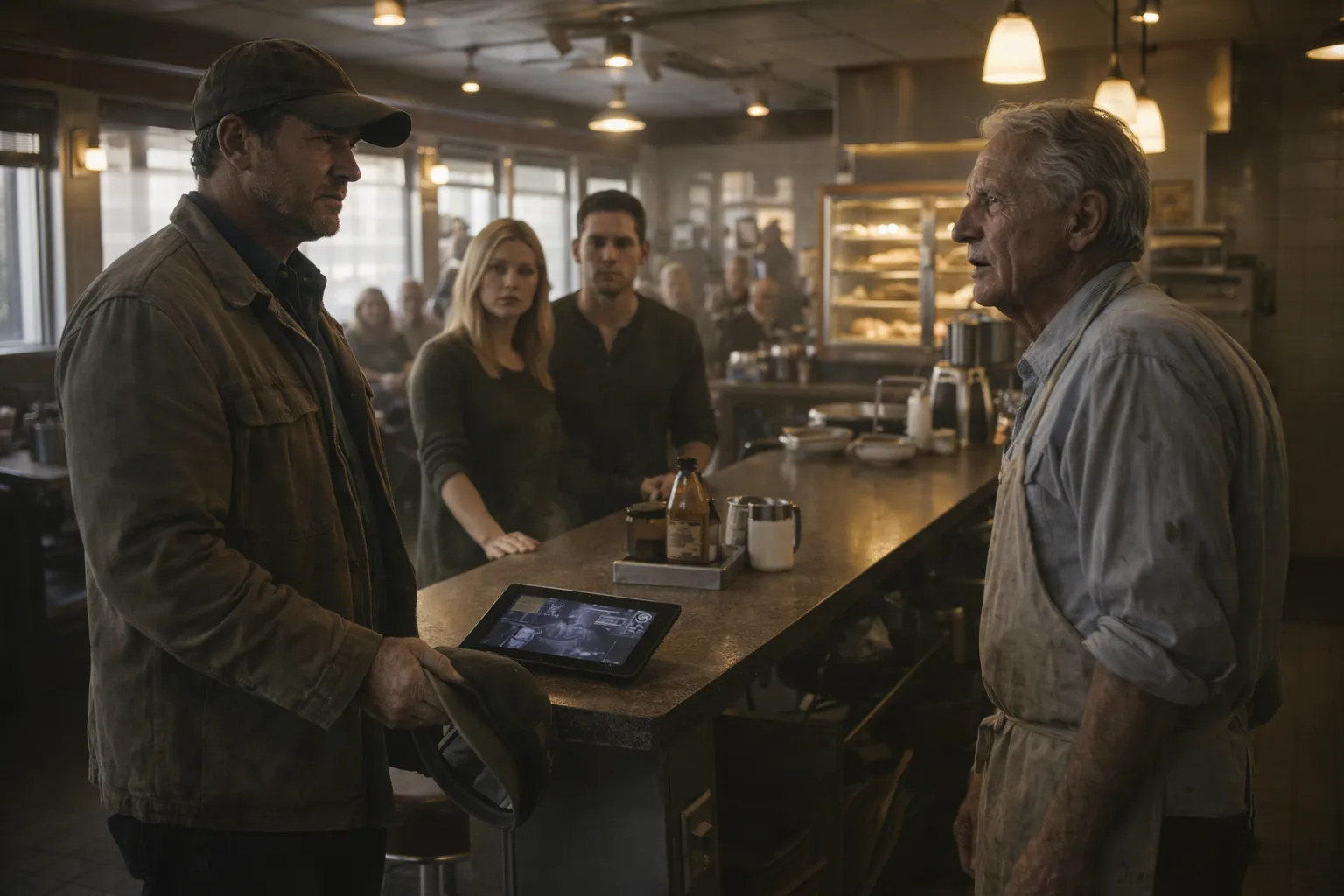
Then he lifted the tablet one of the security consultants had left with him that morning and set it on the counter where everyone could see.
“What you’ve all been describing as missing money,” he said, “was not theft by Henry Lawson. It was theft by the two people who thought they were clever enough to blame a good man because they mistook kindness for weakness.”
He tapped the screen.
The footage rolled.
There was Troy short-changing customers and pocketing the difference. Megan voiding completed transactions. The two of them whispering at the counter. The audio was clear enough that no one had to guess at intent.
“If Henry’s out, my cousin can take the job. We split the referral bonus.”
Then came the footage from that morning: Henry placing his own cash in the till while Megan deliberately turned away, and Troy altering the numbers minutes later.
Gasps moved through the diner like a change in weather.
One waitress covered her mouth.
Ron, from his usual stool, muttered a prayer under his breath.
Patricia looked as though someone had struck her across the face.
Troy found his voice first.
“Sir, that’s not what it looks like—”
Michael did not raise his voice.
“That sentence only works,” he said, “when there isn’t video.”
Megan began to cry.
“Please, Mr. Carter, we didn’t think—”
“No,” Michael said. “You didn’t.”
He turned so the entire room could hear him.
“This man has been paying for strangers’ meals out of his own pocket. He has been working through arthritis, grief, and poverty without once using any of it as an excuse to become cruel. And while he was doing that, two employees I trusted to represent my business were mocking him, stealing from my register, and trying to destroy the only person in this room who still remembered what this place was supposed to be.”
By then, the police had entered.
They moved quietly but efficiently. Troy tried to protest. Megan could barely stand. Neither of them left the diner with any of the swagger they had worn all week.
When the doors closed behind them, no one spoke for several seconds.
Then Michael turned to Henry.
“I owe you more than an apology,” he said. “But I’m starting there.”
Henry looked at him with tired, level eyes.
“You didn’t know,” he said.
Michael shook his head.
“That’s true,” he said. “And it should shame me more than it excuses me.”
Later, in the office, away from the crowd and applause and stunned employees pretending to busy themselves with silverware, Michael sat across from Henry and laid out a stack of papers.
Henry eyed them suspiciously.
“What’s all this?”
“First,” Michael said, “your dishwashing days are over.”
Henry opened his mouth to object, but Michael lifted a hand.
“You are not being dismissed. You are being moved.”
He slid the top paper forward.
It was a new position: Guest Relations and Community Host.
Lighter hours. Full medical coverage. A salary almost three times what Henry had been making. Paid vacation. And one job description that made Henry’s eyes sting before he finished reading it:
To welcome every customer with dignity and help train staff in the values Carter’s Diner was founded on.
“I’m not management material,” Henry said, voice rough.
Michael leaned back.
“Integrity is management material. The rest can be taught.”
Then he pushed forward the second document.
Henry stared at it longer.
“What is this?”
“A release from St. Matthew’s Oncology Network,” Michael said quietly. “Your remaining medical debt has been paid.”
Henry’s hands began to tremble.
Michael continued before the old man could stop him.
“And this”—he touched the third paper—“is a lease on a small one-story house three blocks from here. Two bedrooms. Front porch. Heating that works. The company will cover the first two years, after which the place is yours if you decide to stay.”
Henry looked up sharply.
“I can’t accept a gift like that.”
Michael’s expression softened.
“It isn’t a gift,” he said. “It is seven years of underpayment, neglect, and a debt of gratitude this business owes you.”
Henry lowered his eyes.
For a moment, neither man spoke.
Then Henry said the thing Michael would remember long after the scandal, long after the paperwork and policy revisions and board calls had faded.
“All I ever wanted,” Henry said quietly, “was to be useful.”
Michael swallowed hard.
“You were,” he said. “You are. The problem is that we made you useful without making you safe.”
By the time they came back onto the floor, word had already spread from booth to booth.
The applause started with Ron and rolled outward until the entire diner was on its feet.
Amy, the young mother Henry had helped more than once, stepped forward with an envelope.
“A few of us were collecting something,” she said, embarrassed by the smallness of it.
Michael smiled.
“Then let’s do something better.”
That week, Carter’s Diner created Henry’s Table—a company-funded meal program for anyone in temporary hardship, handled quietly and without humiliation. No child would be made to watch a parent beg at a register. No elderly customer would have to choose between dignity and lunch. And no employee would ever again be forced to cover hunger from their own pocket while the company looked away.
Michael didn’t stop there.
He raised wages across the location, created an emergency assistance fund for staff, ordered a review of every “broken” camera and missing maintenance request in the chain, and required managers to complete training that had less to do with compliance and more to do with conscience.
Three months later, Henry stood at the front of the diner in a clean button-down shirt instead of a soaked apron, greeting regulars by name and teaching new hires the difference between speed and service.
The little house near the diner had flower boxes on the porch by then.
His daughter visited from Seattle and cried when she saw it.
Michael drove over one Sunday afternoon with a pie from the diner and found Henry sitting on the porch in the late light, a mug of coffee in one hand and a look on his face Michael had not seen during those first undercover days.
Peace.
“You settling in?” Michael asked.
Henry gave a small smile.
“Slowly.”
Then, after a pause, he added, “Martha would have liked the porch.”
Michael sat beside him.
For a while, the two men said nothing.
Cars passed. A dog barked somewhere down the street. Evening lowered itself gently over the neighborhood.
Finally Henry said, “You know what surprises me most?”
Michael turned.
“That all those years I thought I was the one helping people,” Henry said. “Turns out people were waiting to help me too. I just didn’t know how to let them.”
Michael looked toward the flower boxes, the quiet street, the house that was modest by every corporate measure and priceless by every human one.
“That makes two of us,” he said.
And at Carter’s Diner, where customers still came for coffee, pie, and the comfort of being known, the story of Henry Lawson lived on—not as gossip about an undercover owner or two disgraced cashiers, but as something better.
A reminder.
That the true heart of a business is revealed not by what it earns when the room is full, but by how it treats the person quietly washing dishes in the back when nobody important is supposed to be watching.