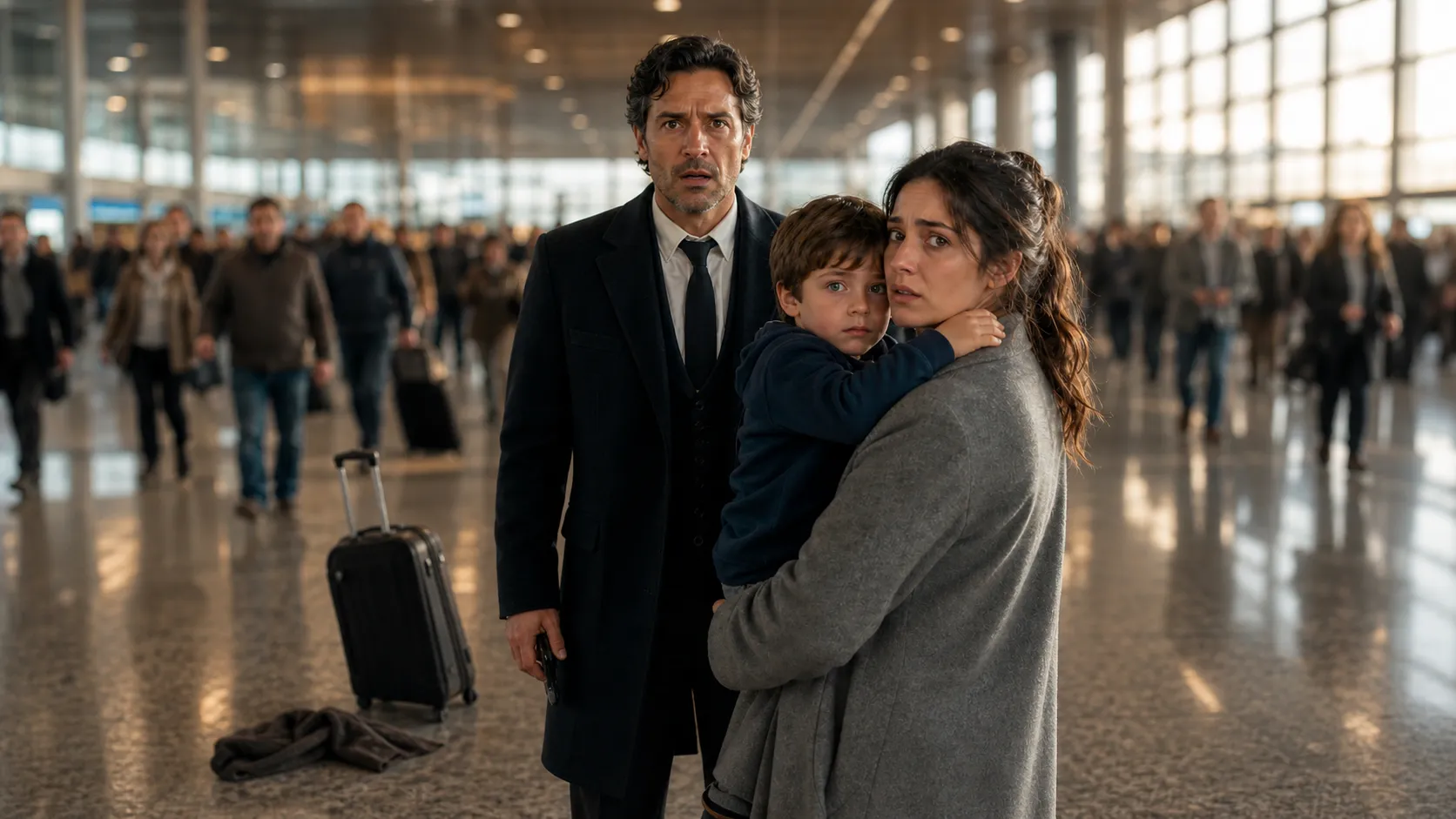
Alejandro Ortega thought the shock was seeing Lucía again after three years of silence. Then he saw the little boy in her arms, caught his own eyes staring back at him, and watched the woman he once loved turn and run as if recognition itself were dangerous. By the time he found her, the truth waiting behind her silence was worse than betrayal — it was theft.
The chaos inside Florence airport should have swallowed the moment whole.
Announcements crackled overhead. Suitcases scraped across polished floors. Tourists collided with businessmen, families with backpackers, grief with relief, departure with return. It was the kind of place where thousands of private stories brushed past one another without ever stopping long enough to matter.
But for Alejandro Ortega, time broke.
One second he was moving through the terminal the way he moved through every room in his life — controlled, fast, expensive, half-looking at his phone while assistants and drivers kept the world organized around him. The next, the noise drained into a distant blur, and all he could see was a woman fifteen meters away near Gate Four.
Lucía.
Three years gone.
Three years of absence with no real explanation.
Three years of telling himself she had left because she wanted a different life, a different man, a different world than the one he offered.
But that was not what stopped his heart.
It was the child in her arms.
A small boy in a dark blue coat clung to her neck with the absolute trust children reserve for their mothers. Lucía turned slightly, adjusting his weight, and for one unbearable fraction of a second the child lifted his head.
Alejandro saw his eyes.
His own eyes.
His own face, softened by childhood.
His own blood, maybe, staring back at him from the body of a boy he had never known existed.
The air went out of him.
When Lucía looked up and saw him, the color drained from her face. Terror moved across it so openly that it frightened him more than anger would have. She gathered the boy closer, turned sharply, and disappeared into the crowd as though the sight of him had triggered some old survival instinct.
“Lucía!”
He shouted it, but the terminal swallowed his voice under a boarding call and the roar of rolling luggage.
He ran anyway.
Past annoyed travelers.
Past a dropped scarf.
Past a child crying at a departure gate.
By the time he reached the place where she had been, she was gone.
Completely gone.
That night, the penthouse overlooking Florence’s old rooftops felt less like luxury than punishment. Alejandro paced from window to window while Andrés — business partner, closest friend, the only person who still spoke to him without flattery — watched from the leather sofa with a look halfway between concern and disbelief.
“You’re certain it was her?” Andrés asked.
Alejandro stopped by the glass and looked down at the city lights.
“It was her,” he said. “And the boy…” He pressed one hand to his chest. “The boy had my eyes.”
Andrés set down his drink.
“If that child is yours, then she left while she was pregnant. And if she did that, she had a reason. Find her.”
That was all Alejandro needed to hear.
For the next forty-eight hours, he became what rich, determined men become when uncertainty wounds their pride deeply enough: relentless. He hired investigators, woke old contacts, traced travel records, and followed the one fragile thread memory gave him — Lucía’s stories about a small northern town near Milan, the place she used to describe when she spoke about childhood with the softness she never showed anyone else.
He drove there himself.
By the time he arrived, evening had fallen into amber over tiled roofs and narrow streets. He showed her photo in cafés, bakeries, a pharmacy, a grocery with cracked windows and oranges stacked in the doorway. Most people shook their heads.
Then a waitress in a small family restaurant paused, frowned, and said, “Yes. She comes here sometimes. Usually with her little boy.”
The room tilted.
Alejandro took the back table and ordered a coffee he never meant to touch.
Every time the bell above the door rang, his heart lurched.
And then it opened.
Lucía stepped inside wearing the same gray coat from the airport. Beside her, holding her hand now instead of being carried, was the boy.
Mateo.
Alejandro did not know the name yet, but he would carry it in his mouth like something sacred by the end of the night.
He stood slowly.
Lucía saw him and stopped in the doorway as if she had been struck.
This time, there was nowhere left to run.
The little boy looked between them with calm curiosity, too young to understand the violence that can hide inside recognition. Alejandro crossed the room carefully, like a man approaching an animal he hopes not to frighten.
Then he asked the only question left.
“Is he mine?”
Lucía lowered her eyes.
And nodded.
That single motion unleashed everything at once — fury, relief, grief, guilt, love, and the devastating knowledge that an entire human life had happened while he went on being admired, obeyed, and alone.
But the truth waiting behind her silence was worse still.
She took him to her apartment because there was no other place to talk. It was small enough that every sound mattered. Peeling walls. Secondhand furniture. A lamp repaired with tape. A couch too worn to flatter anyone’s pride. The contrast to Alejandro’s world was humiliating in its clarity.
His son had been growing up here while he lived among glass, leather, and useless abundance.
When Mateo finally fell asleep clutching a worn stuffed animal, Alejandro turned to Lucía.
“Three years,” he said. “Three years thinking you left because you wanted out. And all this time you were raising my son alone. Why?”
Lucía wrapped her arms around herself as though the old cold had returned.
“Because your mother came to see me first.”
The name hit the room like a blade.
Victoria Ortega.
The woman who had spent her whole life turning elegance into control and motherhood into strategy.
Lucía looked at him with tears already in her eyes.
“When I found out I was pregnant, I planned to tell you,” she whispered. “I was scared, but I was happy. Then Victoria came to me before I could. She said you were already seeing another woman. A woman from your world. She said a child with me would ruin your future, your partnerships, your inheritance, everything.”
Alejandro stared at her.
“There was never anyone else.”
“She put a blank check on the table,” Lucía said. “She said if I loved you, I would disappear.”
He felt nausea rise in him so fast he had to look away.
“I never took her money,” Lucía continued. “I left because of my dignity. And because I believed you didn’t want us.”
Alejandro crossed the room in two steps and stopped only because touching her before she invited it suddenly felt like another form of theft.
“My mother stole three years from me,” he said quietly. “From us.”
Lucía didn’t answer.
Because some truths arrive too late to bring instant comfort.
He rented a room at the only hotel in town that same night.
Then he stayed.
Not for a day.
Not for an apology speech.
Not to relieve guilt with gestures.
He stayed long enough to be inconvenient to himself.
He handed most of the company’s daily decisions to Andrés and redirected everything that could be delayed, delegated, or abandoned. Trust, he discovered, is not rebuilt through declarations. It is rebuilt through presence.
At first, Lucía let him see Mateo only under her eye.
Alejandro accepted that.
He sat on the floor of her small living room and tried to convince a solemn three-year-old boy to roll a toy car.
He took him to the park with a single soccer ball instead of an armful of lavish gifts.
He let grass stain his expensive trousers and mud ruin shoes his old self would have resented wearing twice.
Mateo studied him with the ruthless honesty of children.
“Who are you?” he asked the first afternoon.
Alejandro nearly said your father.
Instead, because he had not yet earned it, he answered, “I’m a friend of your mom’s.”
Mateo nodded, then added, “You have a deep voice. Like the shopkeeper’s. But you smell better.”
Alejandro laughed — a real laugh, surprising even himself.
Little by little, something shifted.
Lucía watched from the bench while Alejandro ran after Mateo in the park, cheering each stumbling goal as if it were the final of a championship. She watched him arrive early one morning and ask, awkwardly, if he could take the boy out for breakfast alone.
“If you trust me,” he said.
She did not answer right away.
Then she looked at his face — at the fear there, the hope, the same eyes Mateo had — and said, “All right. But don’t give him too much candy.”
Over pancakes and orange juice, Mateo asked the question children always ask sooner than adults are ready for.
“Mom says you’re my dad. Is that true?”
Alejandro set down his coffee cup with a trembling hand.
“Yes,” he said.
Mateo thought about that, chewing slowly.
“Then why weren’t you here?”
There is no elegant answer to a child’s honest pain.
Alejandro chose the ugliest truthful one he had.
“Because I was lost,” he said. “But I found you. And I won’t get lost again.”
When they came back, Mateo ran through the apartment shouting, “Dad bought me two pancakes!”
The word hit Lucía like a prayer she had not dared say aloud.
That night they ate dinner together.
For the first time in years, nothing about the room felt temporary.
But happiness built over old silence is fragile, and the past rarely stays buried just because love has finally found the courage to sit down at the table.
A week later, Victoria appeared at the park.
She stood on the gravel path in couture and contempt, perfectly styled, perfectly out of place, watching the three of them with the faint smile of a woman who still believed power could undo any inconvenience.
Alejandro stepped between her and Mateo at once.
“What are you doing here?”
“I came to meet my grandson,” she replied. “Though I must say, the conditions he’s being raised in are disappointing.”
Lucía went pale, but she did not step back.
“Leave,” Alejandro said.
Victoria’s smile sharpened.
“I did what was necessary to protect your future,” she said. Then her gaze drifted over the park, the benches, Lucía’s plain coat, the ordinary world she had always despised. “And now I see the boy needs proper guidance. An environment worthy of him.”
Lucía’s whole body changed.
“Don’t come near him,” she said, every inch of her voice maternal now, no room left for fear.
Victoria looked at her as though speaking to a servant who had forgotten herself.
“My lawyers cost more than you’ll earn in ten lifetimes,” she said. “I’m filing for custody.”
The threat was not empty.
Two days later, the papers arrived.
Victoria claimed Lucía lacked the financial means to raise Mateo properly and argued that Alejandro’s travel schedule made him unreliable. She requested full custody under the language of “best interest,” the favorite costume of people who confuse control with care.
Lucía broke that night.
Not loudly.
Not dramatically.
She held Mateo while he slept and cried into his hair because terror, when it concerns your child, does not need witnesses to be complete.
Alejandro held her and said the only thing he knew with certainty.
“She is not taking him.”
“She knows judges,” Lucía whispered. “Politicians. She knows everyone.”
“I don’t care,” he said. “I will spend every cent I have. I will burn my company to the ground if I must. But no one is taking my son.”
The days before the hearing stripped them both down to essentials.
Lawyers gathered records.
Investigators traced Victoria’s interference.
Financial files were opened.
Witnesses prepared statements.
But the real change happened elsewhere.
Alejandro read Mateo bedtime stories on the floor beside his bed because the child sensed tension without understanding it.
Lucía stopped seeing Alejandro as the polished man who had once been too far away to find and started seeing the father willing to stay in discomfort, fear, and ordinary domestic life without asking to be praised for it.
The courthouse in Milan was cold enough to feel ceremonial.
Victoria arrived like royalty at war, surrounded by lawyers and perfume and certainty. Lucía looked fragile for one second under the marble lights.
Then Alejandro took her hand under the table.
“Look at me,” he said. “We are a family. Families fight.”
The trial was ugly.
Victoria’s legal team painted Lucía as opportunistic, unfit, insufficiently stable.
They painted Alejandro as emotionally impulsive, distracted by guilt, and unreliable because of business travel.
Victoria herself spoke of legacy, security, education, standards.
Not once did she say what made Mateo laugh.
What frightened him.
How he slept.
Which hand he used to draw.
What song he wanted before bed.
When Alejandro stood, he left his prepared notes untouched.
“Your Honor,” he said, “my mother has spoken at length about money, schools, inheritance, and names. She has not said one word about what makes Mateo happy.”
The courtroom stilled.
“I lost three years of my son’s life because my mother decided she had the right to choose what love should survive. Yes, I have money. More than enough. But these last weeks, living in a tiny apartment, I learned something important. My son does not care about my bank account. He cares that I push him on the swings. He cares that his mother sings to him before bed. Mateo’s wealth is not the Ortega name. It is the love Lucía has given him every single day despite everything. If custody goes to my mother, you are not giving a child safety — you are handing a trophy to a collector. If custody stays with us, you are giving him a family.”
Silence followed.
Even the judge seemed moved against his will.
The ruling came hours later.
Custody remained with Alejandro and Lucía.
Victoria’s petition was dismissed.
A restraining order barred her interference.
Lucía let out a sob that seemed to tear years out of her body at once. Her knees gave way. Alejandro caught her before the floor did.
Victoria left without looking back.
Defeated.
Still elegant.
Still rich.
And utterly powerless before the one thing she could never buy: a child’s right to stay where he was loved.
That night, back in the small town, there was no grand celebration.
Only quiet.
Mateo slept.
Alejandro and Lucía sat on the balcony with cheap wine and the strange, fragile peace that comes after surviving something ugly together.
“What happens now?” she asked.
Alejandro kissed her forehead.
“Now we live.”
Months passed, and for the first time, change felt less like damage and more like return.
Alejandro did not drag Lucía and Mateo into the sterile coldness of his old life. Instead, they built something new together — a house on the outskirts of Florence with a large garden, enough distance from high society to breathe, and enough room for a child to run without feeling watched.
He reorganized the company.
Worked less.
Came home earlier.
Let success shrink until life could fit back inside it.
One year after the airport, they celebrated Mateo’s fourth birthday in that garden.
Balloons hung from olive branches. Children shouted around a piñata. Alejandro stood by the grill in a ridiculous apron reading The Boss while Lucía poured lemonade and laughed at him openly.
In a quiet moment, he wrapped his arms around her waist and asked what she was thinking.
She looked at Mateo, blindfolded, swinging wildly at the piñata while laughing hard enough to lose rhythm.
“The airport,” she said softly. “If you hadn’t seen me…”
“But I did,” Alejandro said. “And I would search for you a thousand times over.”
She kissed him then — slowly, gratefully, with the weight of everything that nearly never happened.
Moments later, Mateo broke the piñata and candy rained over the grass.
He tore off the blindfold and ran toward them shouting, “Dad! Mom! Look!”
Alejandro lifted him into his arms.
Lucía wrapped herself around both of them.
And under that gold Tuscan afternoon, Alejandro finally understood what success had never managed to teach him:
that being present, forgiving what can be repaired, and loving without conditions is worth more than every polished life he once thought he wanted.