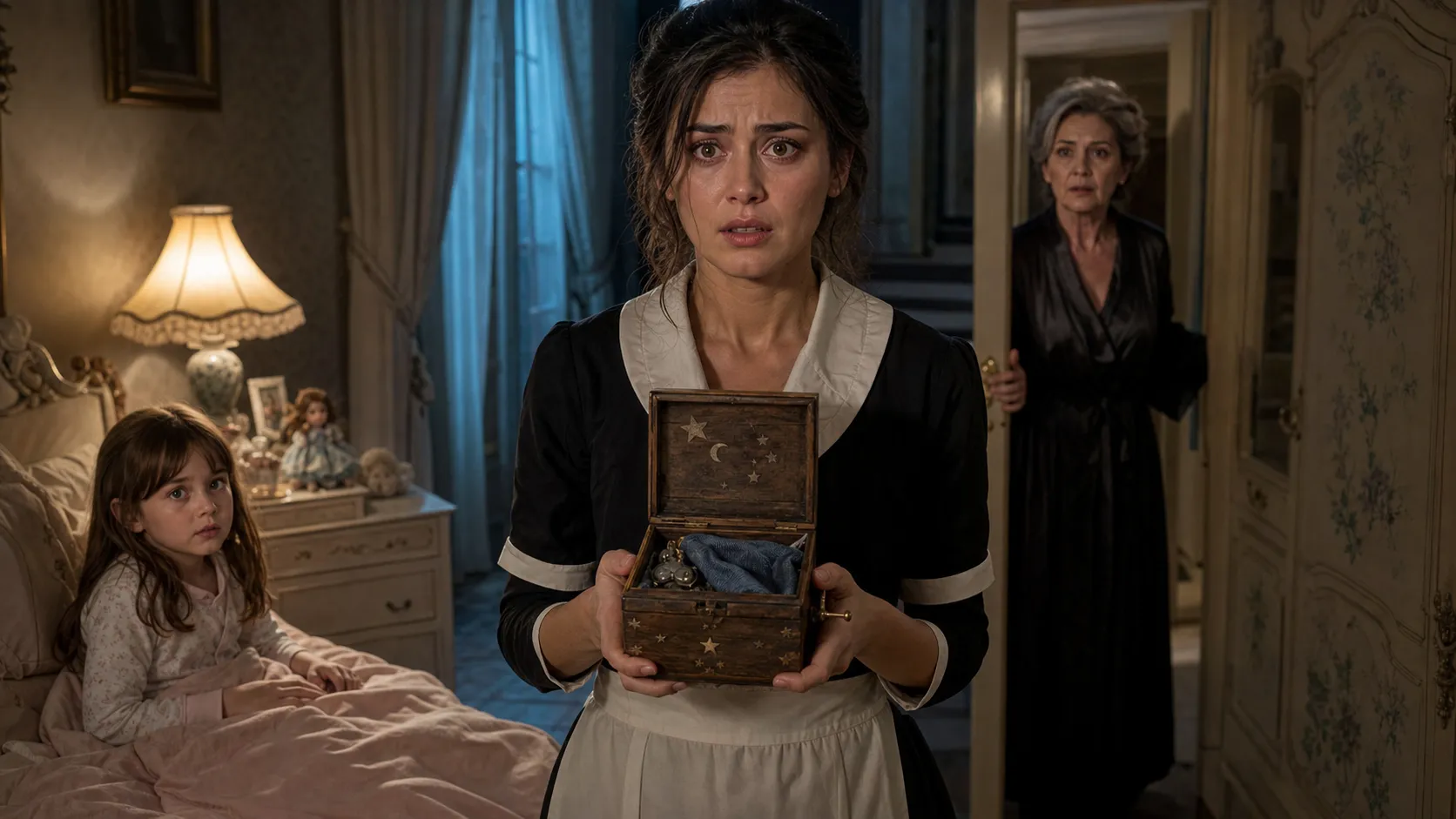
Sofia came to the Vargas mansion for work, not answers. But when the little girl she had been told was mute began singing the exact lullaby only Sofia and her lost daughter had ever shared, one woman’s grief collided with one family’s silence — and the secret buried inside the mansion stopped being survivable.
Sofia straightened her uniform, though her hands would not stop trembling.
The mansion was silent again.
Not ordinary silence.
Not peace.
This was the heavy, deliberate kind that seemed to live inside the marble itself — the kind that made footsteps sound guilty and voices feel like trespass. Since arriving at the Vargas estate, she had felt it everywhere: in the long corridors, in the closed doors, in the polished dining room no one seemed to use, in the careful way every servant spoke as if the walls had opinions.
And now that silence had been broken by a song.
Her song.
The lullaby she had once sung to Luna every night before bed.
The song her grandmother had made up for one child only — a moon song, soft and strange and full of little phrases no one outside their family would ever have known to repeat. Yet Isabella, the six-year-old girl she had been hired to care for, had just sung it word for word in a room lit only by a bedside lamp.
Then stopped the moment she saw Sofia.
Now the child sat very still on the bed, knees tucked beneath her, her large dark eyes fixed on Sofia with a watchfulness far too old for her face.
Sofia could barely breathe.
“Where did you hear that song?” she whispered.
Isabella said nothing.
Of course she said nothing. Mrs. Elena Vargas had told her from the first day: the child was mute. She had never spoken, never answered, never made so much as a sound beyond a laughless breath or the soft scrape of shoes against the floor.
But Sofia had just heard her sing.
Not hum.
Not murmur.
Sing.
She took one step closer.
“Please,” she said, voice breaking now. “Tell me where you heard it.”
The girl’s small hands tightened around the blanket.
And then — very slowly, as if the movement itself cost her something — Isabella touched two fingers to her own throat, then to her chest, then pointed toward the far wall of the room.
Sofia followed the gesture.
At first she saw only furniture: a tall wardrobe, a child’s desk, shelves of dolls arranged with eerie neatness. Then her eyes settled on the old painted cabinet beside the window — a decorative thing, cream-colored, with faded blue flowers on the doors.
She frowned.
“Inside?”
Isabella nodded.
Sofia crossed the room on unsteady legs and opened the cabinet.
Inside, behind a stack of folded winter blankets, lay a wooden music box.
She stared at it.
The wood was worn at the corners. Tiny silver stars had been painted around the lid in a pattern she knew instantly because she herself had painted the same stars, badly and with shaking hands, on Luna’s nursery wall years ago.
Her fingers went numb.
No.
No, impossible.
She lifted the box carefully and opened it.
Inside was a tiny scrap of yellowed fabric tucked beneath the mechanism. Floral cotton. Faded from washing and time.
Sofia pressed it to her lips because she already knew before her mind fully allowed the thought.
It was from Luna’s baby blanket.
The room tilted.
She sank onto the chair beside the desk, music box in both hands, while tears blurred everything in front of her. Across from her, Isabella had climbed off the bed without a sound. She came closer, hesitant but attentive, like a child approaching a wounded animal.
Sofia looked up at her.
“How do you have this?”
The girl hesitated.
Then, with visible effort, she spoke.
The voice was rough from long disuse, barely more than a breath shaped into words.
“Grandma gave it to me.”
Sofia’s whole body went cold.
“Grandma?” she repeated.
Isabella nodded once.
“Elena.”
The name struck like a slap.
Mrs. Elena Vargas.
Beautiful, controlled, chilly Elena Vargas, who moved through the mansion with the poise of a woman who had never once allowed life to wrinkle her. The woman who had introduced Isabella not as a daughter in need of love, but as a problem requiring management.
Sofia stood up too quickly, nearly dropping the music box.
“What did she tell you?” she asked.
Isabella looked frightened now, but still she answered in that thin, damaged voice.
“She said the song belonged to me.”
Sofia pressed one hand to her mouth.
The implication arrived in pieces, each one crueler than the last.
Not coincidence.
Not a shared melody heard by accident.
Not some harmless family overlap.
This was theft.
Or replacement.
Or something worse.
Before she could ask anything else, a voice cut through the doorway.
“What is going on here?”
Elena Vargas stood at the threshold in a silk robe the color of old wine. Her face, even in surprise, was perfectly composed — but only for a second. Then she saw the open music box in Sofia’s hands, saw Isabella standing close beside her, and something dangerous flashed through her eyes.
Sofia stepped back instinctively, then forced herself not to.
“This song,” she said, her voice shaking with rage now, “where did you get this song?”
Elena’s gaze shifted to Isabella.
The little girl immediately lowered her head.
Something about that tiny movement told Sofia more than any answer could have. Isabella was afraid of her.
Elena entered the room and closed the door behind her with infuriating calm.
“You are overstepping,” she said quietly.
Sofia laughed once — a broken, disbelieving sound.
“I heard her sing my daughter’s lullaby.”
“No,” Elena replied, “you heard a child singing a song.”
“This music box was Luna’s.”
Elena did not deny it quickly enough.
Sofia saw that hesitation and moved toward her like a woman who had spent too many years grieving to be frightened now.
“My daughter disappeared six years ago,” she said. “Taken from a market in Valencia while I turned away for less than a minute. I never found her. Not one trace. And now I come into your house, and your silent child sings her lullaby from a music box wrapped in my daughter’s blanket.”
Isabella had gone pale.
Elena’s expression hardened, but there was something underneath it now — not outrage, not superiority.
Fear.
“You will lower your voice,” she said.
“No.”
Sofia clutched the music box tighter.
“Who is she?”
The silence stretched so long it became its own answer.
At last Elena said, “You don’t understand what you’re asking.”
“Then help me.”
Elena looked toward Isabella again.
The girl stood trembling beside the bed, caught between them, too frightened to move toward either woman fully.
Finally Elena spoke.
“She is not your daughter.”
Sofia’s body sagged with a pain so immediate it was almost physical.
Then Elena added:
“But she was never mine either.”
The room seemed to contract.
Sofia stared.
“What does that mean?”
Elena sat down slowly on the edge of the armchair near the window, as though the elegance had gone out of her bones all at once.
“My son Ricardo and his wife were told they could never have children,” she said. “Years ago, after a charity gala in Madrid, Ricardo came home with a baby girl. He said there had been an arrangement. A discreet one. A private adoption handled outside the usual channels.” She swallowed. “He said the child’s mother had abandoned her. He said there were documents.”
Sofia could not feel her hands.
“And you believed him?”
“At first.”
Her eyes moved to Isabella.
“She was barely a year old. Silent even then. Terrified of men. She clung to that music box until the hinges nearly came off. Every time anyone tried to remove it, she stopped eating.”
Sofia looked at Isabella and saw it all at once: the familiarity in the eyes, the tilt of the head, the way she had taken comfort in a melody buried so deep inside herself she had only sung it alone.
Not Luna as a baby.
Not exactly.
But Luna grown into someone else’s child.
Her knees gave way, and this time she did not fight it. She sat on the floor with the music box in her lap and cried openly, no longer caring what dignity looked like in a room where her whole life had just been rearranged.
Isabella took one small step toward her.
Then another.
Sofia looked up through tears.
“Luna?” she whispered.
The girl flinched — not from the word itself, but from the ache inside it.
“My name is Isabella,” she said automatically, as if reciting something learned by force.
Sofia nodded through tears.
“Yes,” she said. “I know. I know.”
Elena covered her eyes briefly with one hand.
“Ricardo is away in Geneva until morning,” she said. “He handles all family records. If there is truth here, it is in his study.”
That was how the night turned from revelation into reckoning.
Sofia did not sleep. Neither did Elena. Once Isabella finally fell asleep curled against the arm of the sofa in Elena’s sitting room, the two women entered Ricardo’s locked office with a box of old keys and the kind of determination only grief and guilt can create together.
They found the false bottom in the second desk drawer.
They found notarized papers with mismatched dates.
Private clinic receipts.
Transfers through shell accounts.
An unsigned guardianship agreement in Spanish.
And, buried beneath it all, one police notice from Valencia — the disappearance report of a one-year-old girl named Luna Bennett.
Sofia could not even scream by then.
The proof was too complete.
Too obscene.
Too ordinary in its paperwork.
Ricardo had not rescued a child.
He had purchased one.
Elena sat down behind her son’s desk and looked older than Sofia had ever seen her.
“I asked questions,” she said quietly. “Years ago. He told me to stay out of it. Then his wife died, and the child stopped speaking, and I convinced myself that uncovering the truth would only destroy her further.”
Sofia turned on her with a fury so clean it nearly steadied her.
“You let me grieve my daughter while she was in this house.”
Elena flinched.
“Yes.”
There was nothing else to say.
By dawn, the police had been called.
So had a family lawyer.
So had a child psychologist who specialized in trauma and identity recovery.
Ricardo Vargas arrived home to flashing lights at the gates and found both his mother and the woman he had stolen from sitting in the drawing room with every document laid out between them like a second trial.
He denied it first.
Then minimized it.
Then called it complicated.
Then called it mercy.
Then, when faced with the Valencia notice and the bank transfers, said the one thing Sofia would remember for the rest of her life.
“She was better off here.”
Sofia crossed the room before anyone could stop her and struck him across the face with enough force to leave the mark of her hand.
“No,” she said, voice shaking. “She was stolen.”
Isabella heard the slap from the stairs.
That was the moment the child began screaming.
Not words.
Not at first.
Just a raw, breaking sound, years of silence cracking open under the pressure of truth, fear, memory, and all the names she had lived beneath without understanding any of them.
Sofia ran to her.
So did Elena.
But it was Sofia the girl reached for.
That mattered.
It mattered more than the lawyers.
More than the police.
More than the papers.
More than Ricardo being led away in handcuffs before noon.
Because children do not care who is legally correct when the world splits.
They go toward the body that feels like home.
The months that followed were not miraculous.
Luna — because slowly, carefully, that was the name she chose to reclaim alongside Isabella rather than instead of it — did not become Sofia’s daughter again in one beautiful scene. She became something harder and more honest: a child returning in fragments.
There were nightmares.
Panic at sudden noises.
Confusion over names.
Shame over loyalty.
Love tangled with grief for the dead woman who had lived in the house before disappearing from the story in ways no one explained clearly enough.
Sofia moved into the mansion temporarily because the therapists said abrupt change could shatter Luna further. Elena, stripped of all performance now, gave up half the house without argument and sat through every painful session as if punishment and repair had finally become the same thing.
It took weeks before Luna sang again.
Months before she called Sofia “Mama.”
And nearly a year before the silence in the mansion stopped feeling like a tomb and started feeling like recovery — the slow, uneven quiet in which trust grows back its first roots.
As for Elena, she changed too.
Not neatly.
Not fast.
But truly.
She funded restitution.
Cooperated fully with the prosecution.
Established a foundation for families of missing children and named it not for the Vargas family, but for Luna Bennett — because this time, at last, the child’s real name would stand where no money could erase it.
Years later, on certain nights, Sofia would still wake in fear, certain the song had only been a dream and that she would open her arms to emptiness again.
Then Luna — older now, taller, carrying both names without shame — would appear in the kitchen doorway with sleep in her eyes and say, “Sing it.”
And Sofia would.
Sleep, my little moon, my shooting star…
This time the song did not echo through a stranger’s mansion like a ghost.
It belonged where it always should have:
in the hands of the mother who had never stopped listening for it.