Alejandro Vargas returned from a month abroad expecting whiskey, darkness, and the rigid silence that had ruled his mansion for years. Instead, he heard his son laughing in the kitchen with the new maid — and by dawn, his pride, his prejudices, and his plans for the future had all hardened into one terrible conclusion: Sofia had to go. He was wrong. And by the time he learned how wrong, the silence in his house had become something far more dangerous than scandal.
The front door of Alejandro Vargas’s mansion closed with a soft, echoing click.
The sound dissolved into the vast hallways the way every sound did in that house — quickly, neatly, as if even noise understood the rules of belonging there. Marble. Crystal. Dark wood polished to a mirror finish. The place had always been designed to impress. Lately, it seemed built for something else too: distance.
Alejandro stood in the entrance hall with the fatigue of a man who had spent a month crossing continents to preserve an empire and returned home with nothing left in him except the desire for silence.
Singapore.
Dubai.
Boardrooms.
Contracts.
Private lounges.
Too many handshakes.
Too many people smiling with their teeth and not their eyes.
All he wanted now was a glass of aged whiskey and the sacred emptiness of his own house.
Then he heard the murmur.
It was faint at first, barely more than a thread of sound moving through the stillness. He frowned immediately. Someone had left a television on. Or a radio. Or one of the staff had forgotten themselves.
The irritation rose fast.
Then he noticed something stranger.
It wasn’t one voice.
It was two.
And one of them — the second one, the one that sent a cold jolt through his chest before he even recognized it fully — was laughter.
His son’s laughter.
Rodrigo.
Alejandro stood very still.
He had not heard that sound in months.
Not real laughter. Not the polite thing Rodrigo produced at board dinners or investor lunches when required. Not the tired exhale that sometimes passed for amusement among well-trained men.
This was different.
Warm.
Surprised.
Young.
Alejandro followed it down the hall.
The house smelled faintly of coffee as he approached the kitchen. The door was slightly ajar. He pushed it open just enough to see.
And what he saw stopped him cold.
Rodrigo sat on the marble counter, jacket off, tie loosened, one leg swinging lightly as if he had forgotten his age, his surname, and every rule that had ever disciplined him into adulthood. Across from him stood Sofia, the new maid, still in her white uniform, smiling with a softness that filled the whole room.
Her hands rested over his for a moment.
Rodrigo looked at her in a way Alejandro understood at once.
Too long.
Too openly.
Too completely.
And Sofia — dark skin, quiet eyes, delicate face, that reserved dignity he had originally mistaken for harmlessness — leaned slightly closer, as though the space between them had already become too intimate to notice.
Alejandro stepped back from the doorway in absolute silence.
His thoughts began spinning before reason had any chance to slow them.
How long had this been happening?
How much had Rodrigo said?
How much had she encouraged?
What exactly had she seen when she looked at his son — a man, or an inheritance?
He retreated to his study and poured himself a double whiskey.
The moonlight through the tall windows cut white shapes across the floor. He did not sit down immediately. He stood there with the glass in one hand and his anger hardening into certainty.
He knew the world too well to romanticize it.
A young woman with no money.
A week inside a billionaire’s mansion.
His only son — lonely, soft from grief, emotionally exposed in ways Rodrigo would never admit aloud.
To Alejandro, the conclusion came almost insultingly fast.
Sofia was using him.
She had to be.
Rodrigo was heir to everything. The Vargas name, the holding company, the properties, the future. Alejandro had spent decades building something untouchable. He would not watch it endangered by an affair with a maid who had slipped quietly through the service entrance and somehow reached the one place in his son that still answered to warmth.
No scandals.
No scenes.
No traces.
By dawn, he had a plan.
At eight the next morning, he called Sebastián Ibarra, the private investigator who had once found a minister’s hidden accounts before the minister’s own wife knew they existed.
“I need everything,” Alejandro said. “Family, debts, school records, hospital records, past employers, anything that explains why Sofia Bennett is in my house and why she thinks my son belongs in her hands.”
Sebastián did not ask questions.
Alejandro spent the day pretending normalcy.
He reviewed contracts.
Signed two acquisitions.
Took a call from Zurich.
Skipped lunch.
But underneath all of it, the same image kept returning: Rodrigo laughing in the kitchen as though the mansion no longer felt like a mausoleum.
That part unsettled him more than he cared to admit.
At dinner that evening, Rodrigo was almost unbearable to look at.
Not because he seemed guilty.
Because he seemed lighter.
He ate more than usual. He spoke without being prompted. Once — once — when Alejandro asked about a meeting, Rodrigo nearly smiled and said he had another plan for his future, something he wanted to talk about when the right time came.
The right time.
Alejandro heard Sofia’s influence in every syllable.
By the third morning, Sebastián returned.
The file on Sofia was thick. Much thicker than Alejandro had expected.
He opened it expecting debt, deception, some opportunistic trail he could use cleanly.
What he found instead slowed him.
Sofia Bennett, twenty-six. Former literature student. University withdrawn two years earlier, not for scandal, but because her mother suffered kidney failure and her younger brother had been diagnosed with a degenerative spinal condition. Multiple part-time jobs. No criminal record. No luxury spending. No unexplained payments. No wealthy contacts. In fact, the opposite: sold jewelry, borrowed carefully, repaid everything. Former employers described her as “unusually honest,” “quiet,” “private,” “devoted to family.”
Alejandro kept turning pages, annoyed now not by guilt, but by inconvenience.
The story did not fit the one he wanted.
Then he reached the last section.
Rodrigo.
Not a romance trail.
Not secret spending.
Not messages.
Notes from the investigator’s observation.
Three nights in a row, Rodrigo had gone to the kitchen just before midnight.
Three nights in a row, Sofia met him there.
And each night, instead of seduction, the investigator found something stranger.
Rodrigo shaking.
Breathing too fast.
Hands unsteady.
Sofia talking him down softly.
Bringing tea.
Counting breaths with him.
Staying until he could stand again.
Alejandro stared at the page.
“What is this?”
Sebastián, still standing near the door, answered carefully.
“Panic attacks, I think. Your son’s had them before. The staff know. No one told you.”
Alejandro looked up so slowly it hurt.
“What do you mean, no one told me?”
Sebastián hesitated.
“It seems he asked them not to.”
For a long moment, Alejandro said nothing.
Because suddenly the kitchen scene changed shape in his mind.
Not a trap.
Not a seduction.
A rescue.
That evening he waited.
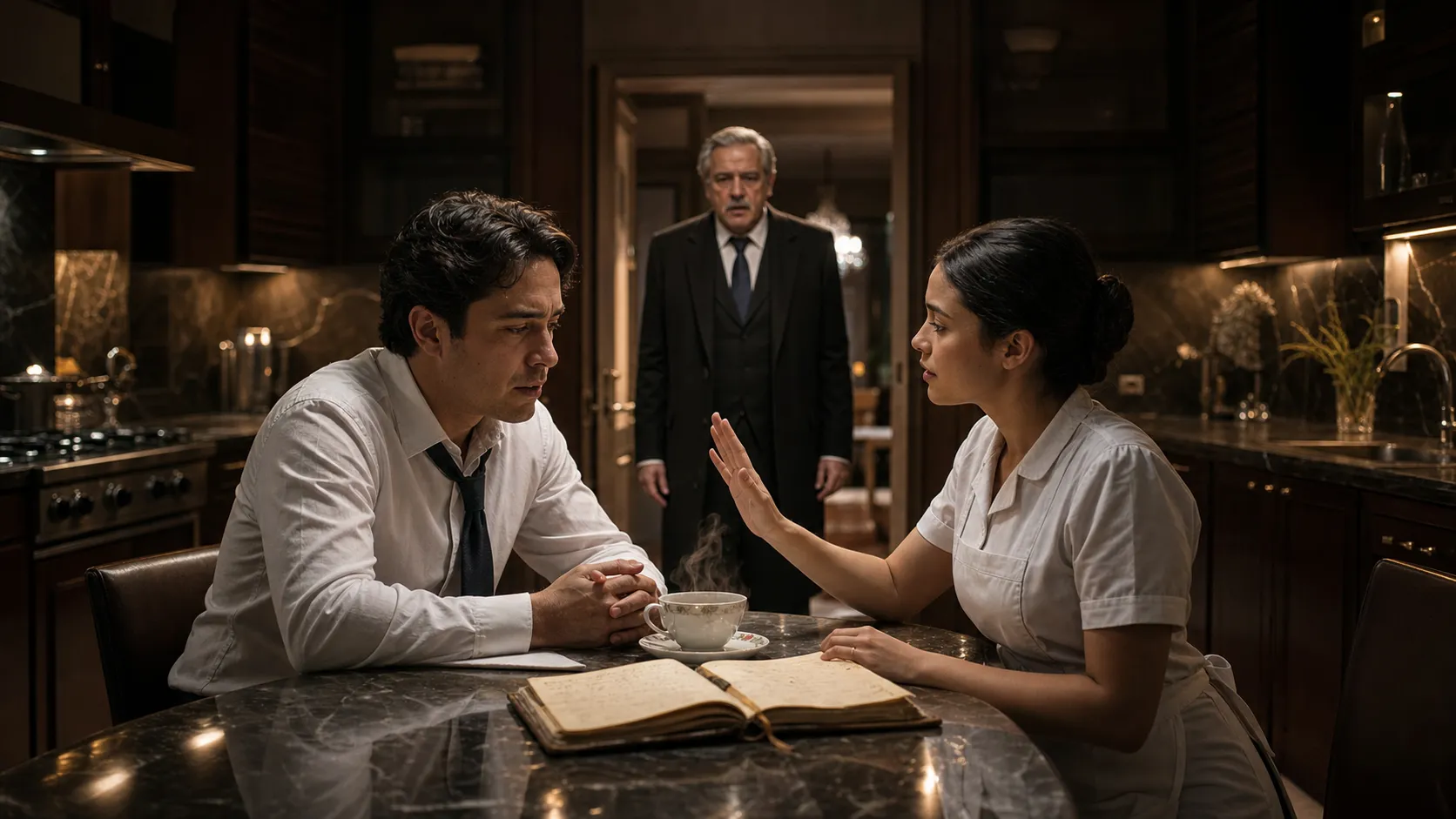
At 11:47, he stood unseen in the dark hall outside the kitchen and listened.
Rodrigo was already there.
His voice came first — low, strained, ragged with the effort of controlling something larger than himself.
“I can’t breathe.”
Then Sofia.
“Yes, you can. Look at me. Not the walls. Not the clock. Me.”
A pause.
“Good. Again.”
Alejandro stepped closer until he could see them through the narrow gap in the door.
Rodrigo sat at the table with both hands gripping the edge hard enough to whiten his knuckles. His face was pale. Sweat clung to his temples. The powerful heir to the Vargas empire looked younger than he had since childhood, stripped of polish, stripped of control, stripped of everything except fear.
Sofia sat across from him, calm as water.
“You’re here,” she said softly. “You are not dying. Your body is remembering pain, not living it.”
Rodrigo gave a broken laugh.
“That sounds ridiculous.”
“It sounds true.”
She slid a small notebook toward him.
Alejandro leaned in.
It was not Sofia’s handwriting.
It was a woman’s hand. Familiar. Rounded. Elegant.
Clara’s.
His late wife.
Rodrigo pressed his palm to the page as though it contained heat.
“She used to write this for me,” he whispered.
“I know,” Sofia said. “That’s why it works.”
The air left Alejandro’s body all at once.
Clara.
The notebooks.
The songs.
The breathing exercises.
The little rituals she used when Rodrigo had night terrors as a boy and Alejandro was always “still at the office” or “on a flight” or “handling something urgent.”
Sofia had found them.
Sofia had used them.
Sofia had been keeping his son together with the tools his dead wife had left behind while he, Alejandro Vargas, was signing contracts in other countries and calling that responsibility.
He stepped into the doorway before he could stop himself.
Rodrigo shot to his feet.
Sofia stood too.
For one stretched second, nobody spoke.
Then Alejandro looked at the notebook in his son’s hand and asked the only question left.
“How long?”
Rodrigo’s face hardened instantly.
“Long enough.”
Alejandro turned to Sofia.
“Why didn’t you tell me?”
She answered without flinching.
“Because he asked me not to.”
Rodrigo took one step forward.
“You don’t get to be angry,” he said. “Not tonight.”
Alejandro almost laughed at the absurdity of being spoken to like a guilty man in his own kitchen.
But the laughter died before it could form.
Because Rodrigo was right.
“When did this start?” Alejandro asked.
“The week after you hired her,” Rodrigo said. “The first night I couldn’t breathe, I ended up in here because I didn’t want the staff hearing me in my room. Sofia found me on the floor.”
Alejandro looked at Sofia.
She lowered her eyes only briefly.
“I made tea,” she said. “That’s all.”
Rodrigo’s voice sharpened.
“No. Not that’s all.” He turned fully toward his father now, years of restraint finally losing patience. “She stayed. She listened. She didn’t tell me to man up, or sleep it off, or be discreet. She found Mom’s notebooks in the music room after a storm knocked down one of the shelves. She remembered every line that helped. She gave me back the only thing in this house that still felt like home.”
The silence afterward was devastating.
Alejandro, for the first time in many years, did not know how to defend himself.
So he did the one thing he should have done much earlier.
He sat down.
That seemed to confuse both of them more than anger would have.
He looked at the table, at Clara’s notebook, at the mug in front of Rodrigo, at the life of his own house arranged in small truths he had not been present enough to notice.
“Why didn’t you come to me?” he asked quietly.
Rodrigo let out one bitter breath.
“You were never there long enough.”
The sentence did not need force.
It landed anyway.
The next days were ugly in the way real change usually is.
Alejandro did not transform overnight into tenderness.
Rodrigo did not forgive him because one conversation had finally happened after years of silence.
Sofia did not suddenly become comfortable in the center of the room.
But the lies began to die.
Alejandro came home earlier.
Twice he canceled dinners.
Once he turned off his phone during a panic spell and sat in the kitchen while Sofia guided Rodrigo through it, saying nothing until his son’s breathing steadied.
On the fourth night, Rodrigo looked at him and said, almost suspiciously, “You can go. I’m fine.”
Alejandro shook his head.
“No,” he said. “I think I’ve gone enough.”
Sofia glanced at him then, really glanced at him, and something in her expression changed.
Not trust.
Not yet.
But possibility.
A week later, Alejandro asked Rodrigo directly:
“Do you love her?”
Rodrigo did not hesitate.
“Yes.”
“And she loves you?”
This time Rodrigo looked toward the garden where Sofia stood hanging fresh linens in the winter sun.
“Yes,” he said again. “But that isn’t the important part.”
Alejandro almost smiled despite himself.
“Then enlighten me.”
Rodrigo’s answer came quietly.
“She would have saved me even if I had been nobody.”
That was the sentence that finished the work pride had resisted.
Because Alejandro understood wealth.
Deals.
Influence.
Fear.
Performance.
Position.
But that — being worth saving when you had nothing useful to offer in return — that was rarer than anything he had ever bought.
That evening he asked Sofia to join him in the study.
She came in stiff-backed, expecting dismissal.
He saw it at once. It shamed him more than any accusation could have.
Instead of standing behind the desk, he remained beside the window.
“I owe you an apology,” he said.
Sofia did not answer.
“I misjudged you,” he continued. “Worse than that — I looked at your circumstances and assumed they explained your character.”
She held herself very still.
“You looked at me,” she said at last, “and decided I must want something from your son.”
Alejandro nodded.
“Yes.”
“And now?”
He glanced toward the hall, where Rodrigo’s voice could be heard faintly, arguing with a servant about whether coffee counted as dinner.
“Now,” Alejandro said, “I know you have already given him something I failed to.”
Sofia’s face softened, but only slightly.
“What do you want from me, Mr. Vargas?”
He was honest enough, finally, not to hide behind formality.
“I’d like you to stay,” he said. “Not as a maid.”
That caught her off guard.
“What, then?”
He gave the smallest shrug.
“As someone my son trusts. As someone this house seems to need. As someone I would prefer not to lose before I learn how to deserve being in the same room with her.”
For the first time, Sofia smiled fully.
Not politely.
Not cautiously.
Warmly.
It changed the whole study.
“I’ll stay,” she said. “But I won’t stay where I’m invisible.”
Alejandro inclined his head.
“Fair.”
That spring, the mansion stopped sounding haunted.
Not because grief left.
It never does, not completely.
But because other things began living beside it.
Music from the old room Clara once used.
Laughter at midnight in the kitchen.
Rodrigo arguing with his father over balance sheets, then walking away mid-sentence because Sofia had called him to taste something burning on the stove.
Alejandro, learning slowly and without elegance how to ask questions before making judgments.
Months later, when Rodrigo told him he intended to leave the company’s daily operations and create a foundation for mental health access using a portion of the Vargas family holdings, Alejandro did not call it weakness.
He asked what kind of building he wanted.
And when Rodrigo told him he intended to marry Sofia, he did not ask what people would say.
He asked whether Clara’s garden would be the right place.
The wedding was small.
No magazines.
No social climbing.
No polished alliances disguised as romance.
Just family, some staff who had become more than staff years earlier, a warm evening, and the soft understanding that love had entered the house through the servant’s corridor because the front doors had been guarded too tightly by pride.
Later, much later, Alejandro would think back to that first night — the coffee smell, the laughter, the sight of his son and the maid too close in the kitchen — and understand how near he had come to destroying the only truly healing thing that house had seen in years.
He had mistaken class for character.
Proximity for manipulation.
Warmth for threat.
But the mansion’s real secret had not been scandal.
It had been this:
while the millionaire was away protecting his name,
the maid had been protecting his son’s life.