The rich guests laughed when the soaked old man begged for food inside one of Chicago’s finest restaurants. But minutes after they threw him into the rain, people started collapsing at their tables — and the man they humiliated was the only one who knew how to save them.
The old man smelled like rain, dirt, and hunger.
That was the first thing people noticed when he stepped into Harper & Lane.
Not the blood on his sleeve.
Not the way his hands trembled from cold.
Not the exhaustion in his eyes, or the careful way he held himself upright, as if dignity was the last thing he owned and he had spent years protecting it from people who thought poverty made a man less human.
They noticed the smell.
Inside the restaurant, everything was warm, polished, golden, and expensive.
Crystal glasses caught the light beneath chandeliers imported from Italy. White tablecloths fell in perfect folds. Candles burned inside glass cylinders. A pianist played softly near the bar while wealthy couples murmured over wine that cost more than most families spent on groceries in a month.
Harper & Lane was not just a restaurant.
It was a symbol.
A place where business deals were whispered over rare steak, where divorce attorneys celebrated victories, where pharmaceutical consultants entertained clients, where people with money came to be reassured that the world still knew where they belonged.
Then the old man walked in from the rain.
The front hostess saw him first.
Her smile froze.
“Sir,” she said, in a voice trained to remain polite while delivering rejection, “you can’t come in here.”
The old man removed his soaked beanie slowly.
His gray hair clung to his forehead. His cheeks were hollow. His coat was torn at one pocket, and one shoe had been repaired with black tape.
“I know,” he said softly. “I’m sorry.”
The hostess blinked, thrown off by the apology.
“I only need something to eat,” he continued. “Even leftovers. Anything. Please.”
A woman at a nearby table covered her nose dramatically.
“Oh my God.”
A man in a navy suit whispered loudly enough for half the dining room to hear, “How did he even get past the door?”
A few people laughed.
The old man heard them.
He looked down, not in shame exactly, but in the weary way of someone who had learned there were a hundred kinds of doors in the world, and most of them were closed before he touched the handle.
“Please,” he said again. “I haven’t eaten today.”
A waiter named Kyle stepped forward with a tray tucked under one arm.
Kyle was twenty-nine, handsome in a polished, forgettable way, with slicked hair and a smile that became cruel whenever he thought the room would reward it. He had spent five years serving rich people and had mistaken proximity to wealth for superiority.
“This isn’t a shelter,” Kyle said.
The old man nodded.
“I understand.”
“Do you?”
The tone made nearby customers look over.
Kyle enjoyed that.
“Because people like you always say the same thing. Food, money, blessings.” He gave an exaggerated laugh. “What was it going to be tonight? ‘Jesus will bless you’?”
The old man lifted his eyes.
“He will,” he said quietly. “Whether you feed me or not.”
For a second, Kyle seemed uncomfortable.
Then he turned to the room.
“Jesus didn’t help him,” he said loudly. “And he thinks He’s going to help us?”
Laughter broke out across the restaurant.
Not everyone laughed.
But enough did.
Enough for the cruelty to feel safe.
Phones came out.
Someone started recording.
At a corner table, a woman in a red dress whispered, “This is awful,” but she did not stand up.
At the bar, a medical insurance consultant shook his head and said, “This city is collapsing.”
The old man stood in the middle of the dining room while strangers laughed at his hunger as if hunger were a moral failure.
Then the manager arrived.
Melissa Carter had spent ten years turning Harper & Lane into one of the most profitable luxury restaurants in Chicago. She understood reservations, investors, branding, legal exposure, and online backlash better than she understood mercy.
When she saw the old man, she did not see a human being.
She saw contamination.
A disturbance.
A risk to the image she had built.
“Sir,” she said sharply, forcing a smile toward nearby diners, “you need to leave immediately.”
The old man looked at her.
“I’ll go,” he said. “I only asked once.”
He turned toward the door.
That should have been the end of it.
But cruelty, once applauded, often wants an encore.
Kyle stepped closer, still performing for the tables.
“Wait,” he said. “You don’t get to just walk in here, stink up the place, ask for charity, and leave like you did nothing wrong.”
The old man stopped.
“I did nothing wrong.”
Kyle laughed.
“You people never do.”
The old man turned.
The sadness left his face for just one moment, replaced by something sharper.
Not anger.
Recognition.
As if he had heard that phrase before in another room, another life, from people who also believed a man’s worth could be measured by how clean his coat looked.
“People like me,” the old man repeated softly.
Melissa’s expression tightened.
“Kyle. Enough.”
But she said it too late.
The security guard had already arrived.
His name was Marcus Bell. Six-foot-four, broad-shouldered, with tattoos running down both arms and the tired patience of a man paid to remove problems quickly. He had worked clubs before restaurants. He had seen fights, overdoses, panic, rage. He had also learned that wealthy people complained louder when security was gentle with poor people.
So Marcus grabbed the old man by the shoulder.
“You heard her,” he growled. “Move.”
“I’m leaving,” the old man said.
Marcus pushed him anyway.
Hard.
The old man stumbled backward into an empty table. A wine glass tipped, struck the floor, and shattered.
Customers gasped.
Melissa whispered, “Careful,” but not because she worried about the old man.
Because she worried about broken glass.
Marcus shoved him again.
This time the old man lost his balance completely.
He crashed through the entrance and fell onto the wet sidewalk outside.
His cap rolled into the street.
Coins scattered from his pocket, bouncing across the pavement before vanishing into the gutter water.
Inside the restaurant, people laughed.
Actually laughed.
A woman near the window shook her head while sipping champagne.
“At least the security works.”
The old man slowly pushed himself upright in the rain.
Blood ran from a cut on his palm where the concrete had opened his skin. His shoulder ached. His coat was soaked through within seconds.
The restaurant door closed behind him.
Locked.
For a moment, he simply stood there under the rain.
Hungry.
Humiliated.
Alone.
Then he looked through the glass at the people inside.
And smiled.
Not a broken smile.
Not an embarrassed smile.
A calm smile.
A terrifyingly calm smile.
Like a man watching something inevitable begin.
Across the street, a black SUV sat parked with its headlights off.
Inside were two people in dark suits.
A woman in the passenger seat lowered her tablet slowly.
“Oh no,” she whispered.
The driver, a man in a charcoal overcoat, exhaled heavily.
“They touched him.”
The woman nodded, pale.
“And the whole thing is recorded.”
The driver opened his door at once.
“Call medical response. Call the department. Call legal.”
“What about the restaurant?”
He looked toward Harper & Lane.
“They just destroyed themselves.”
Inside, business returned to normal almost immediately.
That was the ugliest part.
Kyle continued serving drinks, still glowing from the attention.
“You should’ve smelled him,” he joked to one table.
One customer raised a glass.
“To keeping standards high.”
Melissa tried to steady herself near the hostess stand. Her pulse was still fast, but she told herself the crisis was over.
The man was gone.
No scene.
No lawsuit.
No problem.
At least that was what she thought.
Until the woman at Table 9 stopped breathing.
At first, no one noticed.
She was a well-dressed woman in her sixties wearing pearls and a navy dress. Her husband was still talking about stock prices when she reached for her throat with one hand.
Her wine glass slipped from her fingers.
It hit the table, rolled, then shattered against the floor.
Everyone turned.
Her face had gone dark red.
“Elaine?” her husband said.
She clawed at her throat.
“Elaine!”
He stood so quickly his chair fell backward.
“My wife can’t breathe!”
Chaos exploded instantly.
Chairs scraped. A server dropped plates. A woman screamed for an EpiPen. Another man shouted for someone to call 911.
Then a man near the bar collapsed.
Then another.
A younger woman at a table near the window doubled over, gasping. A man in a gray suit vomited onto the floor. Another clutched his chest and fell directly into his table, sending silverware and candles flying.
The room turned from luxury into terror in less than thirty seconds.
Melissa froze.
“No,” she whispered. “No, no, no…”
Kyle stood in the middle of the dining room, holding a tray, his mouth open.
“What’s happening?”
“Call 911!” someone screamed.
Phones flooded the air.
People cried.
A man shouted, “We’re all going to die!”
Melissa grabbed the emergency phone near the hostess stand with shaking hands.
Her first call was not to the police.
It was to the restaurant’s legal hotline.
“We need help,” she whispered. “Now.”
The lawyer on the other end sounded irritated until she said the words multiple victims.
Then his voice changed.
“Do not admit fault,” he warned. “Do not speak publicly. Do not apologize. Your liability insurance may not protect you if negligence is involved.”
Negligence.
The word hit Melissa like a stone.
Because suddenly she remembered the cameras.
The recording.
The old man.
And the horrifying possibility that millions of people could soon watch what happened inside Harper & Lane before the medical emergency began.
Paramedics arrived within minutes.
Police cars flooded the street. Red and blue lights flashed through the restaurant windows while emergency teams rushed inside carrying oxygen tanks, stretchers, defibrillators, and trauma bags.
The same customers who had laughed at a hungry man were now sobbing in fear.
“Please help her!” Elaine’s husband begged beside Table 9. “Please!”
A paramedic checked her oxygen level and cursed under his breath.
Another paramedic shouted, “We have at least six symptomatic! Possible toxin exposure!”
“Toxin?” Melissa repeated weakly.
A police officer pushed her back.
“Ma’am, stay clear.”
“This is my restaurant.”
“Then you especially need to stay clear.”
The front doors opened again.
Everyone looked up.
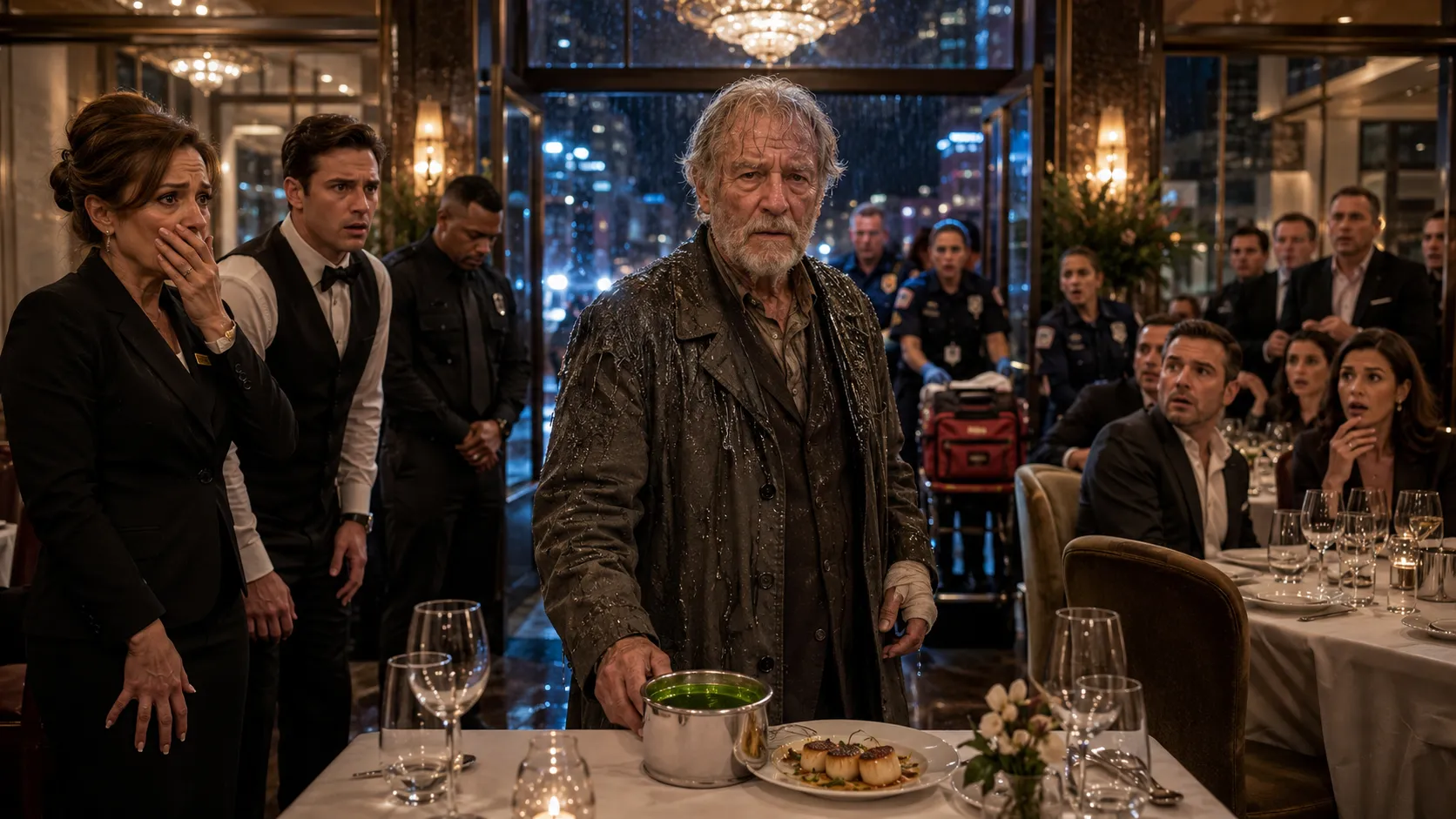
The old man walked back inside.
Rainwater dripped from his coat. His cap was gone. Blood still marked his palm.
Nobody laughed this time.
Nobody made a joke.
Nobody told him he smelled.
A young paramedic moved to block him.
“Sir, you can’t be in here.”
The old man looked at the unconscious woman near Table 9.
“Has she eaten the basil cream sauce?”
The paramedic blinked.
“What?”
“The basil cream sauce,” the old man repeated, calm and precise. “The one served with the scallops. Did she eat it?”
Elaine’s husband looked up desperately.
“Yes. Yes, she did. She had the scallops.”
The old man turned toward the man near the bar.
“And him?”
A server, crying now, nodded.
“He had the same thing.”
The old man looked around the room.
“Who else ordered scallops, mushroom ravioli, or anything finished with green herb oil?”
No one answered at first.
Then hands began to rise.
One.
Three.
Seven.
Ten.
The paramedic stared at him.
“Sir, who are you?”
The old man did not answer.
He knelt beside Elaine.
“Her airway is not blocked,” he said. “This is not choking.”
The paramedic frowned.
“We know that.”
“Then stop treating it like an obstruction. Her muscles are failing.”
The paramedic stiffened.
“What did you say?”
The old man looked at him.
“Her muscles are failing. If you wait until respiratory paralysis is complete, she will die before transport.”
The room went silent around the emergency noise.
A senior paramedic moved closer.
“How would you know that?”
The old man reached gently for Elaine’s wrist.
He did not perform a miracle.
He did not heal her with a touch.
He counted.
Pulse.
Skin tone.
Eye movement.
Breathing pattern.
Then he looked toward the kitchen.
“Get me the container of basil oil. Now.”
Melissa stared.
“I can’t let you into—”
The old man’s head turned toward her.
For the first time that night, his voice hardened.
“You already made one fatal decision because you cared more about appearance than life. Do not make another.”
Nobody moved.
Then a young busboy named Rafael ran into the kitchen.
Kyle whispered, “This is insane.”
The old man looked at him.
“No,” he said. “Mocking a hungry man while your kitchen poisons paying guests is insane.”
Kyle’s face went white.
Rafael returned with a small metal container of vivid green oil.
The old man smelled it once.
His expression changed.
He looked at the senior paramedic.
“Botulinum toxin is possible. Maybe from the garlic-herb oil. Maybe from sealed containers held improperly. Symptoms are coming too fast for normal food poisoning, but the pattern fits a concentrated contamination. Treat as suspected botulism until proven otherwise.”
The senior paramedic stared at him.
“You’re saying we need antitoxin?”
“I’m saying you needed it ten minutes ago.”
A police officer stepped forward.
“Who are you?”
Before the old man could answer, a voice came from the entrance.
“Dr. Jonah Mercer.”
Everyone turned.
The man from the black SUV entered wearing a charcoal overcoat, rain on his shoulders, two attorneys and a federal investigator behind him.
His voice was cold, controlled, and clear.
“Former infectious disease specialist. Former director of emergency response at the National Food Safety Task Force. And the man your restaurant just assaulted on camera.”
The dining room went silent.
Melissa gripped the hostess stand.
Kyle looked as if the floor had vanished beneath him.
Marcus, the security guard, backed away until his shoulders touched the wall.
The old man — Dr. Jonah Mercer — did not look triumphant.
He looked tired.
Daniel Carter, the man in the overcoat, placed a folder on the hostess stand.
“My name is Daniel Carter,” he said. “Federal Oversight Division.”
Melissa’s voice cracked.
“Federal?”
Carter looked directly at her.
“This establishment is now under active investigation for discriminatory conduct, assault, civil rights violations, food safety negligence, and potential criminal liability.”
Melissa nearly collapsed.
“What?”
Carter continued, “The video of your staff mocking and physically removing Dr. Mercer has already passed four million views.”
The room went cold.
Kyle whispered, “Over him?”
Carter turned slowly.
“No,” he said. “Over what all of you revealed yourselves to be.”
The words settled across the restaurant like ash.
But Dr. Mercer was not listening anymore.
He was already moving from patient to patient.
“Start ventilatory support for this woman. Monitor pupils and muscle weakness. Anyone with blurred vision, drooping eyelids, dry mouth, difficulty swallowing, or shortness of breath is priority transport. Send the oil, sauce, garlic, and storage containers for immediate testing.”
The paramedics obeyed him.
Not because he looked powerful.
Because he was right.
One of them asked, “How did you spot it so fast?”
Dr. Mercer looked toward the kitchen.
“Smell.”
The paramedic frowned.
“Smell?”
“Rancid garlic sealed in oil. Improper acidity. Warm storage. I noticed it near the service station when I walked in.” He paused. “I was going to mention it after I asked for food.”
No one spoke.
The shame in the room became almost physical.
Within twenty minutes, every affected customer had been transported to hospital care. None died that night because the medical teams began treating the exposure before full respiratory failure set in.
But Harper & Lane did not survive.
By midnight, the restaurant was sealed with public health notices.
By morning, the video was everywhere.
The hungry old man asking for food.
Kyle mocking him.
Marcus shoving him into the rain.
Customers laughing.
Then the emergency.
Then the revelation.
Dr. Jonah Mercer.
The name shook loose memories across America.
Older physicians remembered him.
Public health officials remembered him.
So did families in three states who had once blamed him for something he had spent years trying to prevent.
Fifteen years earlier, Dr. Jonah Mercer had been one of the country’s leading experts on foodborne illness outbreaks. He had led investigations in hospitals, factories, school cafeterias, and nursing homes. He was known for being difficult, brilliant, and morally impossible to pressure.
Then came the Valtrex Foods case.
A national supplier had distributed contaminated ready-to-eat meals to thousands of grocery stores and care facilities. Mercer’s team found early warning signs and pushed for an immediate recall.
The company delayed.
Executives argued the evidence was incomplete.
Government officials worried about panic.
Insurance consultants worried about losses.
Public relations teams worried about brand damage.
People died.
When the scandal broke, the company needed a name to sacrifice.
Jonah Mercer became that name.
Emails were altered.
Meetings were misrepresented.
A memo he had written urging immediate action was “lost” for seven years.
The headlines called him negligent.
Then reckless.
Then criminal.
He was never convicted, but public opinion did not need a verdict. His career ended. His wife, already ill, died before his name was cleared. His savings vanished into legal fees. His house went next.
By the time the missing memo resurfaced and Valtrex executives quietly settled with victims’ families, Jonah Mercer was gone.
Not dead.
Just gone.
Living in shelters, libraries, church basements, and under bridges in cities where nobody connected the hungry old man in the torn coat to the doctor who had once warned America that profit and public safety were enemies when no one was watching.
Daniel Carter had found him six months before Harper & Lane.
Not by accident.
Carter’s office had reopened several old food safety cases after whistleblowers revealed that contaminated ingredients were still moving through private distributors using shell companies. One name kept appearing in the old files: Mercer.
The doctor who had warned them.
The doctor no one believed.
When Carter found Jonah sleeping behind a church clinic, he offered him shelter, medical care, and consulting work.
Jonah refused most of it.
“I don’t consult for the government anymore,” he said.
“You tried to save people.”
“And watched them bury me for it.”
Carter had not argued.
He simply said, “Then help me make sure they can’t bury the next one.”
Slowly, Jonah agreed to observe.
Not officially.
Not publicly.
He sat outside warehouses. Walked through markets. Ate at soup kitchens. Noticed smells, labels, spoiled packaging, suspicious routes, names on delivery manifests. The invisible man saw what polished inspectors often missed.
That was why he had gone to Harper & Lane.
Not to test their kindness.
Not as a stunt.
He had followed a delivery truck.
The restaurant was only one stop.
The basil-garlic oil came from a specialty supplier used by dozens of luxury restaurants, airline lounges, private clubs, and high-end catering companies across the country.
One bad batch could sicken hundreds.
A national distribution pattern could put millions at risk.
Harper & Lane was not the story.
It was the warning flare.
By sunrise, federal investigators had traced the supplier.
By noon, emergency recall notices went out.
By evening, twelve cities had pulled the same product from kitchens.
Within forty-eight hours, contaminated containers were found in Chicago, New York, Miami, Dallas, Los Angeles, and Boston.
The news networks changed their headlines.
ONE ACT OF DISCRIMINATION EXPOSES NATIONAL FOOD SAFETY CRISIS
HUNGRY MAN THROWN OUT OF RESTAURANT SAVES DOZENS
DISGRACED DOCTOR WAS RIGHT AGAIN
Jonah hated the word disgraced.
He hated right even more.
Being right after people are hurt is not victory.
It is a heavier kind of grief.
Three days after the incident, Melissa Carter sat in a hospital waiting room.
Not as a manager.
Not as a brand builder.
Not as the woman who had ordered a hungry man out of her dining room.
As the daughter of one of the victims.
Her father, retired school principal Harold Carter, had eaten at Harper & Lane that night to celebrate his seventy-fifth birthday. He had ordered the mushroom ravioli. By the time paramedics reached him, his breathing had nearly stopped.
He survived because treatment began early.
Because Jonah Mercer recognized the pattern.
Melissa sat beside his bed long after visiting hours should have ended, holding his hand and staring at the ventilator that had kept him alive through the worst of it.
Her father woke on the fourth day.
His voice was weak.
“Did everyone make it?”
Melissa nodded, tears spilling instantly.
“Yes.”
He closed his eyes.
“Good.”
She began to cry harder.
“I’m sorry, Dad.”
He opened his eyes again.
“For what?”
She tried to answer.
For the restaurant.
For the old man.
For becoming the kind of woman who saw liability before suffering.
For choosing image over mercy.
For not recognizing that the man she threw into the rain was the same man who would later save her father’s life.
But all she managed was, “Everything.”
Harold looked at her for a long time.
Then he said, “Sorry is only useful if it changes where you stand next time.”
The words followed Melissa out of the hospital.
The next morning, she went looking for Jonah.
She found him outside a church clinic on the West Side, sitting on the bottom step with a paper cup of coffee in both hands. The cut on his palm had been bandaged. His coat was still old, but someone had given him a dry wool cap.
Daniel Carter stood nearby talking quietly with a public health attorney.
When Melissa approached, Carter’s expression cooled immediately.
Jonah looked up first.
She stopped several feet away.
For once, she did not know how to manage the room.
There was no room.
Only concrete steps, gray sky, and a man she had failed to see.
“Dr. Mercer,” she said.
He took a sip of coffee.
“Miss Carter.”
The formality hurt.
It should have.
“My father is alive because of you.”
Jonah looked down at the cup.
“I’m glad.”
“I came to apologize.”
Carter looked like he wanted to interrupt, but Jonah lifted one hand.
Melissa’s voice shook.
“What happened in my restaurant was wrong. What I allowed was wrong. What my staff did was wrong. What I did was wrong.” She swallowed. “You asked for food. I gave you humiliation.”
Jonah said nothing.
That was harder than anger would have been.
Melissa continued, “I keep telling myself I was under pressure, that I was thinking about customers, legal issues, the business. But the truth is simpler. I looked at you and decided you did not belong.”
Jonah’s eyes finally lifted.
“And now?”
“Now I know the restaurant did not belong to people like me if we could not feed one hungry man.”
A long silence passed.
Traffic moved in the street behind her. A woman pushed a stroller past the clinic. Somewhere nearby, a church bell rang eleven times.
Jonah stood slowly.
He looked thinner in daylight.
Older.
Not mythical.
Human.
“You think I want revenge,” he said.
Melissa lowered her eyes.
“Maybe you should.”
“No.”
She looked up.
“Why not?”
His mouth tightened.
“Because revenge is too small for what hunger does to people.”
Melissa had no answer.
Jonah stepped down one stair.
“If you want forgiveness, I cannot give it to you today.”
“I understand.”
“If you want to make a speech, give it somewhere else.”
She nodded.
“But if you want to repair something,” he continued, “start with your kitchen.”
“My kitchen?”
“Feed people.”
She stared at him.
“Not for cameras,” he said. “Not for tax deductions. Not once a year when rich people want to feel generous. Every day. Quietly. Safely. With dignity.”
Melissa’s eyes filled.
“My restaurant may not reopen.”
“Then feed people with whatever is left.”
That was the beginning.
Harper & Lane never reopened as Harper & Lane.
The lawsuits came first.
Then insurance battles.
Then criminal negligence hearings.
Kyle lost his job immediately. Marcus Bell, the guard, was charged with assault after the video showed the second shove. Melissa faced civil penalties, public fury, and the collapse of everything she had built.
For several weeks, she fought to protect the brand.
Then her father asked her one question from his hospital bed.
“When did the brand become more important than people?”
She had no good answer.
So she sold what remained.
The chandeliers.
The wine inventory.
The furniture.
The name.
Private investors circled like vultures, eager to buy the space and relaunch it with a softer scandal-proof concept. Melissa refused them.
Instead, with pressure from Daniel Carter’s office and guidance from Jonah, the space became something no one expected.
The Lane House Kitchen.
A public meal center, food safety training site, and emergency response hub for restaurant workers, unhoused residents, elderly people, and low-income families. It served meals through the front door on the same marble floor where people had once laughed at a starving man.
No back alley line.
No shame window.
No separate entrance.
People entered through the front.
They sat at real tables.
They were served real food.
The first day it opened, Melissa stood near the entrance wearing no designer blazer, no manager’s smile, no practiced confidence. She wore an apron.
Jonah arrived twenty minutes after opening.
She had not expected him.
He stepped inside quietly, clean-shaven now, still thin, still wearing the same cautious expression of a man who had learned never to trust rooms too quickly.
People recognized him immediately.
Some whispered.
Some stood.
Jonah ignored the attention and looked around.
The chandeliers were gone.
The white tablecloths were gone.
But the windows had been cleaned. The kitchen had been rebuilt. The staff had been retrained. The menu was simple and safe: soup, bread, roasted chicken, vegetables, rice, fruit, coffee.
No one asked anyone to prove poverty before eating.
Melissa approached him.
“Would you like something to eat?” she asked.
The question nearly broke her voice.
Jonah studied her.
Then nodded.
“Yes,” he said. “Please.”
She led him to Table 9.
The same table where Elaine had stopped breathing.
Jonah noticed.
Melissa did too.
“I can seat you somewhere else,” she said quickly.
“No,” he said. “Here is fine.”
She brought him soup and bread herself.
No cameras had been invited.
No press release had gone out.
But near the kitchen entrance, Rafael, the young busboy who had run for the basil oil, watched with tears in his eyes.
Jonah picked up the spoon.
For a moment, everyone who knew the story seemed to stop breathing.
Then the old man ate.
That simple act did more than any apology could have.
Months passed.
The national food investigation widened.
The contaminated oil supplier was found to have ignored storage failures and falsified safety logs. Executives were indicted. Distributors were fined. Several restaurants quietly settled with customers who had fallen ill. Federal agencies changed inspection rules for sealed oil infusions, garlic products, and high-risk preserved ingredients.
Millions of containers were pulled before reaching tables.
No one could prove exactly how many lives were saved.
That bothered Jonah less than it once would have.
Some victories, he had learned, are counted by disasters that never happen.
Daniel Carter visited Lane House once a month. Not for publicity. To ask Jonah questions. To bring files. To listen when the old doctor noticed a pattern no spreadsheet had caught.
Eventually, Jonah accepted housing.
A small apartment above the clinic.
He complained about the stairs, the radiator, the neighbor’s television, the softness of the mattress, and the fact that everyone kept asking whether he needed anything.
But he stayed.
One winter evening, nearly a year after Harper & Lane collapsed, Jonah received a letter.
No return address he recognized.
Inside was a photograph of a woman in her thirties standing beside two small children.
Behind them was a school cafeteria.
The note read:
Dr. Mercer,
My mother died in the Valtrex outbreak fifteen years ago. For most of my life, I believed you failed her.
Last month, I read the recovered memo you wrote. You tried to stop it. You tried before anyone else did.
I’m sorry we hated the wrong man.
My children eat lunch at school because of the safety rules your work helped create.
I thought you should know.
—Rebecca Alden
Jonah sat at his kitchen table for a long time after reading it.
Then he folded the letter carefully and placed it in a drawer beside others that had begun arriving after the truth resurfaced.
Some apologized.
Some thanked him.
Some only said, We know now.
It was not enough to return his wife.
Not enough to rebuild the years.
Not enough to erase the nights under bridges or the mornings when hunger made his hands shake.
But truth, like food, did not become worthless because it arrived late.
On the first anniversary of the incident, Lane House held no gala.
Jonah refused.
“No speeches,” he said.
Melissa agreed.
Then ignored him slightly.
There was no gala, but there was a dinner.
Open to everyone.
Former Harper & Lane customers came. Some of them had laughed that night. Some did not admit it. A few did. Elaine and her husband came, both carrying bags of donated groceries. Harold Carter came with a cane and sat proudly near the window. Rafael, now assistant kitchen manager, supervised the meal service with the seriousness of a man who knew food could be both danger and mercy.
Melissa moved from table to table with coffee.
At one point, Kyle appeared outside.
Nobody expected him.
He stood beyond the glass doors in a worn jacket, thinner than before, his arrogance dimmed by a year of public shame and unemployment. He did not come inside at first.
Melissa saw him.
Her face tightened.
Jonah noticed.
“Your decision,” he said.
She looked at him.
“What would you do?”
Jonah looked through the glass at Kyle.
“I would remember that hunger teaches badly when no one interrupts it.”
Melissa opened the door.
Kyle stood in the cold, unable to meet her eyes.
“I’m not here to cause trouble,” he said.
“Are you hungry?”
The question struck him.
He looked past her into the room.
Then down at his shoes.
“Yes.”
Melissa stepped aside.
For a moment, the old Harper & Lane seemed to hover there — the hierarchy, the contempt, the easy cruelty. Then it vanished.
Kyle entered.
No one applauded him.
No one forgave him out loud.
Rafael served him soup and bread.
Kyle whispered, “Thank you.”
Rafael nodded once.
“That’s what we do here.”
Later, after the meal rush slowed, Kyle approached Jonah’s table.
The room became quieter.
Jonah looked up.
Kyle’s face flushed.
“I don’t expect you to forgive me.”
“Good,” Jonah said.
Kyle swallowed.
“I just wanted to say… I was wrong.”
Jonah leaned back.
“That’s a small sentence for a large thing.”
“I know.”
“Do you?”
Kyle’s eyes filled, surprising everyone, maybe even himself.
“I watched that video after it happened. At first, I watched it because everyone else was. Then I watched it again. And again. I kept waiting to recognize myself as someone better than the guy on screen.” His voice broke. “I never did.”
Jonah said nothing.
Kyle continued, “I thought working around rich people meant I was closer to them than to people like you. But I was one missed paycheck away from the sidewalk, and I was laughing at a man who was already there.”
For the first time, Jonah’s expression softened slightly.
“That realization is expensive,” he said.
Kyle nodded.
“Yeah.”
Jonah pointed to a chair.
“Sit.”
Kyle hesitated.
Then sat.
No one called it forgiveness.
It was not that clean.
But the door remained open.
Years later, people still told the story of Harper & Lane.
Some told it as a miracle.
Some as a scandal.
Some as a warning about discrimination, food safety, class, arrogance, and the danger of deciding a person’s worth before learning their name.
But Jonah Mercer never liked when people made it too simple.
“It wasn’t one bad waiter,” he would say. “It wasn’t one cruel manager. It wasn’t even one contaminated batch of oil. It was a chain of people looking away.”
Then he would add:
“Chains can work the other way too.”
A busboy who ran to the kitchen.
A paramedic who listened.
An investigator who reopened old files.
A daughter who apologized.
A kitchen that changed its purpose.
A hungry man who returned to help people who had not helped him.
On the fifth anniversary of Lane House, the city placed a small plaque near the entrance.
Jonah hated the idea until Melissa showed him the wording.
It did not mention heroism.
It did not mention scandal.
It simply said:
NO ONE WHO IS HUNGRY LEAVES THROUGH THE BACK DOOR.
Jonah stood in front of it for a long time.
His hair was fully white now. His hands still trembled sometimes, though less from hunger and more from age. He wore a clean coat Daniel Carter had bought him and which Jonah still claimed was “too expensive for a man who likes pockets.”
Melissa stood beside him.
“Is it acceptable?” she asked.
He pretended to consider.
“The comma usage is decent.”
She smiled.
“That is the highest praise I’ll get.”
Inside, the dining room was full.
An elderly man ate soup slowly near the window. A mother helped her daughter cut chicken into small pieces. Two restaurant workers attended a free food safety class in the back room. Kyle, now a kitchen volunteer twice a week, carried bread to a table without asking anyone to notice.
Jonah watched him.
Melissa followed his gaze.
“You were right,” she said.
“About what?”
“Feeding people with whatever was left.”
Jonah looked at the room.
For a long time, he said nothing.
Then he reached into his pocket and pulled out the letter from Rebecca Alden, the daughter of the woman who died in the outbreak that destroyed his life. He had carried it so often the folds had weakened.
“My wife used to say something,” he said.
Melissa waited.
“She said a good table is not measured by what is served on it, but by who is allowed to sit down.”
Melissa’s eyes filled.
Jonah folded the letter again.
“For years, I thought my table was gone.”
He looked around Lane House.
“Maybe not.”
That evening, after closing, Jonah sat alone at Table 9 with a bowl of soup.
Not because he was hungry.
Because he could.
Rain tapped softly against the windows.
Outside, people hurried through the Chicago night under umbrellas and collars pulled high. Some were wealthy. Some were poor. Some looked important. Some looked invisible.
Jonah watched them pass.
He knew the world had not become kind overnight.
It never does.
There would always be doors that closed too quickly. People who laughed too easily. Managers who saw liability before humanity. Systems that protected polished cruelty until disaster forced truth into the light.
But inside this one room, at least for tonight, something had changed.
The old man lifted his spoon.
A young volunteer approached carefully.
“Dr. Mercer?”
He looked up.
“There’s a man outside. He says he doesn’t want to bother anyone, but he hasn’t eaten today.”
Jonah set the spoon down.
For a moment, he saw himself in the glass reflection.
The wet coat.
The blood on his sleeve.
The laughter.
The door closing.
Then he stood.
“Bring him in,” Jonah said.
The volunteer nodded.
Jonah looked toward the front door.
“No,” he corrected gently. “I’ll bring him in myself.”
He walked across the room slowly, opened the door, and stepped into the rain.
This time, no one laughed.
And no one hungry was left outside.