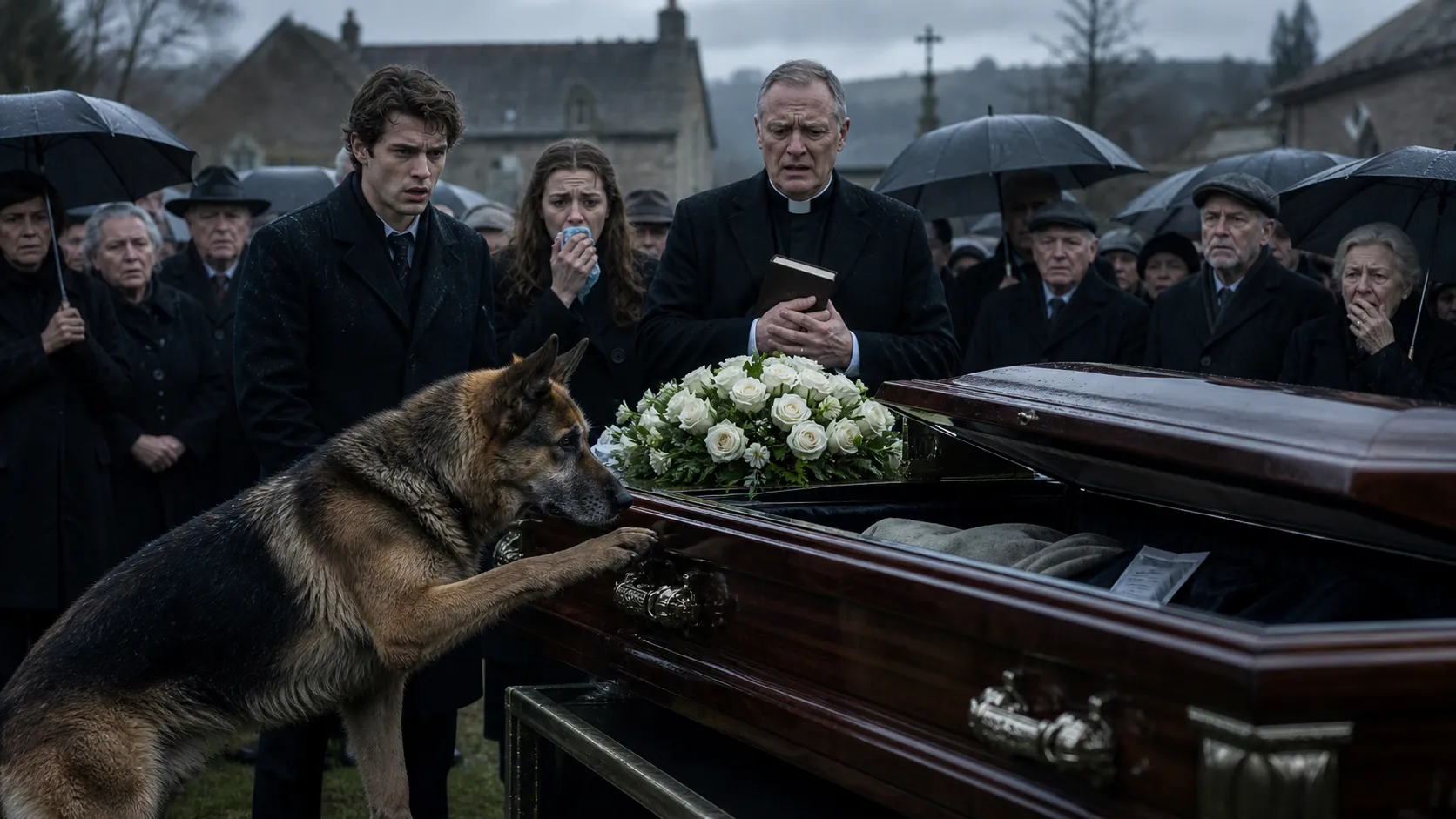
Everyone thought Duke was just a grieving dog refusing to let go of Hannah one last time. But when he would not stop barking at the casket, and the priest seemed more nervous than heartbroken, a funeral meant to bury sorrow turned into something far worse: the moment a whole village realized the dead had not been the only ones keeping secrets.
The day of Hannah Mercer’s funeral began with the kind of sky that seemed to understand grief.
Low gray clouds pressed over Blackwood Parish. The trees around the cemetery shivered in a restless wind. People stood in dark coats beneath umbrellas, their shoes sinking lightly into damp earth as they gathered around the polished casket and tried to speak softly enough to make sorrow look orderly.
Hannah had been loved in the way small-town women often are loved: not loudly, not theatrically, but through casseroles, borrowed rides, remembered birthdays, and the quiet certainty that she had once carried half the town’s burdens without asking anyone to notice the weight.
Her brother Daniel stood nearest the coffin, jaw set so hard it looked painful.
His sister Rebecca kept both hands around a handkerchief she had already ruined with tears.
And beside them, straining against a leather leash held by a nervous cousin, stood Duke.
Hannah’s dog.
A German shepherd with graying fur around the muzzle, powerful shoulders, and the kind of alert eyes that made children fall in love with him and liars feel strangely seen. Duke had followed Hannah everywhere for seven years. Grocery store. Garden. Church steps. River path. Wherever she went, Duke went too, as if loyalty were not a virtue but a reflex built into his bones.
When the service began, he was quiet.
For a little while.
Father Michael stepped forward in his black coat and white collar, opening the worn prayer book with both hands. His voice floated over the mourners in practiced tones — calm, solemn, measured enough to keep grief from spilling into something harder to control.
But halfway through the first prayer, Duke’s body changed.
His ears went rigid.
His head lifted.
And a low growl rolled out of him so deep and sudden that half the mourners looked up at once.
The cousin tightened the leash.
“Easy,” he whispered.
Duke ignored him.
His gaze fixed on the casket.
Then he barked.
Sharp.
Violent.
Not the confused bark of a dog frightened by crowds or thunder or unfamiliar movement.
This was warning.
The sound cracked through the funeral like a thrown stone through glass.
People turned.
Children moved closer to their mothers.
Father Michael faltered for the briefest instant before forcing the next line of prayer out with a little more volume than before.
Duke barked again.
And again.
Now he was pulling hard enough that the cousin lost his footing on the wet grass. The leash cut across his palm. Duke never took his eyes off the coffin.
A murmur moved through the crowd.
“What is he doing?”
“Has he gone mad?”
“Does he smell something?”
An old woman near the back crossed herself.
Dogs know things, people say in villages like Blackwood. They sense storms, sickness, fear, and death. Most of the time that belief lives comfortably in superstition — a thing to repeat in kitchens and laugh about after. But there are moments when it stops sounding quaint and starts sounding like memory.
Father Michael closed the prayer book.
“Please,” he said, lifting one hand. “Someone take the dog outside.”
Nobody moved immediately.
The reason had nothing to do with Duke.
It was the priest.
He was sweating.
Not much.
Just enough for people to notice because the wind had turned cold and everyone else stood wrapped tight in their coats. A bead of sweat ran from his hairline down the side of his face, and when Duke lunged again toward the casket, Father Michael stepped back instead of forward.
Daniel saw that.
His grief sharpened into something watchful.
“Duke,” Rebecca called softly, voice shaking. “Please.”
But Duke did not stop.
He let out a strange sound then — not a bark, not quite a howl, but something raw and urgent, the sound of an animal trying to drag human beings toward a truth they were refusing to see.
He broke the leash.
The leather snapped.
Women gasped. Someone shouted. Duke launched himself forward and hit the side of the casket hard enough to rattle the arrangement of white roses across the lid.
The funeral director swore and rushed in.
Two men grabbed for the dog’s collar, but Duke twisted free, planted himself beside the casket, and barked directly into the seam where the lid had been shut.
Not at the flowers.
Not at the crowd.
At the coffin itself.
Now the silence changed.
Before, it had been ceremonial.
Expected.
Decorous.
Now it was alive.
A silence made of suspicion.
The funeral director checked his watch with the thin, irritated panic of a man who wanted the schedule restored more than he wanted answers. He leaned toward Rebecca and muttered that the ceremony should continue before things became “undignified.”
Daniel heard him.
He turned slowly.
“My sister is in that coffin,” he said. “Dignity can wait.”
That was when Duke began scratching at the wood.
Not wildly.
Not randomly.
One exact place near the head of the casket.
His claws scraped and thudded. He barked once between each strike as if insisting on rhythm, on insistence, on being understood.
Father Michael took a step forward then and, for the first time all afternoon, raised his voice instead of softening it.
“This has gone far enough.”
The words hit wrong.
Too fast.
Too sharp.
Too afraid.
Daniel looked at him.
“Why are you more worried about the dog than my sister?”
The question landed in the center of the cemetery and stayed there.
Father Michael opened his mouth.
Closed it.
Looked toward the funeral director.
That was enough.
Daniel turned to the men beside him — cousins, neighbors, friends who had helped lower barns, pull trucks from snow, and bury fathers before. The kind of men who do not enjoy scenes but know when a scene has already begun without them.
“Open it,” Daniel said.
The funeral director protested at once.
“You can’t do that. The coffin’s sealed. There are procedures.”
Daniel did not raise his voice.
“Open it.”
What followed was ugly in the way truth often is when it first insists on being let in. The director argued. The priest objected. Rebecca cried openly now, begging someone to tell her what was happening. But the men were already moving. One fetched a crowbar from the maintenance shed. Another cleared the flowers. A third knelt to steady Duke, who finally fell silent the moment he saw they were obeying.
That silence frightened everyone more than the barking had.
The metal bit under the lid.
The first crack of the seal sounded like a gunshot.
Several mourners flinched.
One woman turned away completely.
The old groundskeeper removed his cap and held it against his chest.
When the lid finally lifted, the cemetery stopped breathing.
Because Hannah Mercer was not inside.
Not fully.
There was weight in the coffin, yes.
Blankets.
Sandbags.
Something shaped quickly to imitate a body beneath the funeral lining.
But not Hannah.
Her brother made a sound no one there would ever forget — not a shout, not grief exactly, but the stunned, sick howl of a man whose mourning had just been robbed of even its last certainty.
Rebecca collapsed.
Someone caught her before she hit the mud.
Duke leapt once, paws on the edge of the coffin, and pawed aside one of the blankets. Beneath it, taped inside the lining, was a small plastic evidence pouch.
Daniel grabbed it with shaking hands.
Inside was a folded church receipt, a motel key, and one note written in Hannah’s unmistakable hand.
Daniel, if Duke gets you this far, I was right not to trust them. Don’t let Father Michael tell you I was confused. Go to Room 12 at the Crestview. Ask for Lena.
People turned toward the priest as one body.
Father Michael had gone white.
The funeral director backed away from him instinctively, as if guilt had become contagious.
Daniel stared at the note, then at the priest, then at the empty coffin that had nearly been lowered into the ground in front of half the parish.
“Where is my sister?”
Father Michael shook his head too quickly.
“I don’t know what this is.”
But now nobody believed him.
Not after the sweat.
Not after the panic.
Not after the sealed coffin.
Not after Duke.
The deputy who had come merely to direct parking stepped forward slowly and put one hand on Father Michael’s arm.
“We’re going to need you to come with us.”
By sunset, the truth had begun surfacing.
Not all of it.
Not cleanly.
But enough.
Hannah had gone to Father Michael three weeks earlier because she was frightened. She had discovered irregularities in the parish charity fund — money donated for widows, emergency heating oil, and children’s meals that had been diverted through accounts tied to the rectory and to one of the funeral home’s shell businesses. When she confronted the priest privately, he told her she was grieving, exhausted, unstable. When she threatened to go to the police, things turned uglier.
The motel key led Daniel and the deputies to Room 12 at the Crestview on the highway.
Hannah was there.
Alive.
Drugged.
Weak.
Terrified.
But alive.
Lena, the housekeeper whose name was in the note, had hidden her after realizing the “burial transfer” scheduled by the priest and the funeral home made no sense. She had overheard enough to understand that Hannah was not being protected from distress — she was being removed from public sight until her accusations could be buried with a closed coffin and a false story about medication, confusion, and family shame.
The parish bookkeeper talked by midnight.
The funeral director talked before dawn.
Father Michael denied everything until the bank transfers surfaced.
Blackwood Parish never looked quite the same after that.
Not the church.
Not the cemetery.
Not the people.
Because everyone had watched a dog do what the adults had failed to do: refuse the lie long enough for the truth to force its way into daylight.
Weeks later, when Hannah returned home for real, Duke never left her side.
He slept against her door.
Followed her into the garden.
Sat beneath her chair while she gave statements to investigators and cried halfway through them.
If she moved, he rose.
If she stopped, he watched.
If strangers came near too quickly, he stepped between them.
Daniel joked once that the dog had become sheriff, judge, and guardian angel all at once.
Nobody laughed very hard.
Because in Blackwood, after that funeral, people stopped speaking about Duke as if he were merely loyal.
They spoke of him with the strange respect reserved for creatures who have already seen one more layer of truth than human beings can bear comfortably.
And when the parish bells rang again months later for a different funeral, nobody in town forgot to look first at the dog.
Because sometimes grief is loud.
Sometimes lies are louder.
And sometimes the first honest voice at a funeral does not come from the pulpit at all.