Sheriff Daniel Mercer thought he was stopping a dangerous child from causing panic in the middle of a storm. By dawn, with the dam gone, the radio dead, and half the town buried in mud, he understood the truth too late: Leo had been screaming warnings in the only language the adults had refused to learn.
I have been Sheriff of Blackwood Creek for twenty years, and I used to believe experience made a man harder to fool.
I had seen fatal wrecks on Route 9.
I had seen men bleed out in gravel parking lots after bar fights that started over nothing.
I had seen marriages collapse, farms go under, and decent people turn ugly when enough pressure found the right fracture line.
But nothing in all those years prepared me for the night I realized I had almost let my whole town die because I was too proud to listen to a five-year-old boy who never used words.
His name was Leo.
He was small for his age, pale, sharp-eyed, and silent in a way that made people uncomfortable. Not quiet — silent. The doctors had a name for it. The school had meetings about it. The town had something else entirely: impatience.
To most of Blackwood Creek, Leo was just that difficult kid from the yellow house by the culvert.
He didn’t play tag with the others.
He didn’t yell.
He didn’t laugh when grown-ups tried to charm him.
He stared at things.
At cracks in the sidewalk.
At drain grates.
At telephone wires humming in the wet wind.
At the creek as if it were speaking directly to him and the rest of us were too slow to hear.
That week, he was staring at the mountain.
We had been getting rain for seven days straight. Not a decent rain, not the kind farmers bless or old women listen to with tea in their hands. This was a relentless, punishing deluge. The sky stayed bruised purple. The roads sweated mud. The air tasted metallic. Even the dogs had stopped barking.
The creek was rising fast, shouldering at the banks and licking the underside of Miller Bridge, but the county engineers told me Shadow Ridge Dam was holding.
“Within safety limits,” they said.
I believed them.
That is the part I hate most now — not that I made a choice under pressure, but that I hid inside authority so easily. I’m the Sheriff. I trust reports. I follow the chain of command. I let the language of men with credentials quiet the instinct that had begun scratching at the back of my neck.
Leo didn’t care about any of that.
Two days before the collapse, Mrs. Higgins called dispatch furious because somebody was stealing her landscaping stones. I drove out through the rain expecting teenagers.
Instead I found Leo in her backyard, soaked to the bone, dragging a rock twice the size of his head through the grass.
He wasn’t playing.
He wasn’t wild-eyed.
He wasn’t making a scene.
He was working.
His face was twisted with silent effort, jaw locked, hands muddy, shoes slipping under him as he hauled that stone toward the drainage ditch that ran behind the subdivision.
“Leo,” I called, stepping out into the rain, “put it back.”
He stopped at once and looked at me.
Not with guilt.
Not with fear.
With frustration.
Then he pointed — first at the ditch, then at the mountain beyond town, then back to the water.
I didn’t follow the gesture. I didn’t crouch. I didn’t try.
I turned instead when his mother Sarah came running from the yellow house, exhausted and breathless, apologizing before she even reached us.
“I’m so sorry, Sheriff,” she cried. “I locked the gate. I don’t know how he keeps getting out. He’s been obsessed with digging holes all week.”
I remember nodding, annoyed by the inconvenience, rain running cold beneath my collar.
“Keep him inside, Sarah. The ground’s slick. He’s going to get hurt.”
She grabbed his arm gently and led him home.
Leo twisted once to look back at me. His hand pressed flat against the window after they went inside. He watched the ditch. Watched the road. Watched the rain.
I thought he was having a tantrum.
I was wrong.
Over the next day, complaints came in from all over town.
Leo seen near the culvert.
Leo pulling apart stones by the creek bank.
Leo crouched beside a drainage pipe, touching the mud, staring at the flow.
Leo standing under the humming telephone lines with his head tilted as if the wires were giving testimony.
To everyone else, it looked like chaos.
To me, it looked like misbehavior shaped by obsession.
I never once asked the only question that mattered:
What if he was trying to show us something?
The night the storm turned violent, Blackwood Creek felt less like a town than a thing under siege. Wind ripped through the valley in long, screaming passes. Power lines swung. Trees shuddered. My radio lit up every few minutes with fallen branches, minor flooding, stalled trucks, frightened calls from people hearing the creek too close to their foundations.
Then, a little after two in the morning, the station door burst open.
Deputy Miller staggered in, drenched and furious, dragging Leo by the collar of his dinosaur pajamas. The kid was caked in mud from head to toe. One knee was torn open. His fingers were wrapped around a crowbar nearly as long as his arm.
“You are not going to believe this,” Miller shouted. “I caught him at the siren tower. He busted the lock on the manual override box.”
For one sick second, anger overrode everything else in me.
The emergency siren.
The one thing that could throw the whole valley into blind panic if triggered at the wrong time.
I looked at Leo and saw only danger. A child with a tool. A storm already too large. One more problem demanding containment.
He reached for my radio the moment Miller let him go.
Not wildly — urgently.
I pulled back.
“Enough,” I snapped. “This has to stop, Leo. You’re endangering people.”
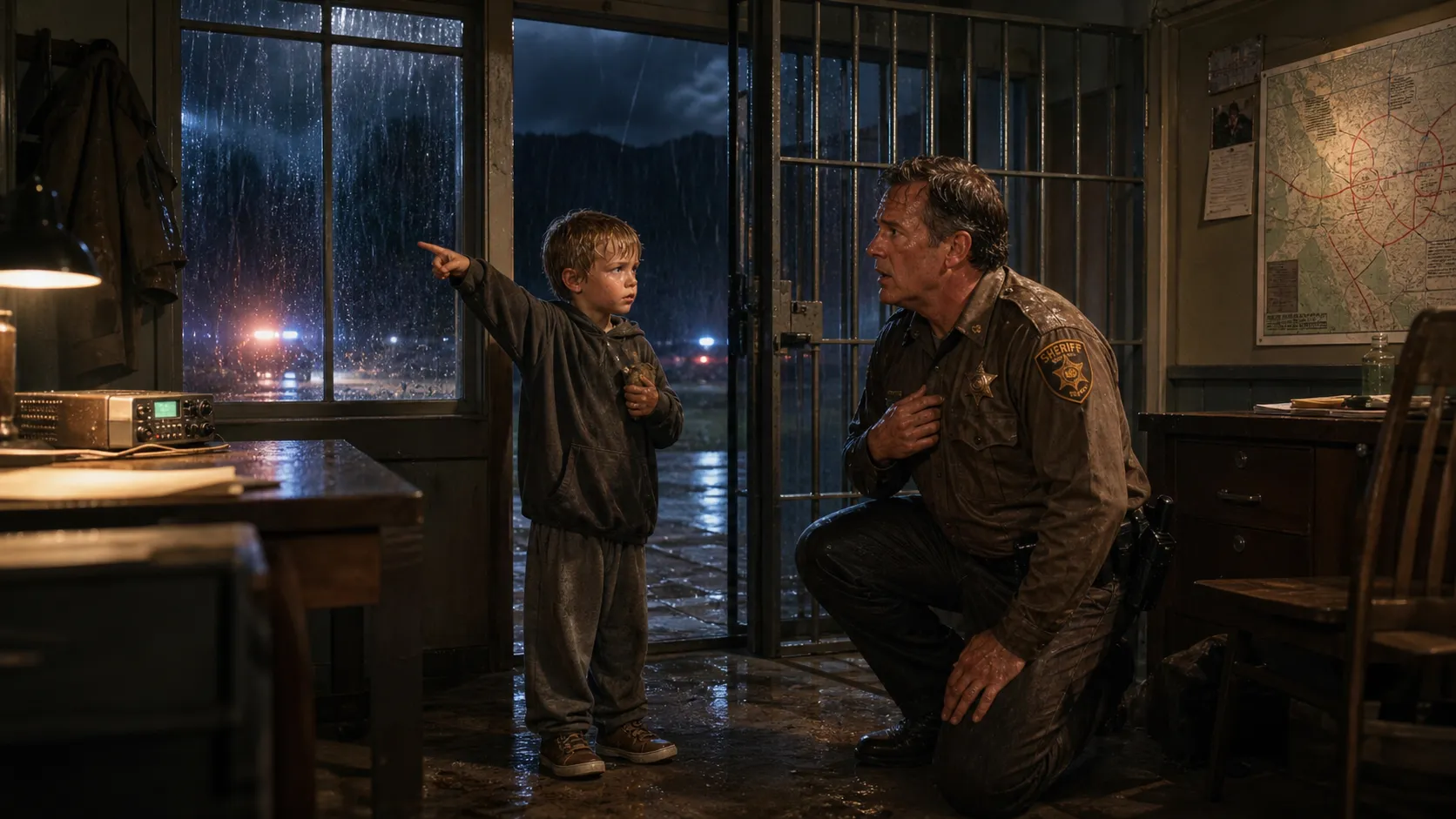
He made a raw sound deep in his throat, something between a growl and a sob, then pointed at the floor. Then both hands rose and crashed downward in a crumbling motion.
He was trying to show me again.
The dam.
The collapse.
The water.
I saw none of it.
I put him in the holding cell to keep him contained until Sarah could get through the storm.
Not to arrest him.
Not to punish him.
That almost makes it worse.
I believed I was being reasonable.
He gripped the bars with both hands and shook them so hard the metal rattled. His mouth opened in a silent scream that still wakes me some nights. He pointed to the window, to the mountain, to my radio, to the floor again.
“The dam is fine,” I told him.
Then I turned my back and poured coffee.
If I had looked at him one second longer, maybe I would have seen what terror looks like in a child who knows he is running out of time.
Twenty minutes later, my radio died.
Not static.
Not interference.
Silence.
Then the building shivered.
At first it felt like thunder hitting too low and too long. But thunder passes. This sound kept coming — deep, monstrous, rolling through the earth itself. The windows rattled. A glass fell and shattered in the break room. Miller looked at me, and in that instant I knew.
Not because I understood the mechanics.
Because the boy in the cell had gone utterly still.
Shadow Ridge had failed.
Everything after that came in pieces too fast for memory to hold properly.
Sirens that never fully sounded.
Emergency lights blinking against sheets of rain.
Mud and black water ripping down the eastern slope.
The trailer park gone.
Miller Bridge twisted sideways.
Cars buried to their windows in sludge.
People screaming names into the dark.
Generators choking out and silence swallowing whole streets at a time.
We spent the rest of the night pulling people from roofs, porches, trees, attic windows, anywhere the water had left them.
By dawn, Blackwood Creek looked as if a giant hand had taken hold of it and dragged half the town downhill.
Mud coated everything.
Fences were gone.
The old feed store had collapsed inward.
Mrs. Higgins’ backyard was unrecognizable.
And along the drainage ditch behind the subdivision — the one I had dismissed when Leo pointed at it — the crude little wall of stones he had been dragging into place was still there, half-broken but visible. It had diverted enough of the first violent runoff away from the Miller house and two neighboring homes to keep them standing long enough for the families inside to escape.
A five-year-old child had understood the water better than we had.
By midday, the county rescue teams arrived. So did engineers, geologists, and officials with clean boots and careful voices. They talked about overload, pressure failure, secondary erosion, subsurface shifts.
Then one of the specialists — a woman from Denver with rain in her hair and mud up to her calves — stood beside the washed-out road and asked me, “Who was the child trying to trigger your warning siren?”
I stared at her.
“What?”
She gestured toward the mountain and the destroyed spillway.
“He felt it before the instruments did, didn’t he?”
Later, in calmer language, they explained what we should have recognized much earlier. Some children, especially children with profound sensory sensitivity, experience the world in ways the rest of us spend our lives filtering out. Vibration. Pressure changes. Low-frequency sound. Repetition. Pattern breaks. The things we call background can become impossible for them to ignore.
Leo had not predicted disaster like some storybook prophet.
He had recognized imbalance.
He had heard the mountain changing.
Felt the water pressure differently.
Seen patterns in the creek and ditches that no adult had respected enough to study.
And when no one listened, he acted.
He stole stones.
Dug channels.
Broke a lock.
Tried to save us with his whole little body.
That afternoon I unlocked the holding cell myself.
Sarah was there, standing with both hands clenched together so tightly her knuckles had gone white. She looked as though she expected blame, accusation, maybe even charges for what her son had done in the storm.
Leo sat on the bench with his wet pajamas changed into donated clothes two sizes too big. He didn’t look at me when I entered.
I didn’t deserve the look.
I crouched down until I was at his level.
The badge on my chest suddenly felt heavier than metal should.
“I was wrong,” I said.
He kept his eyes on the floor.
“I thought you were causing trouble,” I went on. “You were trying to help us.”
His fingers moved once against the bench seat — a small, restless tapping pattern I had seen him do before and never bothered to notice.
“I should have listened,” I said. “I’m sorry.”
He looked up then.
Not forgiving.
Not angry.
Just tired.
Then he pointed toward the window, where the rain had finally stopped and pale morning light was beginning to cut through the torn clouds over the ruined town.
I understood that gesture.
Too late.
But I understood it.
Over the weeks that followed, Blackwood Creek rebuilt itself the way damaged places always do: with plywood, casseroles, donated blankets, insurance arguments, prayer, denial, exhaustion, and too much coffee. We counted losses. Buried two dead. Thanked God it wasn’t twenty.
And the town changed in another way too.
Not all at once.
Not nobly.
At first people were embarrassed.
Then curious.
Then careful.
They stopped calling Leo difficult when he stood near the creek and watched the current.
They stopped dragging their children away from him in grocery lines.
Teachers started asking what he was trying to show them when he arranged blocks in strange patterns or fixated on sounds no one else had mentioned.
Mrs. Higgins, whose house was still standing because of the ditch wall he built from her stolen stones, brought Sarah a peach pie and cried on the porch until Sarah hugged her.
We installed a new siren tower that summer.
At the dedication, county officials gave speeches about resilience, vigilance, and infrastructure. I let them talk. Then I stepped to the microphone and told the truth.
“This town was warned,” I said. “We just didn’t like the form the warning took.”
Every head turned toward Leo, who stood beside his mother in a clean blue shirt, one hand wrapped around the frayed sleeve of her coat.
“Not all warnings come with charts,” I said. “Not all heroes speak.”
People applauded then, but that wasn’t the part that mattered.
What mattered was what happened later.
The next time Leo stacked stones near a ditch, three grown men knelt beside him and helped.
The next time he stared up at the wires humming in bad weather, the power company got called before the line failed.
The next time he tugged at my uniform and pointed instead of speaking, I followed the finger.
I keep my old badge in my desk drawer now.
Not because I retired. I haven’t.
Because I need a reminder.
Authority doesn’t mean understanding.
Experience doesn’t mean wisdom.
And silence, if you’re arrogant enough, can be the loudest cry for help you’ll ever ignore.
When the morning sun hit the ruins of Blackwood Creek, we found the truth buried in the mud.
The child we called a menace had been trying to save us.
And the loudest scream that night was one no one had the humility to hear.