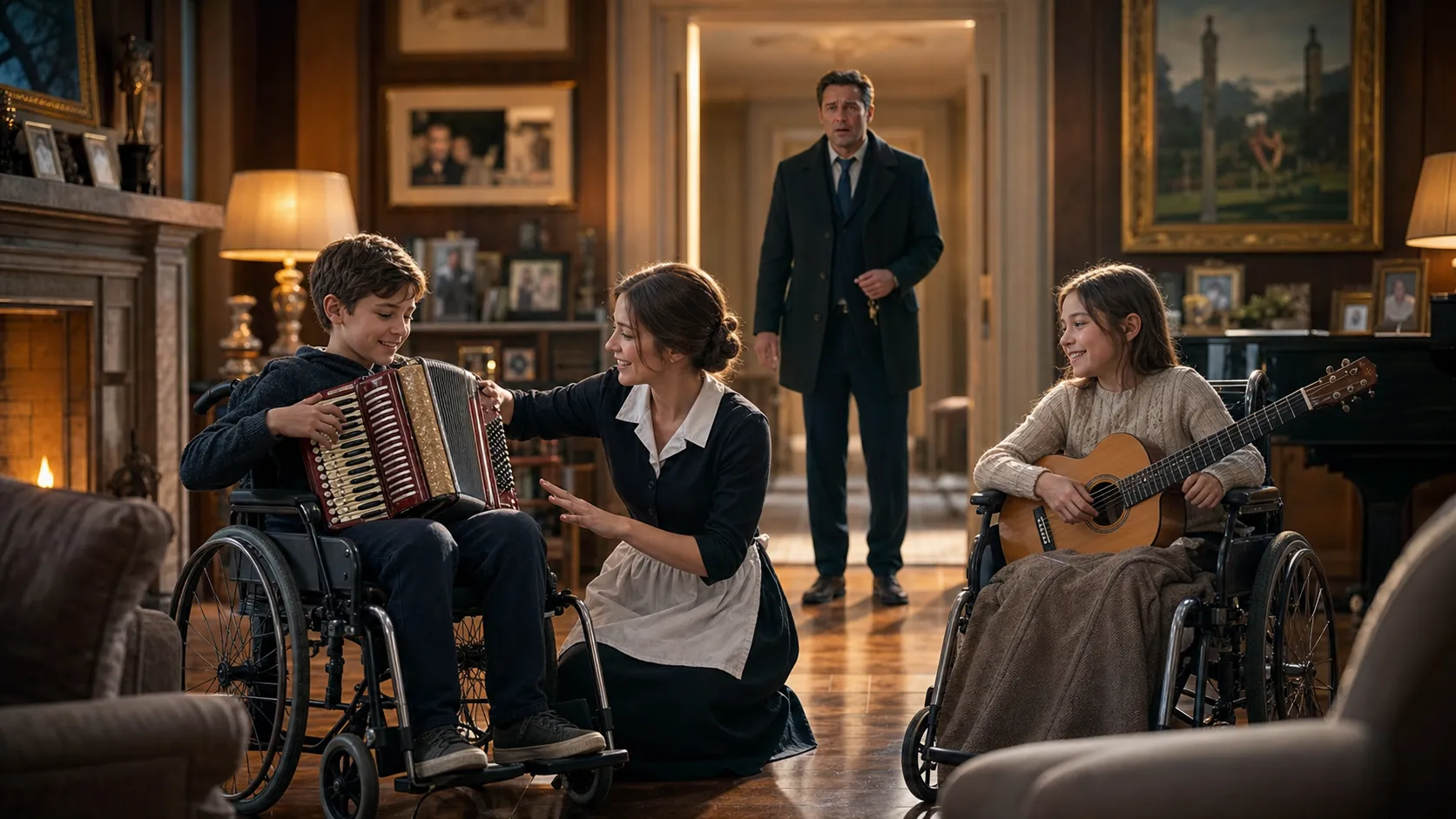
Daniel Harrington thought he was returning to the same haunted quiet that had swallowed his mansion since his wife died and his twins came home in wheelchairs. Instead, he stopped in the doorway and heard something he believed grief had stolen forever: music, patience, and his daughter’s laughter drifting through the house because the woman he barely noticed had been rebuilding his family in secret.
When Daniel Harrington unlocked the front door just before dusk, he expected silence.
Not ordinary silence.
Not peace.
The other kind.
The kind that had taken over his house after Sarah died.
The kind that settled into corners, stairwells, and polished rooms until even the expensive things looked abandoned.
The kind that made a man stay late at the office not because work mattered more, but because grief sounded louder at home.
For months, that had been his routine.
Leave early.
Return late.
Move through the house like a visitor paying respects to a life that had already ended.
He had convinced himself it was practical.
He was a construction executive. There were projects, contracts, decisions, men waiting for his signature, cities willing to reshape themselves around his money.
But the truth was uglier.
Since the accident, since the hospital, since Sarah’s funeral and the wheelchairs and the sterile sympathy and the unbearable rearrangement of everything, Daniel had become afraid of his own front door.
So when he stepped inside that evening and heard music drifting softly down the hallway, he stopped so abruptly his keys slipped in his hand.
For one impossible, traitorous second, his heart betrayed him.
It sounded enough like Sarah to hurt.
Not perfectly.
Not cleanly.
But enough.
Enough to make a widower’s body react before reason could protect it.
He stood in the foyer, not breathing, while the melody traveled through the rooms in fragile, uneven pieces — not a performance, not polished, but alive. Alive in a way the house had not felt for so long that the sensation frightened him.
Then he followed it.
The sound led him to the family room.
And what he saw there had nothing to do with cleaning.
His son Ethan sat in his wheelchair with an accordion balanced awkwardly across his lap, his fingers stiff and uncertain but working, working, working toward something that resembled song. Across from him, his daughter Mia held a guitar against the side of her chair, tapping out a rhythm with a bright pick and a look of fierce concentration. Kneeling between them, one hand steadying the instrument and the other keeping time in the air, was Laura Bennett.
The maid.
The quiet, efficient woman he had hired months earlier because the house needed someone to keep it from collapsing into visible disorder while its owner collapsed more privately out of sight.
Laura was not merely passing time with them.
She was teaching.
No — more than that.
She was building something.
“Try again,” she said gently to Ethan. “Don’t fight the note. Let it come to you. It’s not about force.”
Ethan frowned, adjusted his grip, and pressed again.
This time the little phrase came out clearer.
Laura clapped once, softly.
“That’s it.”
Mia laughed.
Not a polite sound.
Not the careful, thin imitation of happiness Daniel had been hearing from his children since the accident.
A real laugh.
Bright.
Uncontrolled.
Unmistakably hers.
It struck him harder than the music.
Because he had not realized how long it had been since he’d heard it.
He stayed there in the doorway, frozen by the terrible feeling that if he moved, the entire scene might collapse. That one step would send the children back into silence, Laura back into apology, and the house back into the careful death it had learned to imitate.
So he watched.
Laura corrected Ethan’s hand position without impatience.
She waited through Mia’s mistakes as if time cost nothing.
Every small success was met with warmth.
Every failure was turned into another attempt instead of another loss.
Nothing in her manner suggested performance.
There was no effort to impress.
No self-conscious nobility.
No glance toward the doorway to see if anyone was witnessing her goodness.
That, perhaps, was what unsettled him most.
She had done all this without needing him to know.
In the days that followed, Daniel began coming home earlier.
At first he didn’t announce it.
He stood in hallways.
Paused at half-open doors.
Listened from the staircase.
Watched from the margin of his own life like a man trying to determine whether he still belonged there.
He saw Laura bringing library sheet music into the house in a canvas bag.
He saw her turn breathing exercises into rhythm games.
He saw her hide therapy inside play so cleverly the twins no longer looked as though they were being pushed through recovery — only invited toward it.
One afternoon he found an old notebook on the kitchen counter.
The moment he saw the handwriting, his chest tightened.
Sarah.
His late wife’s looping script filled the pages — lyrics, chords, fragments of songs she used to sing to the twins before hospitals and wheelchairs and all the cruel new vocabulary of their lives. Laura had recopied them carefully, adding chord notes, larger print, simplified finger markings, patient instructions in the margins.
Your mom’s song, she had written at the top of one page.
Daniel sat down at the kitchen table with that notebook in both hands and understood, with a shame so clean it almost felt medicinal, that a stranger had been doing the work of remembering his wife inside his own home while he had been out postponing pain in conference rooms.
After that, he stopped hiding.
Not all at once.
Not elegantly.
But enough.
One Saturday, he came home with a secondhand keyboard that barely fit through the music room door. Another afternoon, he brought a paper bag of bakery cookies and set it down awkwardly as if gifts still needed explanation. Little by little, he began sitting on the living-room floor with the children instead of watching from a distance.
When Ethan managed to carry a full melody without losing the rhythm, Daniel applauded as if his son had filled Carnegie Hall.
When Mia missed a chord and laughed through her own tears, he laughed too.
It felt strange in his body at first.
Joy after prolonged grief often does.
It can feel disrespectful.
Dangerous.
Temporary.
Like a betrayal of the dead.
But the house began changing around them anyway.
The windows opened.
Cool mountain air moved through the rooms.
Pine scent drifted in with evening.
Music replaced the oppressive hush.
The mansion would never become what it had once been.
That life was gone.
But something new was taking shape in its place.
One evening, after the twins had finally tired themselves into sleep, Daniel found Laura in the kitchen rinsing mugs at the sink.
The house was quiet again, but now it was the soft, tired quiet that follows life — not the dead kind.
He stood in the doorway for a long moment before speaking.
“Why are you doing this?”
Laura didn’t turn immediately.
The water ran over her hands.
The mugs clinked softly against the basin.
Then she set one down and answered with her eyes lowered, as if the story sat somewhere heavy inside her and had to be lifted carefully to the surface.
“My brother,” she said, “lost control of his body after an accident.”
Daniel stayed still.
“We had doctors,” she continued. “Money. Specialists. Everyone said all the right things. But none of that stopped the silence from swallowing our home.” Her voice thinned. “He stopped trying. My mother stopped laughing. My father worked later and later because coming home hurt too much.”
Only then did she turn to face him.
“I promised myself that if I ever had the chance, I would bring sound back to a house like that.”
There are moments when another person says something so exact it reaches the locked room inside you before you have time to defend it.
This was one of those moments.
Something in Daniel cracked.
Not dramatically.
Not visibly.
But enough.
The next week he canceled meetings.
Ignored calls.
Switched off his phone for an entire afternoon.
For the first time since the accident, he chose home on purpose.
He sat beside his children on the living-room floor with his tie thrown aside and his sleeves rolled clumsily, looking less like a construction executive and more like a father who had finally understood how close he had come to abandoning his own life while still living in it.
Laura guided Ethan through a progression on the accordion.
Mia kept time with the guitar and missed half the rhythm on purpose just to make her brother protest.
Daniel laughed.
Then played badly on the old keyboard.
Then laughed harder when the twins accused him of ruining their mother’s song.
By the end of the evening, the house no longer felt like a mausoleum designed by wealth.
It felt inhabited.
Warm.
Imperfect.
Alive.
And that, Daniel realized, was not a small thing.
It was not decorative.
It was not sentimental.
It was rescue.
Laura never asked for recognition.
She never asked for more money.
Never asked to be praised.
Never reminded him of what he had failed to notice on his own.
Yet she had given him something no fortune could buy:
the courage to stay.
Weeks passed.
Then months.
Music settled into the house so naturally it began to seem as though it had always belonged there, waiting only for someone patient enough to call it back. The twins grew stronger. Their hands learned patterns. Their bodies answered rhythm more willingly than command. Therapy no longer felt like punishment disguised as effort.
And Daniel changed too.
He was still successful.
Still feared in negotiations.
Still efficient, still sharp, still capable of ending a meeting with one sentence.
But the man who returned home each evening was no longer running from the sound of his own grief.
He entered the house now expecting life.
Expecting a missed note.
A wrong chord.
Mia’s laugh.
Ethan’s stubborn concentration.
Laura’s calm voice saying, “Again — but softer this time.”
He had thought pain was the chapter that defined him.
He had been wrong.
Pain was only the chapter that nearly closed the book.
The story kept going.
And sometimes healing does not arrive with a miracle, a speech, or some dramatic act of redemption.
Sometimes it comes quietly.
Carrying a song.